The Customs & Immigration process turned out to be a breeze; actually getting to the offices took longer than getting through them.
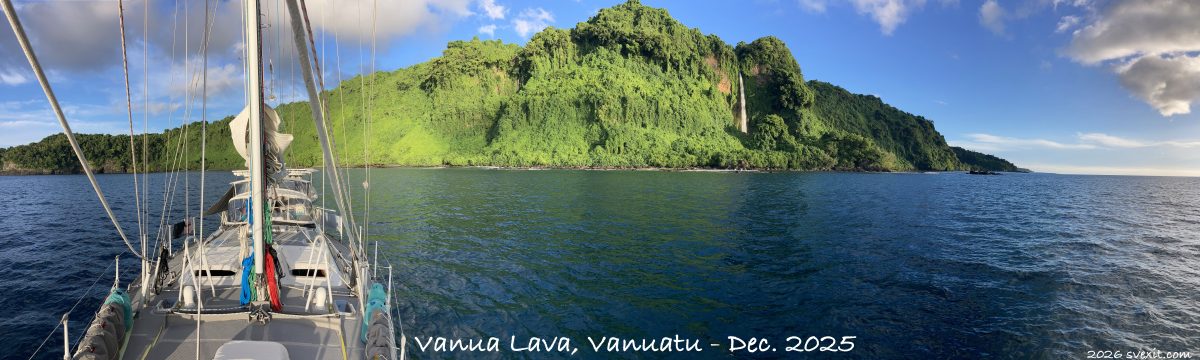
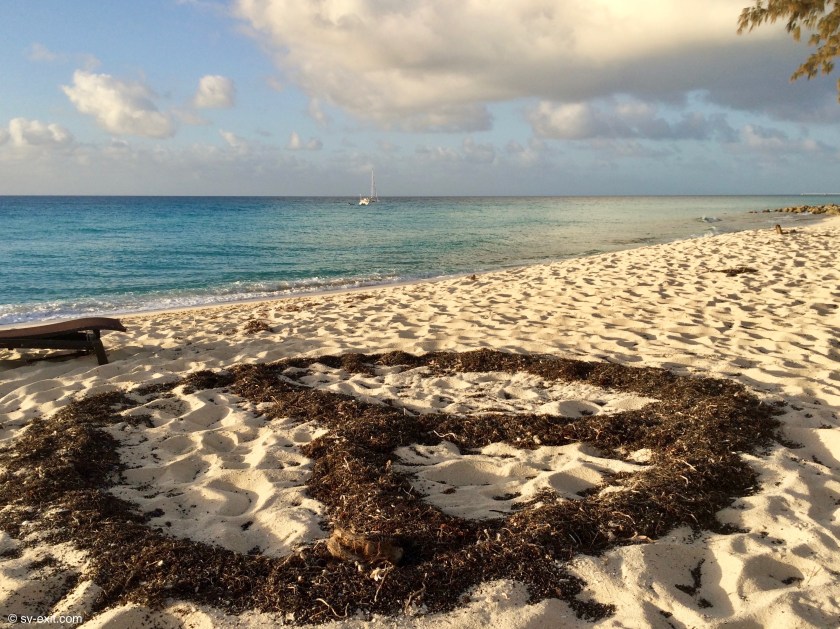
We would have preferred anchoring on the west side of the island, which provided a much more authentic exotic tropical ambience worthy of any postcard.However, we learned that the direction in which swells were approaching the beach would make for a thoroughly unenjoyable rolling motion of the boat.Continually pitching back and forth, ten to fifteen degrees to one side followed by ten to fifteen degrees to the other, did not sound (nor did it look, from the beach) to be a very pleasant or comfortable way to exist.
West side beach
Consequently, we compromised on the less photogenic location in favor of comfort while sitting at anchor.
Our two shore excursions were long overdue.Local Biminians (?), or Bahamians, proved to be exceptionally friendly folk.It seemed as though every person who passed, whether walking, biking, in a car, or a golf cart (which appeared to be a very popular mode of transportation), offered a sincere greeting accompanied with a smile.
The laid back and welcoming demeanor was contagious and quick to catch on… who wants to be an asshole when some smiling guy on a bike asks how your day is going?
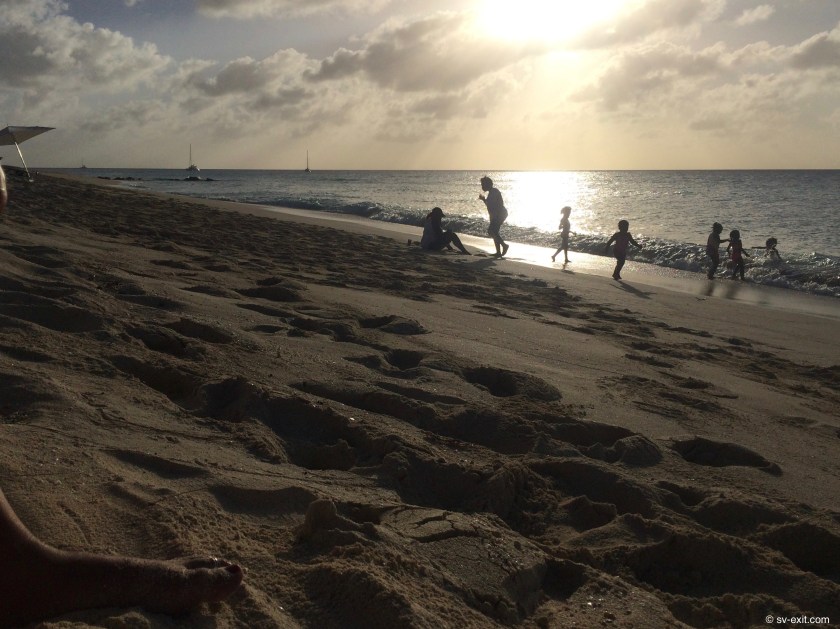
Fried conch and local Kalik beer at a food shack on the beach was a treat after walking a couple of miles along the island through the town.
People watching on the beach
On the other hand, our fuel leak was a pain in the ass to deal with.When contacted, Stacy from UFS was very apologetic and, had we been two hundred and fifty miles to the west, they would have sorted it out.As it was, we got about half our money back and I had the pleasure of fabricating a new sending unit gasket and sorting it out myself.
The damaged gasket
Back in business
Nice that we ended up only paying what we would have paid to replace the diesel in the tank originally.Nonetheless, we would have rather had paid the full amount and not had to deal with diesel leaking under the floorboards of our salon.
Oh well.As we have learned… it is what it is.
We had to wait a few days for fair enough weather to continue on, which meant a number of days spent doing less than glamorous tasks and maintenance chores.The rule of thumb is to get at least something done every day.There is always a long to-do list, but it can be slowly and continually chipped away at.
The plan for departing Bimini was to come up around the north side of the island and cut across the Great Bahama Bank – a very shallow stretch that runs about seventy miles east of Bimini.From Bimini to the eastern edge of the bank depths never exceed twenty five or so feet.
Because of the distance, we knew that we would have to find a sandy spot somewhere along the way, hopefully with depths of about ten to fifteen feet, and anchor overnight.The idea of being thirty miles from solid land in any direction, anchoring in ten feet of water in the open ocean was intriguing, to say the least.
We were told the key was not dropping anchor right along a navigational line that would be taken by other vessels traveling across the bank, and keep lots of lights on… advice we would remember.
Strangely enough, one of the things we immediately noticed our first night at anchor in Bimini, was that a mysterious, and as of yet unidentified, sound we had been hearing through the hull below the waterline seemed to now be conspicuously absent.
The sound could best be described as the very characteristically unique crackling sound Rice Crispy Cereal makesjust after pouring milk in the bowl.We first noticed the sound months ago when we were at anchor in Back Creek, just outside Annapolis, MD.
At night, we could hear the snap, crackle, pop clearly, especially if we lifted up one of the floor boards, exposing the aluminum hull underneath, or listened at the teak shower grate in the forward head.Even lying in bed, the sound could be faintly heard.
To be sure, boats sitting in water produce a myriad of sounds.It’s difficult to convey just how many different noises a person has to get used to on a boat.Waves wash against the hull or slap against the underside of the transom, wind whistles through the metal shrouds, halyards and lines can clack against the mast or spreaders, anchor chains rattle when they shift, ropes such as dock lines or anchor chain snubbers creak under tension, fuel and water sloshes in the tanks, pumps turn on and off, not to mention all the random creaks and groans that may come from wood panels or floorboards… it goes on and on.
Exit has a particularly odd sound that emits from a port on deck through which the lines that raise and lower the centerboard run, from the centerboard to the cockpit.The port leads to the centerboard well (where the centerboardsits when it is raised).The top of the well must sit just above the waterline inside the hull, creating an air pocket.As waves pass under us, the level of water inside the well changes causing air to vent up through the deck port.The sounds this creates is remarkably (or disturbingly, depending on your perspective) like the sound of a whale exhaling. The vent sits just between the salon’s two main forward windows.If we have the windows open a bit, which we often do, we can sometimes hear Exit “breathing”… quite weird.
But the snap, crackle, pop is not any of these previously mentioned sounds.
Google answers a lot of questions we have; but in this case, we found ourselves much more entertained and dumbfounded than enlightened.Theories ranged from electrical currents interacting with the hull, to air bubbles sloughing off the hull, to fish eating algae attached to the hull, or shrimp, or other little macro-critters.Some were put forth by scientists and technical specialists… some were submitted by idiots.One person said it was obviously the sound of other boat propellers in the distance.
We tended to favor the shrimp and small macro-critter theory, ourselves.
Regardless, whatever still yet-to-be verified entity or phenomenon is at the root of the snap, crackle, pop sounds we have heard, it doesn’t appear to be present in the Bahamas for some reason.Since arriving to Bimini, the sounds we had started to grow used to hearing have become conspicuously absent.
We may never get to the bottom of the mystery, but we are still intrigued by that which we no longer hear.One thing for sure, the boat-propeller-theory guy was completely full of shit… despite the sound being gone, there are still plenty of boat propellers around us… unfortunately.
The distance on our Navionics software indicated just under fifty miles from Ft. Lauderdale to Bimini.Without dropping anchor or even making it into the entrance channel, we departed Ft. Lauderdale, plotting our course about twenty degrees south of Bimini to compensate for the current that would continually push us north at an average of two knots as we crossed the Gulf Stream.
The wind was forecasted as SE to ESE at five to ten knots with less than two foot seas – not promising for sailing but we’d rather compromise by running under engine power to make the jump than wait for perfect sailing conditions to appear.
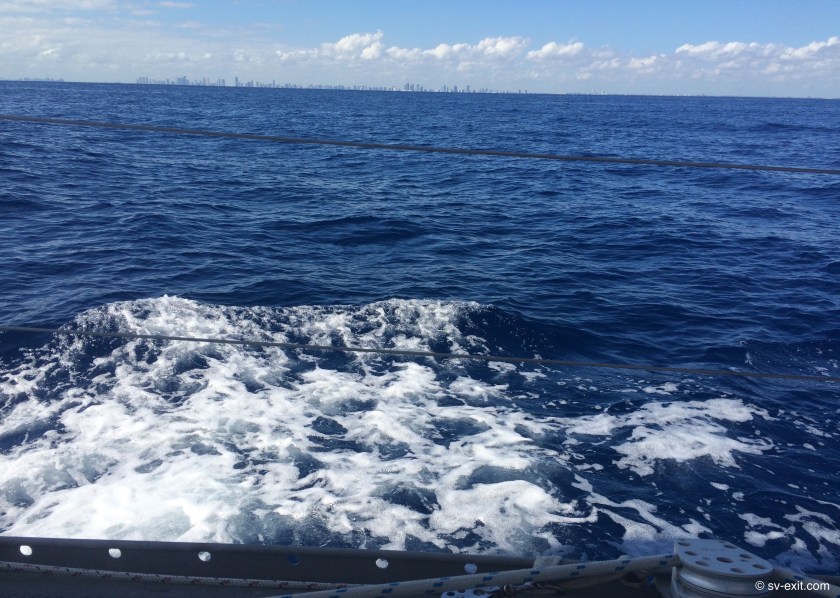
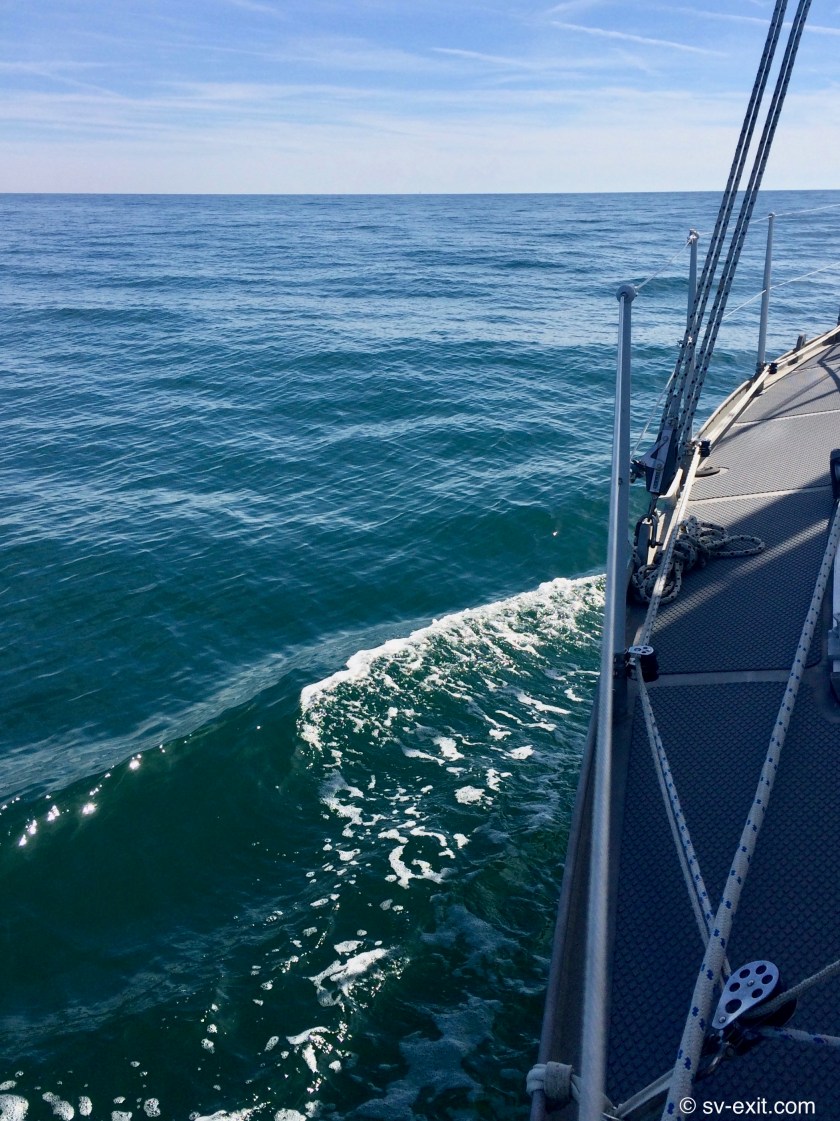
The water around us was almost completely flat and glassy as we looked about.For the first time since Exit had launched (almost six months ago to the day), we were looking at the United States in our proverbial rear view mirror again.
Ft. Lauderdale and the U.S. coast getting smaller and smaller…
In some ways, it had been a long time coming.
In many other ways, it had been a whirlwind of events in a very short period of time.
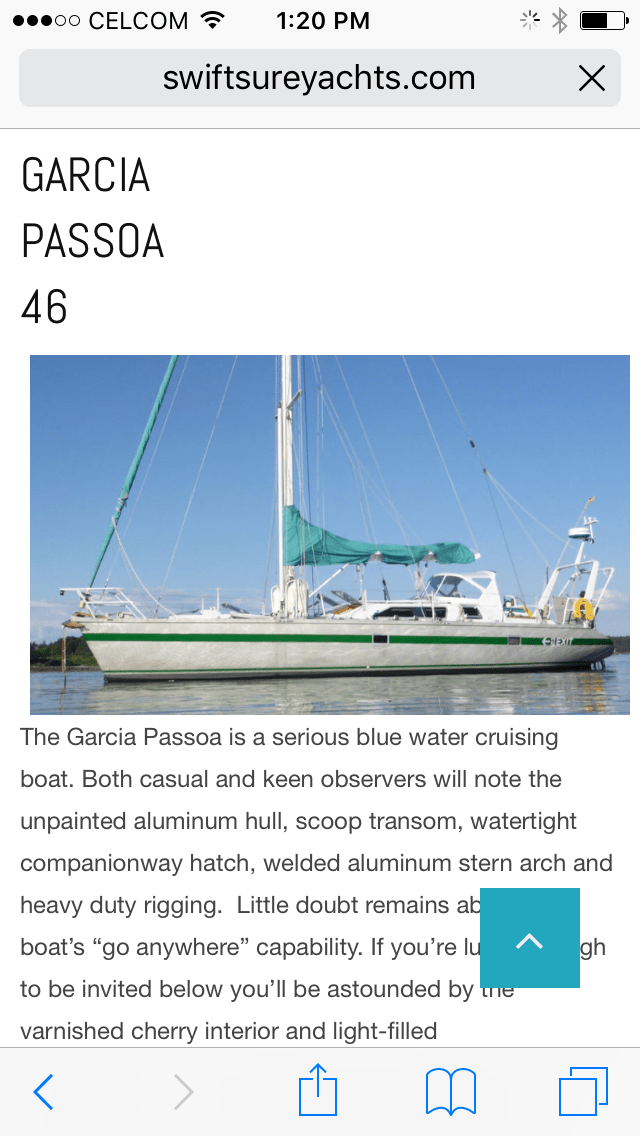
Almost exactly one year ago to the day, we had just booked our flights back to the U.S. from Borneo and were completing the last managerial tasks we had to perform before turning the reins over for good at Scuba Junkie.Ironically, we had also just saved a screen shot of a listing with Swiftsure Yachts of a Garcia Passoa 46 called Exit… obviously, wishful thinking at the time!
Screenshot from Kris’ iPhone dated 2/11/17
Now, as the sun crept across the clear afternoon sky, we inched our way across the gap between Florida and Bimini.Our depth gauge quickly displayed “- – -“ as we passed beyond its’ six hundred foot (or so) depth range.Our only reference came from our charts, which revealed that, beneath us, the ocean’s depths were increasing from one thousand to two thousand five hundred feet.
We hoped to sail for part of the passage; though our priority was getting across the Gulf Stream as quickly as possible.Once we had gotten beyond most of the northern pull of that current, we had all the time in the world.
Our literal last moment departure that morning at 10:00am had created a bit of a complication regarding our arrival at Bimini.Averaging five knots of speed, we expected it to take approximately nine and a half hours, which would mean arriving just after dark.
We had been warned by many people that navigating in anything but deep water, anywhere in the Bahamas, was a recipe for disaster.Random and uncharted coral heads dangerously near the surface require visual piloting anytime a boat is in shallow waters.And, unlike the forgiving mud of Chesapeake bay, running aground on coral would have much more dire and catastrophic consequences.
By nightfall, we were far enough east of the Gulf Stream and had made enough southerly progress that we were able to shut down the engine and sail throughout the night.We knew we would arrive well before dawn, but would just have to sail a few miles offshore until after sunrise.
The individual lights of buildings and towers dotting the Florida coast had disappeared from view hours ago.All that remained was a persistent glow on the horizon which could still be seen even as the gentle glow of Bimini slowly began to materialize.With seven to eight knot winds, we quietly sailed along, only occasionally seeing the navigation light of a boat well off in the distance.
The evening was uneventful until well after midnight when I began to track three different ships off both our starboard and port bow, on headings that looked like they would criss-cross well in front of us in opposite directions.
It wasn’t any big deal, but their movements began to make me suspect we may be approaching a shipping lane, which wouldn’t be ideal to navigate through for the remainder of the night.
I had been referencing the AIS to confirm the boats’ headings and speed, and was glad to have it available as another source of information.Shortly thereafter, I would eat those words as the electronics I was relying partially on were sucked into the Bermuda Triangle.
In hindsight, the first oddity may have occurred just after the three big ships passed in the distance in front of us.When I looked again at the AIS display, it indicated another ship I hadn’t seen before on the same course as the one that had just passed, only much closer.
Looking out into the night, I could see nothing at all where I anticipated a ship’s lights should be.Nonetheless, I was not at all reassured, given I could see the unmistakable AIS target clearly on the screen.Caution won over what my eyes were telling me.I decided a quick tack was in order.
I never saw the phantom ship; but there was little time to contemplate it as weather conditions quickly went from benign to feisty.The seven to ten knot winds jumped to thirteen and suddenly the mild rolling surge became three to four foot confused seas.When we reached nine and a half knots of speed, I chickened out and brought in the genoa.
I remember thinking to myself after getting in the genoa, this whole technical aspect of sailing seems to be getting a bit easier but the decisions that have to be made seem to be getting harder.
I began to notice multiple lights dotting the horizon around us.With some, I could make out green or red navigation lights, telling me their direction, but others were just a white light that I couldn’t even determine distance from.
Over the course of the next two hours, I grew more and more confused as the information I was getting from the AIS just didn’t match what I was seeing.
Eventually, we had eight different boats in all directions around us.It became impossible to tell which boat was which as the AIS seemed to actually contradict what I was thinking again and again.At one point, I hailed the ship SeaExpressII on VHF trying to ascertain their intentions as we seemed, on the AIS, to be at a constant ninety degree angle to them that was closing in distance.
Though I assumed they were the boat directly to my beam in the distance, their captain indicated to me in a very heavy accent that he couldn’t see me on his AIS and if I didn’t pass him starboard to starboard he’d have words with the Coast Guard.
Heavily fatigued and confused, I reluctantly woke Kris early to get her assistance.
Once we got visual bearings on what every boat was doing and began referencing our heading more closely, we started to realized that, not only was the AIS out of whack, but also all three chart plotters (including the independent Navionics on our iPad) were giving incorrect heading readings.
Using any GPS electronics, the heading which was supposedly taking us straight for Bimini, actually put the glow of Florida on our bow… all readings consistent… all wrong.
However, using both our main compass at the helm in the cockpit as well as our handheld compass, we were able to verify that all of the GPS electronics were in error by over one hundred degrees!
By the time I went to bed, the seemingly ridiculous amount of boat traffic seemed to be tapering off, and enough lit markers had been visually identified to give us confidence in our actual location.
I still was incredibly unnerved and perplexed by the whole affair, and continued to try to figure out what the fuck had just happened until Kris grew tired of my exhausted rambling and said, “Obviously something’s wrong with the electronics.We know where we are and where we need to be heading.Now go to bed!”
As usual, Kris’ logic won out.Still trying to wrap my brain around things, I finally climbed into bed at around 5:00am, probably still talking to myself about the Bermuda Triangle and that crazy green light I had seen that looked like a flare coming down into the water earlier in the afternoon… shit!I told myself I wasn’t going to mention that.
Sunrise over Bimini, Bahamas 2018
Just like Ft. Lauderdale, I awoke to Kris at the helm, circling the boat until I was rested enough to be functional again.Only now, it wasn’t Florida in front of us, it was the Bahamas.
Bimini sat in the midst of incredibly colored water.From deep blue, to turquoise, to white in the sandy shallows, it all stretched out before us.
There was a fair wind blowing; and the power boats, sailboats, trawlers, and mega-yachts moving in every direction made the entry into Bimini’s main harbor quite challenging, not to mention the missing or moved navigational markers that hadn’t been sorted out since the last hurricane.
We were flying the yellow quarantine flag, as is required when entering a new country; and one of us had to go ashore to clear Customs and Immigration before we could do anything else.But the marina that supposedly allowed boats to tie up temporarily to do just that wasn’t answering the VHF, and we really had no idea where we were going to anchor, so we just motored along the channel looking for potential spots.
Eventually, we came upon a small promising bay.The chart indicated it was a turnaround point for seaplanes that were landing and taking off, but a note had been added that it was a nice anchorage as long as you stay out of the seaplanes way… wrong!
As soon as we had set the anchor, a large Bahamian standing on the nearby dock started aggressively signaling for us to move on.
At the risk of being yelled at from a closer distance, we quickly dropped the dinghy into the water, and I motored over to have a very apologetic chat with the man.
As it turned out, he was exceptionally friendly.Though unyielding in regards to us not being able to stay at anchor in that location, he kindly let us remain long enough for me to catch a cab into town and clear Customs and Immigration. During this time, Kris had the unnerving pleasure of sitting in Exit’s cockpit watching small seaplanes land, taxi around us, and eventually take off in a flurry of noise and spray.
My cab driver, Scooper, advised me which were the best food shacks in the area, and informed me of all his conspiracy theories when he learned we had just watched SpaceX launch.
After successfully returning to Exit with all our proper documentation in hand, we picked up anchor, continued a bit further down the channel until it basically reached an end, and dropped the hook again.
Nestled alongside a small island of holiday rental properties, just opposite a construction area that appeared to be where sand was harvested and loaded on a barge, and also the bay seaplanes that had to abort their takeoff ended up turning around in, it seemed as good a location as any.
As far as postcard perfect anchorages, I’ll admit it fell a bit short… but, then again, it is the Bahamas… and that qualifies as an exotic location.Now, after a nap, I can get to work on that fuel leak…
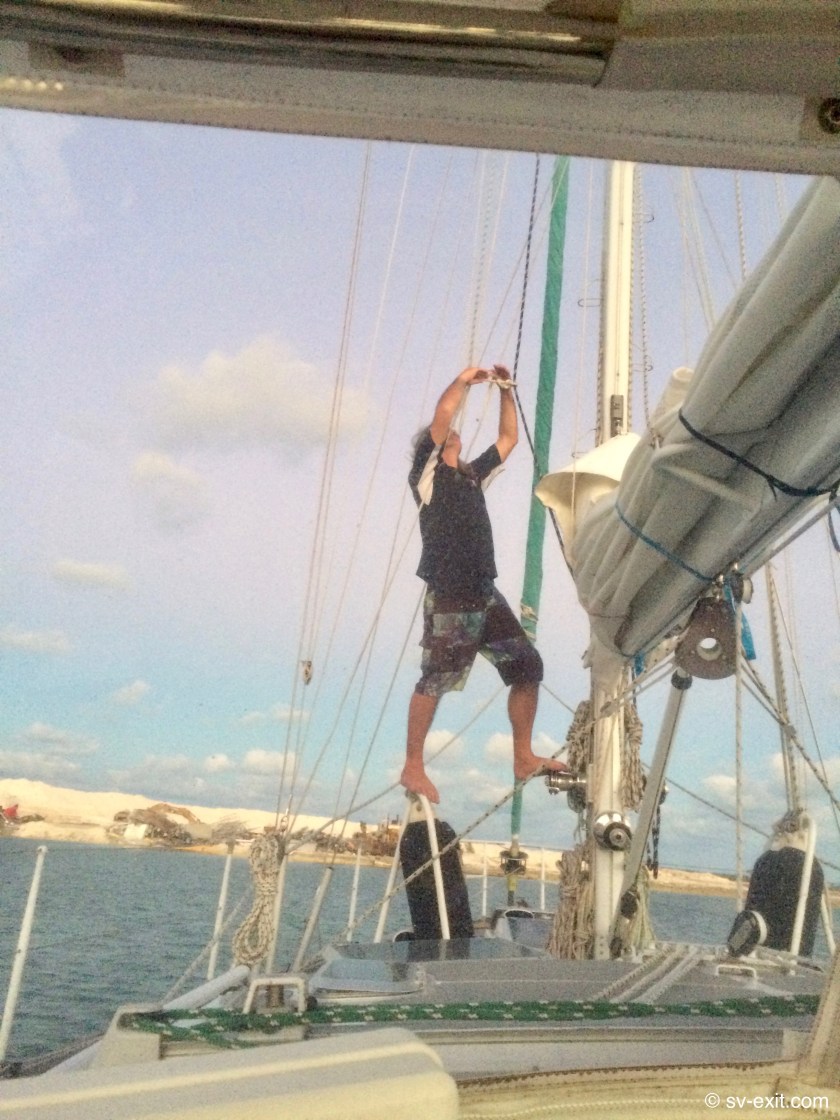
Tying off the main halyard to keep it from “thwacking”
The decision of whether or not to depart from Port Canaveral on the morning of February 15 was an uncertain one.The forecast called for SE winds ranging from five to ten knots, three to five foot seas, and clear skies.
It was all good, except for the clear skies, which seemed to be obscured by a noticeable fog.
The last few nights had been rather foggy as well; but it seemed to burn off by mid-morning.So we remained optimistic and delayed casting off our dock lines for a few hours.An early start would have been preferred, based upon the expected time we calculated for the overall passage; but we knew we would end up compensating for other variables along the way as well.
By 11:00am, the fog had cleared to the point we could see the opposite side of the bay again, and clear areas of bright blue sky began to appear in patches above us.It was definitely improving.
Within thirty minutes, Exit was motoring towards the inlet.A small turtle just off our starboard bow, swimming momentarily at the surface, was interpreted as a good omen.
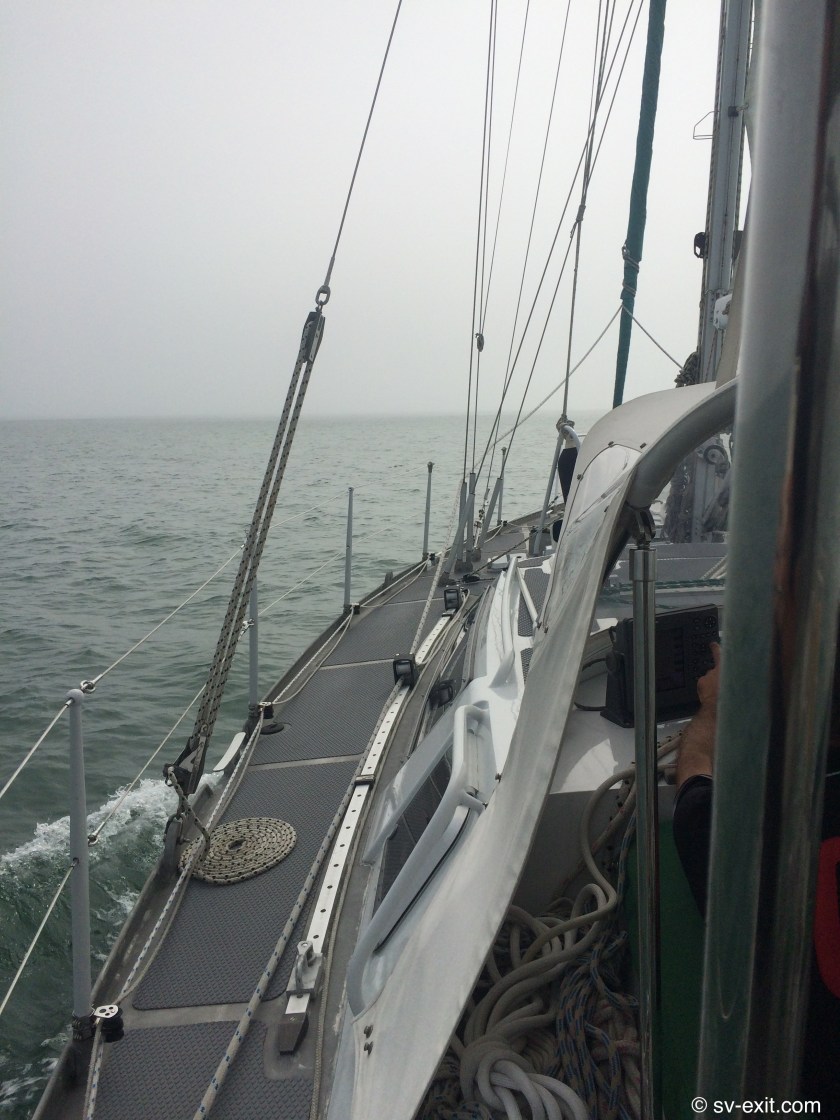
However, as we passed through the inlet and out into the channel, the fog, which had been steadily dissipating, now seemed to close in tighter and tighter around us.This was interpreted as a much less good omen.
As visibility deteriorated to less than a quarter mile, we considered turning around.But we also recognized that the entrance to the harbor was where we had encountered the heaviest traffic; and traffic was what we wanted to avoid in this fog.There were still patches of clear blue sky above and around us.
After considering the options, we felt comfortable continuing on.
Our AIS (Automatic Identification Signal) transceiver broadcasts our own position (and limited information including name, size, course, speed) to all vessels equipped with an AIS receiver that were watching.But even more importantly, we received the same information about any boat transmitting their own AIS.While a lot of smaller power boats and fishing boats don’t have this, most sailing cruisers and especially bigger ships were transmitting for us to watch.
We were also quickly learning how to interpret the information displayed on our radar screen; which, when dialed in correctly, allowed us to see even small boats, or boats that didn’t show up on our AIS.Thankfully, Tom had spotted a loose ground wire on our radar drum while doing the solar work; now, consequently, the radar images we saw on the screen made a hell of a lot more sense.
It was incredibly disorienting, not to mention disconcerting, having no more than a thousand feet or so of actual visibility in all directions, before the water simply melted into a blanket of white.
A ship’s fog horn could be intermittently heard in the distance. Slowly, it began to grow more noticeable.Both the radar and AIS confirmed we had a three hundred foot cargo ship just off our starboard bow.Fortunately, it was not moving.
We made a substantial course change so we could give them plenty of room as we passed behind the massive ship, hoping to indicate to them as well that we had seen them.It was actually reassuring when they hailed us on VHF, confirming that they had seen our course adjustment to take us astern of them.
Underway in the fog… definitely not for the faint of heart.
Less than a quarter mile visibility in fog… have radar, will travel
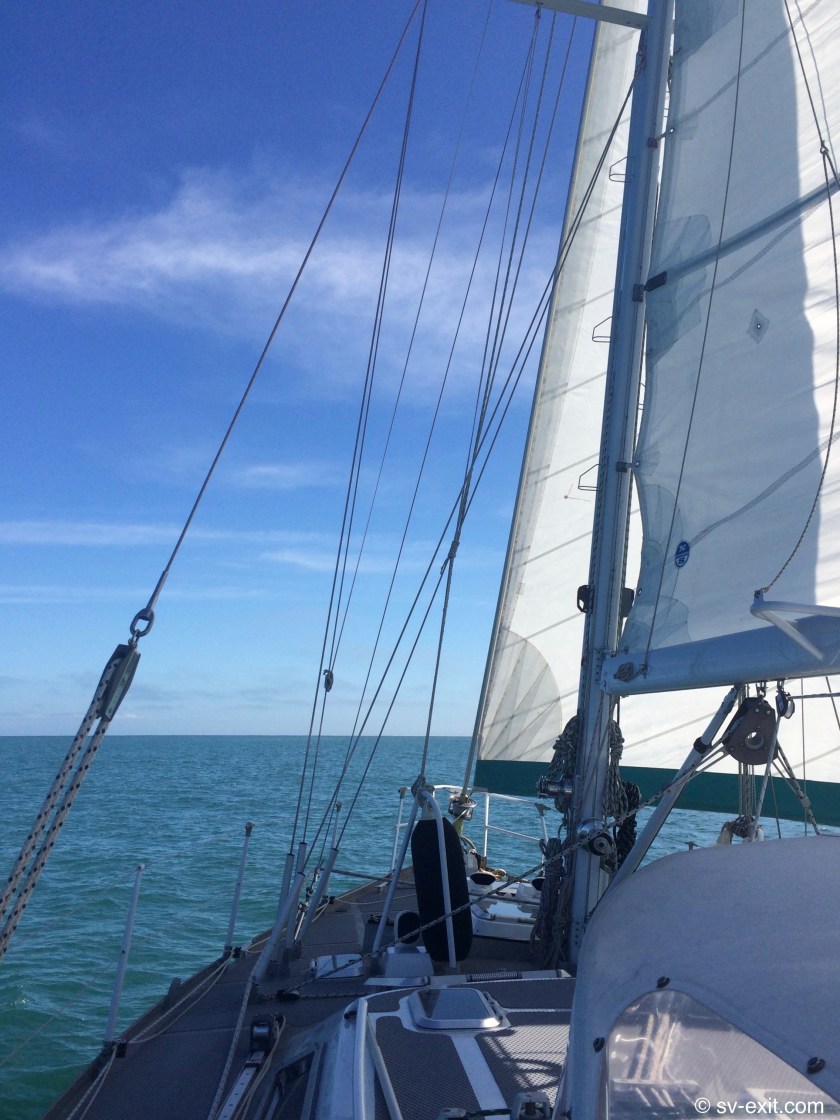
By mid-afternoon around 2:30pm, the fog had completely burned off, leaving a beautiful day with clear, blue skies, eight knots of a SE wind and gentle two to three foot swells spaced well apart.Moving along at nearly five knots, under power of only the mainsail and genoa, it had turned into a near perfect day for sailing.
Ninety minutes later… very different conditions
Looking back, we were now glad we hadn’t made the decision to turn around when the fog closed in.A brief visit by a family of dolphins a couple of hours later further reenforced that thought.
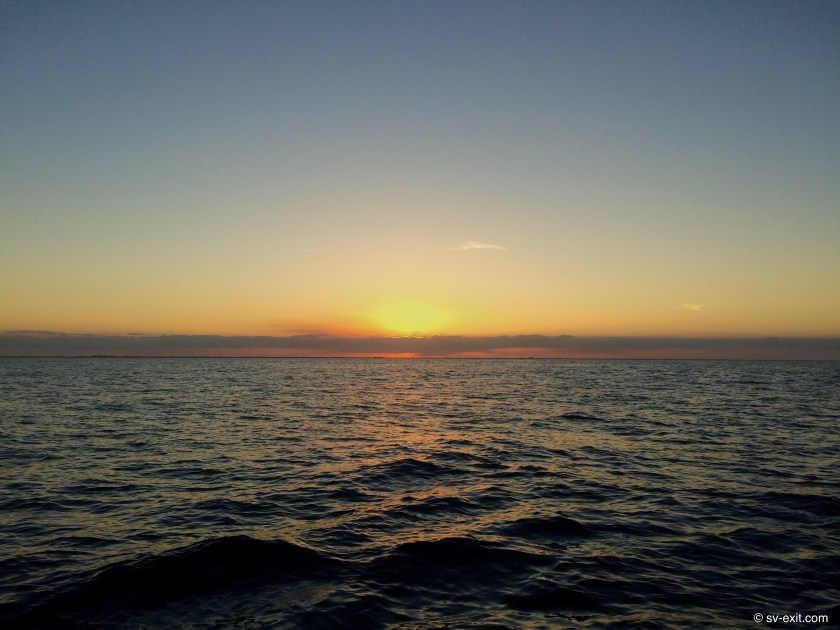
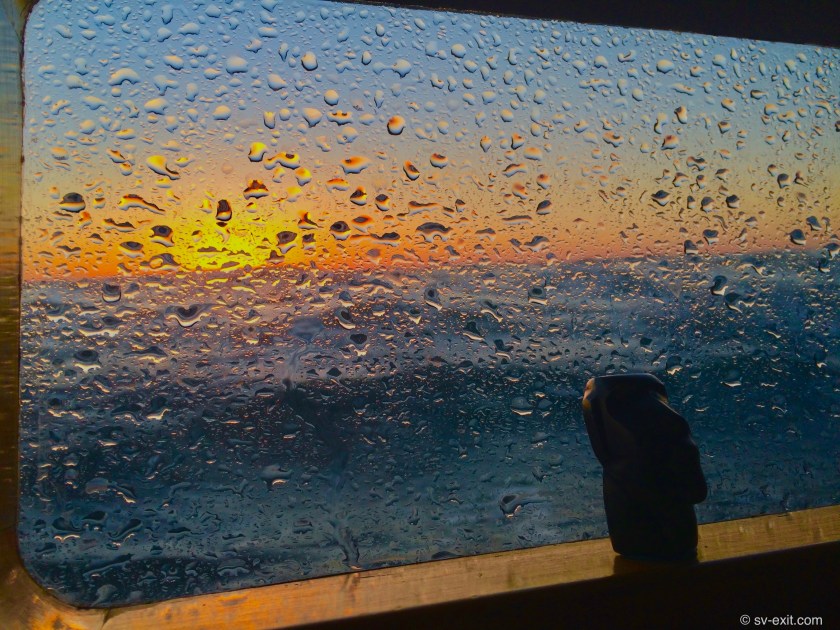
Night prepares to settle in
The cold night watches further north had proven much more challenging to endure.Here, though it was still a bit damp, it couldn’t even be called chilly.
A clear night sky revealed thousands of stars overhead.But there was also a light show to be seen in the water.Our spinning propellor was kicking out a steady stream of bioluminescent fireworks behind us – small flickers, like fireflies, interspersed with occasional larger and brighter bursts, more like a strobe flash.
The mesmerizing show came not only from our prop wash, but also from the breaking waves against the side of the hull.Every slosh of white foam was accompanied by a dramatic flair of lights.At times, the brighter bursts could also be seen thirty or forty feet off our beam.
Six hours went by that evening without seeing a single boat on the horizon… now that’s space to breathe (though Kris had said to me, when my watch started at 10pm, to watch out for shrimp boats that try to run you over).
The morning light brought about quite a change of scenery.
The water color, muddy browns and murky greens we had become accustomed to seeing for months, had been making a dramatic shift to brilliant shades of turquoise.However, that had now changed to an even more intense deep, rich indigo blue.That coincided with our depth meter display, which had plunged from 85 feet down to 385 feet.
An amazing shift in the color of the water
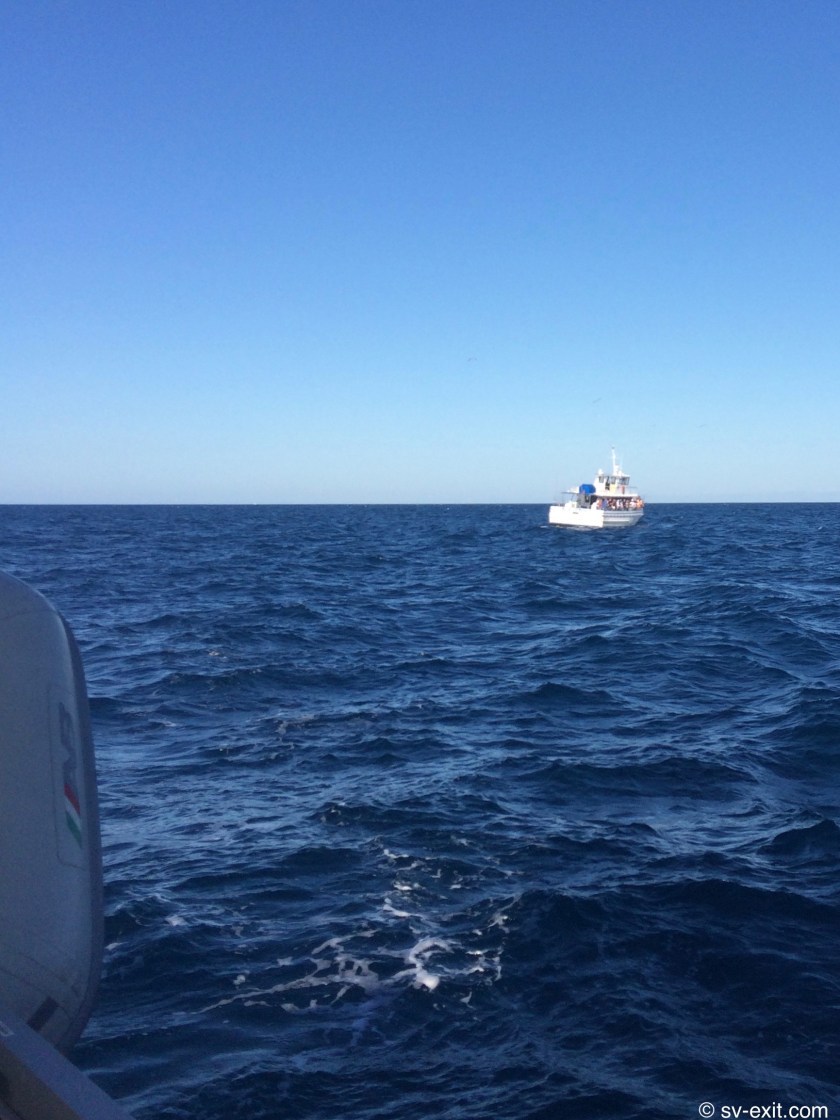
The look above water had changed significantly, as well.Instead of only water in every direction, now there were boats in every direction.At one point that morning, we counted upwards of twenty boats scattered across the horizon in front of our bow.With the exception of one commercial fishing boat in the group, these were all private recreational or chartered fishing boats.
One charter boat with nearly twenty people fishing from the deck
As the Gulf Stream approached closer and closer towards the coast, we were limited in how far offshore we could venture without feeling the opposing current, forcing us to stay closer to all the other coastal boat traffic.Now only eight miles offshore, we threaded our way through the throng of charter fishermen, all looking to land a fish big enough they could feed their family for the next two years.
Fortunately, the boats eventually began to thin out.
Unfortunately, so did our point of sail.At one point, attempting to tack back and forth to maintain our sailing angle to the wind, I maneuvered through what turned out to be a large two and a half mile “figure eight” that, with the three knots of opposing current we found ourselves in, actually put us in a position farther north than we had been.Going backwards bad… I acquiesced and started the engine.
Our depth was now 650+ feet.The color of the water was amazing.
At 6:00pm, the shit hit the fan… again.
While doing a quick once-over inspection of the engine and fuel system (just to be sure), I was mortified to find diesel at the bottom of the bilge, just under the Racor fuel filters.It was all contained inside oil absorption pads that had been placed there for just such an occasion; nevertheless, that was small consolation – it was still there.
I cursed myself for… well, I wasn’t sure what I was cursing myself for, but I had obviously missed something.My first suspicion was that I hadn’t adequately tightened a fuel hose fitting or component on one of the filters.But further investigation revealed that none of these were the source of the diesel in the bilge.I continued looking, and wiping, and feeling, trying to trace where it was coming from.
Eventually, as I grew more and more vexed by not being able to see where the leak was originating from, a dark possibility began to materialize in the back of my mind.Could it be coming from the fuel tank hatch covers or sending unit that Universal Fuel Systems had accessed to clean the tank?No… it couldn’t be.They had the special equipment, and credentials, and impressive name… and charged us $750!
Reluctantly, I unscrewed the floor above the fuel tank, lifted it out of the way (not the easiest task with a eight by three foot sheet of plywood in close quarters on a pitching boat), and peered down.Son of a bitch… therewas diesel everywhere!
The rubber gasket on the sending unit had obviously been put back in wrong and was not making a good seal.There also appeared to be diesel leaking from around both hatch covers, which were each secured with about twenty bolts.There was very little that could be done while we were underway, aside from cleaning it up and covering everything with more absorption pads, hoping to prevent the diesel from getting everywhere as best possible.
Misaligned gasket
Leaking inspection hatches
Diesel everywhere…
On the plus side, we hadn’t had any problems with the engine cutting out.So, though we were furious about the situation, at least we were still on the move.
When I came up into the cockpit at 10:00pm to start my watch, Kris informed me that we had been visited by the Coast Guard while I was asleep.She said they had come alongside us in a thirty-or-so foot RIB, trained a large spotlight on her, and politely asked a number of questions before eventually telling her to enjoy the evening.They never boarded us; however, she did point out that two drones were still tracking just above us.After a period of time, they too went on their way to patrol other areas.
By midnight, we were about twenty miles north of Ft. Lauderdale, still about three nautical miles offshore but able to differentiate individual windows that were lit along the shore.Now it was just about watching for boat traffic (a 600 foot barge moving north along the same three mile offshore line on the charts we were following south is something to definitely get out of the way of) and try to time our arrival at Ft. Lauderdale for after sunrise.
At 3:00am, we were only ten miles out; it felt fitting to be able to make the final push under power of sail only.
At 4:00am, when Kris took over the watch, I went below and was grateful to be able to actually go to sleep and not have to sort out engine problems.
We arrived just off the Ft. Lauderdale channel entrance around 5:00am.Kris let me sleep a few hours more while we awaited the sunrise.We had traveled 166 nautical miles I just over 42 hours, averaging about 4 knots; not bad, though we certainly weren’t on the brink of breaking any speed records.
By the time I climbed up into the cockpit, Kris had already been doing a lot of weather research; she had some very interesting news.
Over the next 24 hours, we had a brief weather window available to cross the Gulf Stream into the Bahamas.After that, things would get messy with significant easterly winds, making crossing impossible for at least a week to ten days.
So we either turn right into Ft. Lauderdale where we can sort out some final provisions, figure out the fuel tank leak, potentially get our non-functioning water maker looked at, and possibly score some scuba tanks… or we turn left and head for the Bahamas before our window of opportunity closes for at least a week, probably even longer…
The jury was already back with a verdict.Screw thisspending more money crap; open opportunity’s door.Exit… stage left!
It wasn’t supposed to happen but you could sense the impending timeframe looming in the background.Many different cruisers had previously warned us against committing the cardinal sin in sailing… scheduling a particular day to be at a particular location.
Understandable where the philosophy comes from.There’s so many variables that come into play when traveling by sailboat:weather and wind (affecting speed and comfort of travel or even if travel is possible), distances between anchorages, tides and currents (which may control passage under bridges or through certain waterways), mechanical difficulties… the list goes on and on.
In perfect conditions, it’s still a snail’s pace that you are moving at.Under engine power we average five to seven knots; under sails alone, it’s probably closer to five.We may settle for three knots if it means not running the engine, but under good sailing angle in a brisk breeze we can make eight knots comfortably.At ten knots, Exit starts feeling much less in your control; and heeling over past fifteen degrees becomes nerve racking for all but the hardiest of racers (Kris reminds me often that she loves sailing and hates heeling). On average, not much faster than a brisk walk.
In some cases, the weather delays or slower speed only set you back a day.But those days can add up quickly.And regarding passages like crossing the Gulf Stream between Florida and the Bahamas, we have heard of boaters having to wait one or two weeks for a north wind to subside, making the crossing even safe to attempt.
And that’s where the time schedule becomes the most problematic. When decisions are based upon the pressure of a timetable rather than sound judgement, things can go south quickly.On the other hand, some people never get anywhere based upon a never-ending wait for perfect conditions that never show up.Balance has to weigh in here… wait until sound judgement says opportunity is knocking and then don’t hesitate; open the damn door.
We recognized this when we told our lifelong best friends, Shannan and Vicki, to book their airplane tickets to Nassau, Bahamas for March 7. They were the only people who came all the way to Borneo to visit us while we lived there, and now they would come to visit us on Exit. We were still well up the East Coast at this time (I believe still in the Chesapeake Bay), but we had three months to get south to Florida and make the jump over to the Bahamas… no problem.
Now the time had whittled down to three weeks.Certainly within our grasp but, still, we knew we couldn’t let any more time slip by or we’d be backing ourselves into a corner.
With the hopes that our fuel issues had finally been definitively put to rest, we decided to make another run for Ft. Lauderdale heading offshore, instead of crawling slowly down the ICW.We’d make far better time offshore.Then we could stop for a final pause before jumping across the Gulf Stream somewhere between Ft. Lauderdale and Miami (getting south of Bimini before crossing meant not having to fight the two and a half knot northbound currents).
The forecasts all said SE winds for the foreseeable future.Not promising for sailing.But the weather and seas looked favorable so the decision was unanimous – take the opportunity to press on, motorsail if necessary, and sail whenever possible… plenty of time.
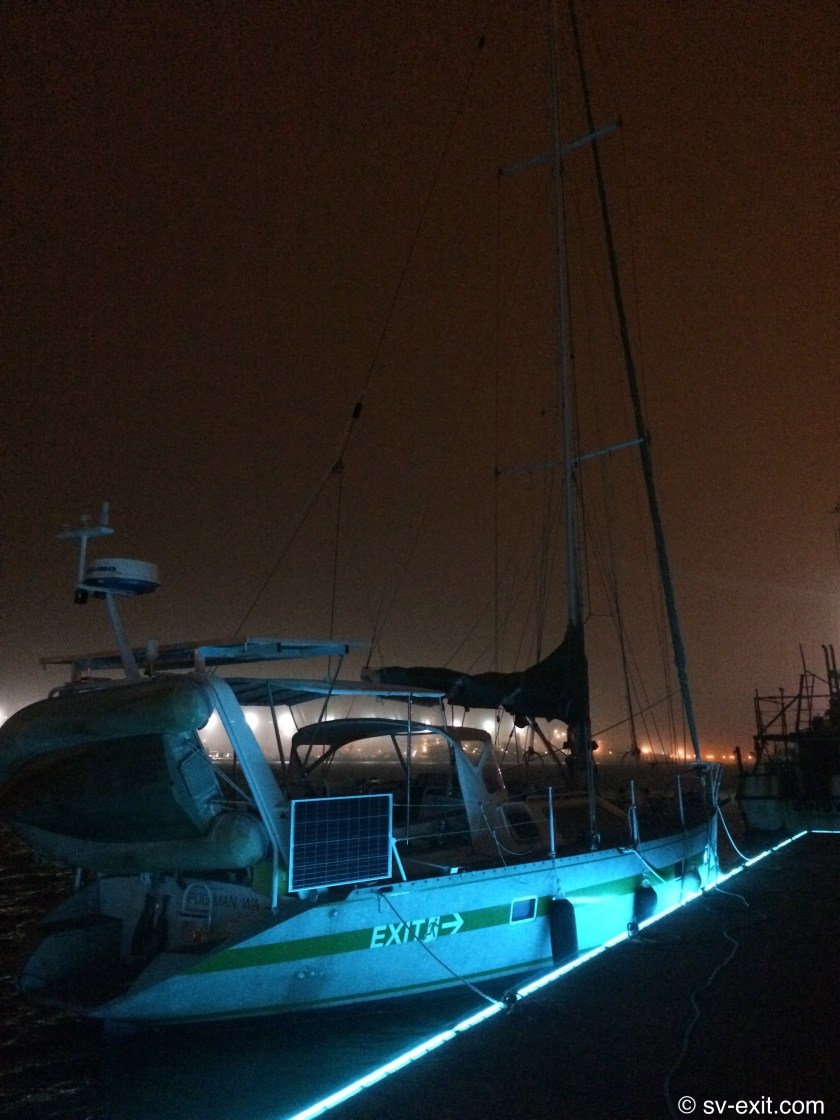
A glimpse of Exit if she was equipped with a Pink Floyd light show… we need to go.
It was mutually agreed that this was another one of those times when bringing in an outside expert would be money wisely spent, despite the fact that we seem to have difficulty ever stopping the hemorrhaging flow of outgoing cash.
We have been told many times that BOAT is an acronym for Break Out Another Thousand.While one would be hard pressed to dispute this, it seems to me that just about any home (especially one recently purchased and moved into within the last six months) more often than not qualifies, in similar fashion, as a vacuum cleaner of funds.
In fact, I would go so far as to hazard a guess that anyone who moves into a home requiring no additional expenditures for a year either isn’t paying attention to their home, or must have spent such a ridiculous amount of money up front that they are – number one: obviously working with a budget that is far outside of even my imagination, and number two: still probably spending ridiculous amounts of money on things their home may not actually need but is getting anyway.
But, anyway… I digress.Where was this going?Oh ya… money wisely spent on an outside expert.
Sometimes the outside expert needs to be a big gun: a full blown company complete with impressive name, high training credentials, specialized tools and equipment, and an accounting department to sort through all the money they are billing out for.
Other times the outside expert needs to be a guy with a tool box who has been turning a wrench for fifty years and simply knows what the hell they are talking about and doing.He, or she, is the company and they don’t need an accounting department because they don’t charge nearly as much money and spend it all on more tools anyway.
In this case, it turns out we would require both.
First we brought in the one man show… a diesel mechanic named Butch.In his late sixties (I’d guess), Butch had the tool box, 50+ years of diesel engine experience, and definitely knew what the hell he was doing.He even had an apprentice of sorts with him.Looking to be twenty-something, the nameless apprentice’s job seemed to be watch, listen, get shit for Butch, and stay silent… he was pretty good.
Butch poked around for a bit.We started the Perkins.Butch listened for a bit.Then he said I’d done about all I could as far as troubleshooting and on-the-fly repair (I took that as a compliment).He added another copper washer to the makeshift rubber washer I had put on the lifting pump cap and then recognized that the entire lifting pump mount was loose – definitely a bigger air leak source and one that I had missed.
He then went on to say he could spend the entire day charging us for work; but, in the end, we would be haunted by this ghost continually until we had our fuel tank cleaned out.
Butch’s explanation went something like this:
Dirt is obviously a potential problem in diesel; but water can cause just as much grief.Water can be removed with the Racor filters our Perkins is equipped with; however, inside the fuel tank that water fosters the growth of algae and bacteria which then collects at the bottom of the tank as sediment.The sediment is made up of live and dead organisms as well as their waste.Especially, in rough seas, the sediment gets stirred up potentially clogging filters or blocking fuel lines.This becomes a bigger problem as the tank is less full and the concentration increases.A fuel tank only partially filled also allows more condensation to happen inside the tank which propagates the growth further.Diesel additives only partially solve the problem as they don’t actually remove the material already built up; physically removing the particles from the tank is the only way to get ahead of the issue.Keeping the tank full helps slow the growth process as well.
Exit had been sitting on the hard with less than half tank of fuel for over a year.Plus, her aluminum fuel tanks are already more susceptible to condensation.Both times we experienced engine problems were in rough seas where the tank would have certainly been stirred up.The concentration of sediment in the bottom of the Racor and the speed at which the replacement filter had already begun to discolor all seemed to fall exactly in line with what Butch was describing.Furthermore, he said the fuel starvation would have become much more problematic as the engine was put under a load, which was probably why we were able to limp in just over idle speed but couldn’t run at 2000rpm.
So, viola!It seemed by cleaning out all the built-up crap inside the fuel tank we had our solution.Only Butch said we’d want to bring in the big guns for that.With an integrated aluminum tank, we couldn’t remove it for cleaning which left two options: either pump out and dispose of one hundred gallons of diesel followed by getting inside the tank and scrubbing it out (a messy and arduous nightmarish task by all stretches of the imagination) or hire someone with equipment capable of doing it all in place (less cheap but also less mess).
After explaining to me how to go about completely tearing apart, cleaning, and reassembling the Racor filter housing (which, with a smile, he said I would be learning how to do today) he tightened the lifting pump, recommended we keep the diesel tank topped up and change fuel filters more often as preventative maintenance, charged us a couple hundred dollars and went on his way.
Progress anyway…
A few phone calls later we learned that the only big gun with equipment capable of cleaning our two hundred gallon fuel tank, Universal Fuel Systems (at least it had the impressive name), was based a couple of hours away in Tampa.However, we also learned that they just happened to already be at our very marina and could stop bylater.
When Stacy, the UFS guy, arrived, he explained that their equipment allowed them to draw the fuel out of our tank at high pressure, send it through two high capacity filters, then return the clean fuel to the tank.All the while, the tube drawing out the fuel is being stirred around the bottom of the tank by the tech, helping to churn things up and suck the sediment from the bottom.
The up-side was, since he was already at the marina, he could wave the travel charge and only charge us $400 instead of the usual $750… sweet.
The down-side was, with the way Exit was positioned and the layout of the dock, we were just short of the hose length needed to get between the fuel tank on the boat and the equipment on the dock.Despite trying, we just couldn’t get Exit in close enough to the dock to make the stretch feasible.Furthermore, choppy water and fifteen to twenty knot winds prevented us from moving to a better spot (especially with an engine we couldn’t rely on) at that time… shit.
Unwilling to attempt moving the boat based upon current conditions, or risk a high volume fuel mishap from heavy equipment on the dock being dragged around by a boat in choppy water, we had to forego an immediate fix that day.
What really sucked, not only was the job now going to cost us $750, but we would have to wait a week to get back on their schedule… arrrrgh!
Fortunately, the way the marina rates were structured, the weekly rate for a slip was the same as three single days.After three, we got four free; so we really didn’t pay any more for the marina slip during the wait.
Pelicans…
more fun to watch…
than mega-yachts
One of the nights, a five million dollar yacht tied up on the T-dock right next to us.They stayed for only about five hours, apparently just long enough for the crew to give the boat a good freshwater cleaning and the captain to get thoroughly trashed during an extended happy hour.Then they untied and motored away into the night… oh, Florida.
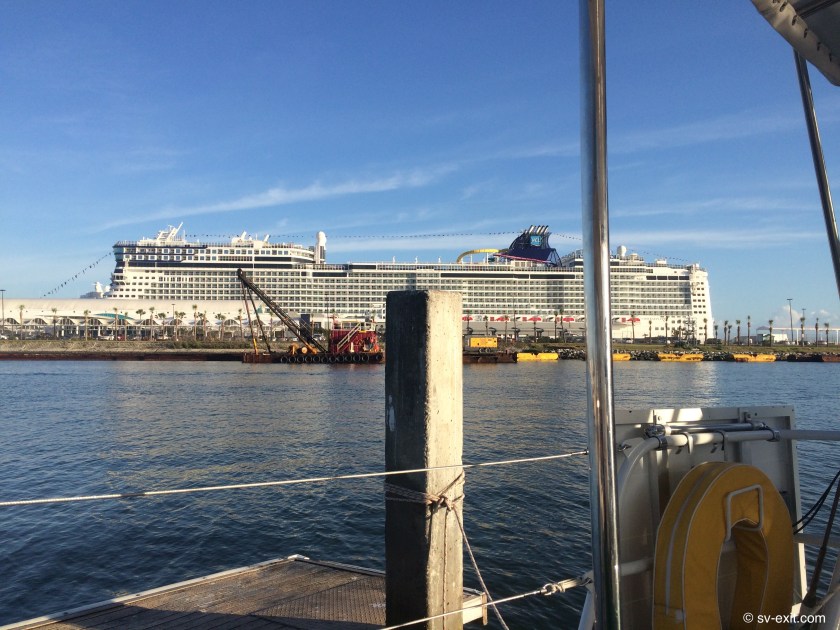
Obnoxious cruise ships and mega-yachts… staying in the bad part of town
The real silver lining of the whole situation came with the realization that, during our entire week’s stay at the marina slip, not once did we have to plug into shore power, run the engine, or start the generator to keep our batteries charged.The solar panels delivered one hundred percent of what we needed.In fact, during the first two weeks of running our new solar system, we had generated nearly 20,000 watt-hours of power – the equivalent battery charging of about 60 hours of generator run time.With every day that passes, we become more and more vehemently certain that going solar was the best investment we’ve made regarding increased self-sufficiency and getting off the grid.
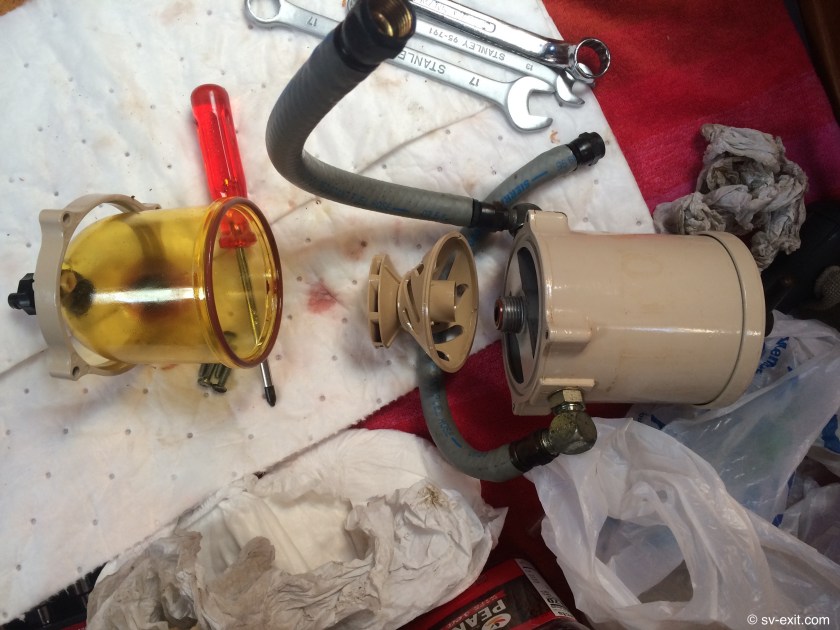
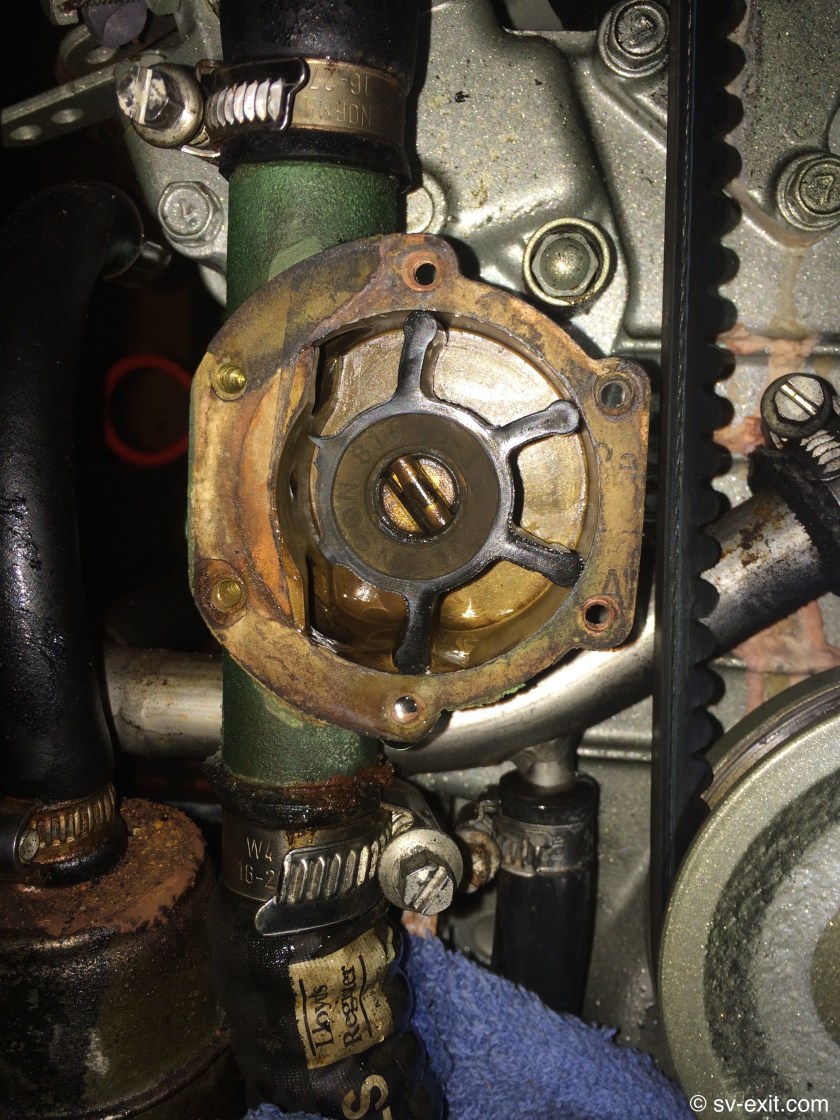
With the better part of a week to work with, we managed to get a substantial amount of stuff accomplished while tied in the slip.I became exceptionally familiar with the Perkins fuel system; by the end of the week primary, backup, secondary and generator fuel filters had all been disassembled and reassembled a multitude of times.There was time to catch up on other general engine maintenance as well, like oil and belt changes.
Inspecting the fuel filter chamber
Disassembly of the Racor
Muck collected in the filter bowl
Reassembling the cleaned Racor fuel filter
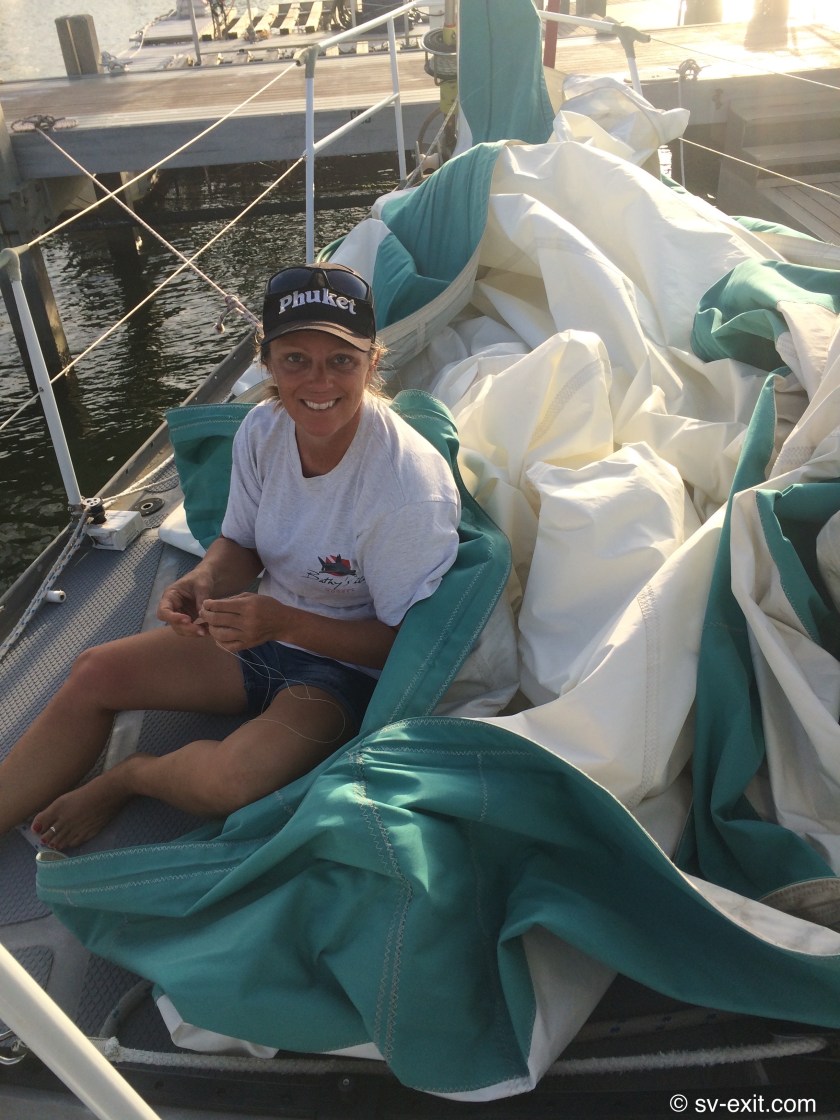
During that time, Kris broke out a duffle bag which held sail repair materials and absolutely went to town – she repaired our genoa sail right out on the deck (some of the stitching needed serious attention), as well as made fender covers from the legs of cheap XXXL sweat pants we had acquired at a Walmart earlier.Pretty damn creative… and probably a hundred or couple hundred bucks cheaper… ka-ching!
Plus another sixty five foot vertical trip for mast top maintenance.
By the end of the week, we were chomping at the bit to get moving again. We had only been off the boat one day on an Uber run into town for a few provisions, some knickknacks, and definitely more spare filters.The day Universal Fuel Systems returned, the sky was clear with no wind, and we eased Exit over to the fuel dock without any difficulty.Stacy and his assistant Mike hooked up their high pressure filter system and got to work.
No doubt, there was stuff coming out.At least two, big, softball-sized dark masses of muck passed through the opaque rubber hose into the filter system.Smaller bits and chunks could be seen as well.
Eventually, the fuel tank was sealed back up and the algae exorcism was deemed complete.At $750.00, it was no drop in the bucket.However, just replacing the diesel in the tank would have cost us at least half that.And, in the end, if it means the trusty Perkins can function in rough seas without being choked by algae, then that’s money well spent.
When it comes to offshore passages, we don’t have much to compare with.The planned passage from St. Marys Inlet to Ft. Lauderdale, FL would only be our third.
Once again, it seemed a bit ambitious but very doable.At 300 nautical miles and an anticipated 2 days 10 hours to complete, this would be equal to our previous two (and only) offshore passages combined.But our approach from the start has been to approach things conservatively and keep trying to push ourselves further and further as we gained experience and a bit higher comfort level.
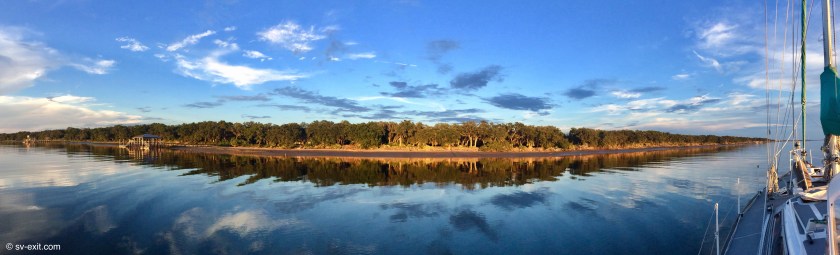
Having finally completed our solar installation project, we had already gotten off the dock at St. Marys Boat Services and worked our way back towards the mouth of the inlet so we wouldn’t have to wait on tides and currents on the day of our departure, anchoring just off Cumberland Island.With two nights waiting on favorable wind and weather, we had the opportunity to do some sightseeing ashore Cumberland Island during one of the days.
Cumberland Island, GA – Feb. 2018
Once owned by the ultra wealthy Carnegie family, Cumberland Island is now a protected park.Driving privileges are maintained only by locals who were named specifically in an agreement when the private island transitioned into park status (on occasion, these permits have to be reapplied for).Residents of the island are comprised not only of people, but apparently there is also a population of wild horses.
The area of the island at which we came ashore is a campground accessed by ferry service.We discretely used the dock to tie off our dinghy, hoping we would not be approached by a park ranger after realizing we had not brought any money with us to cover the $7.00 entrance fee designated on a payment box.
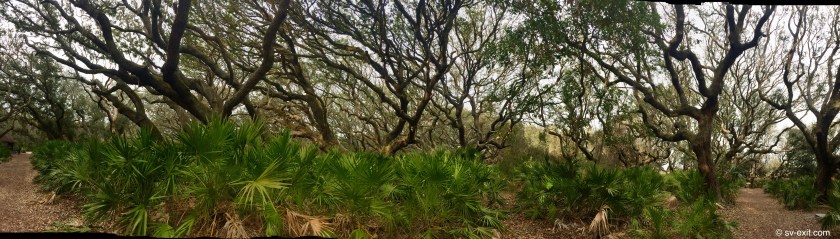
Cumberland Island trails
We spent only a couple of hours on the island but had a great time wandering down a trail that cut through an amazing forest of (I believe) Oak and Cyprus trees which surrounded us, incredibly bent and gnarled in every direction with strange and eerie gray mossy foliage hanging from the branches.The trail lead us to a beach on the opposite side of the island which faced out looking upon the vast Atlantic Ocean… our destination in less than 48 hours which now seemed to beckon to us.Various groups of sea birds, including our now favorite pterodactyl-like pelicans we have grown so fond of seeing, scattered across the surf and beach hunting for food.
While we could have easily spent additional time at the beach or wandering further to see the Carnegie Mansion ruins, both the chill in the air and the final preparations we needed to make aboard Exit pressed us back to our floating home with some of the afternoon still left to accomplish things.
We awoke at 6:00am on the 5th, eager to get underway.The forecast was promising with clear skies and 15-20 knot winds expected from the north.
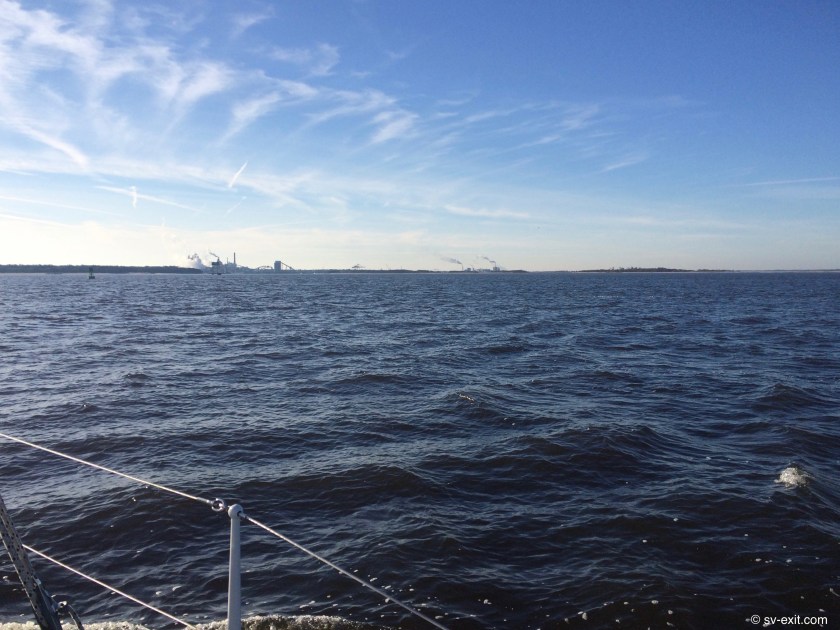
By 7:55am, our anchor was secured on deck and we were motoring for St. Marys Inlet against a two knot current.The skies were clear and a gentle five knot SW breeze seemed to bode well for the day, though the wind direction was not at all as expected and would turn out to be a preview of erratic wind shifts during the entire passage.A half hour later, a lone dolphin passing by in the opposite direction was interpreted as a good omen.Though we were still motoring, we had cleared the inlet and raised the mainsail by 10:30am.
Headed towards the St. Marys Inlet
At 2:00pm, we had just passed Jacksonville, FL when the shifting winds, now east-northeast at eight knots, finally allowed us to unfurl the genoa sail and shut down the engine.The difference between having a diesel engine running continuously at 2000rpm and the utter silence of moving under only power of sails is indescribable.When you need the engine, it’s sure nice to have; but we’ll take sails only any day if given the choice.
Fair winds and blue skiesMinimal wind… but endless space
The log entry at 4:20pm reads, “Rush’s 2112 playing in the cockpit.Not hot, but not cold either… life is good!” I am momentarily distracted by the memory of a similar 2112 moment aboard the Thailand Express train outside Bangkok nearly ten years ago.
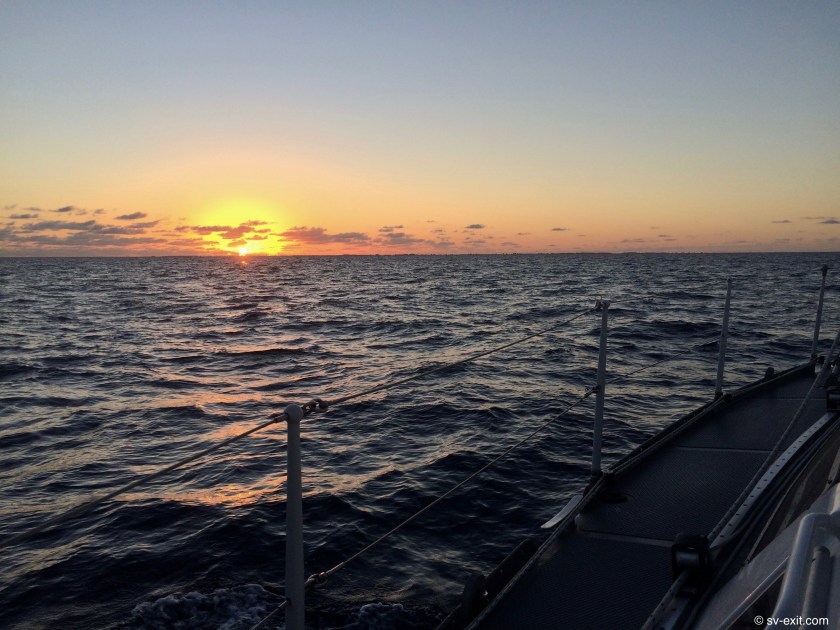
With not another soul to be seen in any direction, the stunning sunset thirteen miles offshore was ours to enjoy alone.
Rapa Nui guardian
That night, as the wind started dying, it began to clock around to the south, making our sailing angle more and more difficult to maintain, especially with a knot of current pushing against us.Just after midnight, we were finally forced to start up the engine when we could no longer maintain even one knot of forward momentum.
Throughout the night we saw almost no other traffic, except for a few dim glows far off on the horizon.
In many way, though they seem very intimidating, night passages are easier as long as the weather makes for comfortable times in the cockpit.The ambient light from the stars, and especially a good moon, is more than adequate to sail under.Furthermore, navigational markers are often easier to spot once they are lit up, as are ships whose direction can be more easily deduced by their red/green navigation lights.
As the first traces of sunrise began to creep over the horizon, Kris was able to shut down the engine and enjoy a brief stint of using sails only; but the breeze tapered off within a few hours, once again forcing us to fire up the Perkins.
Sunrise offshore Florida – Feb. 2018
Though our luck with wind was not holding very well, our luck with rockets attained a Las Vegas Jackpot level.
I had seen an update on Kris’ phone last night about a rocket launch scheduled to occur on February 6th.Kris did a bit more research and informed me when I woke up that, indeed, there was going to be a rocket launch that day.We were ecstatic.And this was not just any run of the mill rocket launch… it was the launch of SpaceX!
We gave up on trying to calculate the odds of us unwittingly passing by the actual launch pad at Cape Canaveral within hours of the scheduled SpaceX launch aboard a sailboat that allowed us a better vantage point than anyone else outside the immediate launch area… we settled on less than 2:6,000,000,000 as we appeared to be the only two people on the planet at that location at that moment.
There was a restricted security area clearly designated on the chart that encompassed the launch area stretching to about three miles offshore which we tracked south alongside of, making sure to stay well on the outside of the line.However, there was also a less obvious criss-crossing pair of lines that extended fifty miles offshore which were more ambiguous to interpret.
It was the US Coast Guard who, just after noon, hailed us on the VHF radio and politely informed us that we were about to enter a Booster Rocket Recovery Area which was restricted to all traffic until the launch, scheduled in about three hours, had been completed and the two booster rockets had been recovered.We were instructed to turn around and fall back about a mile to the north where we could await a confirmation announcement on VHF that it was safe to proceed.
It goes without saying that we turned around.
The ridiculous notion of submitting an insurance claim regarding a collision with a booster rocket…
… or the idea of potentially experiencing our fifteen minutes in the spotlight by appearing on a CNN video with a headline caption scrolling across the screen “Rogue Sailboat Forces Scrub of Long-Awaited SpaceX Launch”…
… neither one particularly appealed to us.
After retreating back beyond the rather innocuous and bland looking yellow buoy (apparently a supreme marker which NASA uses to indicate you are clear of the risk area for being hit by rockets), we sailed in circles for about three hours, eagerly anticipating the scheduled launch time of 3:45pm.
Eventually, our prime private viewing position we had stumbled upon was invaded by a small fishing boat and big power yacht, who also stopped behind the line of danger to witness the event.Still, we had a lot of water all around us and plenty of space in every direction.
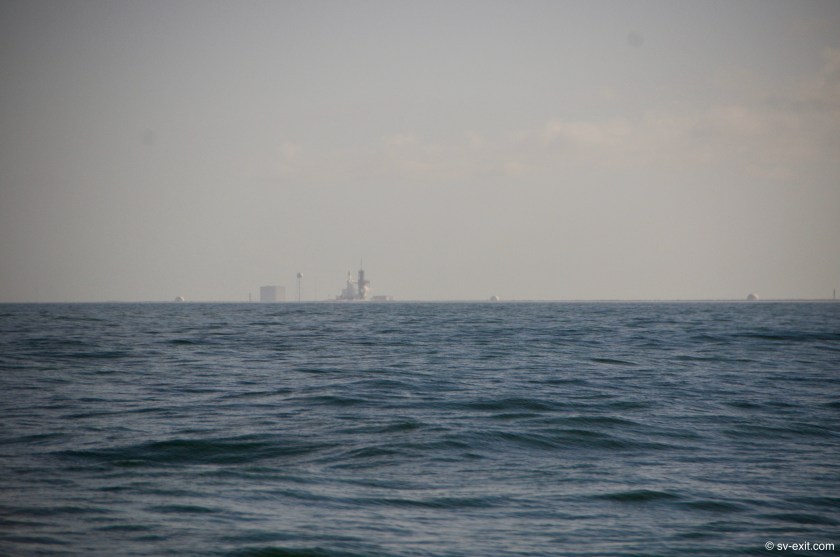
Cape Canaveral – SpaceX countdown to launch
At precisely 3:45, we watched as a massive plume of smoke begin to emerge from the base of the launch pad.Billowing both out and upwards, it quickly engulfed the entire launch tower.Moments later, the unmistakeable shape of SpaceX, only a bright white cylinder from our vantage point, lifted clear of the apex of the exhaust cloud.As the rocket climbed higher and higher, it emitted an impressive trail of orange flame which tapered off far behind it.
We certainly didn’t expect the massive sonic boom that followed shortly thereafter.
We also didn’t realize that the booster rockets which had been fired were designed to automatically return to designated landing pads after separating from the main rocket.After SpaceX had disappeared from view and we thought the show was over, suddenly two bright orange flares appeared in the sky.We watched in amazement as the two booster rockets, now firing a second time, descended slowly in unison making what appeared to be a completely controlled landing back to Earth.
We were less surprised by the second set of sonic booms.
Afterwards, it seemed pretty remarkable to have had the opportunity to witness what may very well have been the birth of a whole new generation of space travel and exploration.Our timing, though completely random, could not have been more perfect in the end.
By 4:00pm, Exit was back underway motorsailing with SE winds of only six knots, which really didn’t matter since we we basically headed into the wind.At least the seas were gentle with only one to two feet of rolling swell.
What we initially thought were plastic bottles… turned out to be Portuguese Man of War jellyfish
It took us about eight hours to get past the Port Canaveral inlet channel, and we reached the point of Cape Canaveral itself just before midnight.
We wanted to hug the point as much as possible, trying to avoid any opposing current from the Gulf Stream which was growing closer and closer to shore as we headed south.At the same time, the point had a number of very shallow shoals and rocky areas we had to stay well clear of.
With SE winds building quickly to 13 knots, three to five foot confused seas, one knot of current against us, and a shitload of lights from fishing boats all around the point (which could be quite difficult to interpret direction, speed, and intent in the dark), getting around the point was quite a messy affair.
By 12:30am, we were clear of the point and all the fishing boats and had returned to our plotted course.During the next few hours, things remained uneventful despite the weather continuing to build.The wind angle continued to force us to run the engine, though we kept the main sail up to try to eek out an extra knot or two whenever possible.
Then, at about 3:20am, my stomach knotted up as I clearly heard the Perkins engine began to hesitate.For about five seconds, the engine rpms dropped from 2200 to 1600.With an audible groan, I tried to wish the engine to fight through it… which seemed to help as the old girl picked back up to regular speed and continued on as though she had merely experienced a moment of diesel indigestion.I made a note in the log book to change filters in the morning, or if Kris experienced the problem again, before that.My watch was going to be over at 4:00am and I was looking forward to sleeping.
However, at 3:45, all prospect of sleep went overboard when the engine again began hesitating.As the engine speed continued dropping, it became obvious that the Perkins was about to stall anyway, so I shut it down.
With 15 knot winds and five to eight foot seas in front of us, there was no way to maintain any speed.Without any speed, we would lose steering.I called down to Kris that I needed her in the cockpit asap while manually steering the boat, trying to change our angle so we could build back enough speed to control the boat while, at the same time, minimizing the waves from hitting us broadside as much as possible.
When Kris came up on deck, it became clear that the only options to maintain maneuverability were to point us directly offshore (deep water, safe but headed straight into the waves) or directly at the coast (limited time till land became a problem, but much less pitching about in the waves).We opted to head towards shore, giving me a couple of hours to try to sort out the engine before we grew uncomfortably close to hard things.
It seemed obvious to be a fuel starvation issue, same as we had experienced in August heading for Norfolk overnight.Same conditions too – rough seas had probably stirred up stuff in the fuel tank, clogging the fuel filters.
Exit has a backup Racor fuel filter system; but, when switched over, the engine wouldn’t start at all.Either I was misinterpreting how the valves needed to be oriented or the problem was affecting both systems.
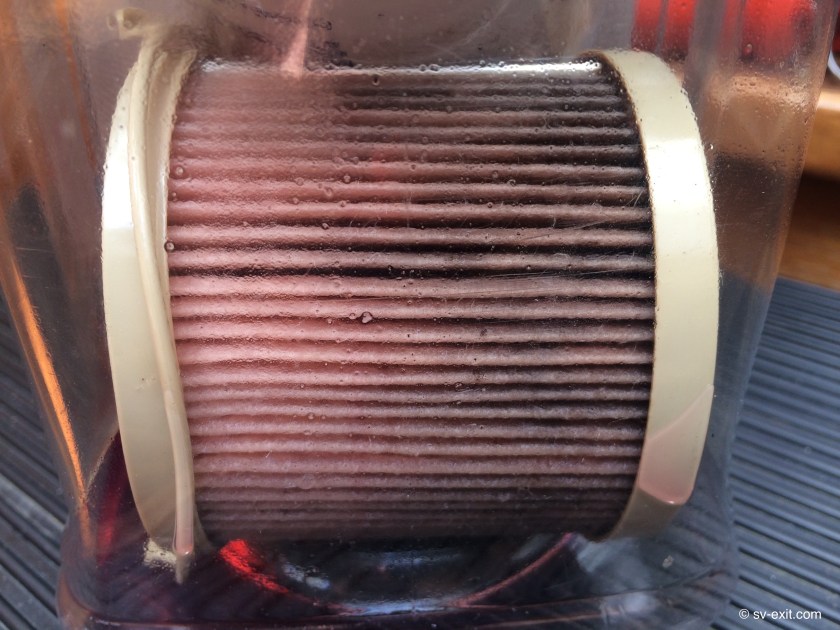
So I commenced with the process of switching out the primary filter, hoping we could at least regain temporary engine power until morning light would make for easier troubleshooting and work.While changing the filter out, which was a foreboding dark gray color, I noticed lots of sediment in the bottom of the Racor fuel bowl.After changing the filter and bleeding the system, I turned the key.Thankfully, the engine started up straight away and seemed all good.
Dirty fuel filters… never a good thing
Thirty minutes later, as I was thinking I might be able to go below and get a few hours sleep, the Perkins started hesitating.The rpms began dropping, and the engine died again… shit!
Back to the drawing board.With the fuel filter as dirty as it was, I anticipated similar problems could be occurring at the secondary filter (on the engine) and/or the fuel lifting pump screen.This meant digging in even deeper.
Finally, around 6:30am the engine fired back up to life… and thirty minutes later it promptly died again (just as I was again headed for my pillow)… fuck!This was becoming a drag!
After another hour of trying various approaches, it seemed apparent that the Perkins was not in good health and this would not be an easy fix.Kris had been manually steering us for four hours by this point.
We agreed that battling against the wind and waves for another forty miles to reach the first safely navigable inlet to the south was not a very feasible option (it would be nearly twice that zig-zagging back and forth to maintain an angle of sail).
Port Canaveral was some twenty-five miles behind us – not the right direction, but a hell of a lot more appetizing.We could comfortably sail a nearly straight line to the channel, and the waves would then be following us, making for much easier going.So, by 8:30am, we were sailing back towards Cape Canaveral.
I spent the entire morning and most of the afternoon trying to sort out the Perkins, but achieved only limited success.After endless bouts of trial and error, all I could conclude was that our fuel tank (still nearly half full but now at the lowest level it had been in months) must be full of crap that was chronically clogging the filters and lines and we had an air leak in the fuel system that repeated bleeding did not seem to be helping.
The source of the air leak seemed to be the cover cap of the lifting pump.Air was getting past the screw holding the cap down, and trying to fabricate a replacement rubber washer on the spot did not fully stop the leak.
By 3:00pm Kris was circling just outside the entrance of the Port Canaveral inlet channel, awaiting a final verdict on the engine.We had already made a call to TowBoatUS, just in case we didn’t have engine power to get us into a marina.However, it struck us as odd when they indicated they had no“Notified, On Standby” mode.Either we needed the tow or we didn’t.We had also been on the phone with our old St. Marys friend Tom, who gave us great advice both on the engine and the entrance to Port Canaveral.
By 3:30 we committed to an unassisted approach from a couple of miles out.The engine was barely holding on – as long as we kept the rpms no higher than 1500 (just above idle), and I poured a tablespoon or so of diesel into the well of the lifting pump cap every few minutes to keep it from sucking in air, it seemed the Perkins would be able to make it in.
We timed our approach to minimize any surrounding traffic as best possible, dropped the mainsail about halfway down the channel, and slowly limped into the harbor with very mild conditions.
Finally, around 5:00pm, we arrived at the Port Canaveral Marina.It had been thirteen hours since the engine had conked out and more than fifty-three hours and 231 nautical miles since we had left St. Marys, GA.
We both nearly fell asleep in our beers and a very mediocre dinner at Fish Lips; but, what the hell?We were safely tied up for the night and would finally get a good night’s sleep… the Perkins could now wait till morning. We had been hit with another challenge and successfully waded our way through it… hopefully, McGyver would have been proud!
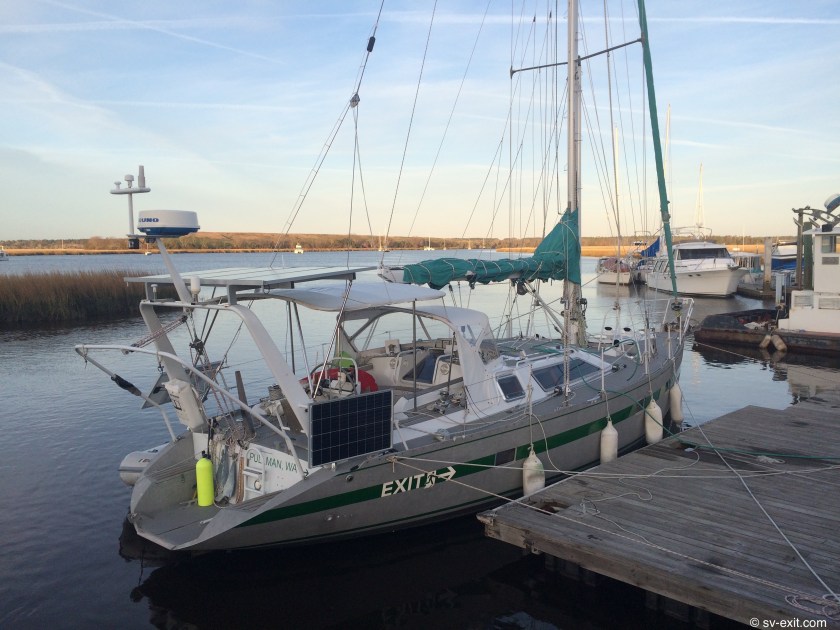
Exit with upper solar panels installed, awaiting lower rail panels
February 4, 2018
As always, things have taken longer than we had originally anticipated.Once every task we undertake aboard Exit is approached by multiplying a time factor of five into the equation, we should start staying right on schedule.
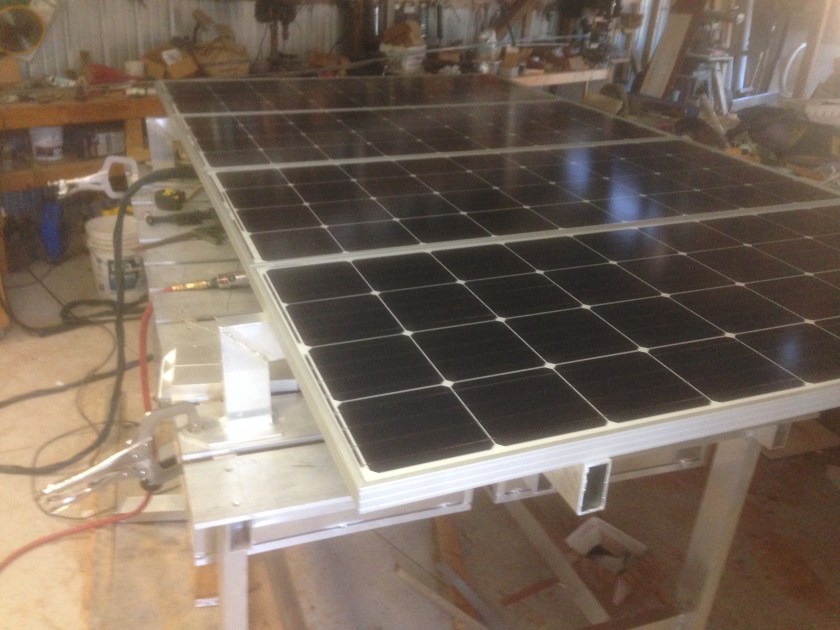
Fortunately, we had Tom Chalkley at the helm for our latest project… installing a solar panel array, which was no simple task.
A number of design evolutions along the way, inevitable logistical challenges that cropped up, and certainly my propensity to want to hide all wiring involved (sorry Tom!), resulted in a much longer process than any of us had initially anticipated.
At times, it seemed that we had half the contents aboard Exit either stacked inside the cockpit or piled about belowdecks.
Nonetheless, Tom’s vast knowledge and experience, aluminum fabrication and electrical capabilities, as well as meticulous attention to detail, resulted in what we feel is a perfect integration of a rather immense system into the existing lines and structure of the boat.Plus, he’s just a really fucking cool guy!
All this, combined with the ambitious vision shared by the three of us, turned a potentially painful, frustrating and less than satisfying situation into a sincerely fun project that, in the end, far exceeded our expectations.Furthermore, despite the delays, Tom held fast and true to his original estimates, keeping the overall costs within the scope of a digestible budget for two vagabond gypsy cruisers.
By the end of the project, we had gained not only the ability to keep our battery banks fully charged using the sun instead of fossil fuel, but we felt we had truly gained a new friend.
With four stationary 180 watt solar panels fixed atop a solid aluminum frame mounted to the existing stern arch and a 100 watt panel attached to the aft rail on either side (which swing up horizontally when in use and can be dropped down flush against the vertical railing), we now have a total of 920 watts of solar capability.Conscientious awareness of our electrical consumption should provide us nearly, if not complete, independence from having to rely on the engine or generator to charge our batteries now.
In addition, five independent solar controller modules equipped with Bluetooth allow us to both monitor and compare individual panel performance as well as follow the daily power generated by the system.
As an added bonus, we had Tom fabricate an aluminum gutter that’s attached to the back of the solar panel frame which we can route to the fresh water tanks via a hose that can be easily attached and detached.This means the panels not only generate power but also serve as a rain catch.A filter canister to strain the water through and cheap digital water meter hooked up in-line (allowing us to monitor how much water is being collected) round out the system.
We already are convinced that adding solar capabilities to Exit has been the most cost effective and best investment we have undertaken since purchasing the sailboat.Exactly how much power can be generated remains to be seen, but we are ecstatic about the overall results.
Furthermore, we believe that the system will most likely pay for itself by the year’s end in reduced diesel consumption and wear and tear on the generator and batteries.Monitoring the performance of the solar array will be a pleasure as we have drinks in the cockpit using ice generated by the sun… nice work Tom!
As it turns out, in addition to learning more and more about sailing every day, we are enrolled in a full-time and never-ending curriculum of diesel mechanic, electrician and plumbing training courses aboard Exit.
Obviously, the more we can do ourselves, the more confident we become in our own abilities to deal with whatever may arise (typically at less than opportune moments), not to mention the amount of money we save if we don’t have to pay someone else to come aboard and sort things out for us.
However, with that comes the responsibility to recognize and acknowledge when something is far deeper in scope than we have any business delving.
If something is already broken, the risk of digging into it to see if we can sort it out becomes much less concerning.If it works, the last thing we want to do is break it.If it doesn’t work, we still have to be careful that we don’t make things worse, resulting in even more expenses than we were facing before.
As was the case with our refrigeration upgrade in Annapolis, sometimes the best we can do is to research the shit out of something, trying to educate ourselves as to how things work as well as learn what equipment and technological options exist.Then, after multiple conversations, turn things over to a qualified expert that we trust (usually based upon someone’s recommendation) who can actually see things through to fruition.
In these situations, the key is to ask lots of questions and, as much as is possible, help along the way (or at least watch closely) so we better understand the system and are far more likely to be able to do maintenance and/or troubleshooting ourselves, when needed.
We are learning quickly that, while technology can be learned, equipment installed, and systems understood, there are always going to be variables, unknowns and unforeseen challenges that will crop up.Sometimes experience is the best, or even only, tool that will get the job done right.This can be especially true when modifying, “upgrading”, or changing entire systems out.
Our entire motivation for reaching St. Marys was to hook up with an electrical engineer, named Tom Chalkley, who we were going to work with to equip Exit with solar power.
The vast majority of boat owners either rely on plugging into shore power at the end of the day or use an onboard generator to recharge their battery banks.We didn’t want to be slaves to either.Solar was imperative for us as live aboard cruisers.We wouldn’t be at marinas to plug in, and running our main engine, or the $10,000 genset, for a few hours every day solely to charge batteries was an expensive prospect when you calculated the cost of diesel, maintenance, and wear and tear.Solar panels could give us the ability to keep our batteries charged all the time without ever starting up the engine or genset.
Ultimately, our goal for solar self-sufficiency was both environmentally and economically based.
We are reminded of the economic incentive every time we fill up our 200 gallon diesel tank.Diesel isn’t cheap and we have to burn diesel to run the engine or genset.
Environmentally, the goal is to get off the grid as much as possible… reduce our overall footprint incrementally regarding both consumption as well as waste.
From the standpoint of practicality, we learned an important lesson about our need for solar charging during our first offshore passage.Though we hadexperienced the luxury of being able to sail without needing the engine for twenty two hours, sixteen hours into that we found our electronics (especially important things like the radar and chart plotter) startingto cut out.Our battery banks had depleted to the point we had to fire up the generator while underway to recharge the batteries.Hopefully, the solar panels would alleviate just such a problem.
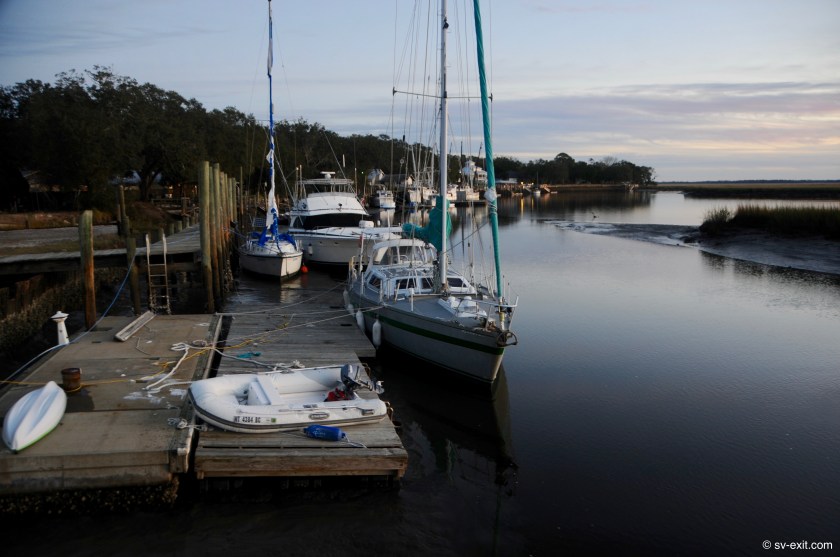
Tom had worked things out with Rocky, the owner of St. Marys Boat Services (both a boat yard and a virtual community of dozens of sailors on the hard working and living on their boats), to allow us to tie up to their dock while Tom did the work.
Rocky was quite the enigmatic character.While always incredibly hard working and polite enough, it was two weeks before Kris finally coaxed a smile from him.Make no mistake though; his hospitality in allowing us to stay at his dock, even after the two to three day project had extended beyond two weeks, went above and beyond.Reluctantly, he took less money than we would have paid for one week on a mooring ball anywhere else.
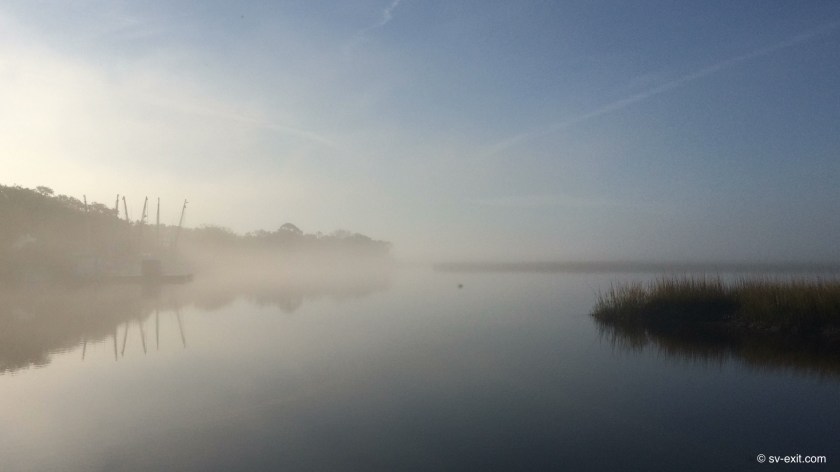
Morning fog on the North RiverGeorgia afternoon in January
I’m pretty sure the boat yard will retain the title of “most unique dock space we have ever used” for quite some time.
It was one of the last yards to haul out at and do extensive refits that actually let boat owners do their own work.It was amazing how essentially a small community of sailors, living on their boats on the hard while they did various repairs, had emerged here.
Some, like us, were “short term” residents, counting our stay in days or weeks (we were one of the few boats that wasn’t hauled out).
Others were either working on intended long-term projects, or had fallen prey to the spiraling trap of a re-fit black hole, never seeming to launch due to an always growing list of things that needed doing.The lucky ones were still counting in months; one very nice couple we befriended had been working on their catamaran four years.
Nestled behind a tiny grass covered island less than 200 feet by 50 feet in size, the boat yard dock was accessible only at high tide via a very narrow channel that approached the dock from about five hundred feet out and had to be followed for about one thousand feet when departing.During low tide, exposed mud on either side of the island increased the size of the island by nearly three-fold and restricted the channel to dinghy use only.
The island at high tide
The main dock was only about fifty feet long, so Exit pretty much took up the entire length of it.
Fortunately, it was a floating dock which raised and lowered with the tide changes, some ranging as much as eight feet.This made it much easier considering our lines were tied to the dock cleats, and otherwise would have needed to be adjusted constantly.
Unfortunately, the dock had less than five feet of water under it.This meant that twice a day, at low tide, the floating dock stopped floating and merely rested at a tilted angle on the mud.Tied alongside, Exit likewise followed suit, twice a day listing slightly to port as she rested awkwardly on the mud.At times, there couldn’t have been more than a foot of water under our starboard side (facing the dock), and we were actually able to see our through-hulls, which should have been under the waterline.
On the soft…
… twice a day
One sailboat (still floating but totaled by Hurricane Irma), tied to a dock directly astern of us, stood strangely upright, even as the water disappeared at each low tide, leaving only mud underneath it.It should have been listing over at almost a forty-five degree angle, except for the fact that it’s keel was embedded firmly in three or four feet of mud.
Nearly six months ago, we had spent weeks on the hard in Deale, MD before launching Exit; subsequently, we had spent weeks at anchor working our way south; now we would spend weeks “on the soft” in St. Marys!
Despite its’ quirkiness, we came to feel quite welcome as the new kids on the block at St. Marys Boatyard Community.The fact was, we were just just a couple of additional odd-ball cruisers who seem to fit right in.
We had heard rave reviews and only the highest of praise regarding Tom Chalkley’s work.As an electrical engineer who had worked for the power company, his electrician credentials were solid.He had done numerous solar installs on yachts already, owned a sailboat himself, and could do all the aluminum frame design and fabrication that would be required.His work was meticulous and well designed; and, as we learned, he was incredibly laid back and easy to get along with.Talking to people in the boatyard, if we mentioned that Tom was doing the solar work for us, we always got the response, “Good choice.”
With solar collection, one of the biggest concerns is that of potential shading.Any shadow across a solar panel, even only a small portion of it, can render the panel almost completely ineffective.This makes it essential to place the panels away from things like the the mast, which can cast a very large, hard shadow.
Our bimini has plenty of space on top, but we wanted to retain the ability to remove the cover once we reached more tropical climates, as well as maintain a line of sight from the helm to the sails and top of the mast.This required us toallow the solar panels no further forward than the backstays.
The massive aluminum stern arch was an absolutely perfect structural support for a solar panel frame.However, the radar, five antennas, stern navigation and transom deck lights, all attached to a vertical strut assembly mounted at the center of the arch, concerned us in regards to the potential shadows they would most likely cast.Yet, options to redesign the mounting strut, shorten it, or change its’ angle all seemed to create additional logistical complications, marginal gains, or aesthetic issues above and beyond the overall nightmares that would inevitably accompany any relocation process.
After much discussion revolving around equipment options, energy needs and conservation, space constraints, budget limitations, and design considerations, we came up with a plan that would net us 920 watts of solar panels (four 180 watt panels plus two 100 watt panels) –plenty to keep our batteries fully charged if we showed some energy-use restraint.
In the end, simplicity won out over grandiose re-design…
Fabrication work in Tom’s shop
…no modifications to the existing structures and minimal additional holes; four fixed panels mounted on a sturdy aluminum frame above the bimini, between the stern arch and the backstays, integrating smoothly into the existing boat lines; and two additional smaller fold-out panels mounted to the aft railings to make up for any potential shadows cast by the radar.
…minimal intrusion and maximum wattage of panels that can be fit in.
Art.. or early signs of going stir crazy?
As is often the case, the design phase took longer than expected.Tom’s keen attention to detail and desire to fabricate not just a generic, utilitarian mounting frame, but rather a custom-designed as well as aesthetically pleasing frame engineered specifically for Exit’s layout, meant that a lot of ideas and options bounced back and forth.We appreciated this, as it allowed us to fine tune many details before committing to something that would be hard, if not impossible, to change or modify at a later stage.
It also meant pulling off panels we had never been behind in order to determine wiring routes, and eventually run the wiring, from the access points on top of the arch to the battery switch locker belowdecks in the salon.
Once the design was essentially finalized, and the cockpit and aft berths were chock full of gear from the aft deck and interior lockers we needed access to, Tom set to work on the aluminum fabrication.
After numerous reassessments, rough assemblies, and final fittings, the actual structure of our new charging system began to take form on Exit, piece by piece.Slowly, our solar vision began to physically materialize.
I’ve always hated Florida.I know I’ve already said this.I still do.
I understand that, to a certain degree, this is probably unfair and unfounded.There are many very friendly and helpful individuals in Florida I will, at some point in the future, probably need to reach out to hoping they have not read this.
It just seems to me that, when it comes to the never-ending onslaught of wtf news, bullshit behavior, and uncovered revelations of people being bad human beings we are constantly bombarded with, Florida is disproportionately represented in the headlines.This can be political, financial, environmental, social, religious… you name it.
Either you are laughing right now and saying, “you too?”, or you are rolling your eyes saying, “what’s your deal?”
Florida is polarizing… definitely not for the non-committers.
Anyway… my internally calibrated negative polarity against Florida has me eternally scanning the radar for anything I can blame on Florida to reinforce my otherwise potentially baseless and unwarranted hostility.
So, when we ran aground in the mud less than one hundred feet inside of the Florida state line (after arriving at St. Marys), it appeared that we had already awoken the dragon.
Shortly after that, we received notification that a gale warning had just been issued for the following couple of days.Florida was so falling into my stereotype.
When the generator died the following morning I directed a number of additional colorful expletives at Florida and made mental notes.Fortunately, an exploded impeller was all that was at fault… something I was becoming well familiar with.
2 of 6 impeller blades gone… definitely an issue
However, by the time it was up and running again, we decided against picking up the hook and trying to relocate strategically for the threatening storm.Though it meant we wouldn’t escape the clutches of Florida immediately (!), we felt the best course was to, once again, trust our anchor set and sit tight for a couple of days.We prepped the boat for the storm and hunkered down below.Already, the wind was biting and the rain was constant.
The rather exposed location was not ideal, and for days we got buffeted around much more than we had in the past.Five knot tidal currents moving in the opposite direction of twenty-five knot winds understandably confused the shit out of Exit; she bounced, shifted, swayed, hunted, drifted, swung, and pulled – the schizophrenic behavior of someone under the absolute influence of two nearly equal opposing forces… but the one thing she never did was drag (bless her cotton socks, as Simon Lloyd, one of our Scuba Junkie family, would say).
For four days we waited out the weather.During that time, the National Weather Service kept issuing alert after alert. The list of shit thrown at us after we entered Florida became a bit comical:GALE WARNING;COASTAL FLOOD WARNING;WINTER STORM WARNING;RIPTIDE WARNING;FREEZING WARNING;WIND CHILL ADVISORY WARNING;HARD FREEZE WARNING;“BOMB CYCLONE” WARNING (the genesis of a new National Weather Service term that was unveiled for our Florida visit)… all this? …in Florida? …really?
To be fair, the entire East Coast was being pummeled by ridiculously extreme cold weather.We heard a report that theChesapeake Bay had been closed at Norfolk to all incoming and outgoing boat traffic due to buildup of ice on the water, as much as five inches thick in places!
But I have nothing against the Chesapeake Bay so I’m gonna let that slide as global warming… Florida, you don’t get off so easy.