Trials and Tribulations (or Bad Luck and Bullshit)

January 5, 2019 

     If I were a devoutly religious person, I might begin to brandish the notion that I am obviously being tested by a higher power… tested in my faith… tested in my resolve… tested in my something.

     But I’m not…

     If I were the President of the United States, I would decree that the Democrats and CNN are to blame for it all.

     But I’m not (thankfully)…  so I’m just gonna call it bullshit and bad luck.

     Our return to the Bahamas seemed like a triumphant victory.  We had spent the hurricane season exploring the Northeast coast, got shit done on the boat that needed doing, and managed to break free of the clutches of the U.S. once again, despite its’ best efforts to distract, delay and discourage us while simultaneously separating us from all of our money.

     After our alternator delay in Norfolk and our subsequent decision to press on rather than spend the time to sort out additional spare parts, it was certainly ironic to arrive at the Bahamas realizing that one of the first orders of business would be to sort out parts.

     The issue with leaking coolant was not an immediate emergency but it obviously needed to be dealt with more sooner than later.  Complete failure of the cooling system would make the engine inoperable and could instantly create an emergency situation.

     Living aboard a sailboat, we are continually reminded that, while a particular situation may not be that significant nor its’ resolution that painful, on a boat the process of getting from a particular situation to its’ resolution can often be significantly painful… inevitably it will, at the least, be more complicated.

     Such was the case here… baby steps… progress… delays… setbacks… frustration… baby steps… progress… delays… setbacks… frustration…

     Oftentimes I find it quite difficult to convey the essence of some of these logistical minefields.  The following is a blow by blow account of the whole process as it unfolded.  This is how a rather minor problem with our engine morphed and evolved, eventually turning into a nearly six week ordeal to resolve:

11/21:

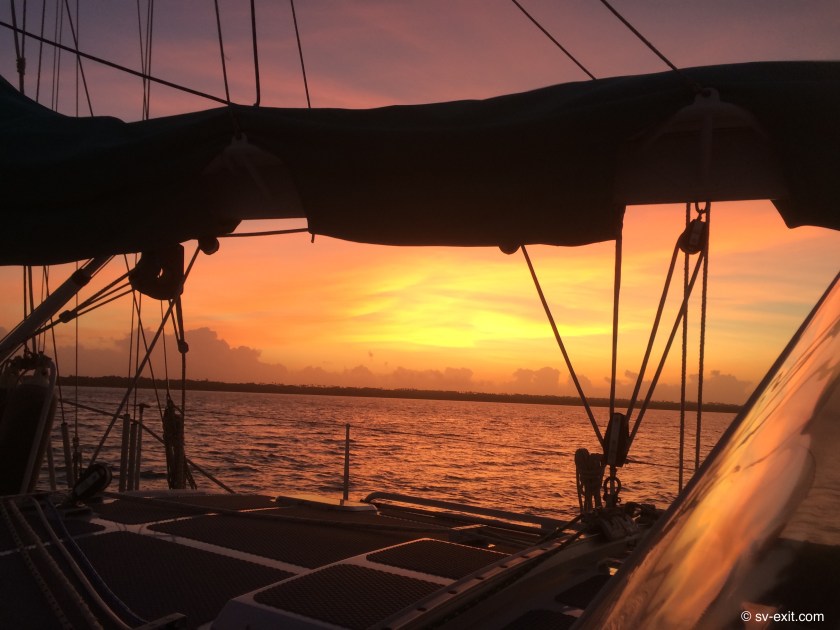
    • Arrive at Powell Cay from Norfolk, VA just as the sun is setting

11/22:

    • Chill out recovering from five day offshore passage & wait for milder wind conditions to move

11/23 – 11/25:

    • Move 14 nautical miles to Green Turtle Cay as it has the easiest access to Customs/Immigration which must be cleared before doing anything

img_1099

  • Have to brave 20-30kt winds in dinghy to clear Customs/Immigration on Friday so we wouldn’t have to wait through the weekend for them to re-open… EEEK!  (Side note: got hit with unanticipated charge of $300 for new cruising permit because we hadn’t returned within 90 days of leaving Bahamas… ouch!)
  • Start diagnosing engine coolant leak (a much slower process when trying to avoid completely disabling engine allowing for a potential emergency move if needed)
  • Awaiting calmer winds to get to Marsh Harbour which will have better overall facilities available
  • Side note: Kris has managed to access an ESPN Internet feed allowing us to stream today’s WSU Cougar football game through our stereo… Go Cougs!

11/26:

    • Move 23 nautical miles to Marsh Harbour
    • Further diagnostics today and the following day convinces me that the freshwater coolant circulating pump is ultimately the source of the problem (again, this is a slow process based upon a reluctance to completely disassemble everything leaving us unable to run the engine in an emergency).  The realization that replacing the water pump would require removal of the timing belt and numerous pulleys put this beyond my scope of comfort.  Part of our learning evolution is realizing when you are in too deep to go it alone… time to bring in outside help.

11/28:

    • We contact a Bahamian named Basil based upon multiple recommendations that he is the best diesel mechanic in Marsh Harbour.  He is available to come to the boat on the 30th.

11/30:

    • Basil comes out via our dinghy and confirms the water pump is, in fact, the problem.

12/1:

    • Parts are ordered from Trans Atlantic Diesel in the U.S.   They estimate 3 day delivery to Marsh Harbour.

12/4 – 12/11:

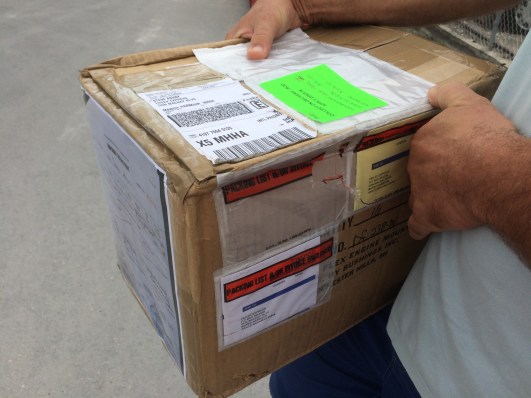
    • Parts arrive in Nassau – this is the start of an excruciatingly slow Customs/Duty clearance
    • Multiple calls made to FedEx over the next week by Kris to arrange required paperwork (which, incidentally,  was already attached to the outside of the box), and sort out endless bullshit that prevented Customs from releasing the package.  No amount of jumping ahead of potential problems by providing documentation in advance or chasing down issues with multiple phone calls seemed to accelerate this brain-numbing process.
    • Multiple weather fronts roll through Marsh Harbour.  Over the course of the following week, we clock more than 720 degrees at anchor due to wind changes
    • Side note:  During this time Kris ordered an SD card for a satellite connection allowing us to get weather updates offshore.  The card is shipped from Europe and is mistakenly shipped to Turks and Caicos.  After Kris receives a call from the accidental recipient, the card is put back on a plane to Nassau.  It appears that, despite the mis-ship, the SD card may reach us before the engine parts.
img_1127
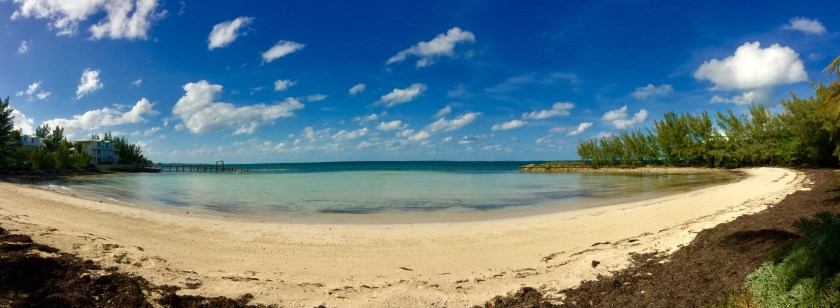
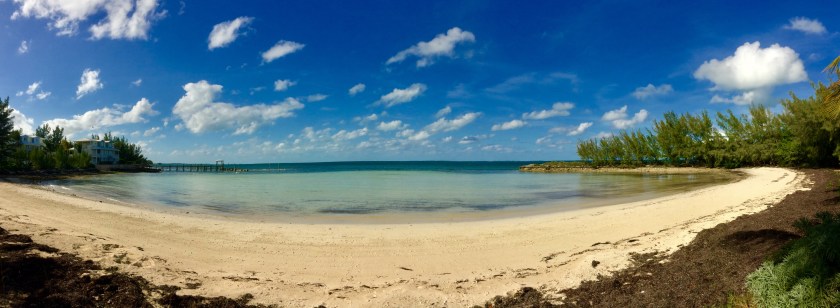
Secluded beach discovery outside Marsh Harbour

12/12:

    • FedEx tracking indicates engine parts to arrive Marsh Harbour by 6pm today

12/13:

    • Three mile walk to FedEx office (they don’t deliver to a boat at anchor).  Turns out parts didn’t get on the plane in Nassau… come back tomorrow.
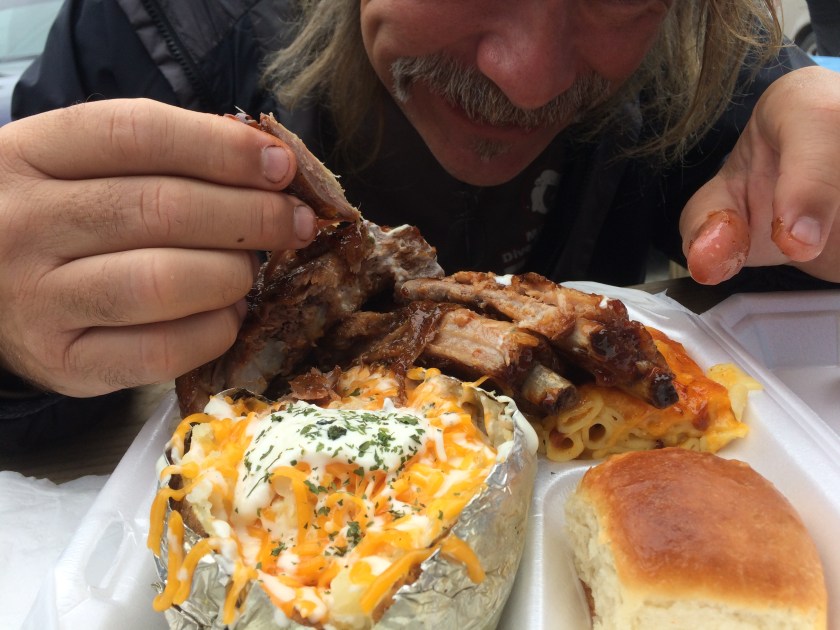
    • The silver lining:  ridiculously tasty ribs and a fully loaded baked potato from a local food shack.
img_1207
Get in my belly…

12/14:

    • Parts are actually in our hands after our second three mile walk to FedEx in 24 hours.  This includes some additional spare parts we opted to acquire while available (see… we’re learning).  Parts cost is approximately US$900…
    • PLUS an additional $700 duty on the FedEx bill… holy shit!  The official FedEx line is there was no clear indication this was a necessary part for our engine despite all the documentation and explanations to the contrary (a part necessary for our engine to run is exempt from all duty and should only be charged the 12% VAT tax).  Kris would initiate a refund claim that still had not been resolved three weeks later.
img_1143
The long awaited parts

12/15:

    • Basil came on Saturday and partially finished repair.  At Basil’s request, we have moved Exit into a slip at one of the marinas.  Understandably, the risk of bringing out tools on a dinghy as well as a more readily available access to getting on and off the boat for potential trips to the hardware store or other possible scenarios makes this request seem most reasonable.

12/16:

    • Sunday – no work day

12/17:

    • Basil finishes pump replacement but we have to wait 24 hrs for sealant to set before starting engine

12/18:

    • Start engine and everything seems good
    • Celebration pizza at Snappa’s Grill

12/19 – 12/22:

    • Big wind blows though with 25+kt winds over next couple of days
    • We make the mistake of sitting through this tied up in the marina.   Taking it up the ass with our stern to the waves made for a very uncomfortable few days.  The idea that being tied to a dock in a marina provides extra security is largely a myth.  The boat is trapped in a slip, secured with multiple lines that prevent it from banging around like a pinball.  Swinging freely at anchor, bow to the wind, is almost always going to be a better situation as long as you have adequate chain out and room to swing (lesson learned).
    • Sometimes you just have to go with the flow…

12/23:

    • Move 20 nautical miles to Spencers Bight anticipating heading offshore for Christmas
  • After setting anchor, it becomes apparent that we still have an engine problem.  A quick inspection reveals that the timing belt has shifted so that it is hanging a quarter inch over the edge of the gears it runs on and is now melting a track through the timing case cover.  Big problem… shit!

12/24:

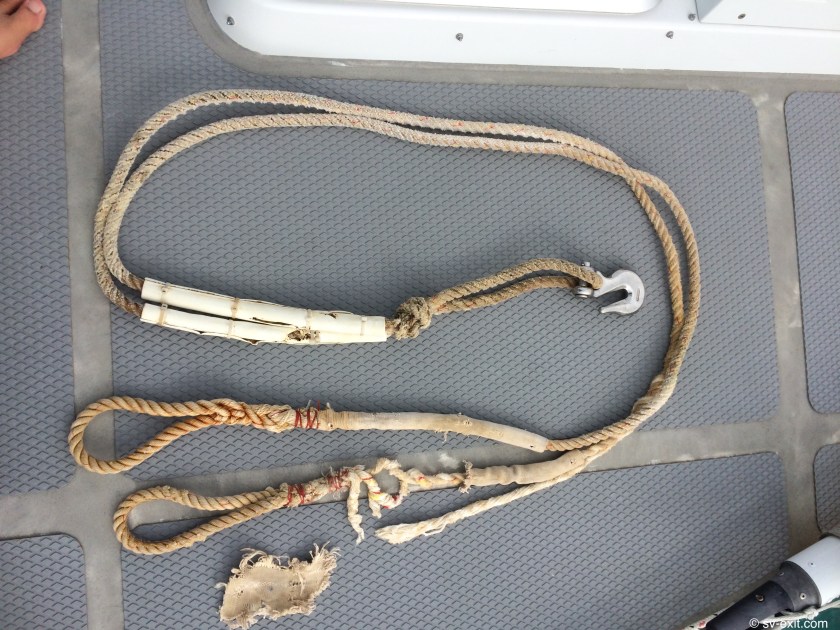
    • A call goes out to Basil.  He offers to drive to Little Harbour, which is five miles away from our current location but the closest point at which we can pick him up by dinghy.  Trying to be courteous of the holidays, we tell him to wait until after Christmas.  As it turns out, Basil is unavailable to come the day after Christmas, and an increase in winds means we can’t get to Little Harbour until the 29th.  Consequently, we sit out a wind storm that reaches 35 knot wind speeds (the biggest we’ve ever seen at anchor) in completely exposed conditions with a largely disabled engine.  More than a bit daunting; nevertheless, Exit performs brilliantly and keeps us perfectly safe.  Ironically, it was probably more stressful in the Marsh Harbour marina with lesser winds. The only casualty – our snubber (which acts as a shock absorber between the anchor chain and boat) took quite a beating and ended up barely making it through the storm.
img_1298
35 knot aftermath… time for a new snubber
  • The pleasant distraction from it all with Christmas celebration: fondue (and steak for Steve), eggnog with Kraken rum (yum!) and cinnamon rolls with rum frosting (yum-yum!) topped off with a laptop showing of the classic The Grinch That Stole Christmas (the original, of course) and holiday greetings from family and our old Scuba Junkie friends Ewan and Lydia (who just got engaged!!!) in SE Asia… nice.

12/29:

    • To Little Harbour mid-day

12/30:

    • Sunday, no work done
img_1307
Endless space to anchor…
img_1311
… yet there always seems to be a catamaran that drops anchor directly in front of us!

12/31:

    • Basil comes out but can’t sort things out entirely o the boat.  The crankshaft gear is not aligning properly on the crankshaft causing the timing belt issues.  He brings crank pulley and gear back to his shop to try to better determine the cause of the misalignment.

1/1:

    • Basil unavailable today. We decide to get the hell off the boat for a New Years celebration and go for a dinghy excursion/picnic into the mangroves for the day.

1/2:

    • Basil successfully reassembles everything.  After some wrestling and adjusting, the engine starts and runs perfectly.  He doesn’t want to charge us for the extra two days but we insist on giving him $100 for each of the two days he came to Little Harbour.  Despite the crankshaft misalignment issue, we feel that Basil has been very accommodating in his schedule to help us out, very capable in his work, very friendly to deal with, and very fair in what he has charged us.

1/3:

    • Engine is officially sorted out.  Hallelujah!!!!  We move 2.5 miles to Lynyard Cay to reduce the swell we are feeling from a shift in the wind

1/4:

    • Move another 2.5 nautical miles back to Spencers Bight to stage for our offshore jump to get the hell out of the Abacos… finally.
img_1337
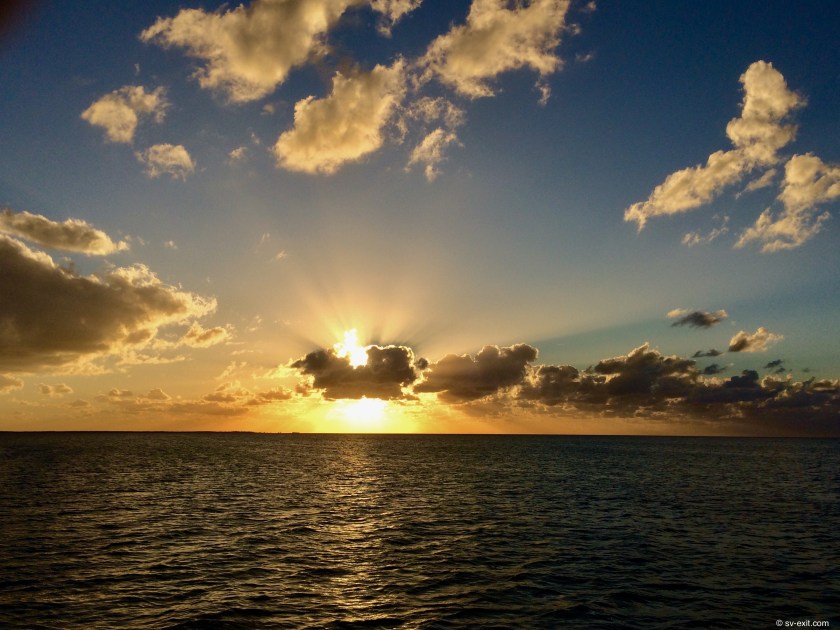
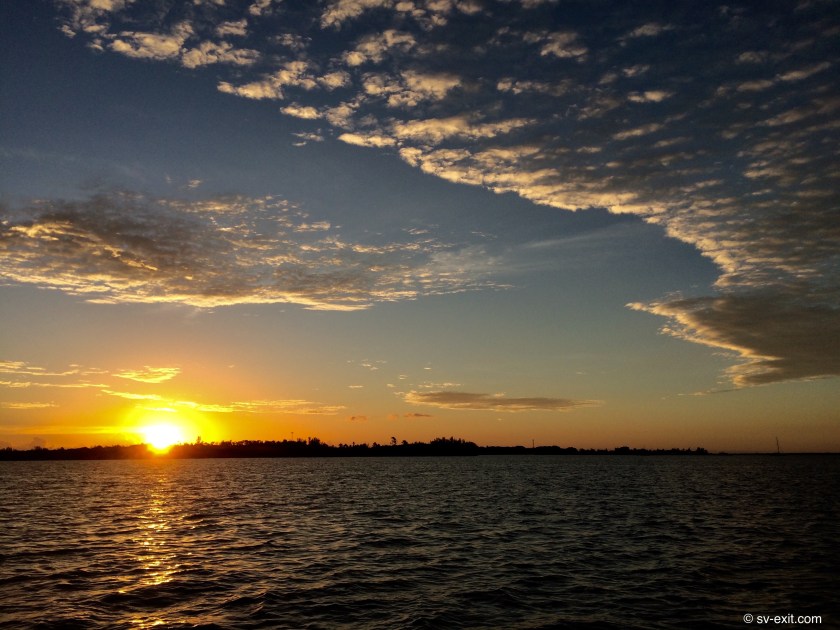
An endless supply of amazing Bahamas sunsets

1/5:

    • Heading offshore for overnight passage to get to Cat Island, which we were unable to reach last year.
    • Side note:  As for the SD card that we thought would arrive before our engine parts – it’s still sitting in Nassau Customs.  Kris’ many phone calls have all been frustratingly unsuccessful at getting the card released.  In the end… fuck it.  We left it behind.  Maybe we can get this sorted out from elsewhere but our recent experiences with Customs leaves us with little optimism and a rather cynical aftertaste on our tongues.

*****

     Overall, a rather benign engine issue that resulted in six weeks of wading through bad luck and bullshit to finally resolve.  December 2018 will certainly go down in the books as Livin’ the Dream…

The big bonus of all this…?  Lots of stuff checked off the to-do list during all the down time – gearbox and engine oil change, fuel and oil filter changes, re-varnishing in the salon, expansion of Kris’ multi-planter garden, baking bread, and a plethora of other bits and bobs… there’s always a positive in there somewhere, even if you have to dig a bit to find it.


Back In The Bahamas

December 9, 2018

A week at anchor in Norfolk, VA sorting out engine charging issues ultimately led to us replacing our alternator.  In light of that, we considered securing a spare fresh water coolant pump, starter motor, and fuel lifting pump before leaving the States again.

Instead we seized a less than optimal weather window and made an offshore break straight for the Bahamas.  Light and erratic winds made for a lot more diesel consumption than we would have liked; but better than crazy wind and storms which we seem to have just missed.

The thirty-plus knot winds that hit the day after our arrival at Powell Cay, Abaco confirmed that we had just threaded the needle.

Unfortunately, during our five day passage en route to the Bahamas, coolant leaking into the bilge heralded the last gasps of our fresh water pump… of course.

On the upside, while underway we had the privilege of seeing humpback whales, green turtles, pods of Atlantic Bottlenose and a pod of Spinner dolphins riding our bow wake, as well as a Mola Mola (Sunfish) hanging out at the surface… amazing!

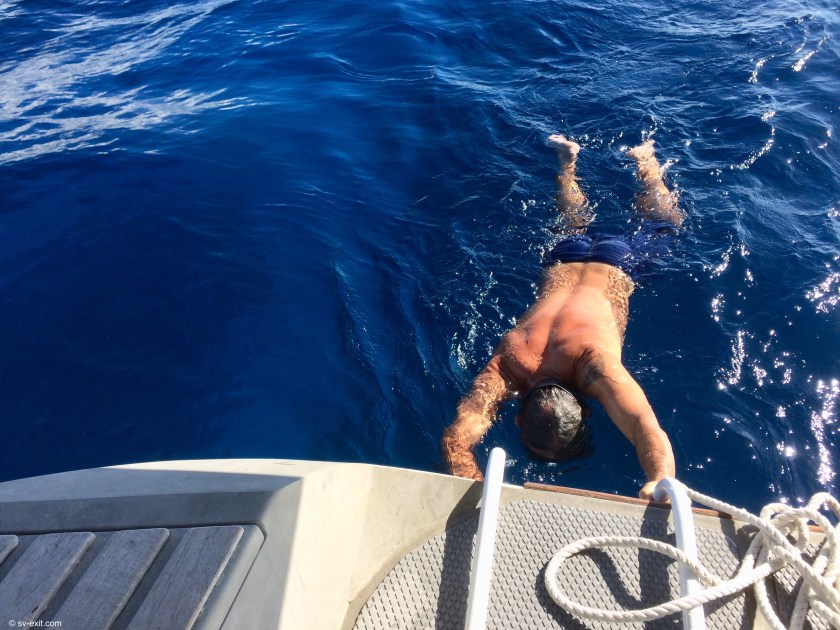
Unique firsts?  Pausing for a quick bath while adrift in 15,000 feet of water… our own private three mile deep bath tub.

Not to mention a mysterious floating balloon ball we happened across.  We never determined exactly what this strange thing was doing hovering just above the surface, but we dubbed it the “CF is awesome” space debris after a message someone had scribbled on the underside of the balloon.

Two weeks at anchor in Marsh Harbour to sort out parts and repair our water pump is not ideal.  However, we have friends who weren’t able to get out at the same time we did, and they’re still waiting for a favorable forecast to make the jump.

It is said that live aboard cruising is a synonymous with repairing your boat in exotic locations.  Not sure Marsh Harbour qualifies as an exotic location but, hey… it’s not Norfolk!

Marsh Harbour beach, Abacos, Bahamas - December 2018
Marsh Harbour beach, Abaco, Bahamas – December 2018

Deja Vu

IMG_0966
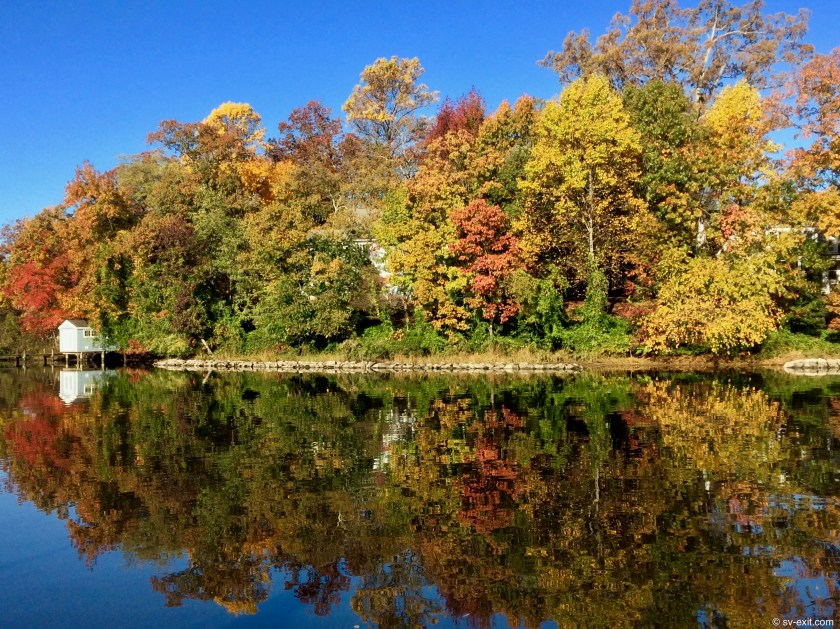
Back Creek’s beautiful whisper that winter is coming

November 12, 2018 

     One year ago today we made the bold statement, as we were setting out from Back Creek bundled in layers of clothing covered by our brand new and yet untested West Marine foul weather gear, that we would never be caught sailing so late in the Chesapeake again.  

     We only got out four days earlier this year… never say never.

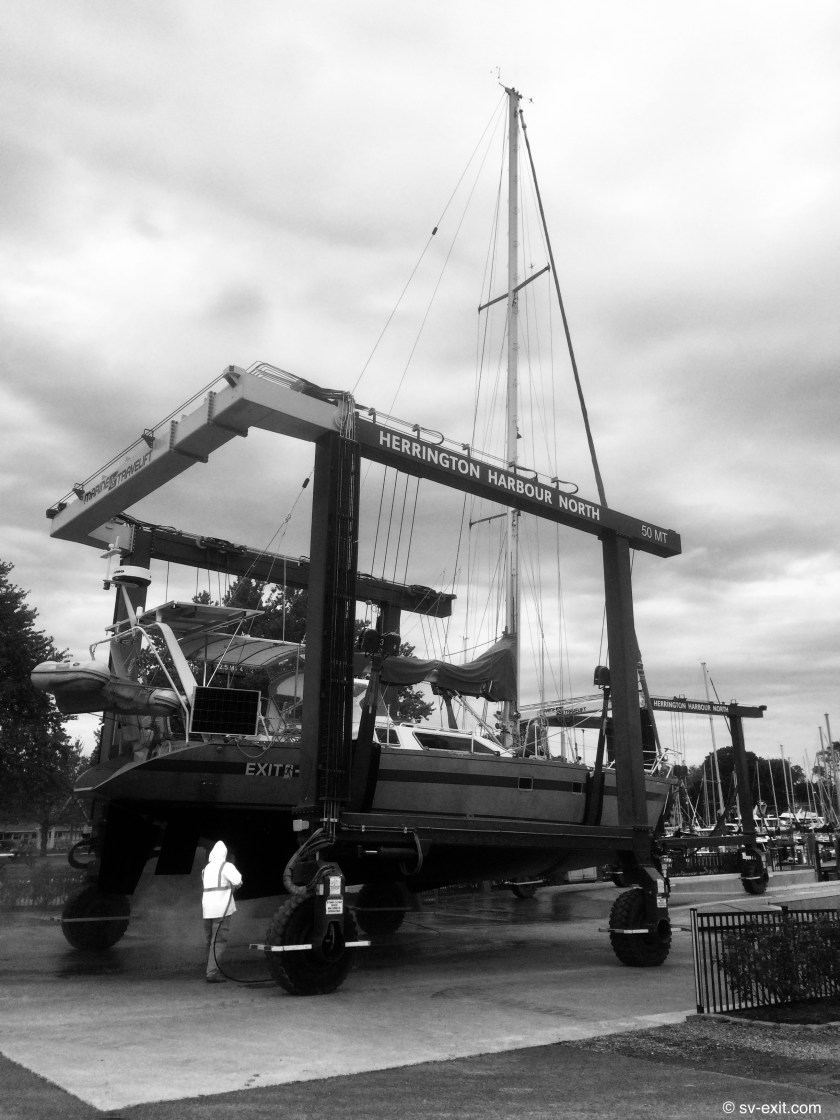
     After successfully launching Exit concluding our first haul out, we took the painful step of making a left hand turn instead of a right as we departed the channel leading away from Herrington Harbour North.  

     Which meant we were going north, not south.

     Though the facilities at HHN were impeccable, its’ remote location made provisioning runs without a car impossible, and it seemed we had begun to wear out our welcome regarding courtesy rides from the office staff. 

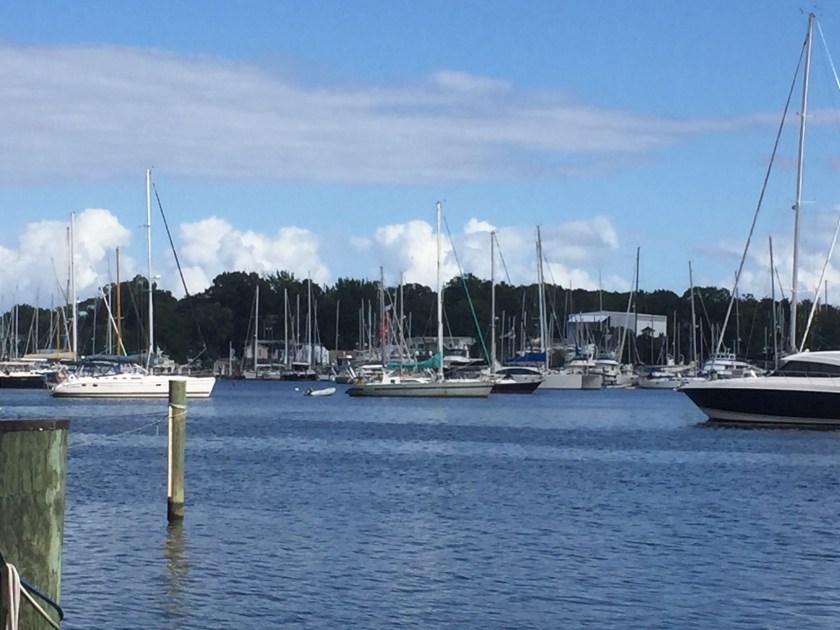
     Back Creek was only a day away and made a lot more sense for final provisioning.

     Finally, on November 8, with fuel and water tanks full, food lockers re-stocked, and a sexy new bottom (on Exit, that is) which we did not plan on seeing again until we reached warmer water, we set out from Back Creek and didn’t drop our anchor again until we reached Norfolk, VA. nearly twenty four hours later.

     Sailing non-stop to Norfolk meant we got there in a day instead of the week we spent nonchalantly meandering there last year.

     Taking into consideration that we were in the Chesapeake Bay rather than the open ocean and we had not seen winds greater than twelve knots since we weighed anchor at Back Creek, we decided to forego our own rule of putting a reef in the mainsail for the night.

     Our typical philosophy was that, though the reefed main generally cost us about one knot of speed, a situation in which building winds during the night required us to put in a reef would force the off-watch person out of bed to help out (overnight we don’t leave the cockpit go on deck while underway in anything but the most benign conditions if the off-watch person is sleeping).  The resulting ten or so miles lost overnight with the main reefed was worth the peace of mind and better rest.

     As the winds that night kicked up to twenty knots and the seas became exceptionally sloppy, I found myself noting a reminder in the log book… Reef at night, damn it!

     As we cleared the Norfolk inlet channel into Hampton Roads Harbor the following morning, we found ourselves once again approaching Willoughby Bay (or The Hornets’ Nest as we had dubbed it last year) and the narrow channel leading into it that Kris had repeatedly vowed never to pass through again after our previous encounter with the wonky-placed marker and the muddy bottom.  Except this time, we had a twenty knot wind on our beam that would be trying to push us sideways.  

     We agreed that, with such a tiny margin for error at the shoaling spot, it was foolish to try to navigate the channel given the conditions.  Even if we followed our previous track exactly, and the shoaling hadn’t shifted in the past year, the wind on our beam would make it virtually impossible to hold a course at the slow speed we’d be traveling. 

     Without another anchorage option and little chance of the wind diminishing anytime soon, we’d have to find an alternative route into Willoughby Bay.

     Our Navionics chart indicated a small channel existed on the west side of the bay, paralleling the shore alongside the Navy Base, though as we approached it, we were hard pressed to identify any markers.  We decided a blind entrance into the wind was preferable to the side winds we’d encounter in the other channel.

    So, with rain pelting down in twenty knot winds, Exit bucked and bounced through the chop as we creeped slowly along the channel, straining to see the next marker in front of us.

     Tense… but uneventful.

     Thirty minutes later, we were swinging on our anchor in almost the exact same spot we were nearly a year ago.

     During our last running of the engine, we had realized that we weren’t getting any charge to our house batteries.  The solar panels and generator seemed to be working fine; it was just the engine charging that seemed to be lacking.  Further diagnostics ruled out possible suspects until I was left with the conclusion that it had to be the alternator.

     Of course, with the weekend upon us, we were in limbo until Monday.  On a boat, it’s almost always about the waiting.

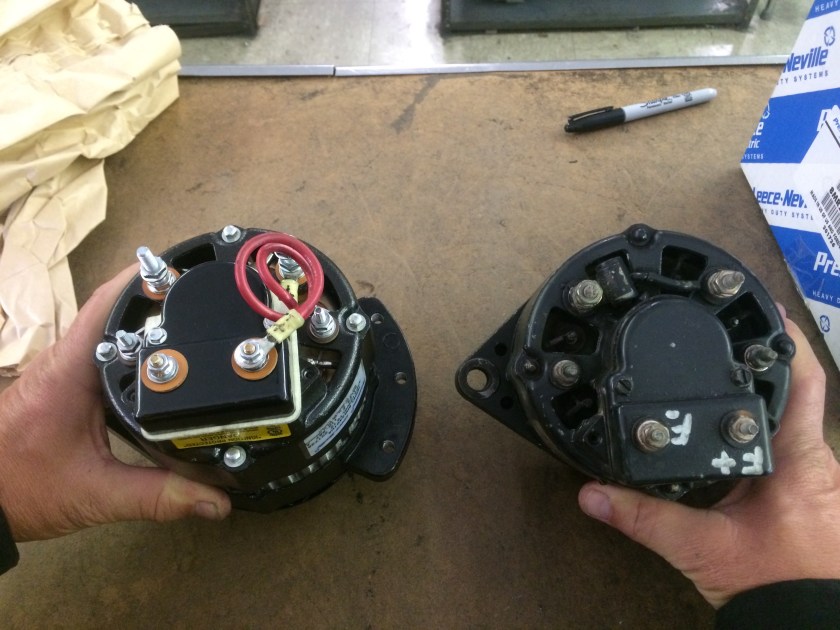
     After gaining permission from a nearby marina to tie up our dinghy Monday morning, an Uber ride placed us at the front door of an electrical shop.  Their bench test of the alternator revealed that just about everything inside was fried.

     Time for a new alternator.  Fortunately, they had one on the shelf.

IMG_0982

     Unfortunately, they didn’t have a starter for us to get as a spare as well.  We have been struggling with the notion of just how many spare parts we should be carrying.  Exit already had shitloads of spares aboard when we purchased her, and we feel like we are better equipped with spare parts than most.  Yet, still, there is always the sense that we should have an extra one of these, or a spare one of those… just in case.  

     Ironically, this feeling seems to intensify after a breakdown… especially a breakdown for which we didn’t already have a spare, which inevitably takes at least a week to sort out.

     On the other end of that tug of war rope is the difficulty of arranging deliveries. We don’t anticipate a week long delay so we don’t start the process early.  By the time a week has passed and we realize we could have arranged a delivery, it’s too late to start.  Hence, we tend to snatch up what’s available at a given time, and always have a long list to refer to when the opportunity arises. 

     The never ending circle… limited space and money for spare parts… having a spare part aboard seems to dictate that part will never break… the part that breaks inevitably will be one you don’t have a spare for… every breakdown prompts a review of the list of spares present/needed… every delay caused by a breakdown reminds you how much you want to be moving again… every time you get moving you have to make do with what you have onboard… rinse and repeat.

     We got pretty lucky with the alternator.  The parts were in stock locally, reasonably priced, and we were able to complete all the diagnostics and repairs without the expense of bringing in a mechanic.  Even so, the process took about a week to sort out, from start to finish.

     Instead of sitting around for another week waiting on additional spare parts, the decision to get moving again once the alternator was switched out was fairly easy to reach.  Especially here in the Hornets’ Nest, which is a central hub for activity if you’re a naval helicopter doing exercises, but not remotely near anything a visiting person on foot could possibly need or want.   

     Waiting out crap weather for a couple of days gave us time to finally narrow down the endless choices we faced  until we were left with two immediate options to choose between.

    Ultimately, our goal of accessing the Pacific Ocean via the Panama Canal seemed premature to shoot for in the short term.  Crossing the Canal is a February to May prospect, and this seemed like too soon a commitment to enter the vastness of the Pacific Ocean for our experience level.  Maybe next season…

     Heading back through the Bahamas towards the Caribbean, getting as far east as the prevailing winds would allow, with the intent of working our way back towards Central America to get south of the hurricane belt by July seemed appealing.  It also left Puerto Rico, Cuba, Haiti, and Jamaica as options to explore if the winds simply would not cooperate with a southeastern trajectory to the Caribbean islands.  

     Minimize the limits and maximize the options… perfect.

     So… Option One was to inch south down the ICW, debating the perfect location, wind and weather conditions to jump across the Gulf Stream back to the Bahamas.  We could continue to utilize opportunities to restock provisions and acquire spare parts… essentially keep spending money.

     Option Two was to take advantage of the small space between schizophrenic storm fronts which seem to be prevalent right now, jumping straight off from Cape Hatteras to make a break for the Bahamas from the north instead of eventually from the west.  The winds were forecasted as light and erratic which would probably mean more motoring than we’d like.  On the other hand, big winds and fierce conditions around Cape Hatteras and Cape Fear were much more concerning to us than no wind at all, so it looked like our chances of getting pummeled were minimal.

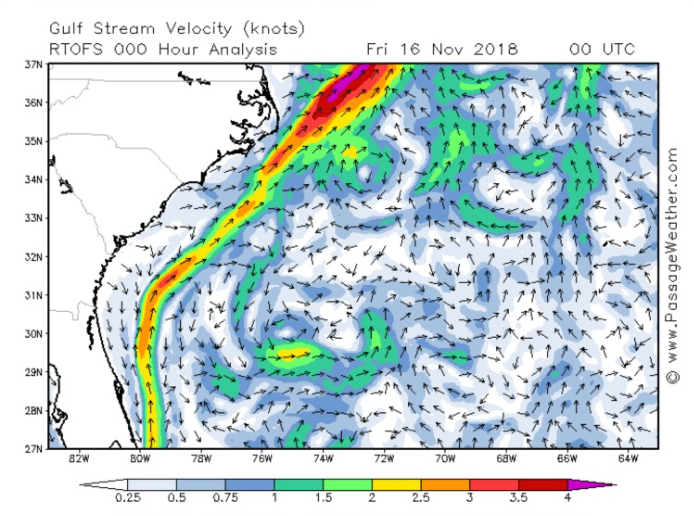
With the risk for high winds off Hatteras being minimal, one of the biggest challenges would be deciding where to cross the Gulf Stream, which widened considerably and became much more erratic just off Cape Hatteras.  If we were really lucky, it looked as though we could even possibly catch the advantage of a favorable minor countercurrent pushing south towards the Bahamas once we crossed 33ºN.

GulfStreamCurrents
Estimate of Gulf Stream currents direction and strength

     The relentless storm fronts and inconsistent winds we’d been experiencing already made Option One seem like an arduous undertaking; it would take forever to work our way south.  Option Two was the obviously appealing choice; quick and direct.  But once we cleared Cape Hatteras, there was a lot of empty space to cover.  We’d be two to three hundred miles offshore in an ocean two to three miles deep… daunting.  Five to six days estimated.  There would be no where to duck into if the weather turned surly.

     Not a perfect weather window for sailing but as close to a guarantee as we could hope for in the weather forecasts that no major front would be passing between the Chesapeake Bay and the Bahamas for the next seven days. 

     Small window… big commitment…  

     Option Two it is.


This Gravel Parking Lot Looks Vaguely Familiar

IMG_0823

October 13 – November 3, 2018 

     Herrington Harbour North.  

     Never say never.

     We said we’d learned our lesson about being in Maryland in November last year.

     We certainly didn’t envision being back on the hard at Herrington Harbour North.

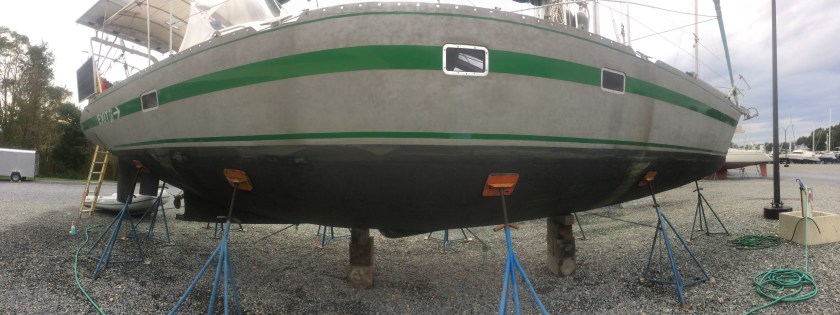
     Now, fourteen months after first splashing Exit, things have come around full circle again.  Once again, Exit sits awkwardly atop stands with a ladder tied to her transom in the same gravel parking lot, less than one hundred feet from the exact spot she occupied when we lived aboard her for six weeks last July and August.

IMG_0877

     We are learning that the real challenge to a successful haul out does not necessarily depend upon blindly ticking off a pre-determined list of tasks.  That would be the approach of boat owners with either deep pockets, or an end goal of working on their boat rather than sailing it.

     The real challenge is getting in and out quickly, as money begins to hemorrhage from everywhere the moment you arrive at the marina.

     Inevitably, closer inspections will turn up some surprises.  It becomes very easy to spiral into a cycle of pouring more and more money at something or getting bogged down with a list that continues to grow.  So, priorities have to be determined and evolve along the way with constant re-evaluations.

     For us, the top priority was checking for any signs of corrosion below the waterline on the aluminum hull, and getting any suspicious areas sanded down to bare metal.  Mild surface corrosion could then be covered with epoxy barrier coats before applying the final coats of anti-fouling paint.  More serious areas of corrosion would have to be discussed.

     With Exit now out of the water, we could get a better look at things.  Looking out from behind a mask underwater doesn’t tend to offer the best perspective of clarity.  On stands however, after a serious power spray, a much clearer picture begins to emerge.

    As we inspected the hull, we were surprised to find more spots of surface corrosion than we had addressed last year, but relieved that, overall, everything appeared very mild.  

     We found ourselves temporarily being sucked towards the black hole of financial implosion as we considered our options.  

     Option one: pay someone $4000 to soda blast the entire hull, $4000 to apply one coat of epoxy and anti-foul paint, and another couple thousand to have the stripes repainted… undeniably sexy… grand total over $10,000 right there… yowsa!

     Option two: do it ourselves.  Live with the condition of the painted stripes above the waterline for now.  Mostly cosmetic… they could be dealt with later.  Sand down all corrosion spots below the waterline by hand and scuff the rest of the paint.  Four barrier coats of epoxy and four coats of anti-fouling paint instead of one… grand total $2000 in paint with another $1000 in incidentals… sold.

     As we resisted the gravitational pull of the financial vacuum, we had to resist the expensively easy way out and re-prioritize our list to address structural corrosion while ignoring the more cosmetic aspects.  

     Repeatedly, strength and safety became our threshold for maintenance and preventative expenses.  If it added to Exit’s strength and reliability, we were more flexible in our budget restrictions.  Anything that simply looked pretty was heavily scrutinized, and rarely made the cut.

     Getting zincs attached to the hull was also at the top of the priority list.  But, with my aluminum welding experience being equal to my experience performing brain surgery, bringing in an outside expert was the only option we considered.  We were lucky enough to have Quentin of Quentin Fabrications available on short notice who made quick work of the fabricating and welding tasks, as well as touched up the single corrosion point deemed suspicious enough to warrant a quick fill with his welder.

     Having Quentin ponder how a twenty six year old boat with no zincs on the hull could have so little corrosion was entertaining.  Having him tell us – if the spot he just finished touching up was the most severe corrosion on the hull we had nothing to worry about – now that was most reassuring.  In fact, he said most of the corrosion points I asked him to look at had only about a third of the pitting that would cause the Coast Guard to demand repairs on a commercial passenger vessel.  Well done Garcia…

     A couple of hours and a couple of hundred dollars later, we had the aluminum tabs for a large zinc on either side of the skeg and two additional smaller zincs on the upper forward edge of the centerboard.  

     Future peace of mind.

     Tim and Paula, whom we met here the previous year, stopped by regularly, pointing out things on Exit that either needed immediate attention or generally questioning the wisdom of performing various tasks given the day’s temperature, or humidity, or wind.  Tim and Paula were just about to wrap up their seventh year working on their boat which sat on stands on the hard at Herrington Harbour North, before heading back to Alaska for the winter… launch date still to be solidified.

     Our spirits were dogged.  Our determination was steadfast. 

     Get in and out quickly.

     Most of the things on the to-do list could be dealt with while the boat was in the water, and we had learned quickly that the list never really shortens.

     Our only brief distraction came in the form of a mandatory hiatus to celebrate Kris’ fiftieth birthday.  With our lifelong friends Shannan and Vicki Schulhauser flying over from Washington State to spend an extended weekend with us in Annapolis, we decided to delay the timing of our launch.

     Instead of sailing to Annapolis to meet them, allowing us time to get only one coat of anti-fouling paint applied, we left Exit on the hard and took a boat-break for the weekend.  Sadly, this meant that, for the second time in as many visits, we would be unable to get Shannan and Vicki out for a sail on Exit.  It will happen… someday.

     Nevertheless, thanks to Shannan and Vicki for the epic land-based party… though my gut and my liver always seem to come out severely desecrated!

     Returning to Exit after a long needed weekend away from the boatyard, we set out to complete the task at hand… get the final coats of paint applied to the underside, get launched, and get moving south again. 

     The days when the sun shown were still quite temperate.  But the days grow shorter, and the nights are getting long; seems like we’re running out of time (sounds remarkably like a Triumph song).

     The frigid East Coast winter temperatures were banging loudly at the door.  We just needed to stay focused and make efficient use of our time to get back in the water.

You Can’t Depend Upon Luck, But You Need A Bit Of It

IMG_0817
Not enough space and no immediate bailout option… 20/20 hindsight

October 12, 2018

     Hurricane Michael, a Category 4 whopper, had already blasted through Florida with recorded winds of up to 155 knots, just 2 knots shy of making it officially a Category 5 hurricane, leaving complete destruction and utter chaos in its wake.  It worked its way inland up the eastern seaboard, slowly losing steam but still wrecking havoc along the way.

     We had moved from the southern anchorage just outside of Annapolis into Back Creek.  Even now, days after the conclusion of the Annapolis Boat Show, there were still boats at anchor everywhere.  

     Our rule had always been to resist anchoring in overcrowded areas, preferring the solitude and security of wide open spaces over the social opportunities and accessibility conveniences of more densely packed anchorages and marinas.

     Over the course of the past fourteen months, our ground tackle had repeatedly proven its worth in reliability; our experiences to date had made us confident in Exit’s ability to handle everything that had been thrown at her.

     Before moving to Back Creek, we had successfully completed the unenviable and expensive, though necessary, task of replacing all six of our house bank batteries.  After nine months of nearly complete solar independence from our generator with regards to battery charging, we had recently found ourselves needing to run the generator again just to keep up with the quickly depleting bank.

     The 12 volt batteries, which were gasping their last breaths, had begun registering minimum voltages of less than 9 volts, barely enough to keep the equipment running. The technical term would be garbage, I believe.  Our windlass, a power hog drawing a staggering 70-100 amps for the brief intervals it is needed to bring up the anchor and chain, started requiring us to run the engine for a bit of time before engaging, or it just groaned, barley moving the chain in a power deficit protest.

     We were fortunate enough to have arranged the four hundred pounds of batteries to be dropped off at a marina very nearby, allowing us to deliver the old batteries and pick up the new ones via our dinghy.  Not easy, but doable.

Now that the batteries had been replaced, everything seemed to be completely functional and all was back to normal.

     Yet, we needed to accomplish a number of other shopping tasks, and Back Creek seemed like a much easier location to work from.

     Plus, there was the residual weather of Hurricane Michael, headed in our direction.  The forecasts predicted 35 knot winds could be rolling through.  Just south of us winds were forecasted to be as high as 40-50 knots, so we hoped the projected trajectory was accurate and we would only be subjected to the outside edge of the storm.

     Our experience had been that the protection Back Creek provided could reduce wind velocities by fifty percent, which was a very appealing prospect.

     So, with some trepidation, we chose to disregard our own rule of avoiding anchoring in tight quarters in favor of an attempt to reduce our exposure to winds in excess of thirty knots (or higher if the storm shifted farther north).

     Admittedly, we were way too close for our own liking to the boat to our port side as well as too close to the boat slips of the marina directly behind us.  

     We were in just over eight feet of water, allowing us a 5:1 scope.  Not ideal, but we had ridden out thirty knot winds on only a 3:1 scope at Block Island when we had to anchor in water forty feet deep.  We trusted our Rocna anchor and oversized half inch chain to keep us in place.  Still, we decided to keep an anchor watch throughout the night, just to be sure.

    By 4:00am, the winds seemed to have topped out at about twenty three knots, and we hadn’t dragged an inch.  It seemed like all was well.

     However, we noticed that the sailboat anchored to our port side seemed even closer than before… uncomfortably close.  They didn’t appear to be dragging at all, so we suspected that they had decided to put out more chain as the winds picked up.

     With only about twenty feet of separation between our bow and their stern as they swung in front of us, I kept climbing into the cockpit every five or ten minutes to take a look… unnerving, but still unchanging.  We weren’t about to try to lift anchor and relocate in the dark with twenty-plus knot winds in tight quarters; and, after more than six hours with no problems, complacency won out over action.

     Just as I was just about to wake Kris to take over the watch, things went to shit in a matter of seconds.

     As near as we could later reconstruct what happened next, it appeared the sailboat on our left swung completely across our bow in a shifting gust of wind.  Because they were only twenty feet in front of us, thirty feet of our anchor chain was now stretched underneath them.  

     They had to have a draft of nearly six feet, which meant that with only eight feet of water depth, there couldn’t have been more than two feet of water beneath them.

     Either their keel or rudder must have tagged our chain as they passed over it, tripping our anchor.  Instantly, we were drifting backwards.

     Immediately, I woke Kris and we started the engine, but things were already moving in a blur.

     Before we could power forward, we were on top of the outer pilings of the boat slips behind us, sideways against three posts.

     Kris was at the stern and I was at midship, desperately trying to push us off the pilings, but the wind kept shoving us back onto them.

     The tip of an anchor, protruding from the bow roller of a boat in one of the slips, was caught on the inside of our lifeline, and our bow was in serious jeopardy of slipping behind another piling which would have trapped us and shoved us straight into the bow of another boat.

     A third boat, whose deck stood about two feet above ours, also had a massive protruding anchor which threatened to either hang up on our stern rail, catch our arch (which the solar panel rack, our radar, and a host of electronics antennas were mounted upon), or tear our rail mounted solar panel clean off.

     Kris moved her hand out of the way only a fraction of a second before it would have been either amputated or crushed between the anchor and our arch.

     As she fought to power Exit forward, I struggled to push us off and keep our bow from slipping behind the outer pilings and into the docked boats just ahead.

    As I repeated a combination of shit..shit…shit, no…no…no, come on…come on…come on, Exit swung out and forward, barely missing the bow roller of the furthest projecting boat in front of us by mere inches.  A crunch emanated from just in front of me as the plastic lens of our navigation light, attached to our bow railing, was torn off by the pulpit railing of the boat in the slip.

     We were finally free of the slip pilings and docked boats, but our anchor and chain were still out, and I battled to pull them up with the windlass before they caught on something, denying us any control. 

     With both of us exhausted and rather terrified, Kris perilously maneuvered in the darkness between the other boats at anchor, mooring balls, and markers while I tried to help direct us and figure out an escape route.  All the while, the twenty-plus knot winds continued to try to push us back into a catastrophic tangle of destruction.

     Eventually, we were able to thread our way through into a small clearing, but still had extremely limited steering ability.

     We angled towards another row of boat slips on the other side of the creek.  This current location was somewhat more protected, so we weren’t fighting the wind nearly as much, but it really didn’t have the space we needed.   At best, if we could get the anchor to set, we’d have a temporary sanctuary we could use to catch our breath and regroup.  

     But we found ourselves slipping backwards, repeatedly having to motor forward as we drifted dangerously close to the yachts on the opposite side of the creek, clearly demonstrating that the anchor wasn’t setting.  The usual rock solid dependability of our Rocna anchor came up short twice.

     As we hauled in the chain again after the second failed attempt, a gruff voice, apparently originating from the window of one of the boats in a slip just in front of us called out in the darkness.  

     Hey, you can’t anchor there.

     More than a bit stressed, I snapped back in a rather perturbed voice, I realize that.  We’re just trying to temporarily hold position so we can regroup to get through to the morning.

      The voice returned.  No… there’s no holding there.  You’ll drag backwards all night long.

     Shit.  OK… thanks.

     We weren’t about to try to thread our way out passed all the boats anchored and moored in Back Creek, which included a big cat that had dragged anchor for the third time just before our anchor chain got tripped, and was still struggling to reset their anchor yet again.

     This left one option… farther back up the creek.

     Unfortunately, the same two boats were still anchored back there when we arrived.

     Literally backed into a corner, we had run out of options.  All we could do was drop the anchor right next to one of the docks and back down as far as possible.  But, with no major wind shift and a person in the cockpit standing watch, we’d be good until noon when we could get the hell out of Back Creek.

     We’d gotten the shit seriously scared out of us, learned some important lessons, and dodged more than one bullet.

     Had we just gone to sleep earlier in the night, it would have been the crunching sounds of us against the dock that we would have awoken to…

     Had we gotten tangled up behind the slip pilings or with the boats that were tied up, the damage would have been catastrophic…

     Had the anchor chain gotten tangled when it tripped… had the windlass remote not worked when it was plugged in (an occasional malady)… had the battery bank (changed only three days ago) still been the old, tired bank which required a few minutes of charging before the windlass would fire up… we would have been fucked.

     Had we not been lucky enough to have lowered the rail mounted solar panels a few hours earlier, or the dinghy was hanging up on the davit at Exit’s stern, the anchor extending from the bow roller we passed so close to would have sheered off the solar panel and ripped into the inflated rubber bow of the suspended dinghy.  Upon later reflection, we were pretty sure the dinghy (which had been tied off on our stern) may very well have helped act as a bumper while we were bouncing around on the marina pilings.  That same anchor still came within a fraction of an inch of taking off Kris’ hand, ripping the solar panel off the railing, and getting hooked up on our stern arch…

     Had the boat that tripped our anchor actually dragged down on top of us, we would have been trapped between that boat and the slips… game over.

     Many things could have happened slightly differently with potentially disastrous and devastating results to both equipment and flesh.  All things considered, we got off pretty easy.  

     The lessons learned were more re-enforcements of what we already knew rather than groundbreaking epiphanies.

     Don’t settle for complacency.  

     The combination of not enough scope and not enough space is a recipe for disaster.  

     Trust your gut instincts.  We thought about moving back into the southern anchorage in the afternoon.  The trade off would have been higher exposure to the wind and waves but more space to work with – more space to put out more chain, more space to swing unfettered, more space to drag, more space to react.  We should have trusted our gut instinct.

     Trust your equipment.  If you don’t, replace it.  If the equipment is sound, it will hold you in fifty knot winds with less risk than hard things in close proximity will ever pose.

     It was ultimately our own fault that we found ourselves in the situation we did.  

     A silver lining…?  Potentially in how we reacted during the situation.  Looking beyond a poor initial decision of being there, at least we were pro-active enough to maintain an anchor watch.  In retrospect, I should have started the engine as I was waking Kris to give us an extra few seconds.  But, during the entire nail-biting ordeal, we kept cool heads and things never deteriorated into a yelling match of confusion.

     It sounds very cliche, but over and over again, there seem to be situations which arise that could be potentially very dangerous or catastrophic events.  Given an inner determination that failure is not an option, the only acceptable outcome remaining is to somehow work through the challenges and sort your shit out.

That’s not to say that simply wishing for something will make it happen.  But sometimes success has to be coaxed, tricked, improvised, massaged, or even bitch-slapped into existence, given the alternative.

     Knowledge and experience help out immensely.  Either one can give the background necessary to make informed decisions.  But lacking both doesn’t make the solution any less there… it just makes it a bit more elusive.  Creativity and tenacity don’t substitute for knowledge and experience, but they come in at a close third and fourth place.

     And, though you can’t depend on luck, sometimes you certainly need a bit of it.

Back To Back Creek

IMG_0721
Sunrise over the Big Apple

October 5 – 8, 2018 

     With two hundred miles ahead of us to reach the C&D Canal, we departed early from NYC… perfect timing to witness the arrival of one of the US Navy’s alien looking stealth warships as we sailed by Staten Island.  We gave it a wide berth as it passed by us in the opposite direction with an entourage of military zodiac escorts to our port side; however, I couldn’t help turning on our radar.  Sure enough, the massive warship appeared on the display as nothing more than a tiny blip, no more distinct than even a small marker buoy.


     Hugging the coast, we were never more than about three miles offshore.

     The only excitement was another bird, no larger than a small finch, which seemed to be well farther offshore than we would have expected (much like we had seen on our passage from St. Marys, GA to Charleston, SC) that decided we needed another crew member aboard Exit.

IMG_0751
New crew member or freeloading stowaway…?

     Except this tiny bird obviously had high ambitions.  It flew straight into the cockpit and landed on the wheel, seemingly to proclaim itself our new helmsman.  For about ten minutes, it balanced there; and, as the autopilot made slight adjustments in our course causing the wheel to turn left and right, it appeared comically that the tiny bird was actually steering Exit. 

     After a bit, it flew out of the cockpit, only to return to its perch atop our wheel a few minutes later and resume its hilarious impersonation of a undersized, feathered skipper.  Shortly after that, it stationed itself atop the lifeline, now apparently taking over the watch duties.

Eventually, our little comedian must have realized that flying would be a much more efficient and speedy approach to reaching its destination than sailing, and it flew off into the distance, finally disappearing from view.  It took quite some time before we were able to stop laughing.

     Fifteen to twenty knot winds and favorable currents allowed us to feel like we were flying down the coast for twenty-four hours.  Although, in exchange for the fast pace, we reached the Delaware Bay hours ahead of when we had planned and were met with winds that tapered off and opposing currents, forcing us to motorsail for almost the entire ten hours we spent crossing the bay.

     During this time, we continually debated whether or not we were going to attempt navigating the C&D Canal at night.  Though the canal is rather wide, we were very nervous about what we anticipated would be a mostly unlit and nerve-racking three hours.

     A couple of hours before sunset, we began to see the outline of a massive structure in the distance.  What we first thought was a huge freighter, slowly materialized into the gigantic cooling tower of a nuclear facility, steam ominously pouring out from its top.  There would be no rain collection today, even if the overcast skies decided to make an offering.


     By the time we reached the entrance to the canal, the sun had nearly set and we were already having a difficult time seeing where we needed to be going.  This solidified the decision that we would drop anchor and wait until morning, when the canal would be a much more friendly passage.

     Not long after setting anchor and having dinner, a loud roar in the distance prompted Kris to ask if we were hearing a plane passing overhead.  The answer came moments later, when the dull roar was interrupted by a louder noise, followed immediately by what sounded like a boat engine revving at high rpm for a short period.  It sounded unmistakably like a boat had just run aground.

     As we scanned the darkness, at last we saw what looked to be a flashlight twitching back and forth in the distance. After some time, a boat with a flashing blue light appeared from shore and approached the scene.  We were a bit confused when the patrol boat stopped short of coming alongside the flashlight, and then, a few minutes later pulled away and departed as what appeared to be a Coast Guard helicopter circled briefly overhead.  

     Intrigued, we turned on the VHF and were subsequently treated to far more entertainment than most people probably found on the TV that night.

     As the drama unfolded in the form of confusing lights in the distance and radio exchanges between multiple boats with flashing lights and the shore, we slowly learned what had transpired.

     Apparently, a twenty to twenty-five foot jet boat carrying an idiotic captain and three passengers had attempted to enter the C&D Canal at a much higher rate of speed than the darkness would warrant.  Either failing to notice or ignoring the brightly flashing green light of a navigational warning marker, they had slammed into one of the earthen jetties jutting out on both sides of the canal entrance, fully running their boat aground… not too smart.

     Fortunately, only one person was mildly injured with head lacerations. 

     The boat with flashing lights was Fireboat #5, which had arrived on the scene, and transported the entire group to a nearby hospital for further evaluation.

     We felt rather wise in having made the decision to drop anchor for the night, choosing to abort our night voyage through the canal.  Not that we would have run aground on the jetty; but still, we had heard reports that floating debris left over from the aftermath of Hurricane Florence weeks before was still present from the canal all the way down the Chesapeake, and we were grateful that the Coast Guard and marine patrols would not be answering a distress call from us that night.

     The following morning we passed the stranded jet boat, still sitting completely dry on the jetty.  


     For over an hour after entering the canal, we were further entertained by the numerous radio calls from what seemed like every boat following behind us, who hailed the Coast Guard on the VHF to report a boat which they had seen aground at the canal’s entrance.

     As we exited the C&D Canal two and a half hours after lifting anchor (awaiting the morning light had also given us the benefit of running with the currents), we found ourselves once again in the Chesapeake Bay.

     Annapolis was another fifty nautical miles away, and we had already begun to see more and more of the floating logs and debris we had heard about, so we made the call to stop mid-afternoon, about ten miles south of the C&D Canal, and make the final push for Annapolis the following day.

     Furthermore, we had just received a text from our friend Benjamin, aboard Crackertale, who we had first met at Block Island all the way back in August.

     We had nearly, but not quite, crossed paths again a number of times since then.  Amazingly, he was currently only a few miles away from our present location, also headed for Annapolis.  We hailed him on the VHF and agreed to meet on the Sassafras River, right next to where we had planned to anchor anyway.

     As it turned out, he decided to continue a bit further on after we had already set anchor, choosing to take advantage of favorable winds and currents that were much more critical for someone sailing single-handed on a small boat with only an outboard engine for supplemental power.  It looked as though we would have to wait for Annapolis for the reunion drinks.


     When we awoke the following morning, a heavy fog had completely obliterated any visual references in every direction.

     Our only previous experience with fog had been departing Port Canaveral, Florida, back in February, just days before we set out for the Bahamas, where we had instantly learned just how daunting and intimidating sailing in fog could be.

     With visibility effectively non-existent, we immediately recognized that this was a challenge we had absolutely no intention of undertaking, so we sat back to wait, patiently hoping it would start to burn off.

     Not long before noon, the all-encompassing white blanket of fog had begun to lift, revealing the shadowy outline of the nearby shore.  Visibility was still less than half a mile, but we had become much more familiar with using our radar over the past six months than we were in Port Canaveral, and felt confident that we could set out with the optimism that the fog would continue to lessen.

    Though the radar proved invaluable, it only lessened the degree of intimidation.   With senses on high alert, and eyes constantly shifting focus between the radar display and our surroundings, we carefully creeped along.  It was amazing how, with the radar, we could still identify not only boats, but also navigational markers and even debris in the water.  As long as we didn’t encounter a stealth warship like the one as we left NYC, we should be good to go.

     Slowly, we made forward progress.  We learned from Benjamin over the VHF that he had lifted anchor before we had, but had second thoughts as the fog thickened outside the bay he was in, and had dropped anchor again to await better visibility.  He lamented not having a radar himself at that time.

     Four hours later, we were passing the Baltimore channel intersection on the east side of the Chesapeake.  The fog had slowly, but steadily, receded and we now had three mile visibility and very calm conditions on the water.

     We noted two things: 1) Baltimore was the farthest north we had gotten on the Chesapeake in our preliminary explorations aboard Exit just after purchasing her, before we started heading south, and 2) we had just surpassed five thousand nautical miles in our travels aboard Exit.

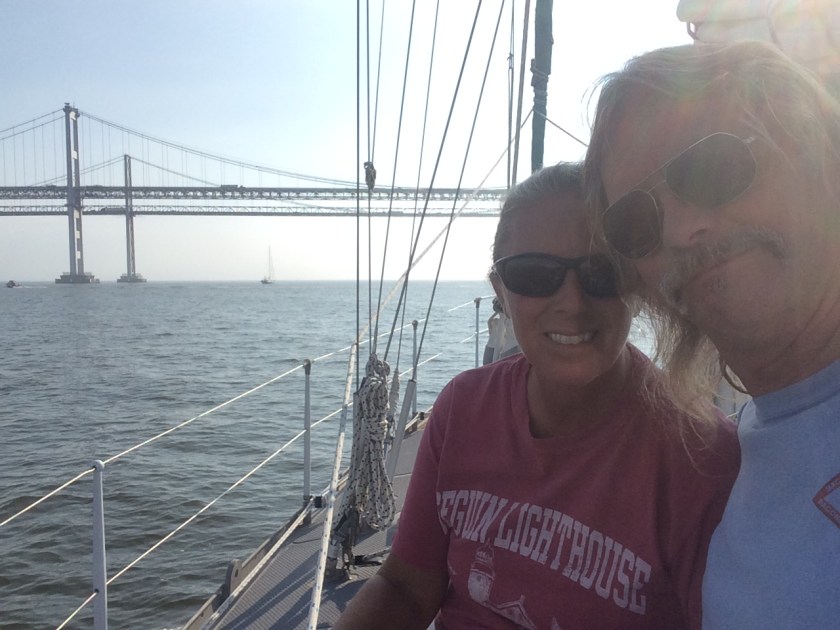
     As we passed underneath the Chesapeake Bridge, we felt an overwhelming sense of deja vu.

IMG_0801

     Two hours later, we arrived at Annapolis.  The enormous Annapolis Boat Show was on its’ last day, and boats were everywhere.  Back Creek, where we had sat for months while we first tasted the lifestyle of cruising, was chock-full and we ended up having to anchor at the south anchorage in the bay just outside Annapolis.

     We had come full circle, back to our old stomping grounds.  

     An hour or so later, Benjamin sailed up and dropped anchor.  Shortly afterwards, he stopped by with his brother and a friend who had met him upon his arrival.  He had also brought a half-full half gallon of Kraken rum…

     …welcome back.


Anchored Behind Lady Liberty

IMG_0543

IMG_0604

September 30 – October 4, 2018 

     We initially anchored in a small bay tucked away on the southwest side of Liberty State Park.  While the anchorage was very protected from the swell of all the boat traffic, it also turned out that the numerous trees lining the park completely blocked our view of the New York skyline as well as all but the head and torch of the Statue of Liberty.  We spent one night there before deciding to gamble on a better view.

Version 3

     We weren’t sure if we would be hassled trying to anchor behind the statue; we’d heard it would be ill received.  But we figured we’d give it a shot anyway.

     Understandably, the area immediately surrounding Liberty Island and Ellis Island is restricted.  There is an approximately one to two hundred yard perimeter marked with buoys designated as a security zone; any boats entering this area would undoubtably be quickly visited by a number of heavily armed boats and/or helicopters.  There is also a quarter mile wide corridor running behind the island which contained cables and pipelines that we needed to stay clear of; snagging our anchor on a cable which resulted in a power blackout for Lady Liberty would most certainly be frowned upon. 

     When all was said and done, after setting anchor between Ellis Island and the Statue of Liberty, no one even blinked a eye at us.  

     There was a bit of swell from all the ferry and sightseeing boat traffic during the day.  Nonetheless, it was minuscule price to pay for what amounted to an absolutely spectacular and unique view of New York City.

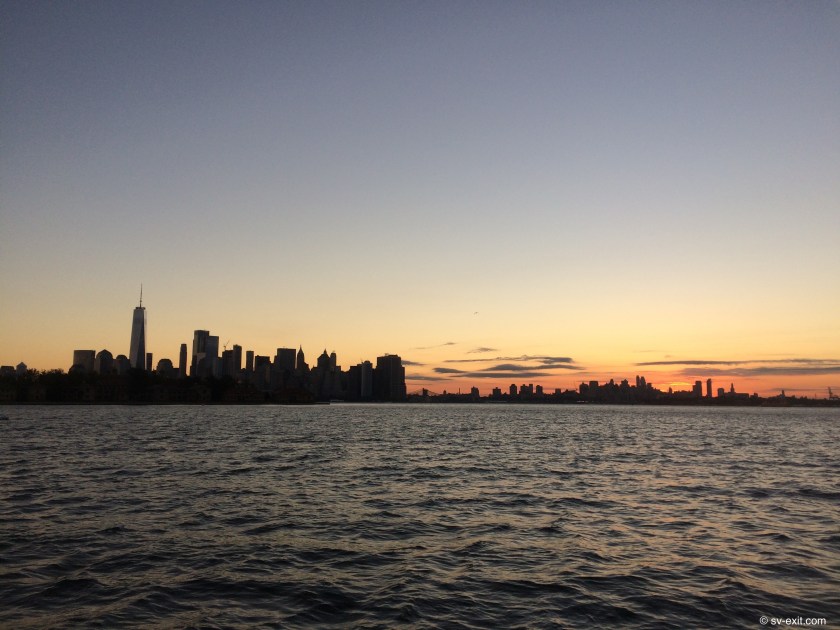
     Right next to us, on our right, stood the Statue of Liberty.  Just to our left, in the foreground, sat Ellis Island.  And just behind that, loomed the amazing skyline of Manhattan.  Sitting in our cockpit, we could see the Empire State Building, the Chrysler Building, the World Trade Tower, the Brooklyn and Manhattan Bridges… everything.  And behind the Statue of Liberty, in the distance, was Brooklyn, Staten Island, and the Verrazano Bridge, linking the two together.

IMG_0560

     The view we had during the day was diminished only by the view we had at night.  The lit Statue of Liberty right next to us and mesmerizing lights of New York’s skyline behind the dark silhouette of Ellis Island is utterly indescribable.  It has to be seen to be truly appreciated.  And to be seen from the deck of our own sailboat sitting at anchor made it even more surreal.

     After a couple of days of utter relaxation aboard Exit, we weighed anchor and headed ten miles up the Hudson River to just off of 79th Street, which gave us access to a marina dock at which we could tie up the dinghy.  

     It was October 2nd… a particularly special day for us.  It marked the thirty six year anniversary of our first date together… the beginning of an amazing journey we never could have imagined at that time.  It also marked the ten year anniversary of our exodus from the United States… the beginning of a new way of life, which also held surprises and unfathomable adventures that had completely changed us while, at the same time, had allowed us to remain true to ourselves and each other.

IMG_0609
October 2, 2018 – Ten year anniversary of our own liberation

     When we reached the 79th Street Marina, we set anchor once again.  The fee we paid for access to the dock (and a warm shower) was only a few dollars less than a mooring ball there would have cost.  However, Exit was slightly longer than the maximum length and we had heard horror stories of the mooring balls dragging regularly (probably due to oversize boats using them anyway), so we decided that our own anchor was the more reliable and prudent choice.

    This put us within walking distance of Central Park, which we visited the following day.  The fact that we had been there before, made the return no less impressionable.  The park’s endless trails and sights made for a great afternoon of wandering and people watching, despite purchasing one of the worst (and most expensive) hot dogs and pretzels, from a street vendor, that I have ever had in my life.  I am not one to typically let food go uneaten; yet, even Kris’ love of pretzels couldn’t prevent half of it ending up in a Central Park trash bin.

This slideshow requires JavaScript.

     We also had the bonus of a reunion with one of our Scuba Junkie family.  Christina Koukkos completed her Divemaster training at Scuba Junkie while we were there.  Though we hadn’t seen her in eight years, we had kept in touch via Facebook, and Christina, who lived in Brooklyn was more than happy to meet us for drinks when we contacted her.

IMG_0705

     One drink turned into multiple pitchers of beer and dinner.  After reminiscing and catching up on each others’ endeavors over the years, as well as current plans, we reluctantly said farewell until the next reunion and took a taxi back to the 79th Street Boat Basin where our dinghy awaited us.

     The currents on the Hudson River that night were ripping and we were far too close to the rocky shore for our liking, but any farther out and we were instantly in deeper than thirty feet of water.

     So, the next morning, after returning to the marina for a quick hot shower and filling of our water jugs, we once again picked up anchor and returned to our prime location behind Lady Liberty, where we chilled out for one more afternoon and enjoyed the spectacular evening skyline view of New York City.

     Now, it was time to get moving again.  We had been to Maine, and we had savored the experience of visiting New York City aboard our sailboat.

IMG_0610
Perhaps the most iconic NYC image we captured

     Our haul out awaited us at Herrington Harbour North, with a long list of tasks to accomplish.

     From here, we would make a dash for Delaware Bay, pass through the C&D Canal (which would shave about one hundred miles off the alternative of sailing offshore all the way south to the mouth of the Chesapeake Bay and then back up north through the bay), and make a brief stopover in Annapolis.

Final Push For New York City

  September 29-30, 2018 

     The heavy rains we had been experiencing provided repeated opportunities for rain catch, thanks to the brilliant design and integration of a gutter system mounted to the overhead solar panels by Tom Chalkley.

     However, the rains were a double edged sword.

     Simultaneously, while we eagerly collected water without having to leave the boat, we lamented at our inability to charge our batteries with free solar power.  And without solar charging, we had to fall back on our diesel consuming generator.

     The biggest problem lie in the fact that our house battery bank was dying.  The batteries were eight years old and obviously on their last leg.  We had begun to have problems with the electronics starting to shut down while we were under sail in cloudy weather or even overnight.  The massive power draw from our anchor chain windlass was also forcing us to run the engine for a while before starting to bring up the chain.  

     We knew the batteries were living on borrowed time when we purchased Exit; now it appeared their demise was growing very near.  We had already replaced the two starter batteries in Charleston, SC one month ago when we began to have problems starting the Perkins engine and had to run jumpers to the house bank.

     Our boat speed indicator had also become inaccurate again.  It was earlier in Charleston that we had also first found barnacle and marine growth on the hull around the transducer paddlewheel to be causing the problem.  The growth surrounding the transducer caused turbulence around the paddlewheel which, in turn, affected its’ performance.

     Having a functional speedometer was not imperative, but we found it to be exceptionally helpful in the continual  process of adjusting our sails.  We could see increases or decreases in boat speed as we fine tuned both the mainsail and the genoa.  Without an accurate speed display, we were having to do a lot of guessing.

      We hoped the batteries would last long enough to get to Harrington Harbor North, just beyond Annapolis, where we had purchased Exit and planned to do our haulout.  

     The speed indicator, on the other hand, was a simple fix.

     So, at 7:00am, just before we set out from Block Island, I undertook the “invigorating” task of jumping into much colder water than I would have liked to first thing in the morning to scrub the underside of Exit’s hull right around the transducer.

     Thankfully, the job only took a few minutes.  Even more thankfully, once we got underway, we were immediately rewarded with a fully functional and accurate speedometer.

     We had finally committed to take the Long Island Sound route to New York City, not so much out of fear for inhospitable offshore weather, but rather on the hope that the forecasted wind direction (and anticipated wind shifts) would allow us more sailing than motoring through the Sound.

     It did require that we adhere to a rather tight schedule in order to benefit from favorable currents.  If the timing wasn’t right, we’d have the current against us much of the way.  

     As we set out with the Big Apple awaiting us nearly one hundred twenty five nautical miles away, or just over twenty four hours, I noted in the ship’s log:  it looks like we will have to really work for the wind, but it’s a beautiful, sunny day; not cold at all.

     Erratic wind shifts certainly made the day challenging.  At times we found ourselves doing nearly eight knots in eleven knots of wind followed by a struggle to make four knots in fifteen knots of wind.

IMG_0468
Passing Race Rock Lighthouse, Long Island Sound

     At one point, we saw a one hundred twenty degree shift in wind direction with breezes that went from five to fifteen knots in only a couple of minutes time.  The wind forecasts we had studied seemed to apply to an entirely different area than we were in.

     In addition, currents seemed to vary considerably, which also added to the overall inconsistency of our success at being able to sail rather than motorsail.

IMG_0470

     Though, to our amazement, we found ourselves nearly three hours ahead of where we anticipated being by evening, we were rewarded with the unpleasant reality that this fact completely screwed up our timing with the tidal currents.


IMG_0476
Long Island Sound sunset

IMG_0478

     Consequently, during our passage to NYC, we ironically ended up racking up close to as many hours running our engine as we had in all the combined time of traveling some twelve hundred miles since we had left Charleston.  The only silver lining we could find in this was the fact that our terminally ill battery bank seemed happy with the constant charge being delivered from the engine alternator.

     Despite the depressing aspect of so much motorsailing, we were fortunate to not encounter any seriously hostile weather during the entire passage.  We even found that the nights required minimal layers of clothing to stay comfortable. 

     By the time we reached the East River, which would lead us straight under the Brooklyn Bridge to the Statue of Liberty, it was 5:00am, and our schedule based upon currents had gone completely out the window.

     We ended up having to temporarily drop anchor until early afternoon, as the currents in the East River reach five knots, requiring a sailboat to pass through only when those currents are favorable.

      While we awaited the current change, in the distance we could see the rough and tumble buildings of Queens and the Bronx on opposite sides of the East River, with multi-million dollar homes lining the shoreline of Long Island right next to us.

     Our navigation down the East River proved rather uneventful, though exciting.

     We were surprised how little boat traffic we were encountering as we passed under the Bronx Bridge, under the La Guardia Airport landing flight path, followed shortly afterwards by the formidable and intimidating looking prison housed on Rikers Island.

     Just beyond Harlem was Hell Gate, a choke point in the river where currents reached five knots and the surface chop resembled an ocean more than a river.  It was here that we started having to weave amongst power boats moving in both directions as well as ferries traveling at a staggering rate of speed.

EastRiverNYC
Approaching Hell Gate

     During this entire time, as Exit bucked and pitched in the substantial chop of five knot currents battling against an opposing fifteen knot wind as well as the wakes of passing boats, we had the breathtaking Manhattan skyline looming above us on our starboard side.  

     Then, with Hell Gate behind us, we passed first underneath the Manhattan Bridge, followed by the Brooklyn Bridge, upon which we had been pedestrians only nine months earlier.

     Before we knew it, the East River spit us out into the mouth of the Hudson River.  Just on the opposite side, stood the iconic Statue of Liberty and Ellis Island.

     We had made it… aboard our sailboat with New York City all around us… spectacular.

IMG_0537


Starting South… Again

September 23 – 28, 2018 

     We had made it to Maine, and now were coming to grips with the reality that we weren’t going to be going any further north, or east for that matter.  The implacable sound of the ticking clock was quickly being drowned out by the sound of alarm bells.  The time had arrived to get moving. 

IMG_0459
Warm thoughts… cold toes

     The plan was essentially to retrace our previous path.  Seguin Island, Onset, Cuttyhunk, and Block Island would all provide potential bailout points for temporary rest; but the strategy was to keep moving as quickly, efficiently and safely as possible with Annapolis and then Harrington Harbor North Marina as the destinations.  The only detour we had planned was a mandatory stop at New York City.

     We ultimately had to make the decision if we were going to get to The Big Apple via Long Island Sound and the East River, or go all the way around the outside of Long Island offshore.  Offshore added a bit of distance but afforded the simplicity of us not having to account for shifting currents nearly as carefully as going inside.  Changing tides would have a much more profound effect on currents through Long Island Sound, and especially the East River.  Three to five knot currents in places on the river would be great as long as they were in our favor.

     For now, that question could wait a bit.  Immediately, it was all about making a run for Block Island, before a final verdict was needed.

     Though we were determined to sail to Seguin Island, the unrelenting fields of lobster pots, combined with a mediocre breeze trying to remain nearly dead on our bow, eventually forced us to surrender to the necessity of supplemental engine power.

     We arrived at Seguin utterly exhausted from dodging lobster pots.  Concurring that we were not mentally prepared to continue overnight, we decided to grab a mooring ball there for the night.  In truth, that decision had probably already silently been made long before our arrival at Seguin.

     There was only one other boat there, and it left the bay just as we were approaching… awesome.  

     However, conditions today were much rougher than during our previous visit.  Waves were breaking over the submerged rocks at the tip of the of the rocky peninsula that made up the east side of the small bay, right next to our mooring, resulting in rather substantial swells entering into the bay.  We were mostly abeam of the swells, causing Exit to roll back and forth continuously.

    Dena and James had also left Robinhood Cove, and arrived at Seguin shortly after we did, proudly sailing aboard their new sailing yacht S/V Cetacea. 

     Technically, the name hadn’t been officially changed from Island Moon, so James jokingly referred to themselves as Island Buffoon on the VHF.  Nevertheless, Cetacea was technically a sailing yacht as Dena and James had purchased a small oriental carpet which sat at the bottom of the companionway steps (apparently the sole factor that distinguishes a sailing yacht from a sailboat)… pretty posh.

     We were quite keen to have one final big shindig together, as this would likely be the last time we would see our sailing soulmates for quite some time.  On the other hand, we were much less keen about going through the hassle of getting the dinghy’s outboard engine out of the locker, where it was stowed, and hoisting it into the dinghy.  The solution:  we dropped the dinghy into the water and commenced with a special forces style assault of Cetacea, rowing like hell through the waves.

     Dena secured our dinghy painter to Cetacea as we came alongside and promptly declared Kris The Queen of Understatement.   Kris had indicated to them over the VHF  that conditions in the bay were “a bit rolly” not too long before.

     Copious amounts of Kraken were consumed, and a raucous time was had by all. 

     But, alas, in due course it became time to make our way back to Exit to prepare for our departure the following morning.  Sad but enthusiastic “until next times” were exchanged and, with much effort we eventually managed to haphazardly and semi-effectively row back to Exit.

     Early the next morning, Cetacea had already sailed away by the time we untied from the mooring ball.  It would be regular texts keeping us in touch until our next meeting.

     We set a course for P-Town.  Though the rhum line we were following was straight, the track we made on our plotter looked more like a rum line.  It zigzagged erratically, like a drunken sailor.  Only, in this case, it wasn’t last night’s rum that was to blame; it was the damn lobster pots.  

     We’ll forever remember Maine for its ruggedly beautiful landscape, guarded by a never ending gauntlet of lobster pots.

     As we approached Cape Cod Bay, we decided to bypass P-Town entirely, opting instead to head straight for the Cape Cod Canal.

     Ten to seventeen knot winds allowed us to sail for twenty one of the twenty three hours it took to reach the canal entrance.  Then, to add to a perfect day of sailing, that night a stunning full moon lit the way for us.

IMG_0461
Full moon rising right at sundown

      We arrived at the canal entrance a couple of hours after sunrise; but an opposing current forced us to drop anchor for two hours in a bay just off the entrance while we waited for the current to shift in our favor for our trip through the canal. 

     Just before noon, we set the anchor at Onset, in almost the exact same spot we had occupied one month before.

     We still had plenty of provisions and a nearly full fuel tank, so the next day all we needed to go ashore for was a quick fill of our four water jugs to supplement the rain catch we had gotten the night before, as well as a return trip to Marc Anthony’s Pizzeria.

     When we departed Onset we headed for Block Island, the last stop in our push for New York City.  Once again, a following breeze between ten and twenty knots allowed us to sail almost the entire fifty seven miles.

IMG_0464
Kris trying to absorb some sunshine during the off-watch

     Just before the sun began to set, Exit entered the large bay of Block Island, known as the Great Salt Pond.  We were flabbergasted to find that, instead of the hundreds and hundreds of boats we had encountered previously, we were now one of only four boats anchored in the entire bay. 

     While we sat in the cockpit enjoying sundowner drinks, Kris pointed out that, without all the ambient noise created by thousands of people aboard hundreds of boats, we could actually hear the surf on the the opposite side of the small island.  It was a completely different experience this time.  In many ways, it seemed like a completely different place.

     Heavy rains forced us to delay our departure from Block Island for an extra day; not a problem.  We had been making good time and it looked like we would still make New York City by the end of September.

What’s That Ticking Sound?

September 23, 2018 

     It had started as a faint spectre, barely perceptible if you really listened.

     But more and more recently, it had moved into the foreground, becoming impossible to ignore.

     The shifting colors of the leaves on the surrounding trees, from green to brilliant reds, oranges and yellows, had slowly been creeping further down the trees.

     Evenings in the cockpit had been all but abandoned, not because of a lack of stunning sunsets or an excess of descending mosquitoes, but rather descending temperatures. 


IMG_0448

So far, we had only fired up the heater one night for an hour, but the discussions regarding not needing the heater were becoming far more frequent… a therapist might interpret this as denial.

     An extra blanket was brought out for the bed.

     Louder and louder the ticking grew…

     We had decided that Harrington Harbor North… ground zero… where it had all first come together, made the most sense for our haulout.  We knew, from experience now, it would provide access to just about everything we would need when it came to materials or services.  It was the logical choice.

     We were certain (often a risky perspective) that our time on the hard would be shorter than last year’s six weeks.  One to two weeks seemed reasonable.  However, we also had intimate experience with the potential can of worms being opened up nearly every time we set out to do something on the boat.  

     A few surprises followed by a few delays… always keeps things interesting.

     Our biggest concern was making sure we got south of the Chesapeake earlier than we did last year.  

     By the time we left Annapolis on November 12, the cold had taken a firm grasp.  It chased us all the way to Norfolk, where we found ourselves stranded for the week after Thanksgiving.  Now, even if we left Harrington Harbor by November 1, it would be pushing it. 

     Which meant getting to Harrington Harbor by mid-October was imperative.  If we counted on a relatively painless procedure with the haulout, we had no more than three weeks to reach Deale, MD.

     The sound… growing louder… incessant and persistent.

     … the worst possible sound for a sailor to hear.

     Not wind… or waves… or creaking lines… but, rather…

     … a ticking clock.


Sovereign Nations

Just another WordPress.com weblog