
January 2-4, 2026
There would be no obvious departure indicator. We could wait here for weeks and keep seeing the same story unfold in the weather forecasts – marginal winds shifting between barely sailable and no wind whatsoever. The shift could happen within twelve to twenty four hour periods or within twelve to twenty nautical mile distances. Furthermore, forecasts that looked promising three days in advance consistently fell through in the following day or two.
The reality we were coming to grips with was that there was not going to be an optimal moment to leave. There was no way we were going to motor for two or three days to get to Guadalcanal, three hundred twenty nautical miles to our west, but it was looking more and more like we would have to be prepared to motor for part of it. The question was how much?
We had just celebrated New Years. It was already January 2026. True…Lata was on the edge of the cyclone box our insurance company had designated a no-go zone from December through April. But still, it was barely inside that box. Cyclone season technically became active in the Pacific starting in November. We were now two months beyond that. While the chance of cyclones here was certainly lower than other places, more than a few locals, in Fiji and Vanuatu and now the Solomon Islands, had pointed out that they had experienced cyclones in the location we were currently standing. That carried a lot of weight. It made us realize that instead of playing it safe, we were in actuality playing Russian Roulette. And eventually the chamber would not come up empty.
In Fiji, in Vanuatu, even over the past week in Lata, we had repeatedly watched weather systems materialize into nerve racking spirals that either skirted around our location or dissipated before passing directly over us. We had already pressed our luck for too long. We simply needed to get to Guadalcanal, the first landmass fully north of 10.000 degrees south…outside “the box”.
When we made the decision to go, it wasn’t because of a definitive weather window. It just wasn’t going to get any better. The forecast models indicated what we could conclude was a best comparable chance for minimal motoring…as good as we were going to get.
So with expectations of, at best, nine or ten knots of wind interspersed with more likely six to eight dropping below five at times, ranging from ninety degrees on the beam to more likely reaching between 100-150 degree – far from optimal for minimal winds – we made our final preparations. It was time to shit or get off the pot.
On the up side, as we weighed anchor late in the afternoon on January 2nd, we expected no rain during our passage and minimal waves. Only a yet to be determined swell – hopefully gentle with a decent interval – remained to be seen.
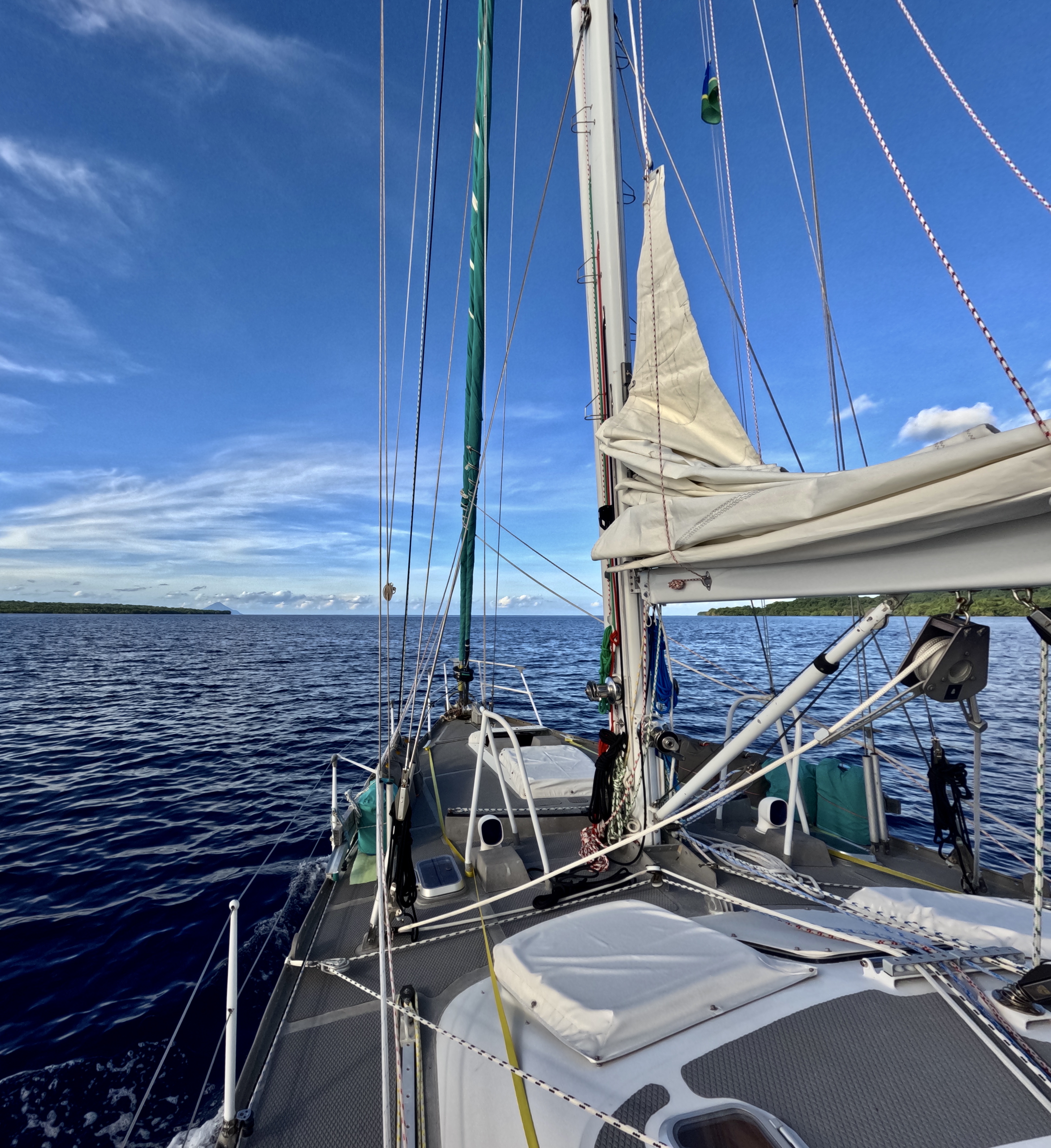
We had decided to forego exploring the Reef Islands; they were in the wrong direction to the east. But the plan was to detour slightly to the north…twenty five nautical miles to the north in order to sail right next to Tinakula, an active volcano we had been watching spew steam from its summit since anchoring in the Shaw Point inlet, directly across the bay from Lata.
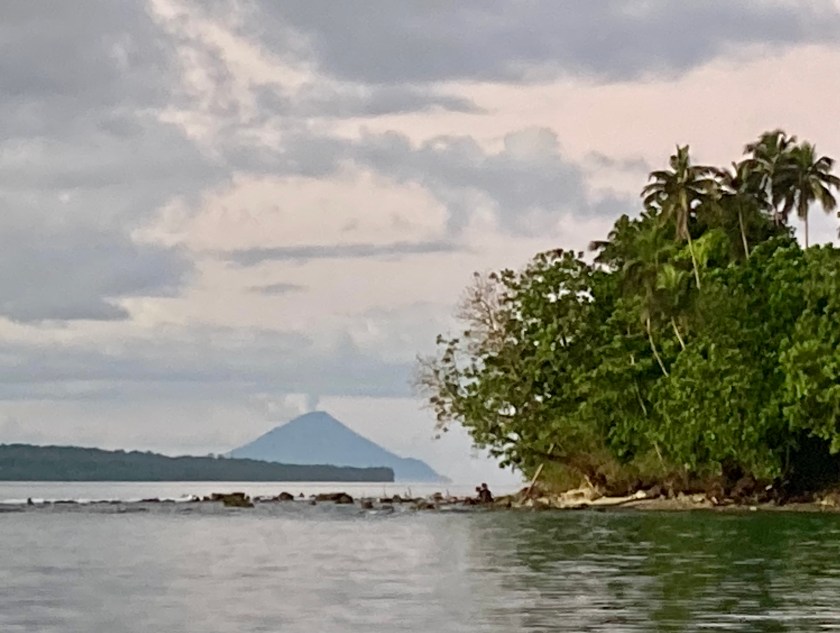
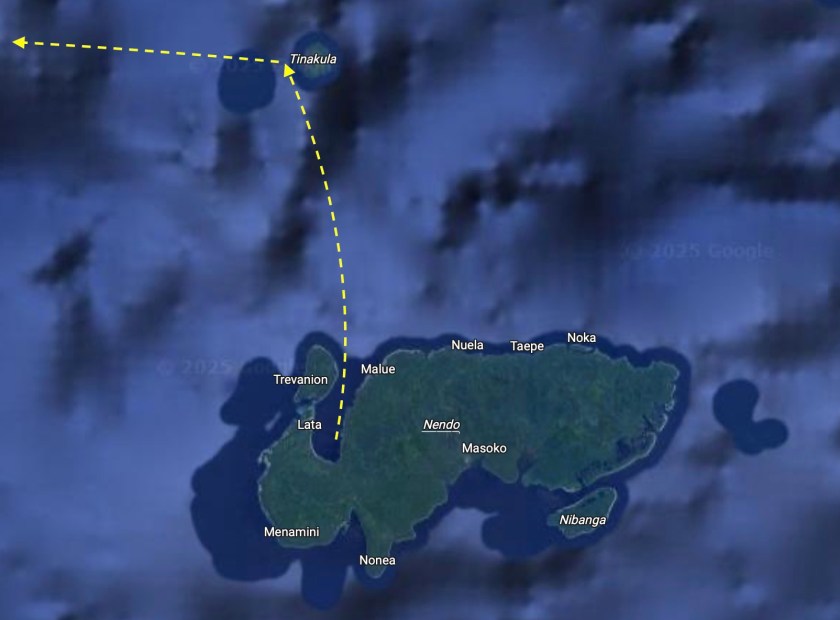
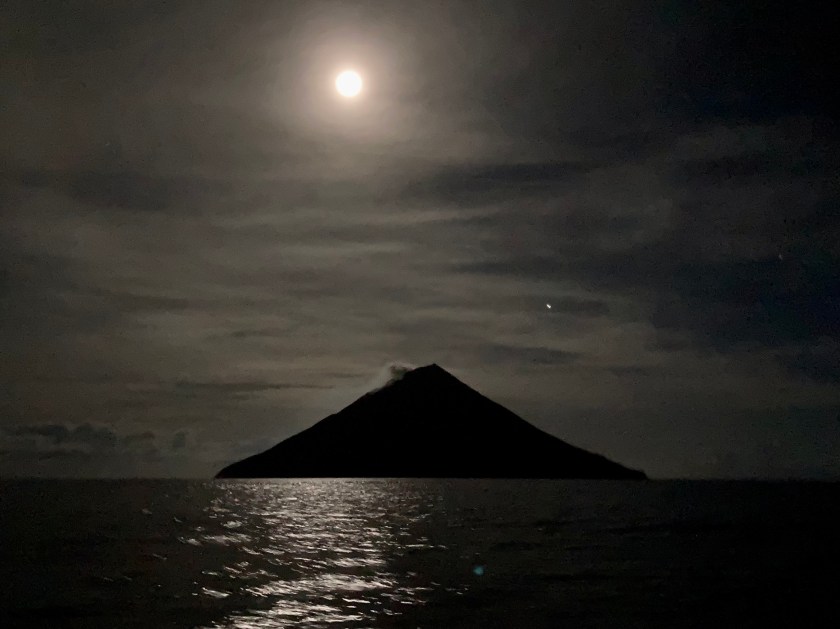
There was no where to anchor along the shore; the sheer walls of Tinakula’s classic cone shaped plummeted into the depths. But we had been told that, on the far side of the volcano, “fire rocks” could be seen, occasionally being coughed out of the caldera. We timed our departure so we would pass within a mile of the volcano between 10pm and midnight, hoping that a potential glowing light show would surpass anything we could see during the day.
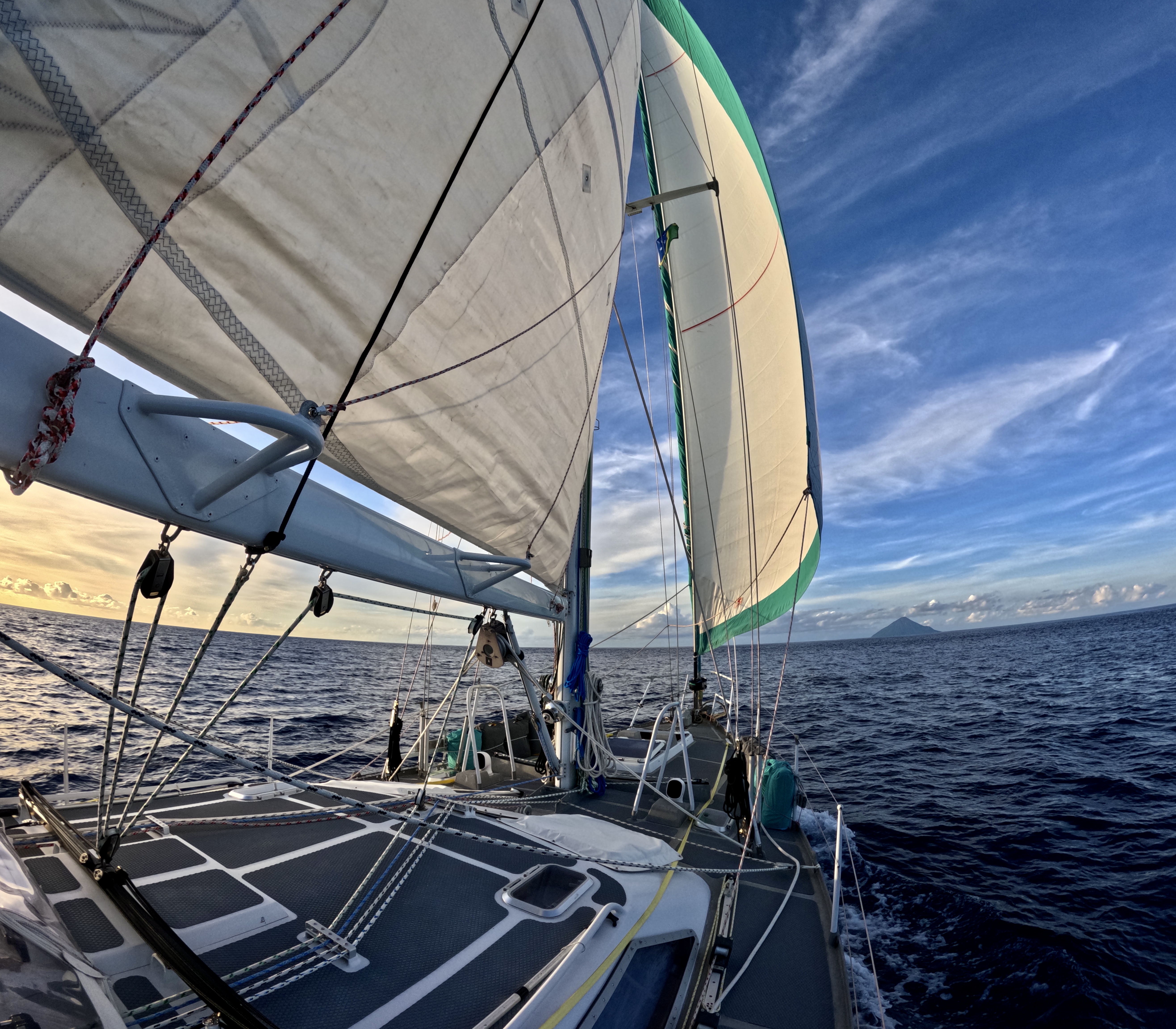
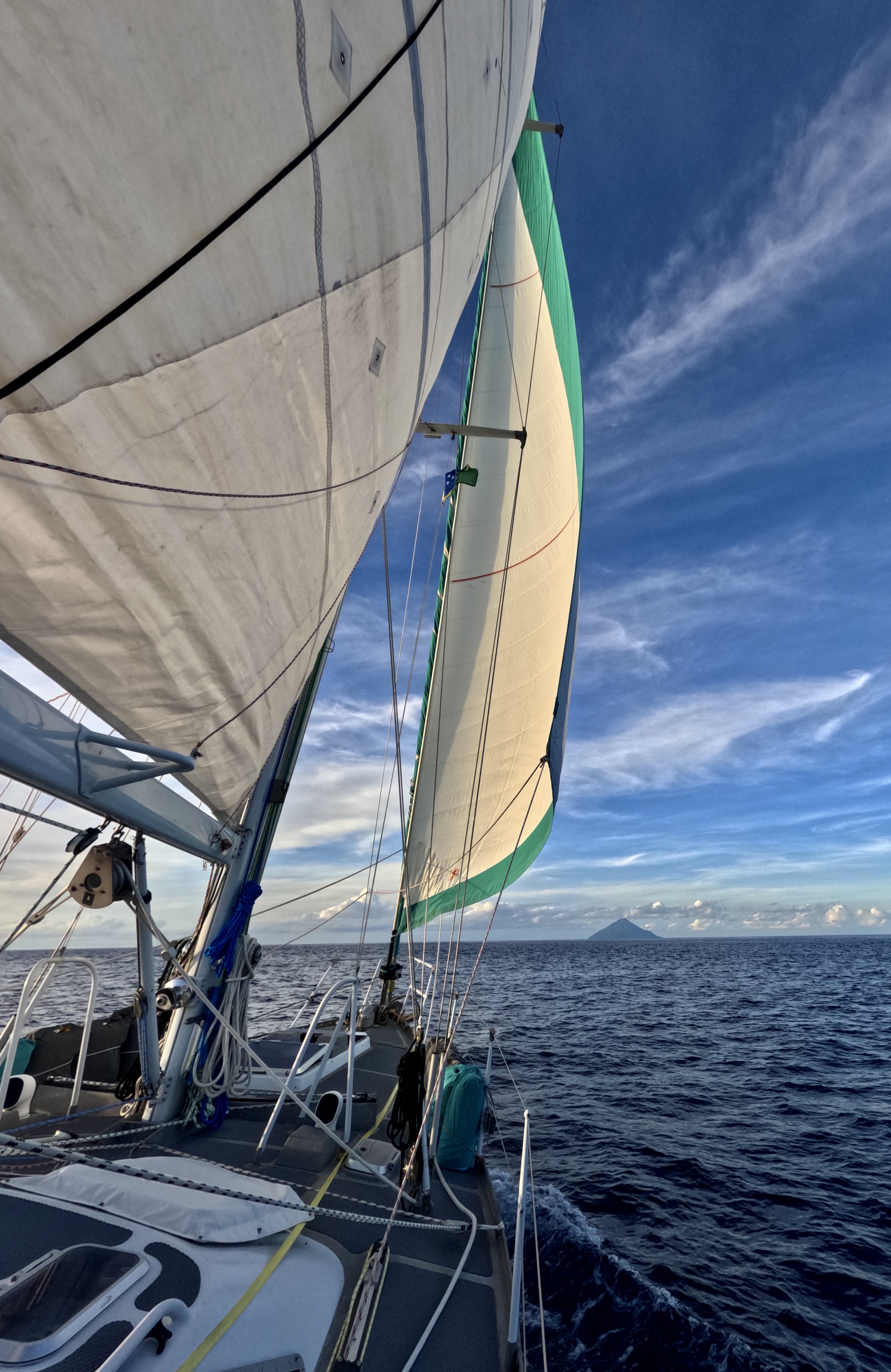
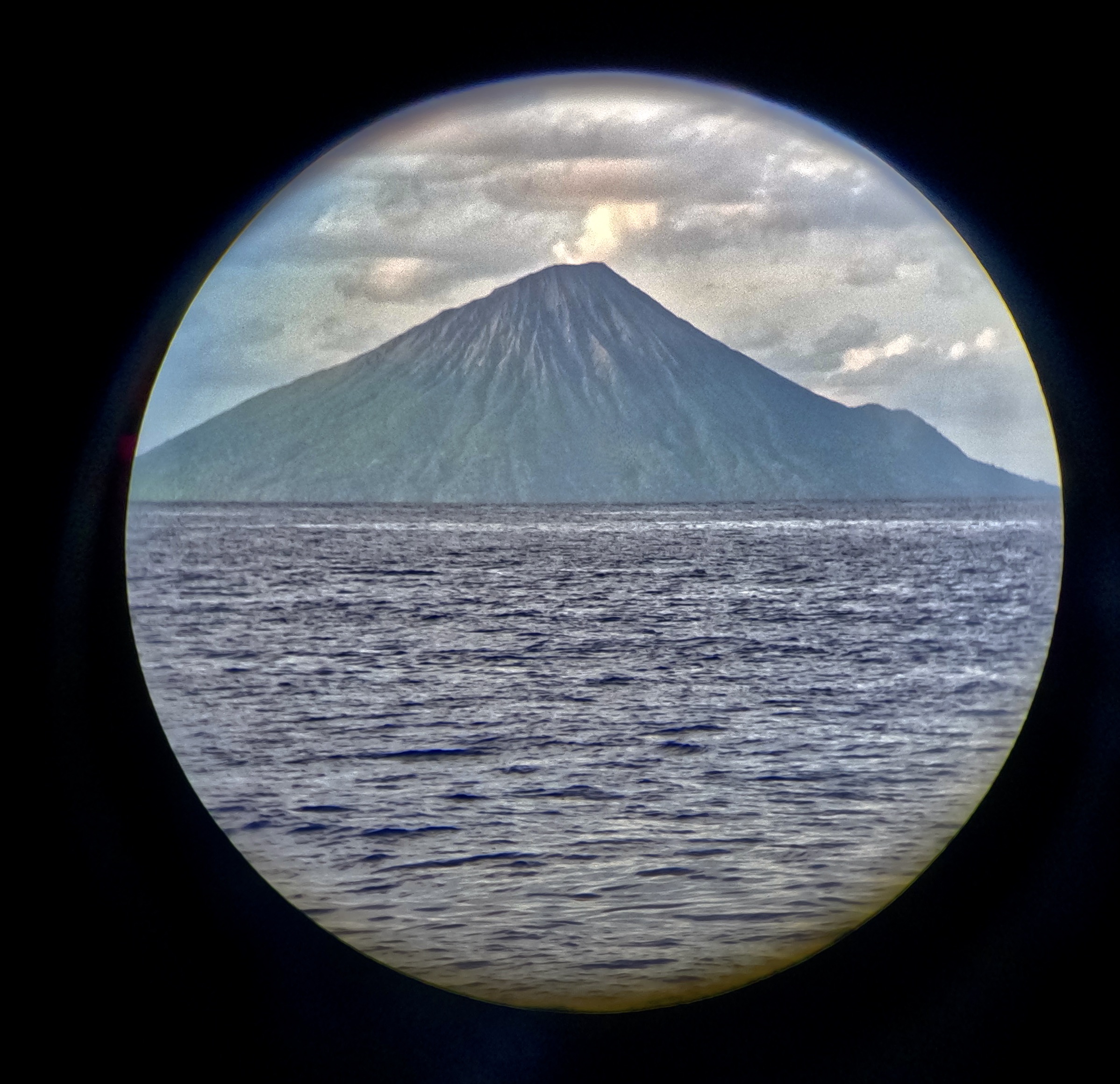
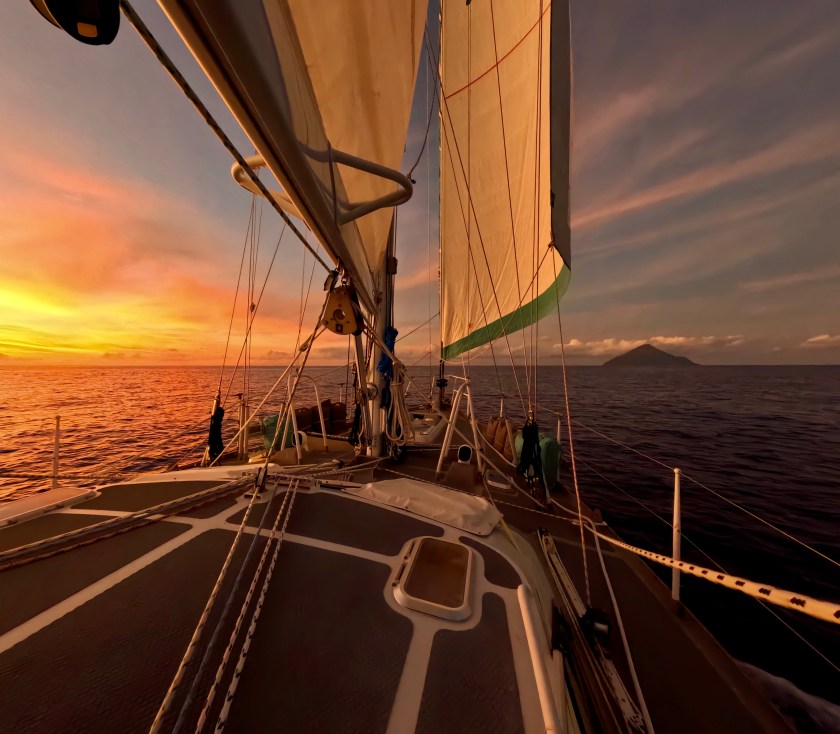
With the added colors of a magical sunset, our approach to Tinakula became more and more dramatic.
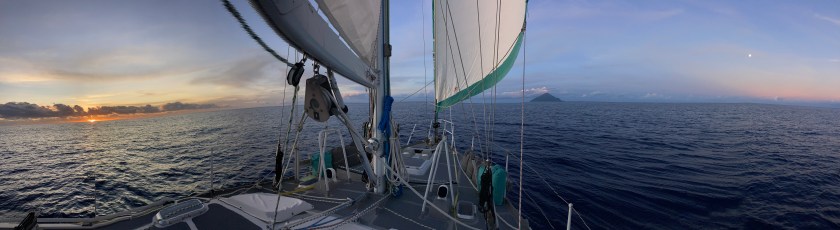
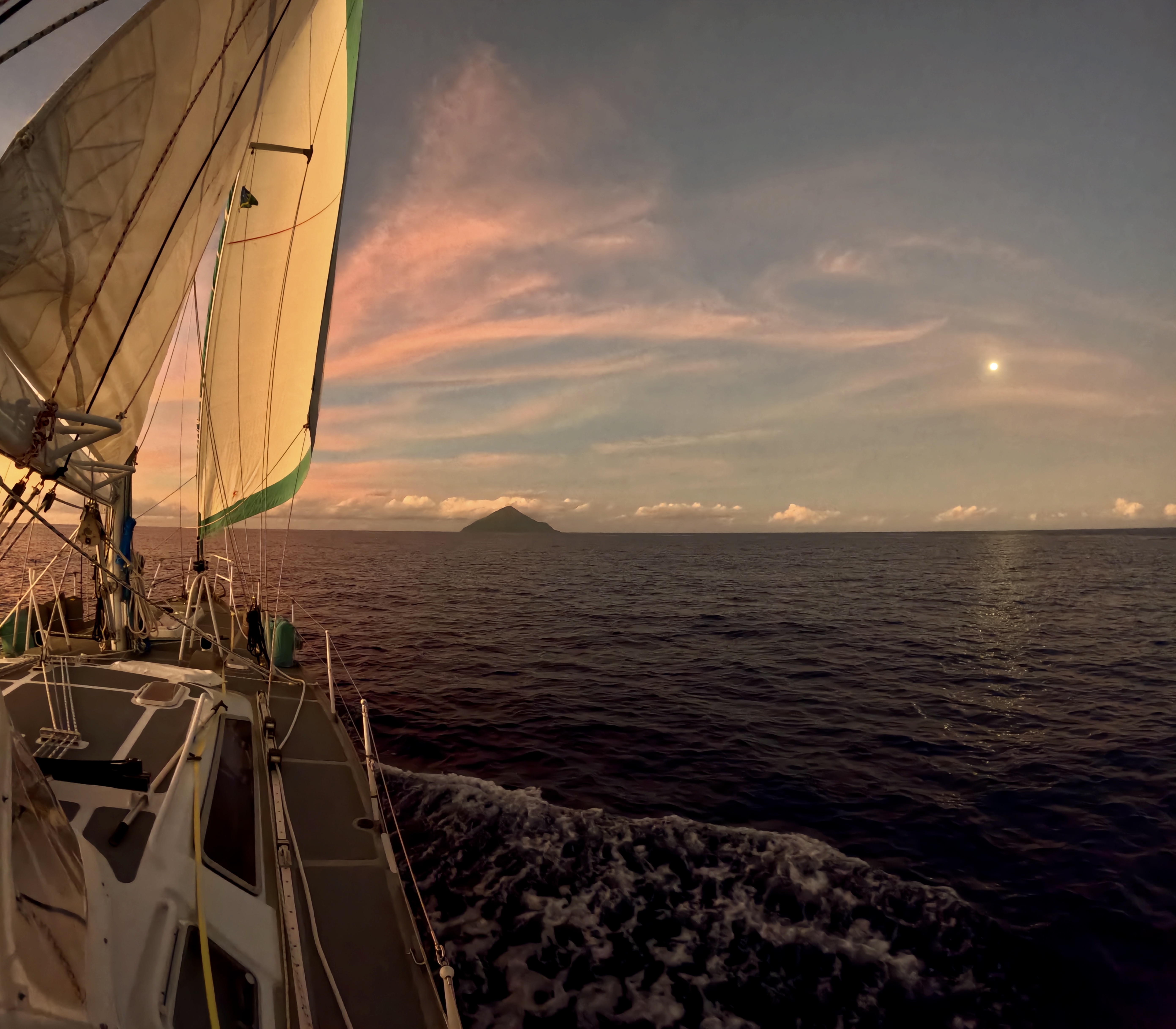
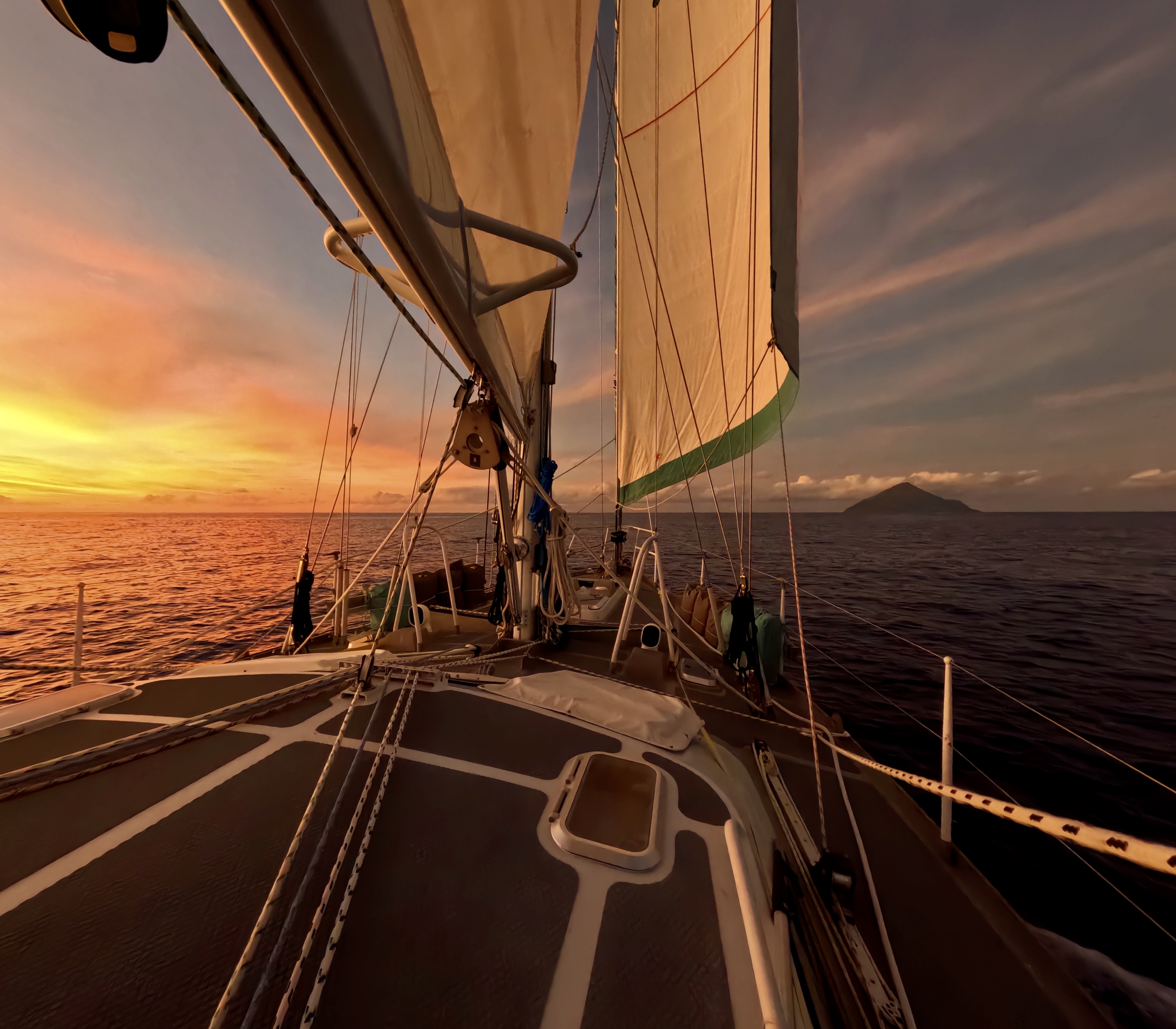
Reaching Tinakula, the night sky was fully illuminated by a moon which rose directly over the volcano, only one day away from reaching its “full wolf super moon” crescendo. While plumes of steam could clearly be seen intermittently belching from the caldera, we witnessed no red glow or catapulting “fire rocks”. As we passed by Tinakula and turned west, we couldn’t help but to feel a slight disappointment in what turned out to be a bit of a dramatic void. Worth the detour, but not quite the show we had hoped for. Oh well…after experiencing the aftermath of Mt. Saint Helens forty five years ago, volcanic drama is maybe something we should know to avoid.
The following morning, twenty hours underway, we were both mentally exhausted after struggling through our first night of passage. The conditions were as benign as one could expect on the open ocean…too benign. Not a moment of double digits on the wind speed display; mostly between six and seven, fluctuating drastically in direction. Overnight, our true wind angle ranged from 100-160°. Not fun.
We were currently in about 10,000 feet of water. Less than thirty nautical miles to the south of our projected course, the Coral Sea plummets down to 23,000 feet. The Santa Cruz Trench. Somewhere out there it apparently reaches a depth of 30,000 feet. Our current situation could be summed up as: a whole lotta wata but notta lotta wind.
Sigh.
While one can, to a certain degree, be exceptionally thankful for a night of no rain, squalls, lightning, high winds, mechanical trouble, or other boat traffic – all the makings of true boredom – it is undeniable that one of the most challenging aspects of sailing is actually sailing downwind when there is almost no wind to sail by. Other circumstances are well and away more stressful, dramatic, or even terrifying…but maybe not more challenging.
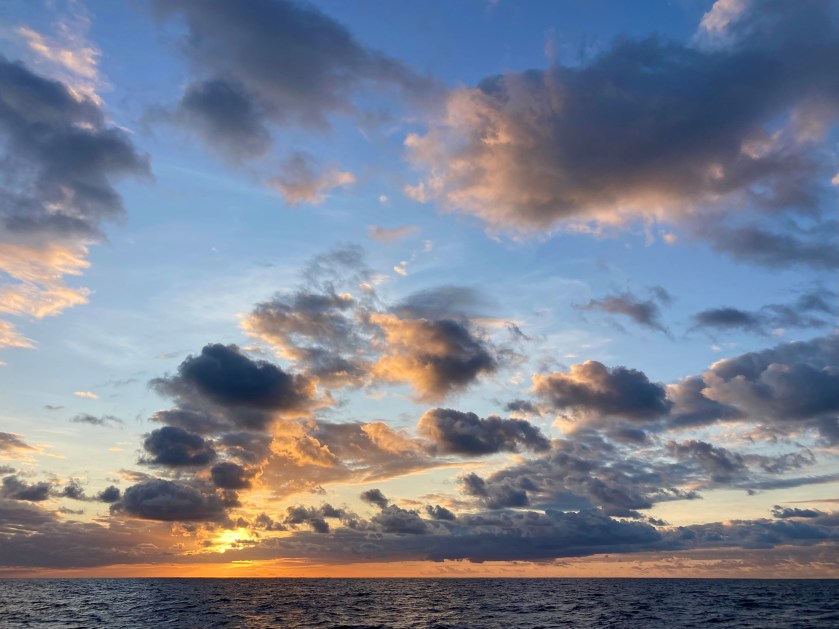
Nevertheless, regardless of whatever trials, ordeals, or struggles an overnight passage may generate, there is no better reward than seeing the colors of a new sunrise emerging above the horizon.
Even through the following morning, we continued struggling to keep the boat speed above even two knots, ecstatic to see anything over three knots on the display, all the while dealing with sails endlessly flogging as the wind collapsed and then re-filled the sails with each passing swell crossing our beam. It becomes hard to distinguish what’s more frustrating…the non-stop banging and noise, or the full awareness of how hard it is on the sails and rigging.
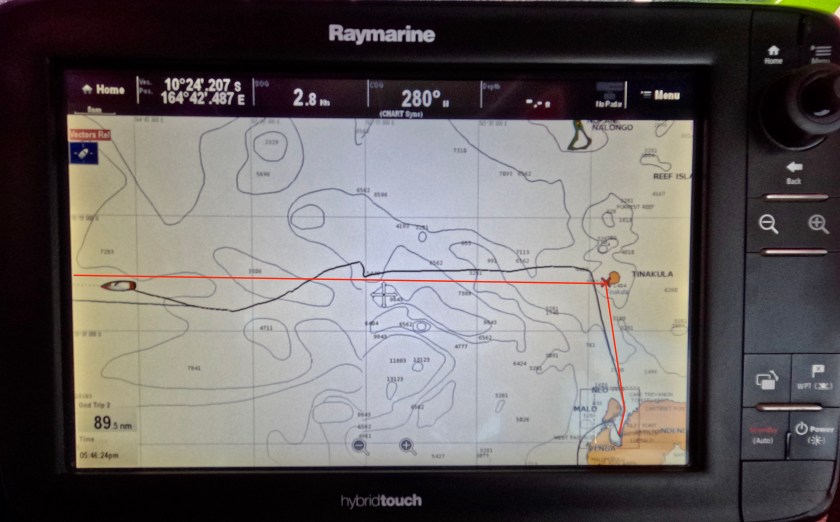
The actual track created by our true course, randomly zig-zagging alongside the perfectly straight line which represents the theoretical course generated by our electronic chart plotter, gives the appearance that a drunken sailor is at the helm. It also is a brutal reminder of all of the extra miles being logged due to the current impossibility of trying to navigate in a straight line. At one point we found ourselves actually going backwards…Arrrrrgh!
We decided to undertake an experiment with a piece of equipment attached to the front of our mast which had never been utilized in our eight and a half years of sailing…the reaching pole. While, in theory, it could help alleviate many of our light air downwind headaches, we had always simply managed without it. Granted, it could be argued that while at anchor might be a wiser place to sort out the logistics of setting up the pole…still, though it had never been attempted, we had already researched things quite a bit. And, after all, mother is the necessity of invention. Need drives motivation. So…off we went.
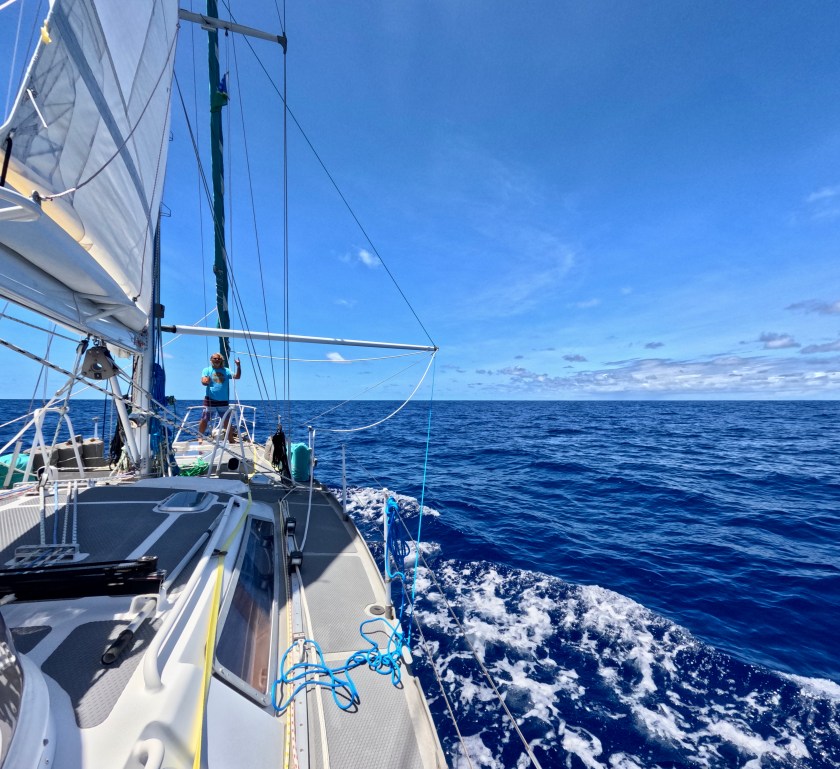
Three hours later, we declared the experiment a complete failure. Despite being successful at setting up and rigging the reaching pole on a pitching deck, it simply didn’t help a bit. Too little wind. The wind angle kept shifting. The pole didn’t seem to be the correct size for the genoa so we redid the entire thing again for the solent sail. It didn’t seem to be the correct size for the solent sail either. Nothing we did seemed to make things any better. At the end of the miserable three hour experiment, all we had managed to accomplish was burning Kris’ off-watch time (she had now been going for twelve hours straight since 3am) and achieve a major facial sunburn and near case of heat-exhaustion for me. Fuck. Maybe two to three knots of speed wasn’t so bad after all…
As we settled in for a traditional under passage single sundowner beverage in the cockpit, we could only smile and toast our previous day’s “under-achievement”: one of the slowest twenty four hour paces we had ever experienced underway – eighty four nautical miles in total; and considering that included six hours of motoring…not so impressive. An average of 2.7 knots of speed sailing for eighteen hours. Ick.
That night, the sun disappeared over the horizon in another brilliant sunset that splashed a stunning array of colors across the slowly darkening sky.
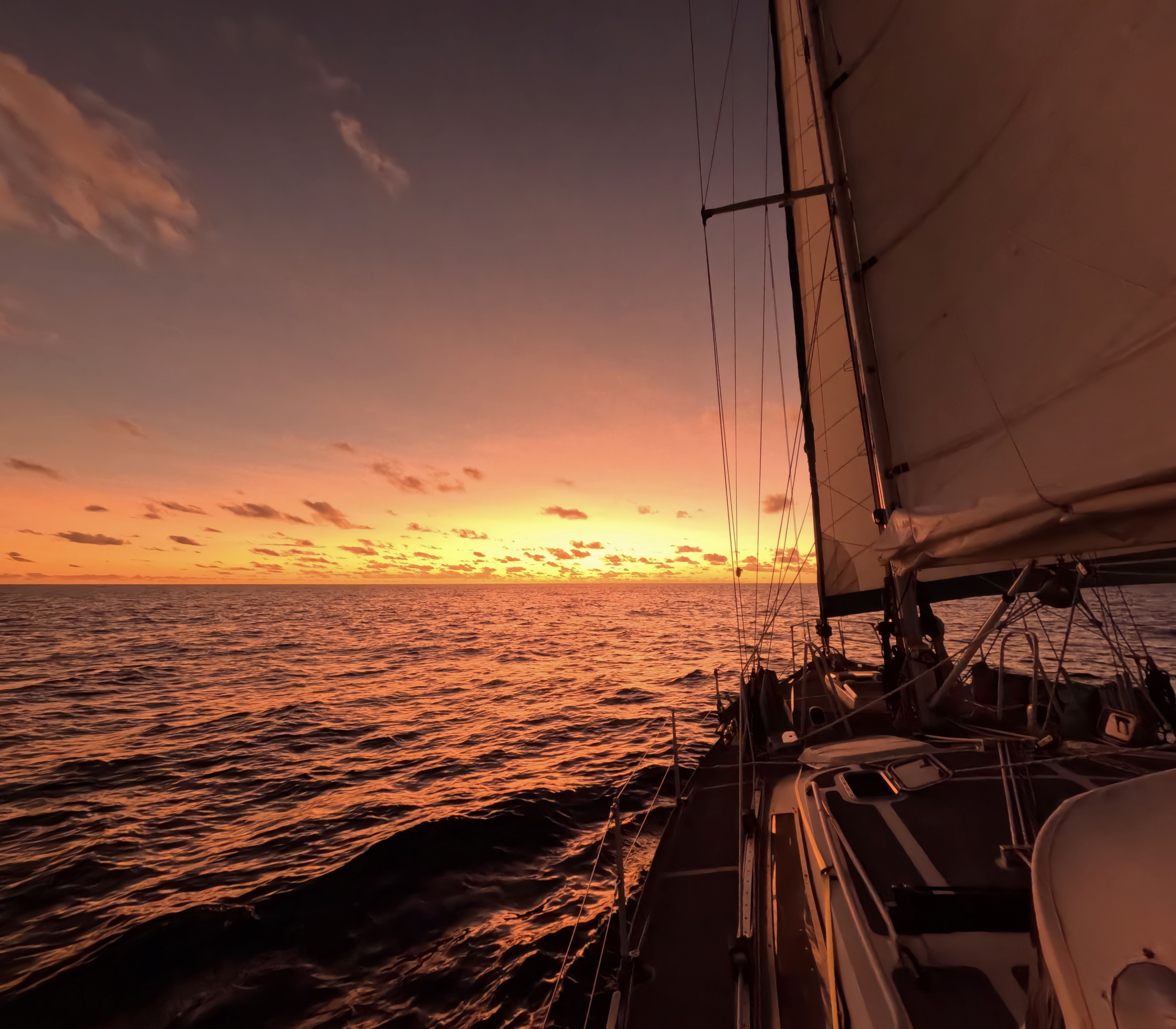
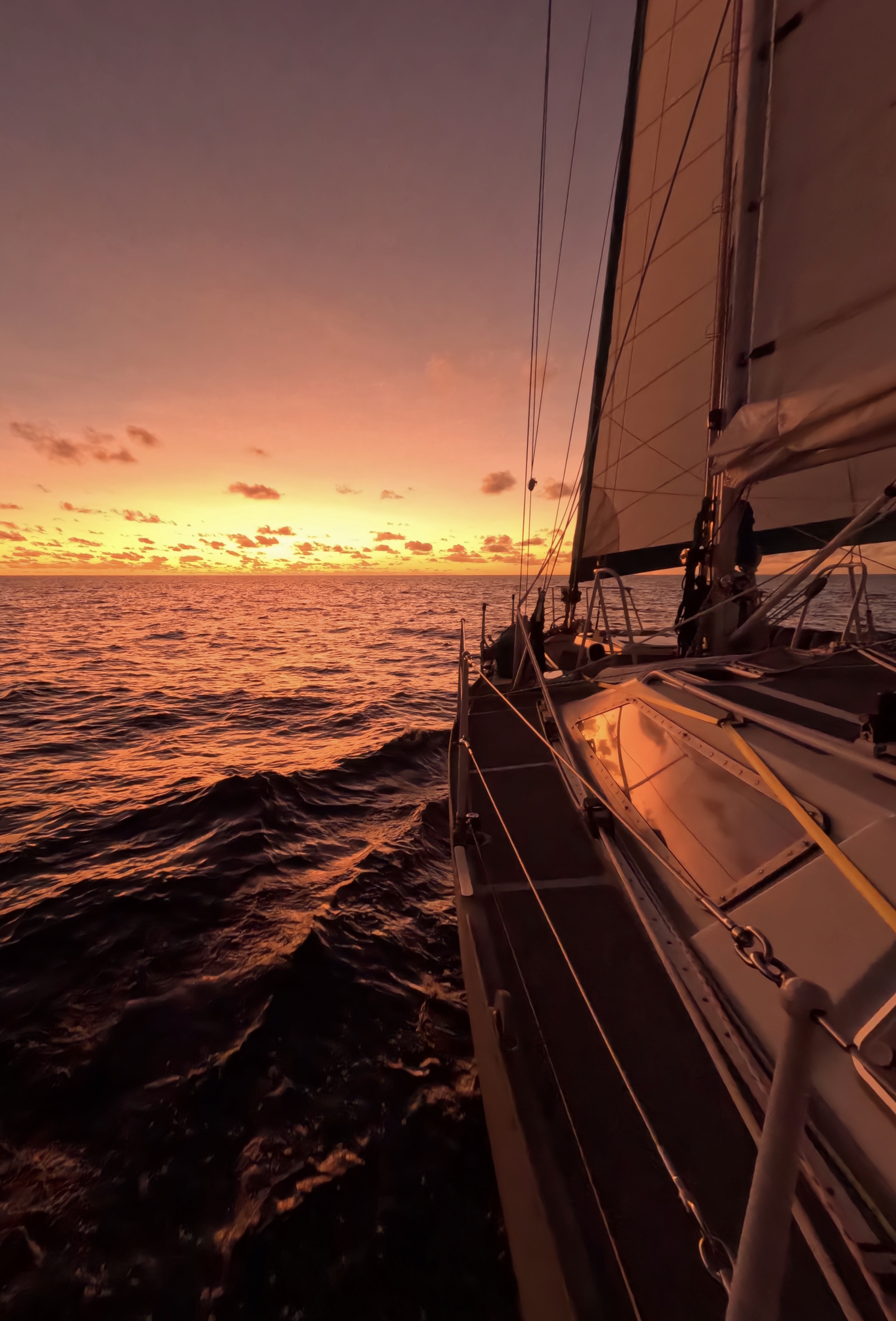
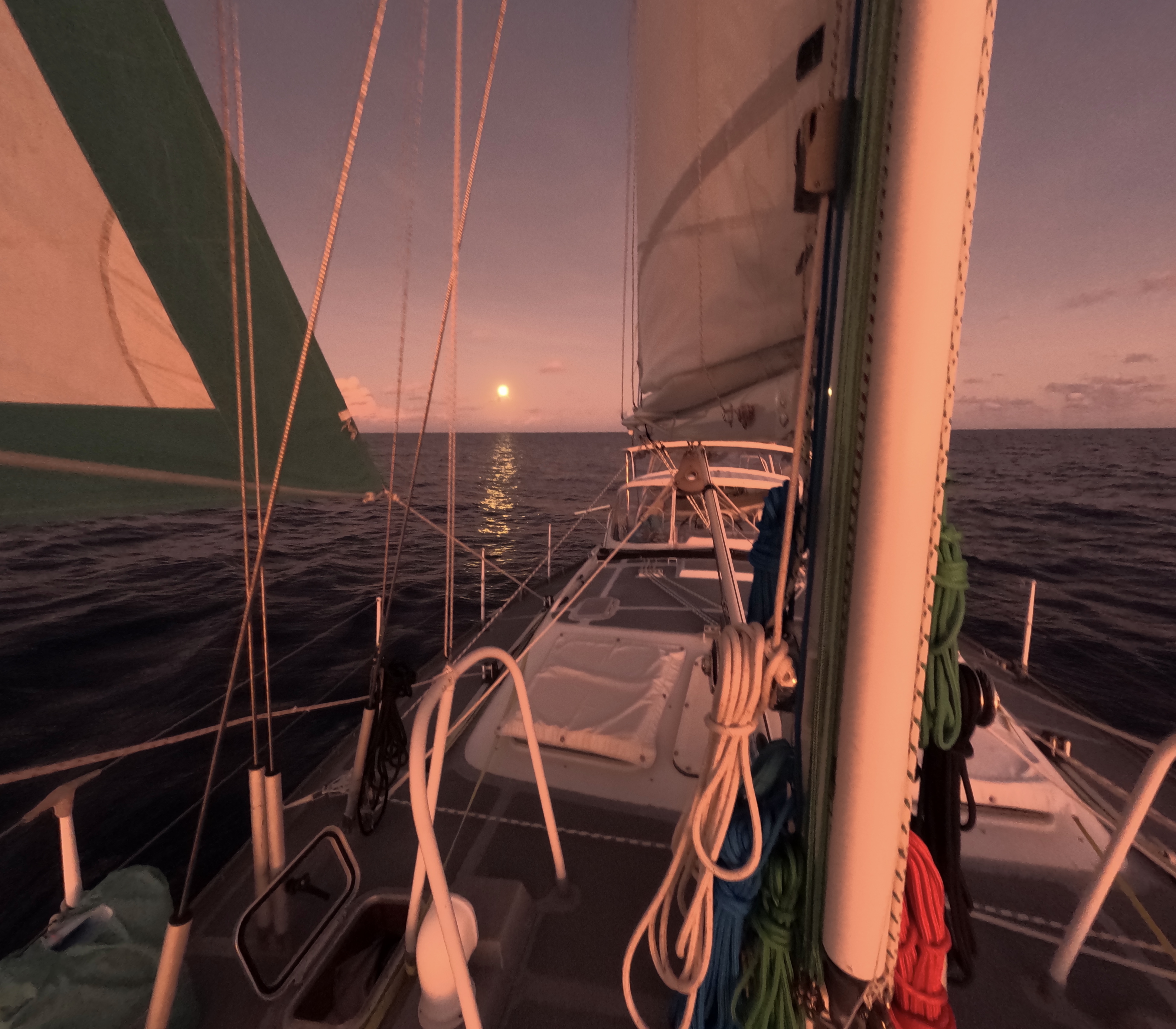
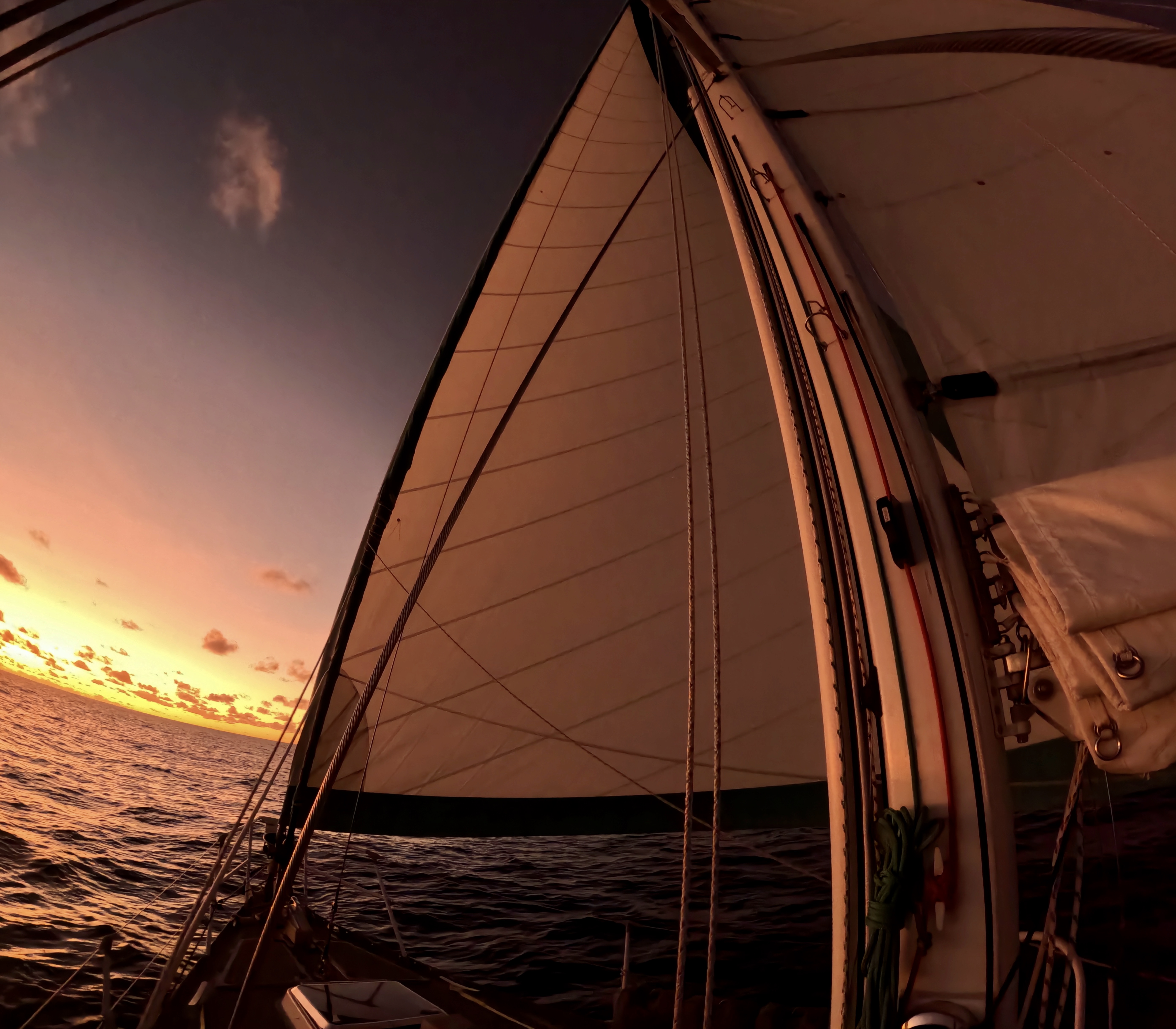
Simultaneously on the exact opposite horizon the “full wolf super-moon” emerged. The sunset was just off our port bow. The full moon just off our starboard stern.
Thirty minutes later the last remnants of reds, oranges, and purples had faded from the sky. Still, for two hours, as the unusually large moon slowly climbed upwards, it seemed as though a spotlight was shining directly into the cockpit from behind us, with the surface of the water behind us completely lit up. Even after the massive white orb had climbed outside of my line of sight, blocked by the bimini above the cockpit, the sky all around remained eerily bright.
Typically, when we are on passage overnight, I prefer when the moon is in front of us. Shining downward, it creates a surreal wash of light between itself and Exit, illuminating a perfect path for us to follow. During such times, the corridor before us can be nearly as well lit as if it were daytime and, suddenly, the trepidations that accompany sailors venturing into the dark unknown can be washed away by the fleeting moonbeams that appear to guide us. Even without the moon directly in front, the overall ambient light of a full moon in a clear sky brings with it a calming peace of mind.
Sadly, though the full moon brought psychological comfort with its illumination, it failed to bring a breeze to sail by. Just after midnight, with the display on our wind speed indicator seemingly unable to show a number higher than five and the display indicating our boat speed even more depressingly showing a measly 1.8 knots, I momentarily turned on the chart plotter and immediately found myself having to stifle a scream that would have caused Kris to instantly bolt up in bed from her off-watch slumber.
The cockpit display calculates our boat speed using an electronic transducer connected to a paddle wheel attached to the underside of our boat. The chart plotter, on the other hand, gets its data via a gps connection pinpointing our actual speed over ground, which at the moment showed 1.5 knots.
Arrrrrrgh! A speed of 1.8 knots was bad enough. But that didn’t even account for the third of a knot of current going against us…we were moving even slower than I thought.
If Jesus had been walking on the water next to us, not only would he have frowned at the litany of names I tossed at his father, he would have also walked right past us without even breaking a sweat.
Reluctantly, I fired up the diesel engine and put it into gear. It would be nearly eleven hours before our trusty Perkins would rest again.
Sigh.

