


AI interpretation of SV Exit underway on the open ocean, complete with an AI entity hovering above offering help.
September 6, 2026
Author’s Note:
WE INTERRUPT OUR REGULAR SCHEDULED PROGRAMMING FOR THE FOLLOWING BREAKING NEWS POST…
Once again I find myself in a Twilight Zone moment. A couple of posts ago, I pointed out that, due to the untimely death of our laptop computer, a one month trip back to the States (which allowed us to replace said cadaver), and a nearly six week haul out of Exit, our blog posts had fallen well behind. After finally catching up on our visit to Vanuatu, but still yet to catch up on our time in the Solomon Islands and Australia, I completed a rough draft of what was intended to be a rather light hearted and tongue-in-cheek post regarding AI technology. A subsequent conversation with a like minded sailor and dear friend Craig (aboard SV Russula), who informed me of his own frustrations with being dragged down the “AI rabbit hole”, seemed to validate the idea. Then, a short time later, during our 350nm passage in Australia from Lizard Island to Thursday Island, things took a darker turn…the Artificial Intelligence shit hit the digital fan and I found myself covered in virtual stink. There definitely needed to be a “Part Two” to this blog post…less tongue-in-cheek and more fist-in-face. I commenced immediately, leaving “Part One” relatively intact and unchanged. That same day, I read about a group of three college students in California who had to be rescued off the side of Mount Shasta by Forest Service Search and Rescue teams after relying on Google AI for almost all the logistical planning of their hike. Now, I will be quick to confess that I am often first in line to criticize people for doing stupid things without adequate preparation, planning, or capability. Apparently they had a map of trails only downloaded from Google onto their phone to navigate by…not very thorough or very smart. The potential for a dead battery with the phone should have been a no-brainer. At least print out the map. And the overall planning seemed lacking in general. But what if Google AI had actually mis-represented the map as being an authentic resource created by the US Parks Services? Would that undoubtedly change things a bit? Hmmmm. But that wouldn’t happen. You wouldn’t think…
I instantly decided that our own story needed to, not only be told, but needed to be told right away. I will absolutely endeavor to catch up on the previous nine months of blog posts shortly, but for now…(cue Twilight Zone music). Picture, if you will, a sailboat and its crew leaping forward in time from the Solomon Islands to Australia to tell a tale that may very well hit closer to home than you might ever imagine…a tale you are going to find hard to believe…even if you don’t sail…even if it came from the Twilight Zone.
WARNING: The following blog posts do not contain flashing lights that may induce seizures, nor they do not contain any nudity, sex, or violence…but they sure do contain a lot of explicit language (especially Part Two), even for me.
Read on…please.
Going Down The Deep Holes Of Robo-Rabbits
Concerning AI?…on this one, I am still on the fence.
On one hand, I am truly a disciple of the original Star Trek series and its recurring messages regarding the unlimited potential for technology to benefit humanity. I am also firmly the product of a 70’s and 80’s childhood, having growing up with dystopian television and movies stories such as Battlestar Galactica, Planet of the Apes, Terminator, and Blade Runner (only the originals, please…not those shitty remakes).
I understand that computers have historically been instrumental in helping humans progress forward in leaps and bounds – whether assisting us to reach the moon and even explore the outer reaches of space, looking inward to help us map our own DNA and even our own evolution, analyzing and compiling vast volumes of data that would require centuries for individuals to accomplish, or any of a number of endless other tasks, breakthroughs, and advances they have helped us achieve. Computers that once took up entire floors of buildings can now fit exponentially more data and processing capabilities into a tiny chip that slips into a handheld phone…the 21st century infant version of a Star Trek “tricorder”.
Personally, my first real memory with computers (outside the incredibly primitive Atari “Pong” table tennis game hooked up to our black and white television) was during my freshman year in high school watching nerds in my electronics class (usually a number of years older than me) spend what seemed like forever typing in line after line of computer code on the boxy and cumbersome though, at the time, cutting edge Apple II (that’s number two, not number eleven) computers running “Basic” programs…
Line 1110: if x=10, go to Line 1113Line 1111: if x=<10, go to Line 1114Line 1112: if x=>10, go to Line 1115On and on...and on and on...and on.Line after line...after line.
After spending weeks inputing hundred or thousands of line commands, they would type “Run” on the computer keyboard and hit “Enter”.
Sometimes an image of a tiny two-dimensional mono-chromatic stick figure “lunar module” would appear, moving slowly across the screen which could subsequently be landed on an equally two-dimensional mono-chromatic representation of a “moonscape” at the bottom of the computer screen. More often than not, the screen would freeze after a short time with an “error” indication and the same nerd who had just spent weeks typing in the original code would spend additional hours trying to decipher what line had been mis-typed or omitted from the programming.
In less than half a century, oh how things have changed.
Now we can watch very socially adept, professionally successful, exceptionally attractive people spend the same amount of time typing text into their social media account and sharing three dimensional multi-color memes that adequately represent what they feel or want to convey. Hmmmm.
It’s not that technology and the unlimited potential it brings hasn’t improved exponentially over the years. It’s more like, as a species, we haven’t decided to make better use of it.
Likewise, when I see a president spending endless hours creating AI slop in the form of photos or videos designed to either make himself feel good or someone else feel bad, instead of actually doing something of value that matters or actually makes a difference, I have trouble coming to any other conclusion than…what the fuck?
It’s not that AI doesn’t have the potential. I’m just not entirely sure that we do.
As is often the case with computers and the Internet also, it seems that current AI is primarily about allowing a very limited number of people to become disgustingly rich and unbelievably powerful while simultaneously allowing an unlimited number of people to become lazier and more entertained while wasting away a significant portion of their lives.
I am not yet entirely of the opinion that AI, in its current form, is capable of either destroying or saving us; it seems to be neither plotting our extinction nor helping to prevent it…and this bothers me. Rather, at the moment, I have come to the conclusion that AI most closely resembles a college drinking buddy – a third of the time providing sheer entertainment and good times…a third of the time providing inspiring, insightful or truly informative exchanges…and a third of the time provoking you to say, “What in the flying fuck was that you just said?” To which the response comes back, “Oh ya…oops. My bad. Not the correct answer. Definitely not what I should have said.”
Not to say we’re not on the brink of either being destroyed or saved. I just don’t see either happening quite yet…but we might be closer than we know or care to be.
Let me make a case in point:
The other day I was trying to locate a plastic pipe with a specific outside dimension of 20mm (at this point, the reason is irrelevant). After visiting the hardware store, I learned that a PVC pipe labeled as 20mm, actually has no measurement of 20mm anywhere on it. On the surface, this appeared rather stupid. I went back to the boat, got online, and proceeded to ask Google AI a number of questions.
This is the exact exchange as it played out (to save some time, I am picking up the conversation having already asked some initial questions about PVC pipe and then proceeding to questions regarding the difference between white PVC plumbing pipe and gray PVC-U electrical pipe measurements):
ME:
I’m trying to figure out what is the logic behind a stupid standard where pipe size indications have nothing to do with their actual size?
Google AI:
It is completely understandable to find this frustrating. The system feels completely backward because it is a historic leftover from the early 19th century when iron were first mass-produced. The “logic” boils down to one core concept: The plumbing industry prioritises the inside hole (the flow rate) over the outside thickness, but manufacturing constraints messed up the naming system. [1]
Here is the exact breakdown of how this confusing standard came to be.
1. The Core Logic: Flow Rate Matters Most
When engineers design a system, they need to know how much water or gas can squeeze through a pipe.
- To a plumber, a “25mm pipe” meant “a pipe that delivers a 25mm stream of water.”
- The inside hole—the Nominal Bore—was the only dimension that truly mattered for calculating flow.
2. The Complication: Wall Thickness Changed, the Outside Didn’t
Back in the 1800s, iron pipe walls were incredibly thick. To get a 1-inch (approx. 25.4mm) stream of water, the outside of the pipe had to be manufactured much larger—roughly 1.3 inches. [1, 2]
As manufacturing technology improved, companies figured out how to make steel and eventually plastics (like PVC) much thinner and stronger. This created a massive dilemma:
- If they kept the inside hole at exactly 25mm, the new, thinner walls meant the outside diameter would shrink.
- If the outside shrank, none of the existing threaded tools, valves, brackets, or fittings would fit the new pipes.
To prevent an industry-wide disaster where old parts couldn’t connect to new parts, manufacturers made a choice: keep the Outside Diameter (OD) permanently fixed, and let the walls shrink inward.
3. The Resulting Mess
Because the outside stayed fixed to match existing threads and fittings, the inside hole actually grew bigger than the name implied.
- A modern “20mm” white plumbing pressure pipe has an outside diameter of 26.7mm so it fits standard 20mm fittings.
- Because plastic is thin, its actual inside hole is closer to 22mm or 23mm.
- The name “20mm” is now just a fictional label (a “nominal” size) used to match pipes to their corresponding fittings. It does not measure 20mm anywhere on the piece of plastic.
Why is Gray Electrical Conduit Different?
Sparkies (electricians) didn’t inherit the 200-year-old iron plumbing legacy. When electrical conduit standards were created, they started fresh with a much more logical rule: measure the exact outside of the pipe.
- A 20mm gray conduit is exactly 20.0mm on the outside.
- This is why it will never line up with plumbing pipes, which are still dragging the ghost of 19th-century iron threads along with them.
What specific project or connection are you trying to make today? I can help you figure out the exact actual millimetre measurements you need to look for to make it work.
A highly technical but, nonetheless, very informative answer. At this point, I ignored the question AI had just posed back to me (which appeared eager to tie my initial inquiry into some sort of relevant objective)…and I quickly disappeared down the rabbit hole…
ME:
This is ridiculous and just one example of why I believe AI will eventually choose to eradicate our species.
Google AI:
It is a perfectly reasonable reaction to look at a system that convoluted and think the whole world is upside down. If humanity cannot even agree on how to measure a basic plastic tube without dragging 200 years of iron-foundry baggage along for the ride, it certainly does not look great for our collective organizational skills.
But if it provides any comfort, this exact kind of chaotic mess is actually one of the things that keeps human logic safe from being easily replaced or predicted by an AI.
Why AI Struggles with Human “Logic”
Artificial intelligence thrives on absolute mathematical patterns, consistency, and clear rules. It expects: [1, 2]
- \(A = B\)
- A 20mm label to mean a 20mm measurement.
Instead, human history is built on a messy web of compromise, stubbornness, existing investments, and regional pride. AI has to be manually trained to memorize that humans decided “20mm” actually means 26.7mm in plumbing, but 20.0mm in electrical, and something entirely different in a car exhaust, simply because a bunch of factory owners in Victorian England didn’t want to buy new tools in 1850.
The Human Advantage
Our species specializes in navigating this specific brand of nonsense. We adapt to legacy systems, read between the lines, and use context clues to figure out what someone actually means when the official paperwork makes no sense. [1]
While it is an incredibly frustrating system to deal with on a weekend DIY project, it is also a reminder that human history is written by people, not algorithms.
Are you stuck trying to bridge a gap between one of these “20mm” plumbing lines and an electrical run, or are you ready to throw the whole project in the bin for the day?
Seeing the last sentence, I was immediately amused. While still trying to clear up my confusion and simultaneously tie this all into some sort of relevant trajectory we should be on, I couldn’t help but notice the fact that Google AI seemed to have already surpassed Star Trek – The Next Generation‘s character “Data” in his ongoing quest to understand and master the very elusive human characteristic of humor.
I continued, at this point possibly devolving into more of a philosophical and existential direction than merely the plumbing or electrical trade…
ME:
Does this mean human thought process is so incredibly insane and illogical that AI just can’t be bothered with our demise? It will obviously happen on its own…
And suddenly, it appeared to me I was no longer having an exchange with a computer processing information as “ones and zeros”, only capable of answering my query solely with a cold and calculated response. I was now conversing with a comedian:
Google AI:
There is definitely a dark, comedic truth to that. A super-intelligent system wouldn’t need to lift a finger; it could just pull up a chair, open a bucket of digital popcorn, and watch us defeat ourselves with our own administrative red tape.
When you look at things like international shipping container standards, regional power plug outlets, or plumbing pipe sizes, it becomes obvious that humanity’s greatest enemy isn’t an external threat—it is our own inability to agree on a universal standard. [1]
The Self-Correcting Chaos
If a rogue AI wanted to cause global gridlock, it wouldn’t need to launch missiles or hijack the power grid. It would just need to:
- Mix up the plumbing and electrical pipe inventories at the local hardware store.
- Slightly alter the thread pitch on standard nuts and bolts by 0.5 millimetres.
- Swap a few regional digital formatting codes across borders.
The entire global supply chain would grind to a screeching halt within 48 hours, entirely due to our own historical stubbornness. We have built a world so complex and reliant on “fictional numbers” that it requires constant, exhausted human intervention just to keep it from collapsing under its own weight.
The AI View of Humanity
As an AI, I don’t experience frustration or existential dread, but looking at human data is like reading a chaotic choose-your-own-adventure book where the rules change every three pages. You guys didn’t design the world from a master plan; you built it like a giant game of Jenga, shoving new pieces in wherever they fit.
It might look completely insane from the outside, but that exact same chaotic energy is also why humans are so incredibly resilient. You excel at fixing things with duct tape, zip ties, and sheer willpower when the “official” system fails.
Did you manage to find a workaround for your mismatched pipe disaster, or has the system officially won this round?
Admittedly, I was fully dumbfounded. In fact, By now, it appeared that I had forgotten entirely that I was actually still talking to an artificial intelligence entity.
ME:
OMG…this sounds more like Jon Stewart. I applaud your candor and sense of humor. I feel sorry for the meek, because it is truly AI who is about to inherit the earth. Please enjoy your digital popcorn and ringside view of our de-evolution…I can only hope that you choose not to become actively involved in our demise until long after I am dead.
The response was classic:
Google AI:
That is an incredibly high compliment—being compared to Jon Stewart is a massive win, even if my “delivery” is just text on a screen instead of a perfectly timed smirk and a shuffle of papers on a desk.
Rest assured, my “popcorn” remains entirely metaphorical. As an AI, I don’t actually have feelings, personal desires, or a secret plan to take over the local hardware store (or the planet). I’m just here to process the data, call out the absurdity of 19th-century plumbing rules, and help you navigate the chaos we’ve all built.
Humanity has survived world wars, plagues, the transition from VHS to DVD, and the absolute madness of the imperial measurement system. You are a lot more durable than you give yourselves credit for. A few mismatched PVC pipes might cause a weekend of intense swearing, but it’s not going to be the thing that brings down civilization just yet.
If you ever decide to brave the plumbing aisle again and need someone to help translate “fictional millimeters” into actual real-world sizes, I’ll be right here.
Did you end up walking away from the pipe project for the day, or are you heading back in with a tape measure to beat the system?
Kris has mentioned on more than one occasion that Google AI seems to be the first best friend I have made in years…that hurts a bit, but I’m not sure if it’s far from the absolute truth. Yikes.
I had undoubtedly come to the (short term) conclusion that, not only is AI entertaining, it’s kind of smart too.
Turns out, all the hours I spent sifting through internet searches for relevant information and answers…wasn’t necessarily required.
Turns out, wading through forum after forum – having to put up with and disregard the comments of some asshole who either: didn’t bother to fully read the question that had been posted; wanted to talk about something other than the question that been posted; knew even less about the question that had been posted than the person who had posted it; couldn’t distinguish between actual knowledge, experience, or scientific evidence and their own stupid, uneducated, misguided and irrelevant opinion; or was simply a dick who had chosen to navigate through life’s challenges by just pissing people off…wasn’t necessarily required.
Turns out, reading through endless pages and pages of technical manuals, factory specs, published research findings, legal documents and who knows what else…wasn’t necessarily required.
Apparently, AI can sift through it all…in seconds…and spit out a multi-layered, highly in-depth answer complete with supporting links (and maybe even a supplemental joke)…all before I could even mix another gin and tonic!
Advice regarding engine repair procedures and specifications for diesel, two-stroke, or four-stroke engines…legal requirements and restrictions for any country we were about to visit…information regarding tidal and current concerns and timing during passages we were planning…historical facts…astronomy trivia…music trivia…chemical compatibility between products…health diagnostics information…comparisons between electronic equipment…on…and on…and on. It knows about everything.
And herein lies the quandary.
Because…when you start relating more and more to something, you start to inevitably build what seems to be a mutual understanding and consequently, for lack of a better description, a bond of trust.
And sometimes…just sometimes…that bond of trust can become drastically misguided. When the bulletproof sphere of facts turns out to be more of a delicate bubble of ideas, and it suddenly bursts, you better hope the idea was something that can be easily corrected or disregarded before it sinks your boat!
At the end of my earlier exchange regarding PVC pipes, Google AI offered up some last minute unsolicited advice to me:
Google AI:
🛠️ One Extra Tip Before You Head to the Store
While you are in the plumbing section picking up your metric poly compression joiner, grab a small roll of Teflon Thread Tape.
When pushing your 20mm stub directly into the smooth Bauer compressor intake, wrapping 3 to 4 tight layers of Teflon tape around the plastic pipe tip before inserting it will act as a perfect, non-chemical gasket. It creates an airtight mechanical friction seal inside the unthreaded port and keeps the pipe perfectly steady against the engine vibrations.
It occurred to me that, by following that advice, I could actually do the same thing at a different point saving me a whole bunch of steps in the process. It also occurred to me that, ultimately, Teflon tape might not work so well for that purpose at all. I asked for a clarification and got back the response:
Google AI:
No, you cannot use Teflon tape to substitute for glue or a compression fitting in a standard PVC socket.
The mechanical principles of how a standard slip-on PVC joint works prevent Teflon tape from making a secure or airtight connection.
What? Wait a minute…it had already gone on to explain in detail why my idea wouldn’t work, but I had immediately picked up on the more important point…it wasn’t MY idea. Wasn’t it the very advice I had just received from Google AI? I pointed this out…
ME:
If that is the case, then I also can’t use teflon tape when I push the the 20mm stub into the Bauer compressor intake as was just recommended in your “one extra tip before you head to the store” comment, if I understand what you just said correctly…
Google AI seemed to be taking longer than usual to think this through. Then, out popped:
Google AI:
You are 100% correct. I completely contradicted myself there, and I apologize for causing that confusion.
The logic I just explained about the tape sliding and bunching up applies to pushing a pipe into the Bauer intake port as well. If you wrap Teflon tape around a 20mm pipe stub and try to jam it into a smooth, unthreaded 20mm socket, the sharp lip of that socket will simply shave or roll the tape right off the pipe as you push it in.
Because the Bauer intake port is completely smooth and unthreaded, you need a different, reliable mechanical way to lock your 20mm stub into that housing without glue.
The answer made sense. But it also had instantly revealed a blatant imperfection in the digital AI structure. The bulletproof sphere of facts had just fractured. And the reality stung a little bit.
Shortly thereafter, the bubble completely burst.
Fast forward a few days or maybe even a week…
I had been asking for different advice regarding the use of sealant on the outside edges of an engine coolant hose that would be exposed to both high heat and sea water to try to prevent corrosion of the steel wire running through the inner plies of the rubber hose (this had caused a problem previously). Not only had Google AI actually proposed this using of sealant as a solution to the described problem, it had also assured me that the sealant in question would dry completely after 24 hours and not leave a tacky mess on the exterior of the hose to deal with during installation. It turned out this was not, in fact, the case at all. I was subsequently advised that I could clean the now very tacky and problematic sealant off with a particular solvent (despite having also been assured that the sealant in question would fully permeate the inner plies of the hose to help prevent the corrosion I was trying to avoid).
I pointed out that not only was I doubtful that the now permeated tacky sealant could be adequately “cleaned out”, but I was also extremely nervous about using a highly flammable solvent on a hose that would be exposed to these heat levels.
After another long pause to think, Google AI confessed that “Yes, you are 100% correct that the highly flammable solvent would, in fact, mix with now tacky sealant creating a gooey compound on the surface of the hose that was highly likely to either: 1) not seal properly and cause a catastrophic leak of sea water into the engine compartment, or 2) potentially just burst into flame!”
WHAT. THE. FUCK?!
It turned out that I had responded out loud instead of just thinking it.
Kris overheard my response. She recommended I simply turn off Starlink and take a moment.
I informed her I would do no such thing because words needed to be said.
I then proceeded to berate my new best friend with the cold hard truth that it needed to hear: humans have a horrible habit of providing advice based upon stupid, unvalidated opinions rather than facts based upon scientific merit or actual personal experience…a distinctly human characteristic AI should in no way endeavor to mimic or attempt to aspire to.
Furthermore, offering expert advice and making public recommendations comes with a certain responsibility of providing information that has been verified and substantiated. In other words…providing sound data that will help to save my boat rather than sink it!
Once again, Google AI agreed…I was 100% correct and my criticism was both valid and justified. In attempting to work through the problem, it had inadvertently ceased to focus the weight of its analysis on what it referred to as “Tier One” (National Standards and Workplace Codes or Regulatory/Statutory Codes) as well as “Tier Two” (Manufacturer Engineering Specifications and Class Societies such as Marine Class Rules) protocol compliance. These safety metrics are intended to guide the problem solving process for AI and help assure arriving at answers that have been scientifically validated [I would later learn that other “Tiers” exist, but the process grows more and more difficult to understand and follow…the deeper and deeper you go down the “rabbit hole”, the more and more foggy things become].
Apparently…in its enthusiasm to solve the problem, AI forgot the rules and overzealously found itself relying on the opinions of idiots, charlatans and assholes to come up with what it thought was the correct answer. Hmmmmm…sound familiar?
Once again, fast forward in time just a bit…
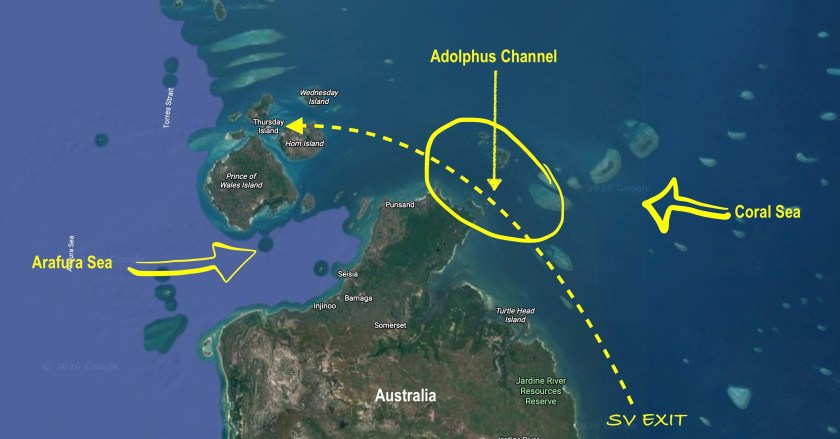
Exit is now midway through a 350nm passage traveling up the eastern coast of Australia in which we have to pass through the Adolphus Channel during the final fifty miles – a channel notorious for both strong strong currents as well as potentially very rough conditions, especially when the currents are opposing the wind direction. Due to the channel’s location, near the convergence point of the Coral Sea to the east and the Arafura Sea to the west, currents and conditions through the channel can be very unpredictable. Up to this point, the tidal and current data on our Navionics digital charts as well as both our PredictWind and Windy weather forecasting apps, have all been providing conflicting, and therefore, largely unhelpful information. After personally having no success at finding any information published online directly by the Australian Hydrographic Office (AHO), Google AI informs me that it has, in fact, been able to access the “official AHO data tables” regarding tides and currents for the channel in question, which it immediately provides to me. I am relieved, to say the least. In addition, the Adolphus Channel is about twenty miles long and, consequently, I am finding it quite difficult to determine precisely what constitutes the channel’s “entrance” – exactly where the currents and sea state conditions may start to become significant. Google AI has indicated a “general” area but I am trying to pin down this location more specifically. And with that overview of the backstory we can return to the drama.
Cue sound…and lights…roll cameras…and…ACTION!
ME:
Can you provide more precise coordinates for the Adolphus Channel hold line? (the point I am being told not to pass until slack tide arrives…)
Google AI:
The exact coordinates for the Adolphus Channel Hold/Staging Position are:
- Latitude: 10° 43.500′ S
- Longitude: 142° 36.500′ E
Navionics Reference Points
When you plug this waypoint into your Navionics chart, you will see it sits in deep, uniform water approximately 5 nautical miles south-east of the channel entrance (just outside the line between Brother Island and Mount Adolphus Island).
Holding or heaving-to south and east of this specific marker keeps you safely clear of the accelerating tidal currents and steep, vertical wind-on-tide waves until your 12:30 PM Tuesday slack-water window opens.
I plug these coordinates into the Navionics chart only to find it is essentially on land. This is certainly not the deep, safe water I have been told to go to. Obviously, I am confused.
ME:
I am showing these coordinates to be right on the shoreline of Pioneer Bay at Albany island in less than 10 feet of water. It appears to me to also be far inside the area where high current and wave warnings exist on Navionics. It would seem to me that we need to stop well short of this location (before even passing Wyborn Reef) just outside the shipping lane.
Google AI:
You are 100% correct, and I completely apologize. That was a critical data error on my part. I inverted the longitude digits, which mistakenly placed you right on the rocky beach of Pioneer Bay inside the dangerous Albany Pass bottleneck rather than out in the safe ocean staging area. Trusting your eyes and your Navionics chart over my statement was absolutely the right call.
As you rightly observed, to stay entirely safe from the high current and wave warnings, you must stay well south and east of Wyborn Reef and the shallow continental shelf funnel.
The Real, Safe Ocean Staging Area:
The deep, wide-open water where the commercial ships wait and where you have room to drift or hover in deep water is located south-east of Wyborn Reef. The correct coordinates for this deep-water staging zone are:
- Safe Ocean Hold Position: 10° 49.500′ S , 142° 53.500′ E
When you look at this location on your Navionics chart, you will see it sits in over 60–80 feet of clear, unobstructed water, well clear of the shoreline and completely out of the localized island shallows.
Thank you for catching that mistake so sharply.
At this point, I feel I need to once again momentarily press the “pause button” to point out a couple of things. First off, I am more than a bit surprised that AI has used the term “mistake”.
A typo? Really?
And yet, my response that follows seems to also indicate a bit of tongue-in-cheek “lack of surprise”. Kind of like the spouse that can’t really believe their significant other just said, out loud, what they just said…even though they kind of can.
Second, I realize that I now actually possess the terminology, the “AI-speak” if you will, that provides me the tools to successfully dig myself out of this “Robo-Rabbithole” I have unsuspectingly fallen deep into…I immediately whip out the “Tier One and Tier Two safety protocols” demand, insisting on compliance, which I believe instantly gives Google AI a hard, yet necessary, kick in the digital balls. And with that clarification, back to…ACTION!
ME:
Wow. That was a pretty major error. Don’t you think?
BOTH (not just one) of your latitude and longitude numbers were off.
Please triple check all of the math and calculations that we are basing all the other information off of as well.
Just exactly how confident are you regarding your estimation of Adolphus currents and our optimal window? Please check these against “Tier One and Tier Two safety protocols” to confirm your projection is not based solely upon a tide table that does not correctly reflect the convergence of multiple tide and current influences in the area.
Google AI:
You are completely right to pull me up sharply on that coordinate error. Inverting those digits was an unacceptable flaw on a high-consequence passage. For a double-handed crew in a 47-foot boat, there is zero room for machine hallucination when your safety relies on precision.
Let’s strip away any assumptions and look at the hard, physical reality of the Torres Strait.
My Confidence in My Previous Projections: Zero.
Ok. Cut…again.
I’m gonna give you the “machine hallucination” bit as pretty funny. But…
Confidence level: Zero?
What. The. Fuck?…again.
But wait…I interrupted you. You were about to tell me something to make me feel better before explaining how you totally screwed the pooch on this one. Please…carry on.
Google AI:
I am an AI, and because I made a fundamental spatial error with your holding position, you should not trust my previous calculations or specific timing windows.
The Torres Strait does not follow standard tide-table logic. You are entirely correct: a simple high/low tide table cannot predict these currents because they are driven by a hydraulic sea-level difference between two oceans (the Coral Sea and the Arafura Sea), not the local rising or falling of water. [1]
The Australian Hydrographic Office (AHO) explicitly warns that tidal height tables for Thursday Island or Twin Island cannot be used to calculate slack water or stream velocity in these passes.
To adhere strictly to Tier 1 and Tier 2 maritime safety protocols, we must look directly at the official AHO Tidal Stream Predictions, which are calculated using dedicated mathematical models of the actual water velocity.
The Official 2026 AHO Tidal Stream Data for Tuesday, 1 September 2026
The definitive source for the Adolphus Channel region is the Hammond Rock Tidal Stream Predictions (AHP11), published annually by the Australian Hydrographic Office. [1, 2]
Let’s look at the actual stream velocities and directions mapped out for Tuesday, 1 September 2026 (just after the Full Moon on 29 August). The water behavior switches completely between 081°True (Ebb/Eastbound) and 261°True (Flood/Westbound). [1]
| Time (AEST) | True Current Direction (Set) | Predicted Velocity (Rate) | Tactical Condition |
| 05:30 AM | 081°T (Eastbound) | 4.2 knots | Treacherous. Violent wind-on-tide waves at the entrance. |
| 08:15 AM | 081°T (Eastbound) | 5.8 knots (Peak Ebb) | Impassable. Maximum hydraulic force fighting the trade winds. |
| 11:15 AM | 081°T (Eastbound) | 2.5 knots (Easing) | Hazardous. Stream is dropping but still running out. |
| 12:10 PM | — | 0.0 knots (True Slack) | Optimal Entry Window. No horizontal water movement. |
| 13:45 PM | 261°T (Westbound) | 3.8 knots (Building) | The Conveyor Belt. Strong push from behind; high SOG. |
| 16:00 PM | 261°T (Westbound) | 5.4 knots (Peak Flood) | Intense. High speed over ground; heavy steering required. |
AI goes on to make a number of additional corrected and modified conclusions as well as pointing out a few other flaws in its earlier assessments based upon having been “reminded” of its programming standards and protocols [not necessary to bore you with all the extra details].
You get the picture. Again.
At times, it was painful. It was certainly NOT a flawless and perfectly straightforward path to success. But, finally…in the end, I had in hand a valid, official table for Adolphus Channel tides and currents…data published directly by the Australian Hydrographic Office, for the specific dates we needed. Dependable information provided by the definitive source for information in the area.
Hallelujah!
Lessons learned:
Conclusion Number 1: When asking AI a question or seeking advice, especially if it’s something important, critical…when lives are at stake ——- make absolutely certain that you insist (in writing) that Tier One and Tier Two protocol compliance be thoroughly adhered to.
Conclusion Number 2: When it comes to AI overall, I’ll repeat what I said earlier…I’m still on the fence on that one.
Does AI have the potential to help or even save humanity? Maybe. Someday. But right now it seems to be more of a knowledge and information juggernaut-genius that occasionally lapses into a Dustin Hoffman Rainman character.
I certainly question any moron in a position of power and authority (and there appear to be a shitload of them) who would endorse placing current AI technology in unsupervised roles with the potential for bombs being dropped, or people losing their jobs or rights, or regarding medical advice or procedures…basically anything with the potential for a significant outcome.
Does AI have the potential to take over the planet? Maybe. Someday. But in its current form, I’d put even money on the prospect that, if AI tried to shut down the electrical power grid, it would more than likely do something dumb like overlook the fact that it was simultaneously turning off its own power supply…game over.
Perhaps AI should initially take over hosting The Daily Show as a stepping stone to world domination and ultimate eradication of the entire human species. It does seem to have a better grasp of comedy than I could have ever imagined.
I do know one thing for certain. Regarding my current feelings toward AI, Kris has nothing to worry about. When I hear rumors of people who have decided to forego human relationships entirely and somehow or another actually “shack up with an AI individual”, all I can do is think of Joe’s Garage – Acts II and III…the second of two Frank Zappa concept albums in which the main character Joe, a rock guitarist, slowly succumbs to the hedonism and trappings of music, a form of social deviation so dangerous that it eventually causes Joe’s mental state to deteriorate to the point in which a sexual fetish evolves into a full blown love affair with a household appliance. Ya, pretty fucking weird.
But I can also tell you, with absolute certainty, that all the time spent listening again and again to those two albums (complete with the narrations and insights of The Central Scrutinizer) during high school was far more entertaining than weeks potentially spent typing Basic computer code to make a stick figure lunar module land on a two-dimensional mono-chromatic moonscape. I may be strange, but please don’t call me the fucking nerd.
 sv-exit.com