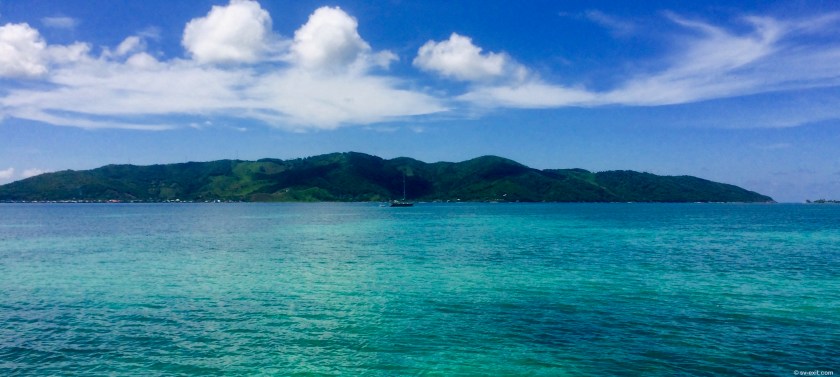
For us mere mortals, there should be solace in the knowledge that even the best get it wrong sometimes.
Real time processing of endless streams of data; monitoring charts, radar displays, and barometric readings; analysing wind, wave, and temperature figures; years of meteorological training in school; years of experience in the real world…
… all give added credibility to a best guess.
*****
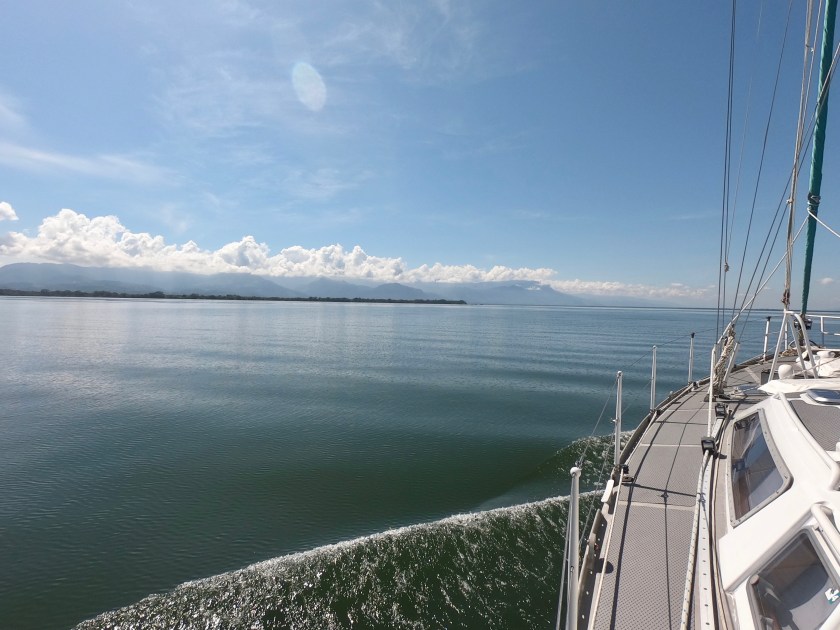
It was pretty dreary the day that we left Fronteras. The plan was to anchor in El Golfete for one last night or two before heading to Livingston. The wind was from a great angle and, had there been more than a half a knot, the sailing would have been phenomenal. Another day of freshwater motoring…
DCIM100GOPROGOPR4247.JPG
DCIM100GOPROGOPR4250.JPG
We took the Mothership on one last trip up the small river past Laguna Salvador, and anchored in the same spot we had discovered before for a couple of nights. Chris Parker had said things offshore would be pretty stinky — nine to twelve foot seas — for a couple of days following a cold front that had passed through, but that would still leave time to catch the tail end of the weather window that could take us all the way to the Caymans potentially.
DCIM100GOPROGOPR4251.JPG
DCIM100GOPROGOPR4253.JPG
DCIM100GOPROGOPR4254.JPG
And then, after a couple of days, it was time to leave El Golfete, head back down the Rio Dulce, and clear out of Livingston.
DCIM100GOPROGOPR4269.JPG
DCIM100GOPROGOPR4268.JPG
DCIM100GOPROGOPR4262.JPG
DCIM100GOPROGOPR4267.JPG
DCIM100GOPROGOPR4273.JPG
Clearing out at Livingston proved to be a cinch, just like clearing in, since we had used local agent Raul.
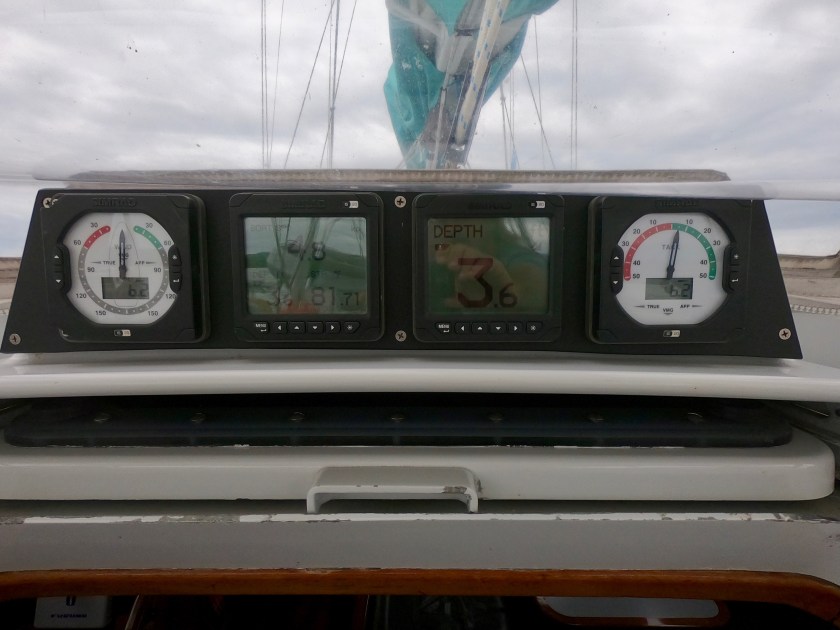
We assumed getting back across the shallow sand bar would be no problem. We would be following the exact track we had laid down on our chartplotter when we came across the other way. Imagine our surprise when the depth indicator suddenly dropped like a rock and displayed 3.6 feet.
Ahhhh… kissing the Livingston sand bar on the way past…
Draft 3.5′ and Depth 3.6’… Shallow draft, deep commitment
Obviously the shoaling had shifted over the past two months, and we found ourselves barely getting over the Livingston bar. Eeeek!
With this drama resolved, we eventually realised our wind direction/speed indicator, located on top of the mast of course, was not working properly. The paddle wheels were spinning but the wind vane appeared to be frozen in place. The wind direction was stuck head on and both the true and apparent wind speed displays were incorrect .
Not the end of the world; but not ideal to start a potentially five day offshore passage.
After a brief discussion, with less than an hour of daylight now remaining, though unprotected from increasing winds and the swell which was building as it crossed the bay, we decided it would be more comfortable to sit out the night here at anchor, rather than to try to go up the mast before morning.
Cabo Tres Puntas looking west towards Rio Dulce
We bounced around quite a bit that night. Not bad… but not great.
On the up side, at least the swell had calmed down quite a bit by morning when I went up the mast. On the down side, going up the mast made no difference, and the indicator was still not working by the time I came back down the mast. Just have to go old school… finger in the air.
And I’m not gonna lie. Not a fan of the windy-swelly conditions mast ascension.
I have heard some pretty scary stories that this doesn’t compare to. And no, it doesn’t look that wavy; but I watched swells touch the deck on the bow three feet above the waterline. And yes, the motion was more hobby-horsing forward and backward than rolling from side to side, which would have been far worse.
Don’t matter, me no likey.
DCIM100GOPROGOPR4281.JPG
62′ up the mast at anchor in wind… with Trump hair
62′ up the mast at anchor in wind
Next time, it’ll sure make going up the mast in pond-like conditions a breeze…
And speaking of breeze…
Almost as soon we got around the Cabo Tres Puntas peninsula, the wind seemed to be coming from the east instead of the forecasted north to northwest wind we expected. And then it started dying.
… the cays of Belize in the distance… no wind.
Cays of Belize in the distance
Instead of bailing out immediately, we hoped that this was a local or temporary situation, and things would improve shortly.
As we motored forward, it slowly became apparent that this was not something that was a bit off in schedule — a little ahead or behind. It was more than a bit off in overall forecast.
The prediction of sustained northern winds simply never materialised. The system had collapsed after only a day.
Shit.
Option one: turn around… which sucked. Option two: motor four or five days to Grand Cayman… which sucked. Option three: change course, head for Belize, and cough up the US$300 to clear in… better than the first two options. Option four: motor overnight, if necessary, to Utila and clear in to Honduras for US$3 each… I think we have a winner.
And so our ambitious endeavour, to sail from the Rio Dulce all the way to Grand Cayman in one swoop, disintegrated.
As an extra lump of coal in our Christmas stockings, we didn’t even get to shut down the engine on the way to Utila for more than two hours. Any wind over five knots remained right on our nose, from the east. And any prospect of tacking slowly back and forth under sail through the night was made quite unnerving by the fact that we were in a busy cargo shipping lane.
By coming around the north side of the island, we delayed our arrival to Puerto Este (East Port) until after sunrise. We knew exactly where we were planning on dropping anchor; still, we weren’t sure how busy the bay would be.
A gloomy Utila arrival Christmas morning (the photo almost looks black and white) revealed to us that there was only one other boat at anchor in Utila… unbelievable.
A Christmas serenade to Kris after setting anchor seemed in order…
Xmas Serenade 2
Xmas Serenade 2
Xmas Serenade 3
Before a 2019 Utila Christmas sunset and fireworks show…
It’s not that we have to leave… it’s more that we have to keep moving.
It seemed like a bit of an epiphany moment, for both of us.
The wooden table was wet from the sweating glasses of gin and tonics as well as Victoria and Gallo beer bottles, all less than a buck fifty during happy hour at The Shack. The pungent aroma in the air was more reminiscent of an Amsterdam coffee shop than most of the bars in Guatemala, also undoubtedly part of The Shack’s appeal. The Allman Brothers’ Whippin’ Post was the song currently challenging all of the different bar conversations in volume.
Josh was talking to Craig about the spreader construction on S/V Off The Grid. Sara, unfortunately, was trying to shake a nasty multi-day bug and had opted to sit out the night. On the other side of the table, Zoe was explaining to Kris the virtues of Swedish genetic heritage. Next to me was Tad, Craig’s best friend for over forty years who had flown in from the States to help Craig celebrate his sixtieth birthday only three days before.
It had possibly been only hours since we had fully recovered from that event.
Tad was still trying to wrap his head around Kris’ and my decision to pick up anchor and head for El Golfete and onward the following day. I guess I was having trouble fully making sense of it as well, certainly having trouble articulating it.
As Whippin’ Post started to fade out, it was replaced by the unmistakeable riff of In-A-Gadda-Da-Vida, Craig stopped Josh in mid-sentence to voice his approval of the song selection to Marvin; Tad looked at Craig and started fist pumping the air.
I continued trying to make sense of everything to Tad… we still had over a month remaining on our visa. Food, drinks and expenses were dirt cheap here. We really liked the overall vibe of the place and the people. We couldn’t always get what we wanted but we could usually get what we needed.
No… we weren’t 100% certain where we were headed. Backtracking felt like… well, going backwards. Still, we weren’t keen on Belize as the clear-in costs are quite high; Mexico anchorages are far and few in between; and Cuba just seems too out of the way now. Which leaves backtracking towards the Bay Islands or even the Cayman Islands. If we decide to sail to the Dominican Republic, trying to catch the whale season, the Caymans are along the route. If we decide we are ready to venture through the Panama Canal, we will need to pass two hundred miles offshore from Nicaragua to avoid the current security issues that area faces; an approach from the Caymans or Jamaica would be perfect.
It’s not that we have to leave… it’s more that we have to keep moving.
Sometimes it comes down to needing to get away from a place. Sometimes it simply comes down to needing to keep one’s forward momentum.
Craig alluded to this when he sent praise in our direction, for exploring areas of El Golfete and Lago Izabal that gringos who spend twenty years here haven’t seen, without actually getting stuck here for twenty years.
Four weeks of exploring overland; two additional weeks on a dock at Monkey Bay Marina; and two weeks at anchor, split between El Golfete, Fronteras, and Lake Isabel. Plus we got some stuff done. It had been a productive two months.
Visiting Guatemala has truly been a stunning experience. Inconceivably dense green forests filled with a staggering variety of birds, butterflies, and other animals make for both picturesque landscapes as well as surreal backdrops for excavated Mayan temples and ruins.
DCIM101GOPROGOPR3203.JPG
DCIM101GOPROGOPR3176.JPG
DCIM100GOPROGOPR3331.JPG
Howler monkeys
DCIM100GOPROGOPR3397.JPG
DCIM100GOPROGOPR3770.JPG
DCIM100GOPROGOPR3873.JPG
DCIM100GOPROGOPR3847.JPG
DCIM100GOPROGOPR3866.JPG
DCIM100GOPROGOPR3889.JPG
DCIM100GOPROGOPR3956.JPG
Vibrant colours stand out boldly without being at all gaudy, literally woven into every aspect of Guatemalan life: in the clothing they wear; the textiles, art, food, and architecture; at the markets.
Apparently Kris has a bag fetish
DCIM100GOPROGOPR3697.JPG
DCIM100GOPROGOPR3451.JPG
DCIM100GOPROGOPR3450.JPG
DCIM100GOPROGOPR3654.JPG
And, with the exception of that dickhead Enrique, Guatemalans are among some of the most welcoming, sincere, and friendly people we have met.
Buying corn soup from a vendor
Playing with local musician
Our favourite food stand
Walking to Aguas Caliente
In addition to seeing some amazing places during that time, we’ve had the opportunity to reconnect with our old friends Shannan and Vicki; facilitate reunions with some of our Scuba Junkie family Ollie and Flo, Nic and Gav, as well as Shane; hang out with kindred spirits Josh and Sara (S/V Off The Grid), Craig (S/V Samba Pa Ti) and his daughter Zoe; and meet incredible new friends — Tad (Go Cougs!), Mike and Anais (S/V La Flaca), and of course, Jerome (S/V Eagle Ray).
First jam w/ me, Jerome, Nigel and Tom
Added drink choices to the menu…
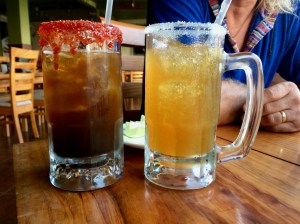
Michelada vs. Chelada
But, still, in the end… eventually, we need to keep moving.It’s not goodbye; only until next time.
Hell… it’s been ten weeks since we had a sail up!
When Chris Parker, weather guru for sailors, says: those in the Northwest Caribbeanplanning on getting east anytime in the next couple of months are unlikely to find a better sailing window than the next four or five days, it’s hard not to take heed.
That… and the fact that when birds gather in large numbers, it’s always a sign something is about to happen… especially if you start hearing dramatically ominous music in the background (cue: Alfred Hitchcock shadow).
Hmmmm…
Though we haven’t, by any means, determined an extended (beyond a week, or four) destination — Dominican Republic, Bonaire, Panama — we pretty much have to backtrack to the Caymans to get to any of the above.
Twenty five miles long and half as wide. The largest body of fresh water in Guatemala.
Despite the fact that the lake is only twenty-five feet above sea level, the looming Sierra de Las Minas range near the southwestern tip of Lake Isabel, dominates the horizon on a clear day. More typically, low clouds drifting into the valleys obscure the upper peaks, some of which range from one thousand to nearly ten thousand feet in elevation.
The Rio Dulce is fed by Lake Isabel. Whether at anchor or in marinas, those staying on the Rio Dulce for hurricane season usually hang out around the town of Fronteras, which is less than two miles downriver from the massive lake.
Surprisingly, very few people spend much time exploring Lake Isabel.
Maybe not surprising, really…
Tons of information — websites, forums, chat groups — can be found online. However, a great deal of information seems to be sourced from second or third hand accounts; or from a couple of cruising guides that are very thorough but potentially dated in their information (in one case, the newest edition is over ten years old).
When it comes to safety and security, everybody has heard something. But rarely can anyone give you first hand information. Furthermore, something may have taken place at some time; but that may have been years ago, or even a decade or more.
Just about every place has experienced crime, or violence, or both, at some time. Unless it is a recurring phenomenon, the real question seems to be whether the story has stuck over the years, or has it been forgotten?
Some places deserve their reputation.
Livingston, at the mouth of the Rio Dulce where we cleared in, is not a dangerous place, but it does have chronic theft. The advice to us was don’t anchor overnight there. Our friend had fenders that were tied to the side of his boat cut and stolen during the night; and we recently heard of a locked dinghy outboard taken from a dinghy while on its davits overnight.
Some places, like the coastlines of Somalia or Venezuela, can be quite dangerous areas to sail. Violent crimes occur regularly, piracy is an active threat, and one is well advised to steer clear. It sounds like the coast of Nicaragua is quickly becoming that way.
However, some places simply seem unable to shake an event in their history.
During a conversation with another sailor one evening, we were warned against anchoring in a specific area of the Rio Dulce between El Golfete and Livingston. Apparently people aboard a sailboat had, in fact, been killed… over ten years ago!
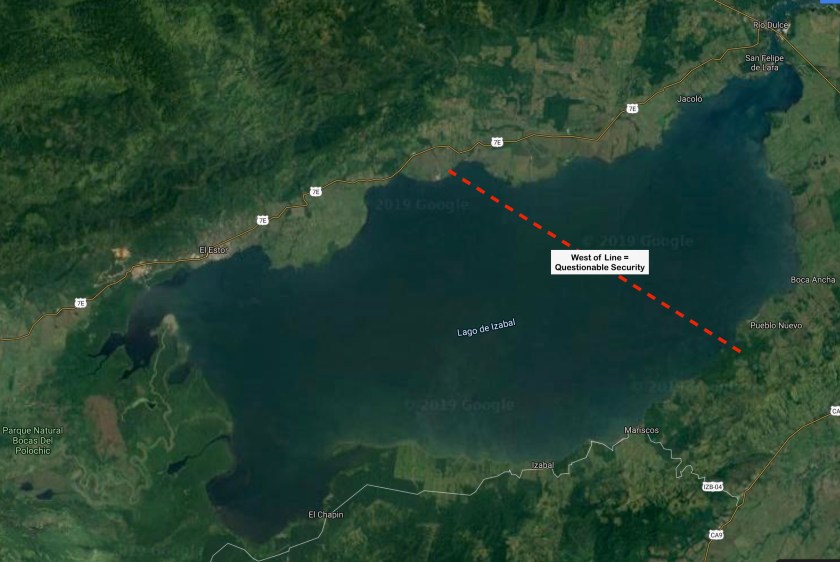
And, while we were never able to pinpoint a particular event that had occurred on Lake Isabel, one of the cruisers’ guidebooks actually specified that “all anchorages west of a specific line should be considered as questionable from a security standpoint, and you should only travel here with a buddy boat”.
For us, the whole buddy boat thing never seems to have a lot of appeal. I understand the allure of the strength in numbers approach; still, we are generally the people trying to get away from the crowd, not join the masses.
Hanging out with people because you enjoy their company and are of like kindred spirits is one thing. Hanging out because it makes you feel safer is another. I guess its either the mindset they won’t fuck with us if we outnumber them or, if one is being chased by a bear – I don’t have to be the fastest person, as long as I’m not the slowest.
Honestly, I don’t think I want to bank on someone else being a more appealing victim than myself; especially not the poor bastard right next to me.
Anyway, with the security question still definitively unresolved, we opted to venture into Lago Izabal and have a look instead of heading immediately for El Golfete (which also supposedly has its “questionable” areas).
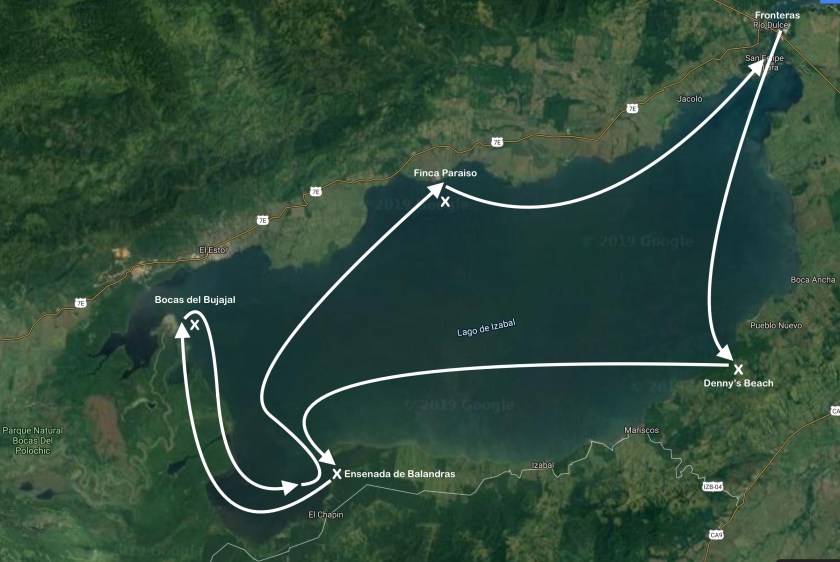
First stop: Denny’s Beach. Right at the theoretical line of demarcation between carefree bliss and dangerous frontier. We considered going ashore to visit what seemed to be a very uninhabited resort until two local water taxis deposited a couple dozen new check-ins on the dock.
After two nights, we picked up anchor and flung ourselves headlong into the unknown. Our destination, a spacious bay in the southwest corner of the lake called Ensanada Balandra (also known as El Refugio).
Approaching El Refugio
A mile and a half front to back and half mile wide, it offered unlimited and well-protected space for us to anchor.
We had now travelled almost the entire length of Lake Isabel without seeing one other recreational boat. Quite a few locals in their tiny cayucas — fishing, gathering plants at the shoreline, moving about — going about their business; offering a smile, or a wave, or more often both.
No moments of concern. The biggest risk had been running over a floating branch or a fishing net. But if the risk of collision with fishing tackle constituted real danger, then Maine would have to be considered one the most dangerous places on the planet.
Instead of peril, we found tranquility; and one of the most pleasant anchorages we’ve ever been in.
DCIM100GOPROGOPR4127.JPG
DCIM100GOPROGOPR4128.JPG
A tiny, almost completely hidden, side river that fed into the bay offered a great dinghy excursion. Endless varieties of birds, howler monkeys in the nearby trees, and even a group of manatees that we found constantly hanging out near the entrance of the bay.
Always very shy, the manatees never allowed us get to closer than about a hundred meters to them.Even when we shut off the dinghy engine and tried to stealthily paddle closer they would disappear underwater, only to surface again after a minute or two, equally distant from us as they had been before.
Only the most discerning observer would have recognised the subtle tells that our def-con status was elevated. Dinghy, outboard, and fuel all secured and padlocked on the davit at night; limited time outside the direct view of the mothership; no mast or deck lights on at night (motorised night traffic was non-existent and we wanted to avoid drawing attention after dark).
During the day, our view was the dense jungle tree line around the bay, the entrance of the bay, and the Sierra de Las Minas range which dominated the horizon, the purple silhouette of its nine thousand eight hundred foot peak sometimes emerging from the lower clouds.
DCIM100GOPROGOPR4133.JPG
At night, only one actual light on a mountainside miles away. A faint glow of light over the trees in one direction and a brighter glow from the other side of the lake in the other.
Aside from the occasional outboard engine, or airplane miles above, there were almost no human sounds outside our own. If the wind blew one direction, we could faintly hear what sounded like a heavy machinery in the far distance, from the same direction as the faint glow at night. We eventually concluded it must be the de-forestation phase for a palm oil plantation… buzzkill moment.
Five days since entering Lake Isabel. Aside from the small local cayucas, we were yet to see another boat on the water.
We picked up anchor and made our way north along the west end of the lake.
DCIM100GOPROGOPR4143.JPG
DCIM100GOPROGOPR4147.JPG
Conflicting information had left us uncertain as to where the best anchorage would be. All we knew was that there were multiple bays of unknown depth, a nickel mine which may or may not be active, and a town called El Estor (or “the store”, supposedly named from the days pirates sailed Lago Isabel and would visit the town to buy or loot supplies).
Departing Ensanada Balandra, clearing around the peninsula which comprises one side of the bay, we were visited once again by the manatees, who waved us off from a comfortable distance of about a hundred meters… cheeky.
We headed for the barely visible smokestack of the nickel mine ten miles to our north.
And as we grew nearer, through our binoculars, we spotted sailboats.
Not pirate boats… but rather, buddy boats – two monohulls and a cat.
Three. At anchor. Closer than we’d want to be to the nickel mine and El Estor.
Bocas del Bajajal, the bay we’d hoped to tuck into, was either too shallow for us, or we simply couldn’t find a deep enough channel to give us access. So we opted to anchor just outside it, a quarter of a mile or so from the three sailboats.
DCIM100GOPROGOPR4154.JPG
DCIM100GOPROGOPR4158.JPG
Any question as to whether the sailboats were together was laid to rest when, after about thirty minutes, one after another, each boat picked up anchor and moved an equal distance away on our opposite side. We could never quite figure that one out.
Also strange was the fact that, at night, two of the boats kept their mast and deck lights off (like we had been doing), but the third boat was lit up. Hmmm. Perplexing…
Maybe a lack of communication. Maybe a disagreement in strategy. Maybe an intentional (or unintentional) allocation to decoy status on the part of the lit boat. Strange…
After watching a few local boats carefully pick their way amongst a network of, for lack of a better term, navigational sticks near the shore in order to gain access to a small river next to our anchorage, we followed suit and found ourselves exchanging distant looks with dozens of howler monkeys occupying the trees along the shoreline.
The Rio Polochic, very busy in the past when it was used for hauling goods downstream to El Estor, today only had a couple of local fishermen and a few small boats headed to communities upriver. Though it stretches some thirty or more miles, we didn’t get much farther than a couple of miles before turning around.
The nickel mine, a bit more than a mile to the northeast of where we were anchored, was in operation. Big, gaping wounds in the earth surrounded the mine where the Guatemalan jungle had been peeled back by machinery to expose the dirt and rock underneath.
Especially at night, the endless drone of the conveyer belts and mining equipment, as well as powerful industrial lights which illuminated smoke constantly belching out of the stacks, provided a staggering incongruity with the surroundings.
El Estor, two miles further along the shore to the east, also seemed out of place in the surroundings, with its even brighter glow at night and constant layer of haze over the town during the day.
After two nights, we were ready to return to the unequivocal solitude of Ensanada Balandra (El Refugio) on the other side of the lake… the buddy boats could have their nickel mine.
DCIM100GOPROGOPR4168.JPG
DCIM100GOPROGOPR4169.JPG
DCIM100GOPROGOPR4170.JPG
DCIM100GOPROGOPR4174.JPG
DCIM100GOPROGOPR4165.JPG
DCIM100GOPROGOPR4184.JPG
During our return stay at El Refugio, a cayuca pulled up alongside Exit while we were at anchor, which hadn’t happened yet. A man named Roberto and his son were out fishing for the day and night.
The boy sat silently at the bow, reluctant to speak even when asked a question. The man, however, was quite chatty… without speaking a word of English.
We were able to put together bits and pieces of conversation — the community just outside the bay where they were from; the fact that the fishing sucked right now.
Curiously, we both got the impression that he seemed rather sad that very few boats came to visit the bay. He was very adamant to convey to us that the area was not dangerous and that we should not worry about being disturbed.
Eventually, the man wished us an enjoyable stay, started up his outboard, and they set off towards the shore to reset their nets.
He seemed like a genuinely friendly guy; and I remember feeling somewhat guilty afterwards for not having had the presence of mind to offer up a bit of fuel as a goodwill gesture. Paying forward never hurts.
Although this anchorage, for peace and solitude, was certainly top-shelf, we decided only to stay one additional night. We had already been out here on the lake for a week; and our provisioning prior to departing Fronteras had not been exceptionally long-term in its scope.
We were now out of beer, bread, most of our fresh fruits and vegetables, as well as data for our phone (which gave us our only internet access).
The one thing out here that had been even more sparse than people was wind.In eight days, there had not been a single time when the wind was over a few knots before mid to late afternoon.We had a couple of blustery squalls here or there; but even those were generally closer to sundown or at night.
So, there was a lot of motoring done to get from one place to another on Lago Izabal.Oh well… you can’t have it all.
About halfway back to Fronteras, on the other side of the lake, we stopped to anchor just offshore of a small community called Finca Paraiso.
DCIM100GOPROGOPR4223.JPG
This was the only other place we saw another sailboat while we were on the lake. They anchored quite a reasonable distance away from us, late in the afternoon. It made the fourth sailboat in a total of eight days… unbelievable. Including us, not more than five visiting boats on the entire lake.
The following morning, we took the dinghy ashore and walked about an hour along a gravel road, past fields and pastures, until we reached a natural hot springs, appropriately named Aguas Caliente.
Walking to Aguas Caliente
DCIM100GOPROGOPR4190.JPG
DCIM100GOPROGOPR4193.JPG
DCIM100GOPROGOPR4195.JPG
DCIM100GOPROGOPR4216.JPG
DCIM100GOPROGOPR4217.JPG
Tons of hot, sulphur-springs fed water cascaded down over rocks long covered with surreal looking mineral deposits from the spring water, creating a twenty foot tall waterfall which fed into the cool water of the small river at its base.
DCIM100GOPROGOPR4214.JPG
DCIM100GOPROGOPR4212.JPG
DCIM100GOPROGOPR4204.JPG
DCIM100GOPROGOPR4201.JPG
DCIM100GOPROGOPR4210.JPG
Standing at the bottom of the waterfall, the sensation was quite bizarre —- not only the spring water almost, too hot to stand under, and the rather cool water from the river the hot springs fed into — but also from the crazy fish all around that relentlessly chewed and nibbled at our legs and feet.
Even more strange, was seeing our friend Craig, from S/V Samba Pa Ti, who had just happened to come via a collectivo bus to visit Aguas Caliente on the same day. A mutual WTF moment.
Later, while we enjoyed a couple of beers at one of the beach bars at Finca Paraiso, watching Exit sit at anchor on water that was nearly perfectly flat, we met Mike and Anais from S/V La Flaca, the small sailboat that had anchored about a thousand feet from us.
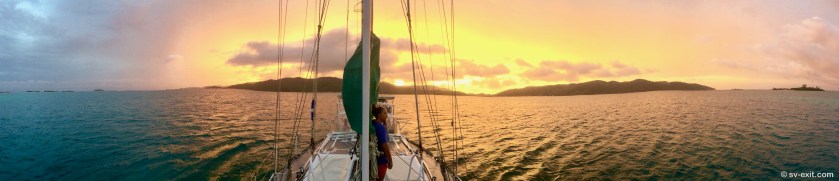
Then, after a fabulous day ashore visiting the hot springs, one last sunset on Lake Isabel, just offshore from Finca Paraiso…
DCIM100GOPROGOPR4225.JPG
DCIM100GOPROGOPR4230.JPG
The next day, we returned to Fronteras. Passing under the bridge (one of our favourite pastimes) was the all clear signal that we had returned safely from our adventures on Lago Izabal.
DCIM100GOPROGOPR4237.JPG
DCIM100GOPROGOPR4240.JPG
After finding a way to get beyond all the hype and uncertainty, we had once again figured out a way to successfully navigate the unknown…
For all its endearing qualities, Guatemala certainly has its share of some pretty weird shit going on.
There is no postal system in the whole country, for fuck sake. Really?
Be that as it may, one thing can be said with absolute certainty: Guatemalans recognise a shady and corrupt politician when they see one, and they have seen plenty.
**PART TWO OF OUR OVERLAND ADVENTURE BETWEEN GUATEMALA AND MEXICO**
Mexico or BUST
We felt confident, as did most of the locals who WERE certain we’d been screwed by Enrique, that Tikal was probably not a concern. It was getting to the Mexican border, and then onward to Palenque, that was seriously in doubt. As for the Palenque to Playa del Carmen connection? Ha… just getting as far as Palenque was highly unlikely.
A number of other tourist companies had indicated to other people that they had completely discontinued that run.
Ya… ya. We now knew about Enrique. Ya…ya. We shouldn’t have given him money. Ya… ya. We had subsequently read all the posted shit.
That morning, as we waited to be picked up outside our hostel , yet another tour operator stopped and asked what we were waiting for.
A transfer to Playa through Palenque? From the guy with a scar? Why do you guys keep giving him money? There’s not gonna be any bus…
Ya… ya. We’ve heard.
A taxi rolled up and stopped.
That’s your ride. Good luck.
We got in. The taxi stopped at the shuttle drop off. But instead of us getting out, two more passengers got in. A high strung, nervous Filipino woman we had met the day before; and a backpacker from Spain, who (of course) spoke Spanish fluently.
They had paid to get to Palenque as well. The high strung, nervous Filipino woman had given her money to a guy with a scar on his face. People had told her she’d been screwed. She spoke almost no Spanish and was already arguing with the taxi driver, who spoke almost no English. The other woman didn’t seem too concerned.
There’s not gonna be any bus…
Apparently, there was no bus… but, there was a taxi.
Across the street, Enrique pulled a handful of bills from the stack in his fist, and handed them to the same taxi driver.
Four passengers paid instead of two… make sure they get to Palenque. Easier to get them there than refund them all here.
As we pulled away, the “thumbs up” Enrique gave us was downright creepy.
Eventually, thanks in large part to the Spanish woman, the taxi driver seemed to warm up. It seemed less and less likely with each passing mile into the isolated countryside that the driver was going to pull over and shoot us.
Twice, the taxi had to stop for military road blocks. Once, I’m pretty sure I saw a one hundred Quetzal note pass from the driver’s hand into the hand of the guy with the automatic weapon during a handshake.
Four passengers paid instead of two… make sure they get to Palenque.
As morning became afternoon, we arrived at the Mexican border. The taxi couldn’t cross. We had to walk across, get our stamps from both the Guatemalan and Mexican authorities, and then wait on the other side of the fence.
Road Checkpoint
Walking across the border
Crossing into Mexico
Someone will pick you up. The taxi driver was waiting on the other side of the fence. In Guatemala.
After an hour, no one had shown shown up. One driver on the Mexican side of the fence had asked if we already paid for our transport. When we said yes, he informed us someone else will come.
Still no one.
Eventually, we saw the original taxi driver on the Guatemalan side of the fence. He was on the phone.
There’s not gonna be any bus…
A short time later, he was passing part of the stack of bills Enrique had given him to another driver on the Mexican side of the fence.
Someone will pick you up.
He signalled that this was the shuttle that would get us to Palenque. Yes… it was paid for.
Four passengers paid instead of two… make sure they get to Palenque.
We piled into the car. Four hours later, we were dropped off at the bus station in Palenque. Inside, we stepped up to the ticket booth. The woman didn’t speak English at all.
She looked at the “voucher” and smiled. No… we definitely did not have tickets already reserved in the system. Yes… it would cost us about one hundred US dollars to buy tickets from Palenque to Playa del Carmen. No… she probably didn’t know Enrique.
Four passengers paid instead of two… make sure they get to Palenque. Only two paid for the final connection… and they’ll be in Palenque when they find out the truth.
Paying too much for tickets, that was one thing. But we had been sold tickets that didn’t actually exist… a whole different level of asshole.
But, hey as far as getting screwed, it could have been a lot more painful screwing.
Enrique is a weasely, dishonest, and unethical fat bag of shit. Although returning to Flores to confront him could be potentially very satisfying, the Cartel connections (he more than likely has) make that prospect almost certainly a much more foolish venture.
Dumb mistake already made. Best not to make an even dumber one.
Playa del Carmen
Some reunions can be orchestrated, some are the perfect fortune of unscheduled converging orbits, some are completely random and unforeseen. Sometimes you get all of the above.
Such was the case for us in Mexico.
A planned reunion with Shannan and Vicki, our oldest and dearest friends from Pullman, who would be in Playa del Carmen for nearly two weeks.
Mostly eating and drinking, with an occasional wander around town or even out to Cozumel for the day.
DCIM100GOPROGOPR4025.JPG
Michelada vs. Chelada
It is when you get to see the people most dear to you that you can truly appreciate how special those moments really are.
Also, to our delight, three additional people would emerge from our Scuba Junkie past during that same time.
After almost three years, it was incredible to see Nic and Gavin again. Not only catching up with them over food and lots of drinks; but also a day diving the two ridiculous cenotes, The Pit and Dreamgate. It’s cool enough to go diving with SJ family, even better that we are returning to Dreamgate, a magical cenote we had the fortune of diving over fifteen years prior. At that time, it had only been discovered a few months earlier and we were among the first two dozen people that had even been inside. It was special to be able to share that with two old SJ friends from the other side of the world.
DCIM100GOPROGOPR4103.JPG
DCIM100GOPROGOPR4069.JPG
DCIM100GOPROGOPR4062.JPG
DCIM100GOPROGOPR4072.JPG
DCIM100GOPROGOPR4091.JPG
At The Pit, while we were changing over tanks, a woman in the pickup parked next to us recognised Gavin’s Scuba Junkie shirt. An American who worked for another dive shop on Mabul nearly ten years ago remembered me from the MBR bar… fucking crazy.
And, at Dreamgate, our first tarantula in the wild. Anyone who knows Kris, knows this was not a highlight of her day.
DCIM100GOPROGOPR4109.JPG
DCIM100GOPROGOPR4104.JPG
And later that day another SJ face from the past, a Canadian named Shane along with his girlfriend Sheena, caught up with us for the food and beverage part of the reunion. The fact that he, too, was in the same location made the statistics seem impossible.
Sometimes the scale of everything seems vast and endless; impossibly unlikely in its particulars. Other times, it seems like Jerry Falwell or Rod Serling are the only people who can offer plausible answers to impossible realities.
Fucking weird… must be the converging energy vortex.
Oh ya… and more random jams in bars. This one with a smoking’ blues band one night while wandering in Playa del Carmen.
Have to go through Flores, eh?
Turns out, you pretty much have to pass through Flores in order to get back to the Rio Dulce, whether through Palenque (which we had no desire to pass back through), or Belize City (which might cost us just to cross the border).
Turns out, once you get back to back to Flores, it’s really hard not to walk past Enrique’s tourist office. Just a matter of principle. Just to have a chat.
Turns out once he screws you, you pretty much won’t see Enrique if you arrive at the office looking for Enrique.
Maybe… it’s for the better.
Maybe… one of those pivotal moments you never realise. You don’t realise it because Enrique wasn’t actually there to make everything suddenly turn out potentially very differently… potentially very badly.
Survival… as a rule, a higher priority than revenge or justice.
Maybe… it’s for the better; part of that converging energy vortex.
Less than twenty four hours in Belize
If you’re in Belize for less than twenty four hours… you only pay US$32.50 instead of $40 to clear out… sweet? Ok. Fuck… really? What’s it gonna take to get back to Exit?
At least we scored on two litres of coveted Belize One Barrel Rum during our stopover at the Belize City bus station… yes!
It was literally off the bus at the Mexico/Belize border, walk across the border after clearing past authorities on either side, then back on the bus. Off the bus again at Belize City to purchase a ticket onward directly to Rio Dulce, wait four hours at the bus station (during which I had a wander into the nearby market and secured the two bottles of One Barrel), then back on a bus to the Belize/Guatemala border… less than twelve hours total inside Belize and a savings of fifteen dollars with Immigration.
Back to the Rio Dulce
A lot of shit needed to be done aboard Exit. Nothing that required a haul-out; but a handful of things that would certainly be easier with marina access.
Plus we definitely could use the free water. We had filled tanks using the watermaker once since entering the Rio Dulce, but had heard mixed advice and were trying to avoid it, if possible.
So…
Re-galvanise Rocna anchor
Replace Perkins oil and filter
Replace Racor and Perkins fuel filters
Replace the fuel hoses we had made in Roatan
Clean and waterproof dodger cover
Clean and waterproof bimini
Clean and oil interior wood
Sort out dinghy chaps
Sort out deck sun shades
Sort out bimini side sun shades
Replace the propane hose we had made in Roatan
Refill the near empty propane tank
Add spray insulation around fridge and freezer shells
Update our Navionics software (and set up our new iPad)
Fill the water and fuel tanks
A serious list. Certainly not everything. But an admirable dent for one stop. Everything but the Sunbrella work and the anchor re-galvanising we were able to do ourselves.
We were ecstatic with our dinghy chaps and deck sun shades (which included an outboard cover), made by a local canvas guy named Nery. His work was top quality, and he had everything done by the time we had returned.
Temperature on deck without sun shades
Anchor re-galvanised
Before…
Transporting to RAM Marina
Anchor re-galvanised
But we were ready to cast Exit’s lines off the dock pilings and get back at anchor, damnit!
Giving Thanks
Thanksgiving Day in a marina… ewww.
Yes. The food was fabulous.
Yes. Both the hospitality and kindness were limitless.
Yes. The mean age of those in the marina had to be in the seventies.
Yes. We were uber-thankful to be getting back at anchor in two days.
We had promised the marina managers we’d be out of the slip by the end of the month. There were still a handful of things on the to-do short list, but they could wait days or weeks, and certainly didn’t require being tied up at a marina.
The three-country-road-trip was well worth all the effort. However, neither of us could deny, we were both eagerly anticipating the chance to let Exit, once again, swing with the wind at the end of her anchor chain…
Ten days in Fronteras gave us just enough time to acclimate to the area, get some logistics sorted for our land journey to Mexico, start the process on a couple of boat projects which would be undertaken while we were away (re-galvanising our Rocna anchor as well as having dinghy chaps and sun covers made).
The town of Fronteras, in many ways, reminded us of a much nicer smelling Semporna (from our Scuba Junkie days in Borneo).
Fronteras Main Street
Fronteras Main Street
Bees attracted to corn in the market
Tight squeezes
Over the Fronteras bridge
The bay in front of The Shack
Back yard view
Good fishing in the back yard
Mmmmm… pizza good
The Shack, one of the bars on the waterfront, quickly became a favourite place to hang out. Gin and Tonics for less than a dollar fifty were the initial draw. The owner, Marvin, is a great guy who offers open mic night every week, which opened the door to meeting a really talented musician named Jerome.
Every now and then, our paths place us in an orbit with some really fascinating people… and Jerome is certainly one of those people. Not only did he have some great stories as well as a lot of insight for us as sailors, but he was also an awesome front man on guitar, harmonica, and vocals for me to jam with during two different open mic nights and even a late night jam in the cockpit.
I couldn’t understand some of the scientific vocabulary used by the hyperbaric physicist, and some of the things I could understand just seemed downright bat-shit mental. But, one thing for sure, I always enjoyed Jerome’s company. And he has damn fine taste in guitars… long live Guild!
First jam w/ me, Jerome, Nigel and Tom
First jam w/ me, Jerome, Nigel and Tom
Late night jam in the cockpit
Second night at the Shack
Second night at the Shack
Second night at the Shack
Second night at the Shack
Two Guild guitars
But now it was time to leave Exit tied to the dock at Monkey Bay Marina, and head further inland to do some land-based traveling by bus.
Exit under house arrest
We had figured out a route through Guatemala and Mexico, that would get us to Playa del Carmen in time to see old friends while still making a number of stops along the way to see more friends and take in the sights.
On paper, our route roughly resembled what could have been a child’s drawing of a sailboat… ironic. In actuality, there was no mistaking it… we were definitely back on the dirt.
… and back on the bus. For Kris’ birthday, no less.
Kris’ birthday on the bus
Antigua
Described in one guide book as: afantasyland that would never be included in a list of authentically Guatemalan experiences. Building codes are adhered to, garbage in the streets is picked up, and stray dogs mysteriously disappear during the night… more like what a Guatemalan town would be if Scandinavians had taken over for a couple of years.
We liked it.
Less aggressive hawking. Very chilled environment. Amazingly vibrant colours covered the walls of century old buildings with the most striking and eclectic display of front doors we have ever encountered. Timeless (and horribly difficult to navigate) stone streets remain untouched as part of the agreement securing Antigua’s UNESCO Heritage status.
DCIM100GOPROGOPR3432.JPG
DCIM100GOPROGOPR3434.JPG
DCIM100GOPROGOPR3439.JPG
DCIM100GOPROGOPR3443.JPG
DCIM100GOPROGOPR3442.JPG
DCIM100GOPROGOPR3444.JPG
DCIM100GOPROGOPR3445.JPG
DCIM100GOPROGOPR3446.JPG
DCIM100GOPROGOPR3447.JPG
DCIM100GOPROGOPR3450.JPG
DCIM100GOPROGOPR3451.JPG
DCIM100GOPROGOPR3452.JPG
DCIM100GOPROGOPR3453.JPG
DCIM100GOPROGOPR3454.JPG
DCIM100GOPROGOPR3458.JPG
DCIM100GOPROGOPR3464.JPG
DCIM100GOPROG0013468.JPG
DCIM100GOPROGOPR3467.JPG
DCIM100GOPROGOPR3474.JPG
DCIM100GOPROGOPR3480.JPG
DCIM100GOPROGOPR3481.JPG
DCIM100GOPROGOPR3500.JPG
A brief reunion with Craig’s daughter Zoe, who now lived in Antigua, put us on the inside track to a couple of memorable bars.
DCIM100GOPROGOPR3503.JPG
DCIM100GOPROGOPR3502.JPG
Cafe No Se, a bar opened by an American expat twenty years prior, had an incredible story behind it, as relayed to us by its fascinating owner John. Dark and mood lit with surreal towering wax candle sculptures, it had all the vibe I would imagine of a Prohibition-Era Speak Easy.
Complete with a small book store hidden behind an antique refrigerator door attached to the wall — the location where illegal bootleg mescal had been sold in the early days of the bar — the now legal, but still fittingly named Illegal Mescal, had recently placed second in international tequila competitions.
The Irish bar Snug also turned out to be a great source of pub food and happy hour specials, with the exception of a near heart attack inducing hour when Kris thought she had lost her iPhone one night… eek!
The Earth Lodge
An eco-lodge on the side of the mountains with a perfect view of Antigua down in the valley surrounded by volcanos. On a clear enough night, we could just see the red glow of actual lava spewing out of the active volcano Fuego.
We decided to move each day from one to another uniquely designed bungalow, just to have a different view of the valley. Quiet and tranquil would be an understatement. More than easy to do absolutely nothing for a few days.
DCIM100GOPROGOPR3587.JPG
DCIM100GOPROGOPR3586.JPG
DCIM100GOPROGOPR3621.JPG
DCIM100GOPROGOPR3596.JPG
DCIM100GOPROGOPR3633.JPG
DCIM100GOPROGOPR3634.JPG
DCIM100GOPROGOPR3588.JPG
DCIM100GOPROGOPR3610.JPG
DCIM100GOPROGOPR3582.JPG
DCIM100GOPROGOPR3597.JPG
Kite Festival of Sumpango – Day of the Dead
The Day of the Dead. Though it sounds more like an episode from the Zombie Apocalypse series, it is actually more of a family oriented celebration tying the the living to the dead. Families gather in cemeteries for picnics, offerings are made to the deceased, and attempts to communicate with the dead are initiated.
For nearly twenty years, the tiny town of Sumpango hosts thousands of people attending the Gigantic Kite Festival every November first, celebrating the Day of the Dead. The elaborate kites, ranging in size from a couple of meters to six meters in diameter, are displayed on a football field. Eventually, all but the largest will make an attempt at flight amongst a field of onlookers.
DCIM100GOPROGOPR3684.JPG
DCIM100GOPROGOPR3687.JPG
DCIM100GOPROGOPR3690.JPG
DCIM100GOPROGOPR3692.JPG
DCIM100GOPROGOPR3693.JPG
DCIM100GOPROGOPR3697.JPG
DCIM100GOPROGOPR3698.JPG
DCIM100GOPROGOPR3702.JPG
DCIM100GOPROGOPR3718.JPG
DCIM100GOPROGOPR3723.JPG
The kites, constructed and flown by families commemorating the deceased, are considered conduits through which communication between the living and dead can be enhanced.
It’s a county fair vibe, with the added flare of potential risk of injury or death from a gigantic flying toy.
DCIM100GOPROGOPR3651.JPG
DCIM100GOPROGOPR3650.JPG
DCIM100GOPROGOPR3648.JPG
DCIM100GOPROGOPR3654.JPG
DCIM100GOPROGOPR3663.JPG
DCIM100GOPROGOPR3644.JPG
DCIM100GOPROGOPR3671.JPG
DCIM100GOPROGOPR3727.JPG
DCIM100GOPROGOPR3731.JPG
DCIM100GOPROGOPR3742.JPG
DCIM100GOPROGOPR3745.JPG
DCIM100GOPROGOPR3747.JPG
Lake Atitilan
Apparently one of a handful of places on Earth located in the midst of an energy vortex of some cosmic significance well beyond my comprehension… which essentially seemed to mean a universal convergence point for a lot of pot smokers and yoga instructors.
The view
Buying corn soup from a vendor
Trying the local Michelada
Apparently Kris has a bag fetish
Before taking a water taxi to the town of Santa Cruz, we stopped at a restaurant/bar at the edge of the lake for drinks, where I befriended one of the local musicians. Later we learned that a man who owed the Cartel money was executed outside this very restaurant one morning, just a day or two after these photos were taken… fucking hell.
DCIM100GOPROGOPR3755.JPG
Playing with local musician
DCIM100GOPROGOPR3753.JPG
The area… picturesque, without a doubt. A huge lake surrounded by dormant volcanoes covered in lush jungle.
DCIM100GOPROGOPR3749.JPG
DCIM100GOPROGOPR3750.JPG
DCIM100GOPROGOPR3756.JPG
DCIM100GOPROGOPR3773.JPG
DCIM100GOPROGOPR3770.JPG
DCIM100GOPROGOPR3769.JPG
DCIM100GOPROGOPR3766.JPG
DCIM100GOPROGOPR3764.JPG
DCIM100GOPROGOPR3767.JPG
Even better, another Scuba Junkie reunion. This time with Ollie and Flo, two old SJ friends. Ollie, one of our dive master trainees from ten years back, with Flo, now manage Isla Verde, a beautiful resort located right at the edge of the lake.
It was the first time we had the pleasure of meeting their 3 year old son, Henry — obviously a sailor in the making who, when shown a photo we took in Antarctica of a penguin which occupied eighty percent of the photo’s field of view, Henry managed to point out the tiny, out-of-focus boat in the background. Good skills swab!
We can’t thank Ollie and Flo enough for all their hospitality, as well as thanks to Isla Verde’s owner Riley. Its alway amazing to see Junkies in strange places.
And… traditional American blues guitar artists playing during the nightly happy hour on a REAL record player? In the jungle of Guatemala? Really? Holy shit! Now that is righteous.
Though we didn’t quite achieve that performance level at open mic night, to be fair… everyone was pretty trashed. Good times.
On a bit of a side note… I must admit that, once again, I was the individual responsible (or irresponsible should be the term) for the bar’s gin stock running dry. One of the dangers of having Gin & Tonic specials!
Flores (Suckers making a rookie mistake)
We had just taken an overnight bus from Lake Atitlan, requiring a bus transfer in Guatemala City that ultimately dropped us off just outside the island town of Flores.
Buses, in Central and South America, are a remarkably comfortable and affordable travel option. The “executive first class” option lands you in a seat comparable to a Lazy-Boy recliner in comfort, usually for well less than a hundred dollars.
However, the temperature inside the bus’ lower deck can be that of a meat freezer. The only possible justification we could conjure up was an attempt at maximum air ventilation, without which could result in sleeping inhabitants fatally succumbing to either diesel or latrine fumes.
When we stumbled off the bus just after sunrise, our brains may have actually been mildly hypothermic. We waded through the first wave of taxi drivers and asked a small old man toward the back of the group to take us to the hostel Kris had reserved before we left Isla Verde.
Over the course of the next hour we made a number of what can only be described as inexcusable rookie mistakes that left us scratching our heads at our own stupidity and complacency a short time later.
Inexplicably, by seven a.m., we had made and paid for reservations not only to the ruins of Tikal, but also for bus tickets to the Mexican border and onward to Playa del Carmen.
By nine a.m., we had realised there was a high probability we had been suckered.
The battery in Kris’ iPhone, which had died on the overnight bus trip twelve hours earlier, preventing any online research while we were underway, was now sufficiently charged. Enough so for Kris to start finding all kinds of TripAdvisor and other online warnings regarding the dishonest and unethical business practices of Enrique – the same fucker who had just sold us the tickets.
If we had paid too much for tickets, that was one thing. But if we had been sold tickets that didn’t actually exist… that would be a whole different level of asshole.
We decided a visit to the tourist police INGUAT was worth the time. However, in a very broken conversation we were able to ascertain that, while yes, they were well familiar with the shady business practices of Enrique the scar-faced Cartel thug, they couldn’t do anything in this instance until after he had actually ripped us off… fuck.
They made copies of everything we had and sent us on our way, inviting us to contact them if it all went to shit.
Tikal
Test question number one from the “Did Enrique really screw us?” inquiry was whether we would even be picked up for the day trip to the Tikal ruins.
We were… and to be fair with full disclosure, it was a great day trip. The guide Ruben, a Mayan descendent who was living on part of the land converted to national park when Tikal gained UNESCO Heritage status, was incredibly knowledgable and had a personal stake in passing on the history as well as carrying on the legacy of Tikal.
The Maya were aware that the earth was round and orbited the Sun. Maya hieroglyphic script is one of only five basic writing systems ever developed in the history of mankind. The Maya calendar, over five thousand years in its cycle, is more accurate than the Gregorian calendar currently in use. They were the people from which the Aztec and Inca civilisations emerged.
For over a thousand years, Tikal represented the heart of the Maya civilisation. The city’s structures, built between 600 B.C. and 900 A.D., pre-date both Machu Picchu and Chichen Itza. And yet, ultimately, Tikal was mysteriously abandoned within one hundred years time.
The already excavated structures number only a fraction of the thousands of earthen mounds scattered throughout the area. Mounds that hide additional currently undisturbed Mayan ruins, have remained swallowed by the thick Guatemalan jungle for over a millennium.
DCIM100GOPROGOPR3781.JPG
DCIM100GOPROGOPR3783.JPG
DCIM100GOPROGOPR3789.JPG
DCIM100GOPROGOPR3794.JPG
DCIM100GOPROGOPR3839.JPG
DCIM100GOPROGOPR3790.JPG
DCIM100GOPROGOPR3840.JPG
DCIM100GOPROGOPR3847.JPG
DCIM100GOPROGOPR3793.JPG
DCIM100GOPROGOPR3798.JPG
Wandering around the remnants of what had once been a gleaming central hub for tens of thousands of people was surreal. Massive limestone temples and structures silently emerged from their still partially buried states, peaking out above the upper canopy of the surrounding trees. Even with their staggering scale, they struggle to remain free, as the jungle relentlessly seeks to reclaim them.
DCIM100GOPROGOPR3864.JPG
DCIM100GOPROGOPR3866.JPG
DCIM100GOPROGOPR3907.JPG
DCIM100GOPROGOPR3904.JPG
DCIM100GOPROGOPR3859.JPG
DCIM100GOPROGOPR4004.JPG
DCIM100GOPROGOPR3956.JPG
DCIM100GOPROGOPR3912.JPG
DCIM100GOPROGOPR3846.JPG
Later, it was amazing to learn that, fifty years before, my Mom’s sister had cooked breakfast on a Sterno stove atop one of the same Tikal ruins we were currently standing on… crazy.
With the 2019 Caribbean hurricane season nearing its end, we finally made it to Guatemala. Despite our intentions of a July arrival to the Rio Dulce — a location with a long established history of protection from Caribbean storms — it was now October. Had we waited any longer, the boat traffic we would have encountered on our way in would have mostly been departing in the opposite direction to start their sailing season. Ya… we were a solid three months behind most everyone else… but hey, what’s new?
The hundred fifteen mile overnight sail from Utila covered the entire spectrum ranging from sublime downwind sailing, to frustrated motoring with zero wind, to a twenty five knot squall smashing us from dead upwind.
Strangely, earlier in the day, all three boats had been visited repeatedly by a roving group of very curious and seemingly unseaworthy birds.
Later, with the sun touching down on the horizon almost directly in front of us, we were treated to the privilege of being escorting into the sunset by a pod of dolphins riding Exit’s bow wake.
Exit, Samba Pa Ti, and Off The Grid had all picked up anchor and set out from Utila within an hour of each other; however, any semblance of unity (often loosely defined as three specks stretched across the horizon) instantly disintegrated when the evening squall hit. All three boats scattered in different directions and it would be twelve hours later, outside Livingston, Guatemala, before we saw either boat again. Fortunately, the only casualty was a flying fish discovered later on deck (not so fortunate for the fish…)
The following morning, having just concluded our overnight watches pounding through the sloppy conditions left behind by the squall, we patted each other on the back in recognition of surpassing eight thousand nautical miles travelled aboard Exit.
Utila to the Rio Dulce
After anchoring in the bay of Cabo Tres Puntas, directly opposite the mouth of the Rio Dulce for a short rest time, we experienced a rather painless clearing in at Livingston. Thanks to an early enough start, were fortunate to be able to head immediately up the river, saving us from having to anchor overnight in Livingston, which had a sketchy reputation.
Conversely, Samba Pa Ti spent the night there, hoping to sort out ongoing fuel line problems. Apparently the streak of Honduran bad luck had gone international and crossed over to Guatemala with them, as Craig promptly had the fenders stolen off the side of his boat that night!
Cabo Tres Puntas, Guatemala
Livingston, Guatemala
We had heard endless stories about how stunning the journey up the Rio Dulce was… it had been anticipated as our hurricane season hideaway for months and months.
Now, after sitting in the middle of what was predicted by both history and our insurance company to be a hurricane risk hotspot — and subsequently having watched storm after storm pass up the U.S. East Coast, through the very area our insurance company had recommended we be at — we were finally here!
Traveling up the Rio Dulce, Guatemala:
Nearly ten miles of tranquil river, winding its way through the Guatemalan jungle. Incredibly dense foliage stretching outward in all directions, sometimes looming atop limestone cliffs carved out three hundred or more feet directly above.
We’re motoring instead of sailing, unfortunately; but it’s still magical.
DCIM101GOPROGOPR3170.JPG
DCIM101GOPROGOPR3171.JPG
DCIM101GOPROGOPR3176.JPG
DCIM101GOPROGOPR3181.JPG
DCIM101GOPROGOPR3187.JPG
DCIM101GOPROGOPR3199.JPG
DCIM101GOPROGOPR3203.JPG
Every now and then, a small group of buildings emerge along the shoreline ahead.
The chances are almost equal that the occupant of the small dugout style cayuca fishing near the shore is an over forty year old woman or a twelve year old boy.
After two hours of snaking our way back and forth, mostly in solitude, the Rio Dulce expands out into a lake called El Golfete. On one side, a number of small community bays; on the other side, largely no development whatsoever.
After a few days at anchor in Texas Bay, we ventured out to explore other anchorages.
DCIM101GOPROGOPR3270.JPG
DCIM101GOPROGOPR3261.JPG
DCIM101GOPROGOPR3267.JPG
Oftentimes, our dinghy proved to be the absolutely invaluable resource, especially when it came to exploration.
DCIM100GOPROGOPR3316.JPG
DCIM100GOPROGOPR3331.JPG
DCIM100GOPROGOPR3327.JPG
DCIM100GOPROGOPR3325.JPG
DCIM100GOPROGOPR3316.JPG
DCIM100GOPROGOPR3314.JPG
DCIM100GOPROGOPR3309.JPG
DCIM100GOPROGOPR3307.JPG
DCIM100GOPROGOPR3298.JPG
DCIM100GOPROGOPR3294.JPG
DCIM100GOPROGOPR3282.JPG
DCIM100GOPROGOPR3280.JPG
DCIM100GOPROGOPR3273.JPG
Following a dinghy reconnaissance up a small unsounded and inaccurately charted river, we became confident enough to return with the Mothership and feel our way along, eventually dropping anchor in a spot that seemed like complete jungle isolation (with the exception of a few local boats occasionally passing by with wave and a smile.
DCIM100GOPROGOPR3348.JPG
DCIM100GOPROGOPR3346.JPG
DCIM100GOPROGOPR3367.JPG
DCIM100GOPROGOPR3394.JPG
DCIM100GOPROGOPR3387.JPG
DCIM100GOPROGOPR3379.JPG
DCIM100GOPROGOPR3380.JPG
DCIM100GOPROGOPR3381.JPG
DCIM100GOPROGOPR3382.JPG
DCIM100GOPROGOPR3390.JPG
DCIM100GOPROGOPR3395.JPG
DCIM100GOPROGOPR3396.JPG
DCIM100GOPROGOPR3397.JPG
DCIM100GOPROGOPR3401.JPG
DCIM100GOPROGOPR3403.JPG
DCIM100GOPROGOPR3412.JPG
DCIM100GOPROGOPR3416.JPG
DCIM100GOPROGOPR3422.JPG
DCIM100GOPROGOPR3408.JPG
Eventually, it was time to move a bit further upriver to the town of Fronteras where we had a date with Monkey Bay Marina. Exit, once again, being placed under house arrest.
At US$220 per month to tie up in a slip, it was too cheap to pass up.
It provided us the opportunity to get our anchor re-galvanised (a two week prospect), complete projects like clean and waterproof our bimini and dodger covers, as well as perform oil and fuel filter changes with a means of disposal.
Plus, if everything went according to plan, we would also be able to sort out an inexpensive source for Sunbrella dinghy chaps and sun shades for Exit’s deck. The dinghy was beginning to show signs of wear and tear from both constant use as well as sun exposure; we couldn’t affordnot to protect it. Furthermore, a recent check with our infra-red temperature gun confirmed surface temperatures on our aluminium deck in excess of one hundred twenty five degrees Fahrenheit during the day! That makes Exit literally an aluminium frying pan on bare feet. It has become obvious that some kind of removable sun shade for the deck would make a huge difference in our comfort, both above and below deck.
Lastly, Exit safely tucked in a marina gave us the peace of mind to set out on a four week land exploration through Guatemala and Mexico. The chance to experience completely new locations, revisit destinations we hadn’t seen in ten to twenty years, and rendezvous with old friends in the least likely of places.
Given the opportunity, we probably would have been happy to have sat through the rest of hurricane season in Honduras, comfortable with the knowledge that the Rio Dulce was only twenty-four hours away if the weather really became threatening.
However, Honduran Immigration would certainly not have been so keen on this strategy.
We had already burned two-thirds of our ninety day visa in Guanaja. Though we had really enjoyed Guanaja’s isolated feeling, Roatan placed us more in the grip of civilisation (as much as an island could), making repair parts and provisions much more readily available.
For a payment of forty Lempiras (about US$1.60) to a local family, we were allowed to tie our dinghy up to the semi-derelict sailboat Cap. Herwith, which gave us access to land as well as inexpensive dinghy security… no one would be allowed to mess with a dinghy that provided ongoing income potential for the family watching it.
The dirt road leading up and over the hill brought us to a paved road which, in one direction, led us to the windlass mechanic we stumbled across.In the other direction, just down the street, was the grocery store Eldons, which turned out to be one of the best stocked stores and most reasonably priced stores we had seen since leaving the States.
Now, after two weeks in Roatan, we had gotten our windlass working and were thoroughly stocked up on provisions. However, we were down to only two weeks of our visa remaining before we had to be out of the country.
Two weeks in Roatan had been enough… we were well ready to move on.Roatan has the feel of being mostly a short term tourist destination. The cruise ship industry is obviously one of its major targets, and it shows.
On one hand, we were amazed and inspired by the conservation work being done by Sherman Arch and his family. Nearly four decades ago, they opened a wildlife reserve right next to where we were at anchor in French Harbor. While most of the space is dedicated to iguana preservation and conservation, they have a number of rescued toucans, parrots, turkeys, and even a monkey onsite; as well as a large space at the dock with huge tarpons.Oddly enough, they also have dozens of lobsters which can freely enter and exit the enclosed area that we watched moving back and forth.
DCIM101GOPROGOPR3039.JPG
DCIM101GOPROGOPR3045.JPG
DCIM101GOPROGOPR3070.JPG
DCIM101GOPROGOPR3052.JPG
DCIM101GOPROGOPR3060.JPG
DCIM101GOPROGOPR3055.JPG
DCIM101GOPROGOPR3050.JPG
DCIM101GOPROGOPR3046.JPG
DCIM101GOPROGOPR3062.JPG
DCIM101GOPROGOPR3051.JPG
On the other hand, right next to this protected area is a cay that was purchased and opened as a “watersports park” by an Iranian businessman.You can rent jet skis, go horseback riding on the beach (actually just being led around on horseback by a staff member waist deep in the water), play on enormous plastic water toys, and visit caged tigers and lions among other endangered animals.
We were anchored, literally, between the best and the worst of humanity.
At the Iguana Reserve with Exit at anchor and French’s Cay Animal Prison in the background
Sherman Arch was an instrumental force in persuading the government to convert a football field size area, on the opposite side of the bay, into a marine protected area where fishing, including the removal of conch and lobster, is prohibited.They patrol the area themselves.
He was visibly mortified when we described to him what we had recently seen snorkelling there; what appeared to us to be signs of cyanide fishing within the protected area – dozens of otherwise healthy octopi, eels, wrasse and other small fish dead or dying in the sand.
Despite the fact that we were well ready to clear out of Roatan and head for the Rio Dulce, we were hoping that the weather gods would be slightly more cooperative.For weeks now, continuous fronts coming from Africa had sucked almost all of the wind from our area as they passed north of Cuba.Forecasts had given us no more than a couple of hours of wind at a time; and any stretches of good sailing wind seemed to arrive without warning (often with accompanying squalls).
Initial information suggested that continuing to Utila, the third of the Bay Islands, might be problematic when it came to clearing out.If customs and immigration officials turned out to be difficult to organise in Utila, as was rumoured to be the case, it could force us to return to Roatan to clear out with both the clock ticking as well as the wind against us… not a pleasant prospect.
But, after talking to a number of people, we eventually decided the concerns were unfounded.
So, instead of moving to the even more populated West End of Roatan with S/V Samba Pa Ti and S/V Off The Grid, we opted to head for Utila.Even if we had to to motor, at least it was in the right direction and would break up the monotony of motoring all the way to the Rio Dulce.
So, after one more beautiful Roatan sunset…
DCIM101GOPROGOPR3074.JPG
DCIM101GOPROGOPR3075.JPG
…we set out on a clear day, with zero wind.The nearly smooth ocean surface allowed us to see a surprising amount of detail on the seabed nearly one hundred feet below.
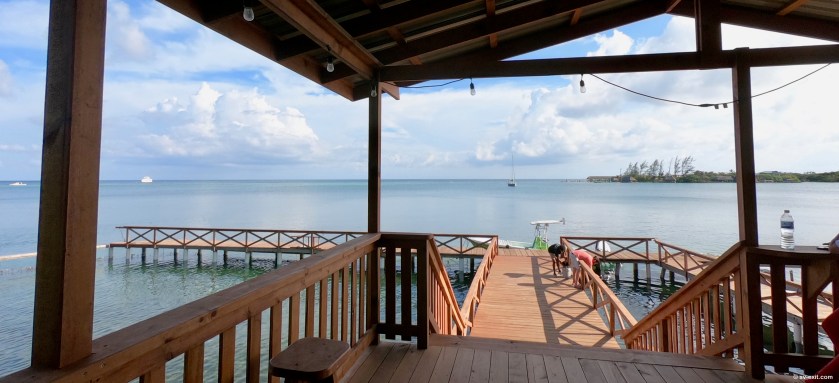
On the down side, no wind meant we motored the nearly six hours to Utila. Still, in a bay with only one other sailboat at anchor, we found an equally beautiful sunset and possibly the best Long Island Ice Tea Kris has ever tasted (complete with conservation-minded metal straw!!!) at the bar Mango Tango, which we were anchored right next to.
Immediately the feel of Utila seemed well better than that of Roatan.More than anything, it reminded us of the backpacker vibe of Thailand.
Instead of the cars of Roatan, and unlike the lack of any cars in Guanaja, Utila opts for what seemed to be a compromise… golf carts, as a primary mode of motored transportation. This meant that, once S/V Samba Pa Ti and S/V Off The Grid caught up with us, a road trip around Utila via golf cart was well in order. Given the driving environment, and especially the close quarters in town, Josh deserved major credit for volunteering as wheelman all day.
DCIM101GOPROGOPR3089.JPG
DCIM101GOPROGOPR3086.JPG
DCIM101GOPROGOPR3093.JPG
DCIM101GOPROGOPR3094.JPG
DCIM101GOPROGOPR3095.JPG
DCIM101GOPROGOPR3097.JPG
DCIM101GOPROGOPR3101.JPG
DCIM101GOPROGOPR3102.JPG
DCIM101GOPROGOPR3117.JPG
As for scuba diving, the option of getting tank air fills for three dollars each in Utila — as opposed to the ten dollars per tank Roatan had tried to extort from us — meant scuba diving was back on the menu… which meant we even had the opportunity to take our friend Craig, from S/VSamba Pa Ti, for a dive.
DCIM101GOPROGOPR3120.JPG
DCIM101GOPROGOPR3129.JPG
DCIM101GOPROGOPR3084.JPG
DCIM101GOPROGOPR3131.JPG
DCIM101GOPROGOPR3133.JPG
DCIM101GOPROGOPR3134.JPG
DCIM101GOPROGOPR3139.JPG
DCIM101GOPROGOPR3084.JPG
As it turns out, Utila is the place to be if you have a musical itch that needs scratching.Our first day ashore, during a conversation with an expat in one of the bars, we were told to stop by open mic night at Sea Breakers, which we did.
And, while it did feel good to pick up an electric guitar and sit in for a handful of songs/jams, I would have to confess that meeting the bartender Johnny turned out to be much more fruitful than meeting the owner, whose guitar playing skills were only marginally better than his listening skills, which were non-existent.
Rhino’s Beergarden and Delicatessen was actually the place that raised the bar to a new level when its came to phenomenal music, great company, fantastic food, and ice cold German beer! The owner, Reiner, who had opened only one month ago, was not only able to pour a perfect glass of beer, but also cook an insane spaetzle dish with German sausage, bake delicious homemade pretzels, and play a mean guitar.
DCIM101GOPROGOPR3119.JPG
DCIM101GOPROGOPR3118.JPG
After an impromptu jam session during our final visit to Rhino’s, Reiner insisted that the photo he took was destined to be hung on the Wall of Fame/Shame. I left a guitar pick as a pledge that I would return someday to sign the photo.
Still, after ten days in Utila, we found ourselves holding visas that were on the verge of expiring.
Not something to fuck around with, despite what you might be told by Guanaja shady expat character “a.k.a. John Smith” who sailed into Honduras years ago, ran out of money, and now lives aboard a derelict boat, unable to leave the country not only because his boat’s not seaworthy, which is the case, but also because he owes the Honduran government thousands of dollars in fines for overstaying his visa… smart guy.
Even extending our visa in Honduras was something we had ruled out. Based upon the C-4 agreement between Honduras, Guatemala, Nicaragua, and El Salvador, we worried that extending our visa in Honduras might result in our Guatemala visit being limited to thirty days on our entry stamp.
Not worth the risk… it was time to move on.
So, with only three days left on our ninety day visa, we painlessly (comparatively, at least) cleared out with the official at the Honduran immigration office as well as customs at the Port Captain’s office next door.
Somehow or another we had managed to avoid the lion’s share of grief and headaches during our stay in the Bay Islands — headaches which seemed to fall square on Craig, of S/V Samba Pa Ti. A chronic and catastrophic fuel line failure coming in from Roatan; being pickpocketed on the island of Utila; having his dinghy stolen while tied up to his anchored sailboat (at least it was recovered twelve hours later); and, finally while clearing out, getting saddled with a monetary fine by the Port Captain for an expired registration document… talk about shitty luck.
Having already learned to recognise that, at best, a minimal sympathy for electrical windlass issues were to be expected in the rather large world of sailing woes, my mouth remained zipped tight.
In some ways, living aboard a sailboat full-time is a world apart from life ashore.In other ways, the guy on the boat next you is no different than a dirt dweller’s next door neighbour.
Take, for instance, the idea of necessity versus luxury.Oftentimes the only distinction between the two is whether I have it or you have it… if I have it, it’s out of necessity.If you have it and I don’t, it must be superfluous.
We don’t have a bow thruster; therefore, we deal with it.We certainly could use one every now and then, but we don’t consider one a necessity.To the contrary, we actually find a great deal of satisfaction in successfully working through a situation without having to rely on a bow thruster.
On the other hand, we do have an electric windlass, and certainly consider it more than a luxury.
But tell someone who doesn’t have an electric windlass that yours is broken… the chances are nearly one hundred percent that you will elicit exactly zero sympathy from them.
*****
After an uneventful six hours travelling from Guanaja to Roatan, we opted to anchor at Lime Cay Bight, which was completely undeveloped except for a few houses and Mango Resort, with its five colourful overwater bungalows.
Our Rocna anchor typically does much better in sand than grass, which has a tendency to get piled up in a big mound, preventing the anchor’s tip from digging in properly.However, after leaving the Bahamas, we have found it much more challenging to find good patches of sand to anchor in.More and more, we find ourselves searching bays covered in turtle grass.
Such was the case with Lime Cay Bight.
After unsuccessfully searching for the right combination of depth and bottom composition, we eventually had to settle for multiple attempts to set the anchor in turtle grass.
On occasion, the deck connection at the bow for our windlass remote control acts up.You push the up button… nothing.You push the down button… nothing.Shit.
The seemingly arbitrary feisty behaviour is, no doubt, the result of mild corrosion which is inevitable given the location’s exposure to the elements.Sometimes it requires nothing more than a wiggle; other times a more thorough cleaning is needed to get it working again.
To complicate the challenge of repeated attempts to set the anchor, the windlass connection decided to play up as well… not very nice of it.
Normally, wiggling the connection either works or you get nothing.Worst case scenario, if necessary, we bail out on the remote control at the bow and operate the windlass from the cockpit, which can get tricksy. Either it’s difficult to see what’s happening, or Kris operates the windlass from the cockpit while I am sorting things out at the bow – not something I like to do (there are many stories of nine fingered sailors who have had their hands too close to a windlass and chain being operated by someone else.Not ideal.
However, something else was going on as well.
Intermittently, the click of the solenoid could be heard, which seemed to indicate that the connection was okay but the windlass was not engaging (much like the click you hear when you try to start your car and the battery is almost dead – ignition on… no starter).Doble caca!
Finally, after multiple attempts and an ongoing dialogue of swear words with myself, we were able to get a good anchor set with our ailing windlass.
And though Manny, the owner of Mango Resort, was very friendly, the resort was officially closed for September.Like so many other people, he reminded us that very few people come visiting at this time of year… ya, ya… we know.
This left a bit of dinghy exploration and snorkelling to be done as off-boat activities, but nothing more.We hadn’t gotten a chance to fill our tanks since our last dive, so going for a dive was off the table.
We ended up waiting five days for enough wind so we could sail the ten miles to French Harbor instead of motoring.During that time, I tried to do a bit of diagnostics on the windlass.However, I was hesitant to dig in too deep, not wanting to chance having the windlass die completely while we had no nearby access to any services whatsoever.
In theory, our windlass can be operated manually if necessary, but I have never been able to get the damn thing sorted out for a multitude of reasons.Which leaves hauling up everything by hand.
Now, I realise I’m no spring chicken, but I do consider myself in better-than-poor shape, and I have never been timid about breaking a sweat.What I don’t understand is the physics that makes a half inch chain more than twice the weight of a three-eighths inch chain.I’ve already had a science teacher tell me that’s impossible but, like electrical voodoo, I believe it to be true.
Regardless, hauling up the ground tackle by hand would be my fallback plan, not the primary strategy.
When the wind finally picked up, we managed to get the anchor up with our still debilitated windlass and make it to French Harbor, where we found more visiting sailboats than we had for the previous five months combined!This included three people we met briefly while at anchor at Michael’s Rock on Guanaja – Josh and Sarah, aboard S/V Off The Grid, as well as Craig, back aboard his boat S/V Samba Pa Ti, who had just been joined by his daughter Zoe.
Now that we were back amongst the civilised world, with access to hardware stores, mechanics, and other resources including Internet, the windlass issues could be properly dug into, hopefully with a happy resolution.
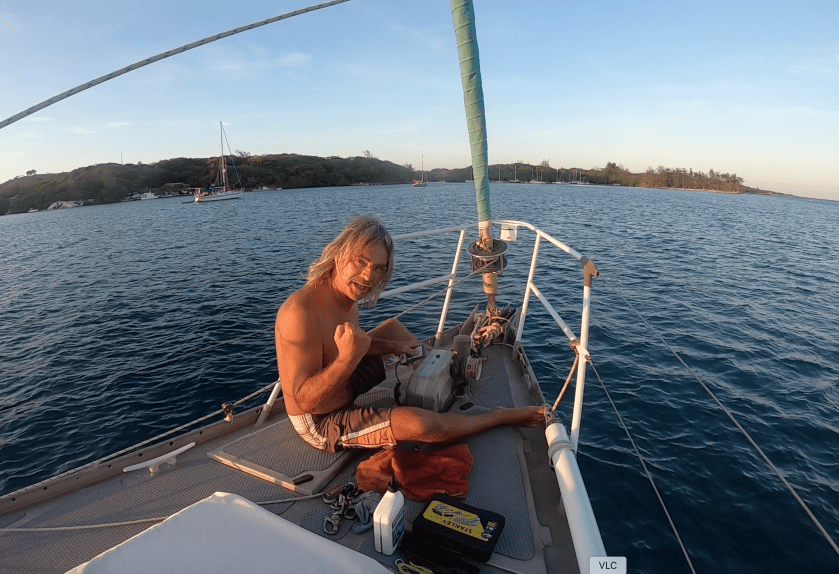
Armed with a multimeter, Nigel Caulder’s Boat Mechanic’s Bible, and an Internet connection to get real-time advice as needed, Exit’s Chief Engineer (me) commenced with diagnosing corroded connections, burned connectors, and overheating wire.After quite some time, I emerged from the fray with a sneaking suspicion.As a final act of confirmation, a battery was hauled up on deck and jumped directly to the windlass motor… nothing.
After twenty seven years residing at the bow of a boat, the windlass motor itself appeared to have finally given up the ghost.
Tablespoons of black powder, the remnants of the carbon brushes, poured out of the inside when we opened the motor… not good.
If we couldn’t get the motor repaired, chances are we’d have to replace the windlass entirely… I’m guessing a $3000-4000 prospect for an electric windlass… Eek!
But, a windlass motor is not that different from a starter motor, and identical to the motors which raise and lower the lobster traps on the local fishing boats… so, it’s not like we’re trying to locate a brain surgeon… stay optimistic.
After asking a few people and posing a few questions to forums, we had a very general area that a mechanic could possibly be found in with an even more general description of how to find him.After a while of walking, and looking… and asking, and walking… we stumbled upon an open door of an unmarked building.
The entire inside of the room was essentially a huge pile of used mechanical and electrical parts with a few poorly defined paths running through, surrounded by shelves and tables piled high with more parts.The guy behind the counter looked to be in his twenties.Possibly, the guy who just writes up the work orders… possibly, the mechanic.
His English was non-existent.
Our Spanish is pretty limited.
Where is the bathroom…?How much for the beer…?
Pretty graspable stuff.
¿Permisso los pollos en el autobus?Are chickens allowed in the bus?
Can even pull that one off…
But… The up and down positive electrical connections on my boat’s windlass motor have a direct short across them… can you fix this?How much will it cost?How long will it take?… Hmmmm.
We did our best to communicate back and forth.In the end he told us to come back in three hours.
I tried to clarify… Maybe get an estimate in three hours?
He tried to clarify… Maybe fixed in three hours.
As we walked away, Kris was not even remotely convinced.Just leaving our windlass motor with a random guy we can’t even communicate with, eh..? Ok…really..?
It seemed like less of a gamble to me.Whether this kid went and got the old man in back… or he was the fourth generation mechanic who actually performed the miracles, this room full of broken parts was not a graveyard of repair failures… to me it looked like the product of years of salvage and scavenging work… parts to be used in the future.Any repairman, not worth his weight in gold, would not have been in business long enough to gain this calibre of an in-stock parts inventory.
The motor was where it needed to be.The question was simply, could it be revived or would it, too, become part of the shop’s spare parts inventory pile?
Three hours later, we poked our heads back through the doorway.
Sitting in a vice, sporting a brand new coat of glossy black spray paint, was our motor.The middle post already had the black clamp from a set of jumper cables attached to it.Arial (????), who turned out to be not just the cashier but also the Dude, touched the red clamp to one of the other two posts and the motor whirred to life.Then he touched the other and the motor reversed direction.
Hallelujah!!!
He had documented the procedure with photos of various damaged parts that had been discovered during the surgery.Lots of problems… Still… it lived.
And… the big question…
?Cuantas cuesta? How much is the cost?
He writes on a piece of paper… three… two… zero… zero.Three thousand two hundred…
Processing… processing… processing…
Wait… thirty two hundred Lempiras.
That’s… a hundred twenty dollars.
Sweet.
Fortunately, the reassembly process proved easier than the disassembly process.And, though Jay (one of my electrical voodoo witchdoctor/advisors) had run the math and recommended we up-size the cabling gauge running to the windlass, we could delay that until after we reached the Rio Dulce.
So… the moment of truth…
When the up button was pressed and the chain began grinding its way up… and the down button started letting the chain back out…
… a true Johnny Bravo… VICTORY!… erupted from my lips.Back in business!
To those sailors who haul up their ground tackle by hand, I salute you, oh salty dogs… and I promise to never bring up the existence of Exit’s stern anchor electric windlass in any bar conversation!
Amazingly, we have whittled away all but only about two weeks of our ninety day Honduran visa.We don’t have long before we will be forced to clear out and head for Guatemala.
Now if we could just get the wind-less bit sorted out.A twenty four hour motor to Livingston is exactly what we want to avoid.
After arriving to Guanaja on July 10, uncertain as to whether we should even stop here to clear in or continue onward to Roatan, we now find ourselves finally departing only after spending two months here.
True, we did spend longer in the Bahamas. But that’s a lot of islands and cays covering a lot of space. While we may have spent a month in one area, in general, our movement was in a forward direction with little backtracking.
Now, for the past sixty days, we have rotated between three anchorages no less than ten times… El Bight – providing not only accessibility to Bonacca, but also maximum wind protection when things kicked up; Graham’s Cay – providing maximum breeze and ventilation relief when things really got hot; and Michael’s Rock – providing absolute solitude and incredible views both above and below the water when the weather cooperated.
El Bight
Graham’s Cay
Michael’s Rock
Still, in the back of our minds, we were always aware of the fact that we were, to a certain degree, tempting fate. Hurricane season in the Caribbean lasts roughly from the middle of July to the middle of November.
When we returned to Grand Cayman towards the end of June, after our visit to the States, our strategy was to make for the Rio Dulce in Guatemala. A renowned haven for boaters to sit out the hurricane season, it has the benefit of never having been struck by a hurricane for as long as hurricanes have been recorded.
Unfortunately, our insurance company does not distinguish any location south of the Georgia border as being “hurricane safe” during that time frame. The increase in our most recent premiums certainly reflected that perspective.
Nevertheless, even if we stopped along the way at either Belize or Honduras, the Rio Dulce was still attainable by mid-July.
And yet, here we are.
Stalled in Guanaja, enjoying the location… and then it’s three weeks after mid-July.
We still pay heed to the notion that, until we get to the Rio Dulce, it behooves us to pay particular attention to the SSB forecasts of weather guru Chris Parker, and not try to second guess any threatening weather that begins to develop in our direction.
Any potential hurricane that could threaten this location would almost certainly originate from Africa, giving plenty of forewarning for those ready to make the twenty-four hour jump to the Rio Dulce.
August 10, our twenty eighth wedding anniversary, comes and goes.
Still enjoying the location…
Kris heads to the mainland for a five day outback excursion while I remain aboard Exit diligently taking care of our baby at anchor.
Still enjoying the location…
August 15, marking the two year anniversary of Exit’s launch and our move onto the water, comes and goes.
That’s alright. We’re only a month behind the tentative schedule we softly agreed to aspire towards.
Still enjoying the location…
I find myself suddenly bedridden, experiencing my own five day outback excursion in the form of three solid days of no food and anything-but-solid outback activity, while Kris diligently takes care of her two babies at anchor.
Not enjoying the location so much right then…
But the darkness slowly passes. It’s unicorns and rainbows and marshmallows again. More diving. More relaxing. More snorkelling. More drinking.
DCIM100GOPROGOPR2148.JPG
DCIM100GOPROGOPR2357.JPG
DCIM100GOPROGOPR2194.JPG
DCIM100GOPROGOPR2280.JPG
DCIM100GOPROGOPR2159.JPG
New Guanaja friends – Hector and Cart
Pelicans!
Cay Cafe
Sunset over Sure Feels Good from S/V Exit
DCIM100GOPROGOPR2146.JPG
Bonacca Carnival Parade August 2019
And then it’s September.
Holy shit… seriously?
As the haze begins to clear, a darkness returns, and one thing becomes certain. Though we are not statistically in the safest place to be, we have just dodged a bullet. During the first week of September, Hurricane Dorian, packing Category 5 winds of 185 miles per hour, has pummelled the Bahamas and U.S. east coast, largely in a reverse mirror of the path we took from Maine to Jamaica.
It was even less likely to directly affect us than it would Alabama (I probably just made someone’s list somewhere).
Nonetheless, two questions continued to remain at the forefront of our thoughts.
Was our dear friend Benjamin safe? We had seen a photo posted a short time ago taken by Benjamin atop the mast of his sailboat Cracker Tale which sat spiderwebbed into the mangroves near Marsh Harbor, Abacos just twenty four hours before Dorian levelled the Bahamian town. We had heard nothing from him since the storm hit.
Were we beginning to confuse comfortable with complacent? Though the two are nearly opposites of one another (acceptance of one’s environment vs. ignoring one’s environment), at times they can be very hard to distinguish between.
In this case, the finger snap that awoke us from the hypnosis of comfort transitioning towards the paralysis of complacency came from the local population.
When people who have lived in an area for their entire lives observe that the current season has been particularly dry, and that drought conditions historically signal a high danger for storms and hurricanes, one would be foolhardy not to take heed.
Whether a local insight, or an understandable reaction to the devastation witnessed with Dorian, the locals have begun to grow nervous.
Regardless, we are pushing our luck. Hurricane season is reaching its zenith, and we need to be in the Rio Dulce.
Again and again we hear, you guys are kind of behind everybody else… which makes us laugh. We’re generally okay with that. However, as tempting as it may seem, rolling into the Rio Dulce in mid-November, just as the boats are starting to head out in the opposite direction would be rather ridiculous.
The real question is… can we get there before October?
As we raise anchor inside the reef of Guanaja for the final time during this visit, we have to say a huge thank you to Don and Annette for all the hospitality, kindness, and generosity offered to us during our stay. Sure Feels Good knowing we have friends in Honduras we can always return to.
We also receive a long awaited update from our friends James and Dena aboard S/V Cetacea. The text reads: Benjamin is ok. But his boat is, in his words, toast.
We have to smile.
In the big picture, some things are simply more important than others.