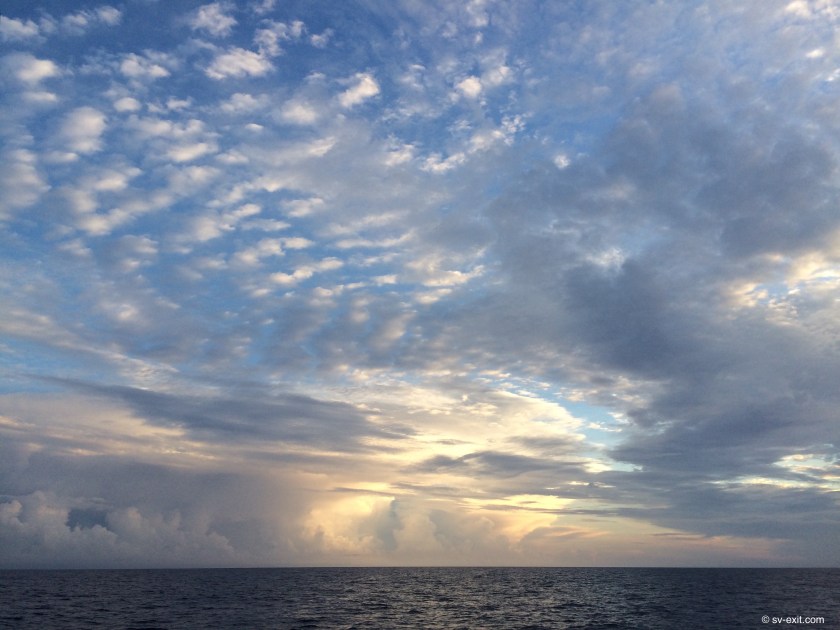
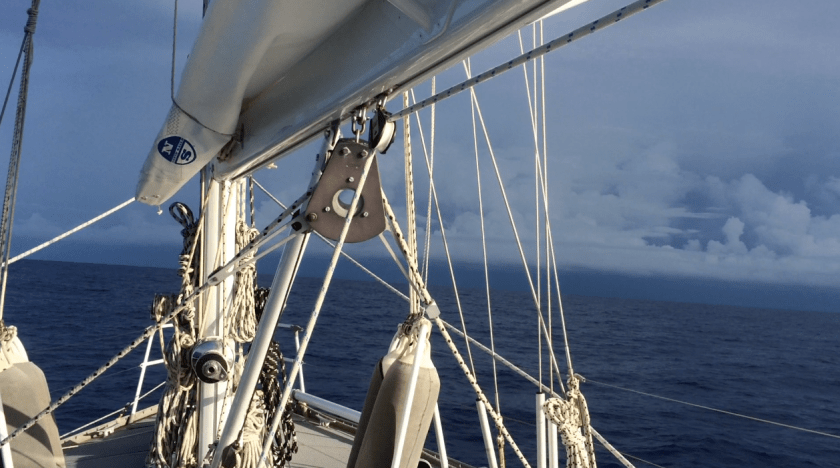
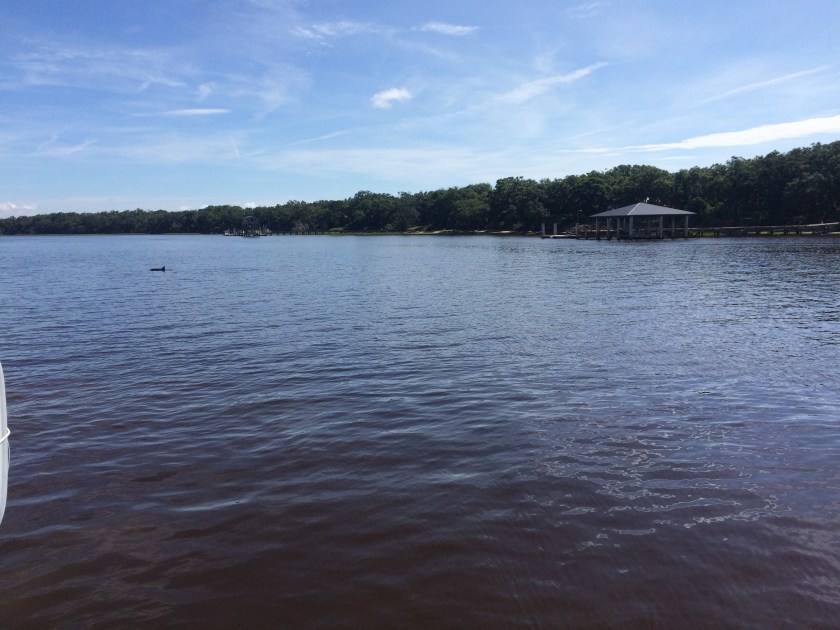
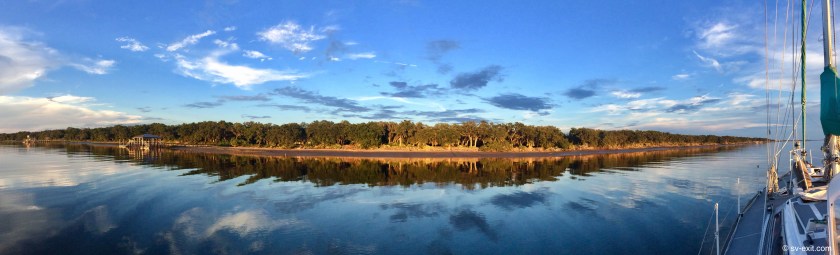
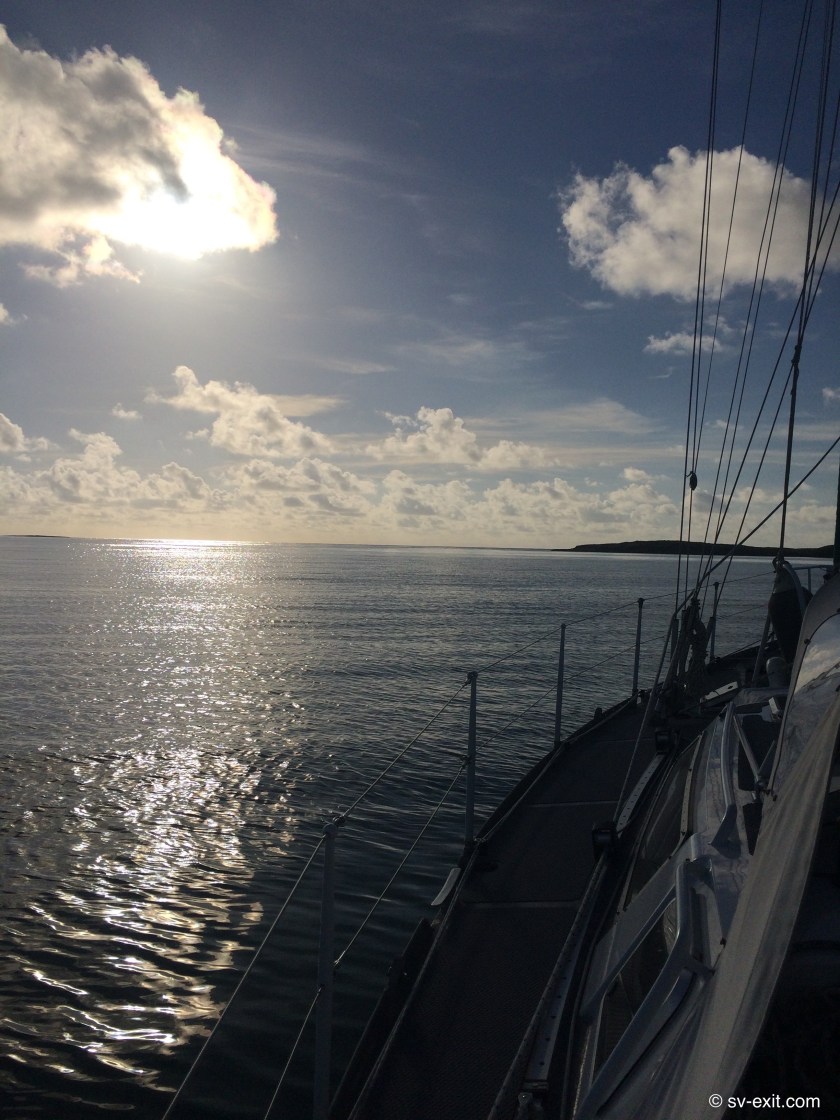
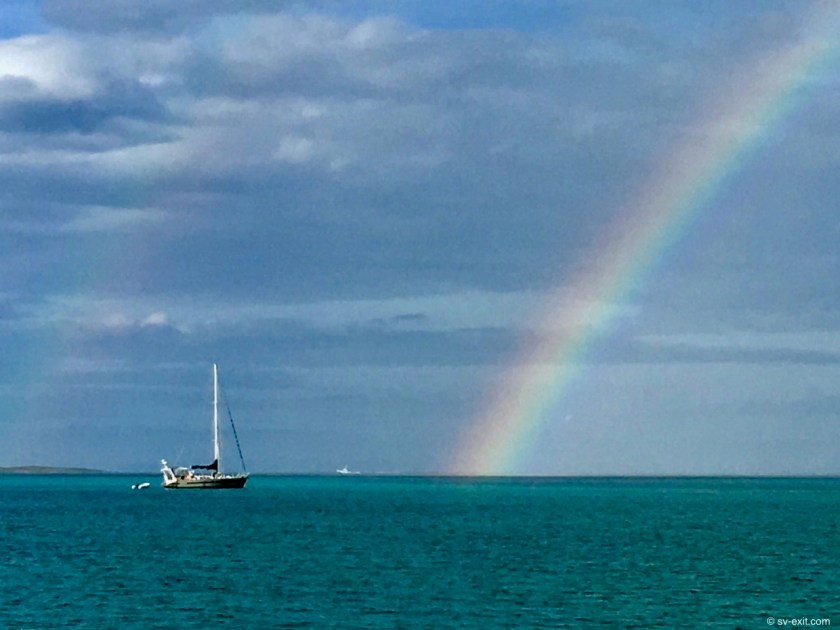
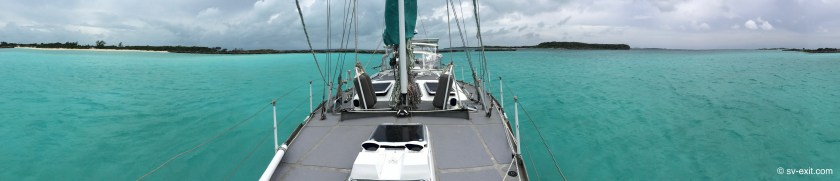
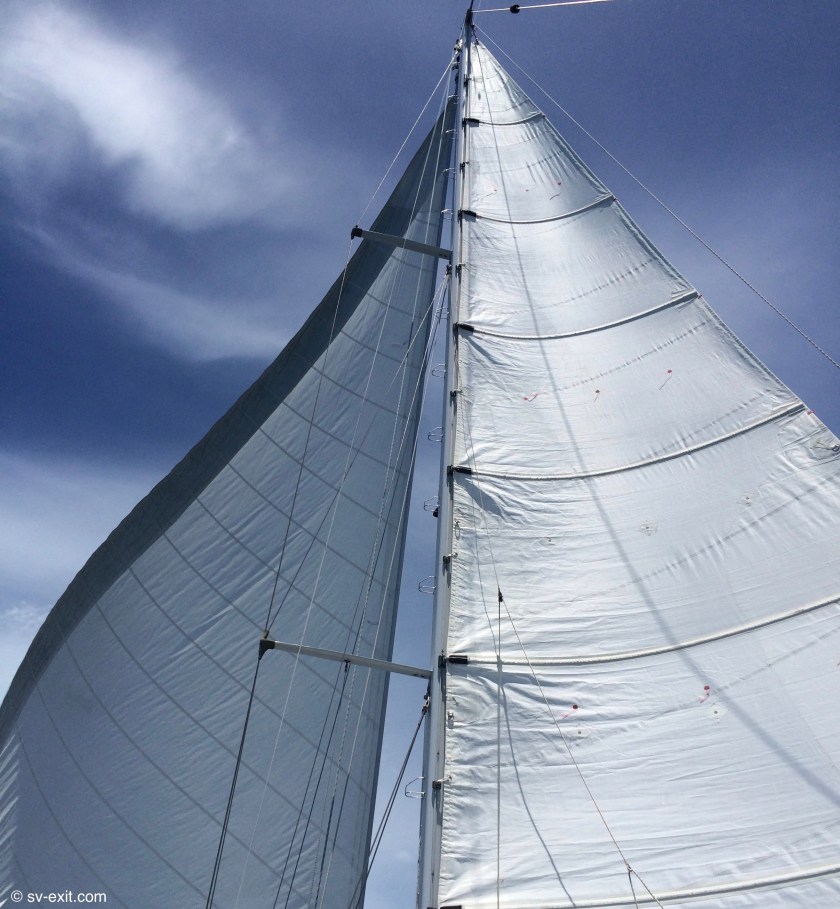
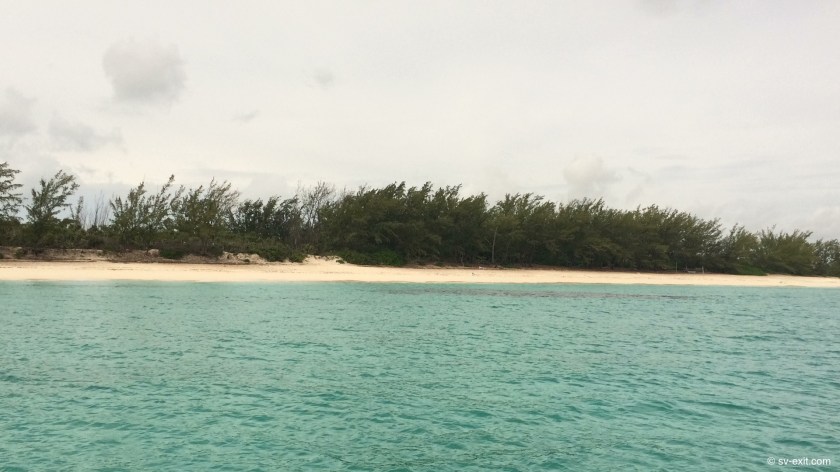
Our arrival at Cumberland Island, GA after a three day and nearly four hundred mile open ocean passage from the Bahamas had sparked a multiple day recovery and re-acclimation period.
We spent most of the 16th sleeping, and most of the 17th and 18th cleaning and relaxing.
We were still yet to solidify exactly what our plan was, now that we were back in the States; but we knew anything we were potentially going to get done here required us to head up the North River and get close to Rocky’s boatyard.
After an unsuccessful attempt to get fuel in Fernandina – stressful only up to the point that we learned the fuel dock we were circling in front of would not re-open until 2019 following the completion of long overdue hurricane repairs, we chose to head up the North River, trying to find a good place to drop the hook.
Snaking back and forth, the North River winds its way three and a half mile through of marsh grass and lowlands before reaching the boatyard.In some places, it stretches eight hundred or more feet from shore to shore; in others it is not much more than a hundred feet across.It has severe shoaling around some of its’ turns and we became intimately familiar with its bottom twice a day while tied up to Rocky’s boatyard dock in February.
As we left the wide, deep channel of the St. Marys River and steered into the narrow mouth of the North River, we had to stay far to the left.We remembered the point extending out on the opposite side created a shallow area that extended halfway across the entrance.
Sections of the river are twenty five to forty feet deep, even in some of the narrow spots.But other sections can be eight hundred feet wide with less than one hundred feet of that being deeper than three feet.
Misleading… even tricksy.
It was now low tide.
I remember asking Kris, “Should we get out your iPhone?”It contained a photo we had been given in February that clearly indicated all the shoaling areas along the banks before the boatyard…
I remember her looking at the Navionics program running on our iPad, our exact position shown as a little red boat icon superimposed over the displayed chart.
I remember her saying, “Nah… the shoaling is along the inside banks of the turns.”
I remember Kris asking me if I wanted to take the helm.
I remember responding in a possibly not exceptionally enthusiastic affirmative.
I remember climbing behind the wheel, looking up, and immediately seeing the display on our depth gauge, surprisingly, in the single digits.
I remember saying, “Seems kinda shallow, maybe we should raise the centerboard?”
Plummeting depth gauge… now under six feet…
I remember Kris didn’t even have time to stand up when…
Shhhhhhhhhhhhlop…
…the unmistakable sound of our aluminum hull sliding on the soft bottom of the North River.
And then… no more sliding.
We’re stuck.No backing… no turning… just stuck.
I immediately cried out “FOUL!”… followed by, “I was behind the wheel less than thirty seconds!” … followed by, “I hate this fucking river!”
The next five minutes was spent sitting in the cockpit, trying in vain to prop up my crushed self-esteem, until the divine forgiveness of a timely rising tide picked us up off the mud, simultaneously freeing both Exit and what little was left of my dignity.
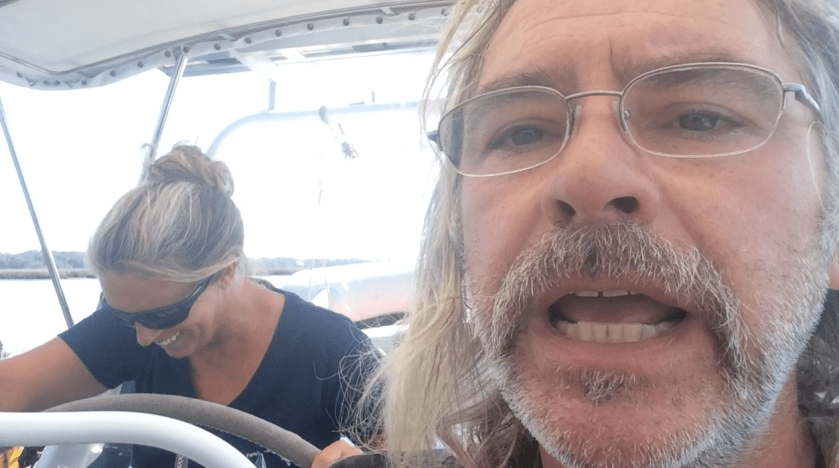
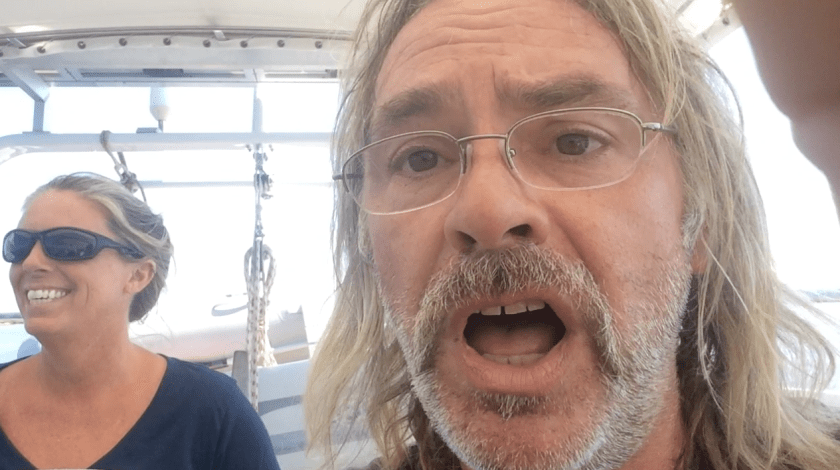
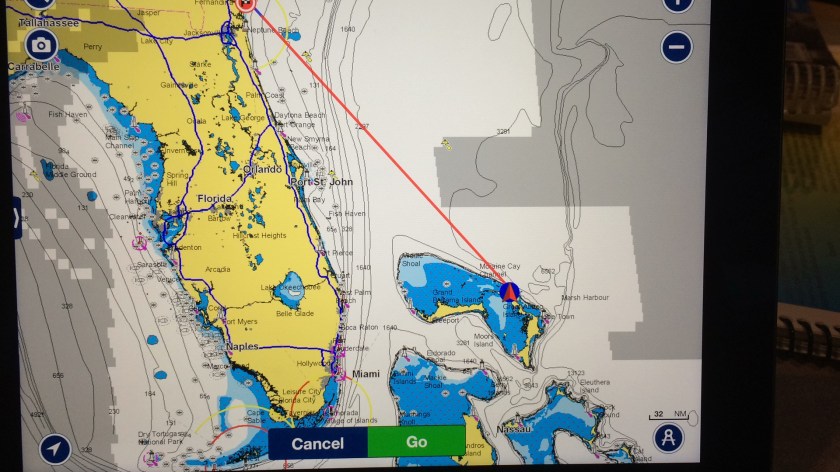
As we retreated back, shadowing the track we had just laid down on our Navionics chart, Kris could be heard laughing continuously in the background of two short videos I made.
During one I lamented how much I hate this fucking river; the other was a message for two Scuba Junkie friends/staff still working in Komodo who were considering buying a sailboat and cruising Australia whereby I expressed a belief that they would be much wiser to invest their money in a van.
Fortunately, this blog site does not currently support videos.
“I hate this fucking river” rantStill ranting…
The North River had been victorious on this day.
Admitting temporary defeat, we slinked back into the St. Marys River deciding to anchor next to the town of St. Marys for the night.Tonight we would drown our embarrassment in drinks and hopefully fried cheese Saganaki at the Greek restaurant.
Three hundred fifty nautical miles.Averaging five knots it would take us around three days to complete.
For us, ambitious.
But we’ve found ambition is exactly what it takes.
There were a lotof uncertainties.
Uncertainty regarding weather.Mixed forecasts, depending on who you listened to and what resources you referenced.Winds seemed to be from every direction at one point or another.Could be no wind at all.Could be good sailing.Could be nasty squalls with bursts of high wind and rain.
Uncertainty regarding the course we’d chosen to take.Around the north open ocean side of Abaco with a long straight northwesterly shot to the Georgia border.The alternative route, picking our way through the inside shallows to the edge of the Abacos Sea, followed by a shorter jump west across to Florida, would offer better protection from building seas but force a longer threading of the needle through the rocks and reefs until reaching the drop off.
We preferred the long open ocean passage to Georgia.If the weather held, we could have some brilliant sailing.If the winds died, we’d have a long and relentless grind under motor.If the weather turned ugly, we’d have no where to go…
Uncertainty.
But, in the end, we had chosen the straight shot across more open ocean.Eighty miles offshore from the nearest Abaco land we would still be eighty miles away from the Florida coast.
We were also hoping to get lucky with the Gulf Stream Current.If we had calculated correctly, we would be approaching it’s apex at just about one hundred fifty miles into our course.
Depending on the strength of the current at any given point and our relative angle, we could hope to gain anywhere from a half knot to more than three knots of speed.Once we found ourselves inside, we figured we could adjust our course to maximize the benefit of the free energy.
Ironically, we noticed that the course we had plotted would take us through the outer northeast corner of the notorious rocket impact area stretching seventy five miles offshore from the Cape Canaveral launch site.It was part of the same block of restricted rocket recovery space, prohibited to boat traffic during launches, that we had been turned away from just prior to the launch of Space X in February.
We figured the chances of another launch being scheduled, once again, at the very moment we were passing through the restricted area to be pretty astronomical.
Although I did consider the fact that I had seen a rocket, being launched at Cape Canaveral, from all the way in the Bahamas one night while I was on deck after midnight. I don’t think that, in the end, we even checked online to confirm there was no launch scheduled.It would be pretty ridiculous if this level of complacency turned out to bite us in the ass…
******
Eee-ahh… Eee-ahh… Eee-ahh… a sound reminiscent of a London police car.
The near silence in the cockpit has just been shattered by a piercing alarm indicating our autopilot has lost its connection again.
Jeeves, the name we have affectionately given our electronic chauffeur, or autopilot, typically alleviates our need for the sometimes relaxing yet mundane, sometimes arduous and exhausting task of hand steering the boat for hours on end.
We just input a heading in degrees.Jeeves, tied into both navigational electronics and directly connected to the steering system, maintains that course automatically, making adjustments as needed.Great… as long as it works.
Without obvious rhyme or reason,Jeeves occasionally throws a fit.He loses his connection link with the navigation equipment, can’t tell where he is, and simply disengages from the steering.The wheel, no longer being controlled, begins drifting aimlessly… not ideal.
The London Police car sounding alarm is Jeeves belligerently announcing, “Somebody had better get to the wheel pretty damn quickly because I’ve just stopped steering and we’re drifting!”
A probable corroded connection somewhere between the multiple units all communicating with one another has been plaguing us intermittently for months.Having checked every connection possible, I am left with only connections behind water sealed panels that are constantly exposed to the elements.So far, the fear of causing other problems by opening these panels has outweighed the annoyance of Jeeves’ periodic outbursts.
Back to the reality of constant challenges that come part and parcel with cruising aboard a sailboat.
After switching the autopilot breaker off and back on again to reset the system, Jeeves seemed content to carry on, at least for the time being.When we are lucky, he’s good to go again for an always indeterminate amount of time.When we’re not, he throws this annoying tantrum repeatedly until eventually either he gives up or we do, and resort to hand steering for a while.
******
This passage turned out to be a roller coaster ride, both mentally and physically.
Some of the best sailing we’ve ever done.Some of the most frustrating mandatory motoring stretches we’ve ever done. Some pretty freaky moments of what have we gotten ourselves into?
Only seven hours into very mild sailing conditions, vicious looking storm clouds quickly materialized and stacked up across the horizon.Sitting on less than three knot winds, we had already dropped the main, furled in the genoa, and fired up the engine.By the time the clouds, growing more and more ominous looking, were on top of us, we were already prepared.
Time 1407: Ominous clouds bearing down quicklyTime 1416 (only nine minutes later): Developing into some pretty scary looking shit
In the blink of an eye, winds had catapulted from less than three knots to thirty knots.We were glad we had already dowsed the sails.This would not be the only storm encountered during this passage.
We had plenty of opportunity during this passage to experiment more with the subtleties of downwind sailing.Different configurations, adjustments and setups which had confused us when we were primarily sailing upwind now came more into play.
Now, sailing almost entirely with the wind aft of our beam, we experienced the slow paced evolution of better understanding:6.7 knots of speed before in 8 knots of wind when the gulf stream gave us better than a knot of current and the sail trim was clicking… now less than 3 knots of speed in 15 knots of wind when six foot waves were tossing us around and the sail trim obviously wasn’t clicking.
Erratic weather and conflicting information became a bit of a theme during this passage. Looking opposite directions often provided opposite perspectives and reversed your decisions…
Sunrise the morning after the stormLooking to portSame time… looking to starboard
Ups and downs… as reflected in periodic ship’s log entries:
June 13: 7:50am – Anchor up under sail; making for St. Marys Entrance (350nm/3 days); forecast S-SE winds at 10-15 knots
9:20 – Outside cut; mild chop with 3-5ft swell well spaced; overcast but no threatening clouds in the sky
13:00 – Wind ❤ knots, Engine on and sails in
14:00 – Squall approaching; winds have shifted 180 degrees to WNW at 15-25 knots; seas building to 6-8ft
15:00 – Sailing a little, then siting a little, then motoring a little, then pooing a little… Squall came from NW… holy crap! Seas calming from 6-8ft; storm clouds still near but perfect sailing right now
20:00 – One reef in the main for the night; currently S at 10-12 knots
June 14: 00:00 – Engine on with main up, wind ❤ knots again. Florida coast and ship traffic lights on horizon…ick!
12:00 – Tired of 12 hours of engine noise; motor-sailing straight towards gulf stream for free ride hopefully
12:45 – Good choice.Making 5 knots in 5.8 knots of wind… yes!
13:30 – Pod of ten or more dolphins came to play at the bow for a few minutes!
15:00 – Making 6.7 knots of speed in just over 8 knots of wind (1.3 knots from Gulf Stream current)… sweet!
16:20 – Making 5.7 knots of speed in 5.5 knots of wind (2 knots from current)… sweeter!
16:45 – Another bow riding pod of dolphins hung around even longer.Just entered Cape Canaveral rocket impact area – no rockets in sight, no Coast Guard hails… think we’re ok.
21:00 – Minimal chop but lots of lightning in front of us;One reef in main & full genoa; Winds SSW at 8 knots but getting 4 knot boost from the GS current – making 8 knots of speed
22:00 – Winds W up to 14 knots with 10.5knots of boat speed!Seas kicking up fast
23:00 – Wind speed indicator freaking out again (reading 25-50 knots of wind on display).Amazing bioluminescent light show happening all around us.
*****
Approaching midnight.
Not a single light from shore is visible.
Not a single light from another boat to be seen.
It is a feeling of complete isolation.Fifty miles offshore in the North Atlantic Ocean, the only thing we’ve seen since last night have been pods of curious dolphins.
Unable to locate a single outside reference point, my eyes strain to identify anything in the utter blackness outside the cockpit.
Beyond Exit’s decks, there is only dark.Clouds have completely smothered any ambient light offered by the stars and moon.
Sudden streaks of lightning flash all around us, bursting intermittently and without warning, providingmomentary glimpses of a feisty, building sea all around us.
And yet, in what could be a computer generated Hollywood movie effect, the water surrounding Exit literally is aglow.It looks magical, in stark contrast to the impenetrable black curtain of rest of the night.
Both hauntingly dim and distinctly present, churning eddies of sparkles and streaks briefly light up alongside the boat with every wave and swell that breaks against our hull.
Exit’s bow appears to cut through a wave of light, as the surge of water displaced to either side by our bow wake glows eerily, the result of bioluminescent organisms in the water.
It is truly surreal… hypnotic.
Plus we have apparently found a sweet spot in the Gulf Stream current.Our GPS indicates that we are currently picking up an amazing four extra knots of speed riding the current.
As the wind began to pick up, hovering between thirteen and fourteen knots, and the seas continued to build up, Poseidon smiled briefly down upon us in the dark.Our boat speed steadily rose, the display in the cockpit now drifting between six and eight knots.
But a quick glimpse at our GPS revealed, with the favorable four knot Gulf Stream current accounted for, that on this night we were actually learning to fly.We spent three hours streaking along consistently at between an amazing ten to eleven knots of speed.
At one point, I clocked us making 11.8 knots of speed in 14.5 knots of wind… Yikes!
Certainly not being a racer, at times barely being a sailor… it’s times like this that the inexperienced are wisely prompted by that naggingfeeling of uncertainty to perform an introspective reality check on their comfort level.
In this instance, it was the absolute darkness in every direction that was so disorienting.Dramatic bursts of lightning across the horizon and hypnotic bioluminescence glowing alongside the hull all added to the surreal environment.The faster we went, the brighter the glow appeared to become.
There is a sense of being on the edge of control.We thought our sail decision was sound – a single reef in the main (a reefed main was quickly becoming our overnight standard procedure) and our 130% genoa partially furled.
Yet, even with reduced sails, we found ourselves still flying along at 10.5 knots of speed in thirteen knots of wind.Any feelings of anxiousness came, not from our present situation.Rather, it was the uncertainty of Poseidon’s full intent tonight… had we seen the brunt of the storm or was it still building?
If the winds reached a sustained fifteen to twenty knots, I wasn’t sure if I’d maintain my smile…
Continuation of ship’s log entries:
June 15: 3:00am – Eeek!Crazy times!Still amazing bioluminescence all around us while we learn to fly at 11.8 knots of speed in 14.5 knots of wind with 4 knots of current.
8:00 – Wind clocking north, NW at 8-10 knots; confused seas with 2-3ft chop; losing benefit of GS current quickly
9:01 – 273.2 nautical miles this passage makes a total of 3000 nautical miles traveled aboard Exit!!! Woohoo!
12:00 – Wind dying. NW at <5 knots; engine on
13:00 – Wind shifting. W at <5 knots
14:00 – Wind still shifting; now SW at <5 knots but seas calming.Still 40nm from St. Marys inlet… not gonna make it by dark… shit.
16:00 – Have decided against night entry into St. Marys inlet; will have to circle until morning once we get close
17:00 – Winds W at 5-10 knots; seas calm but there are BIG storm clouds building to the south
17:30 – Weather warnings issuing on VHF to south; nasty clouds continue to stack; steering east – can’t outrun storm but can try to head for its’ edge
17:35 – Engine on and all sails in; gonna make a run in the opposite direction under engine power.
17:45 – All Hell breaking loose!Wind W at 20-30 knots, seas 3-4ft
18:00 – Wind dropping to 15-20 knots but seas building 4-6ft
21:00 – Wind holding at 16 knots with sloppy and confused seas, raising double reefed main to try to avoid running engine all night
22:00 – Trying to sail through the night, awaiting first light to navigate inlet
Freakishly ominous cloud #2…
…in 24 hours
Throughout the night, the messy seas that had been kicked up by the evening storm slowly began to settle back down. The only casualty we found was a flying fish that had become trapped on deck during the rough seas… technically my first catch from the deck of Exit.
Fortunately, the worst looking clouds had passed just south of us, and we had been relatively near the outside edge of the whole thing.It could have been far, far worse.
As can often be the case, the visual intimidation of really scary looking storm clouds approaching, as well as the ongoing uncertainty of whether you’re currently experiencing the worst of what’s in store or just a preview, makes for higher drama at the beginning of a storm than at the end.
In this case, the storm was undoubtably a whopper that just tagged us with its’ edge.
The wind and minimal rainfall just over us had lost most of its ferocity in less than half an hour.Still, the big ocean swells and confused waves that had been generated further to the south tossed us around for the rest of the night as they passed by.
Now, as the sun began to rise the morning of June 16, the seas had finally settled back down, and we were on our final approach towards the St. Marys inlet in our own sailboat… arriving back in the States… surreal.
By 9:00am, we were at the mouth of the St. Marys River.
At 10:00am, seventy four hours and three hundred eighty five nautical miles after raising our anchor in the Abacos, Bahamas, we dropped anchor just off Cumberland Island in Georgia, USA.
Dolphin welcome just off Cumberland Island
Oddly enough, we were within a few hundred feet of the exact same spot we had anchored at in February, just prior to leaving for the Bahamas.
The same spot… full circle.
Only five months… and one thousand six hundred twenty seven nautical miles… plus at least that number of stories later.
Nearly four months after arriving in Bimini, we are finally departing the Bahamas.
Our insurance policy requires that we be north of Jacksonville, FL before July 15, to avoid hurricane season within the Bahamas, Caribbean, and the Gulf of Mexico area.We have learned that hard deadlines need to be approached with a great deal of buffer factored in, just in case of weather issues, potential mechanical difficulties and other unforeseen concerns that could cause serious delays.
While the Bahamas hasn’t achieved that most highly regarded and coveted status of “magical” (reserved for places like Borneo, French Polynesia, Micronesia for example), we have had some amazing experiences.
Some of the standout highlights would have to include:
Reaching the milestone of two thousand nautical miles traveled aboard Exit (and we will reach three thousand nautical miles during the passage back to the States).
Taking in the unbelievable colors of Bahamian waters (certainly the widest spectrum of color we have seen in one area) as well as the magical Bahamian sunsets
Learning to safely and successfully navigate through all those different colors of water.
Anchoring overnight in the open ocean in fifteen feet of water, all alone, thirty miles from the nearest land on the Great Bahama Banks.
Experiencing our first local regatta in George Town (the Family Islands Regatta with its traditional sailboats had to have been much cooler than the Cruisers Regatta the month before).
Having our lifelong friends Shannan and Vicki come to visit us aboard Exit.
Dinghy excursions from the mothership which included seeing juvenile turtles and sharks in the mangroves, scuba diving with dolphins, and snorkeling with turtles and nurse sharks, as well as our first encounters with bonnethead and Caribbean reef sharks.
Celebrating my 52nd birthday aboard Exit with Kris.
Tasting lionfish ceviche as well as snapper caught by my own hand spearfishing for the first time.
Adding sailing onto and off anchor, without assistance from the engine, to our repertoire of sailing skills.
Befriending people like Ray Cunningham (proving once again that every place we visit has a local saint) as well as Jay and Tami (proving once again that there are likeminded cruisers to be found among the sea of assholes and idiots).
Watching pods of dolphins bow-ride Exit while under sail as well as scuba diving with them.
Not to mention, of course… sailing, sailing, sailing… and all the adventure that incurs.
Ultimately, the fact that this has been our first real shakedown cruise aboard our own sailboat was truly the most magical aspect of this journey.
Do we see ourselves returning to the Bahamas?I could certainly see that happening.But it would more likely be in transit to somewhere else.The opportunity to return as even more experienced and confident sailors, plus the ability to circumvent Florida entirely, definitely has an appealing sound to it… but that would be an entirely different chapter.
Our departure from Marsh Harbour signaled a ready to launch status.We were re-provisioned, full of fuel and water, and prepped to go off-shore as soon as the call was made.
From Marsh Harbour, the plan was to press northwest.
The bigger decision was yet to be made….
Do we:1) push all the way to the northwestern edge of the inner banks at depths of ten to twenty five feet until we reached the tip of Middle Shoal nearly one hundred thirty miles away and jump over to the Florida coast?
Or do we:2) find a spot somewhere in the next fifty miles, before Little Abaco Island disintegrates into an endless stretch of reefs, that we can jump outside to instant depths of one hundred to five thousand feet, and set a trajectory directly for St. Marys, on the Georgia-Florida border?
*****
On the day of my birthday, while having cocktails in the cockpit, we had felt a great deal of sympathy towards our neighbor, a young man single-handing a thirty-some foot traditional sloop I couldn’t identify, who was hoisting himself up the mast in a Bosun’s chair.
Every time a power boat came by at a speed excessive enough to create a substantial wake (which seemed to be every thirty seconds), this poor bastard would pitch back and forth at the top of his mast like a fly sitting atop an old-school tick-tock style metronome, all the while yelling out to the passing boat, Slow the fuck down, asshole!This is a no wake zone!
The following day, I couldn’t help but to think of him as we sailed clear of the Marsh Harbour Channel markers and the VHF crackled to life one last time.
The final words we heard coming from the speaker were anonymous.Proper radio etiquette had been abandoned… no specific vessel being hailed… the person doing the hailing not identifying their own vessel…
Just a frustrated captain issuing the angry statement across the airwaves: Rules of the road mean nothing if you’re an idiot!
It was the last thing we heard leaving Marsh Harbor and it seemed rather poetic, in a salty way.
From Marsh Harbour, our intended destination, not quite thirty miles to the northwest, was Crab Cay, just south of Manjack Cay.
This meant we had to pass through Whale Cay Cut, a short stretch that exposed us to the open ocean conditions.The cut carried a brutal reputation for its’ ability to throw an unrelenting stink at unsuspecting boaters.We saw nothing that concerned us.
Then, as we tacked around, positioning ourselves through the cut relative to two catamarans that were approaching the cut from the opposite direction, a fast moving squall passed through.
Winds jumped up to an excess of twenty five knots. We furled in the genoa and fired up the engine to make certain we had adequate control through the narrow cut.
As lightning detonated all around us and we passed through Whale Cay Cut, things suddenly seemed to take a Twilight Zone twist.
There was a moment of panic as we watched the wind speed indicator, which had risen steadily from ten knots to twenty five over the past fifteen minutes, now begin to climb higher and higher… It rose from twenty five to thirty…
Then from thirty to thirty five….
Then from thirty five to forty…
Then to forty five…
This didn’t seem possible.Yes, it was blowing like a son of a bitch out there.But, the wind hadn’t jumped twenty knots in the past sixty seconds.
And then the number on the wind indicator kept climbing…
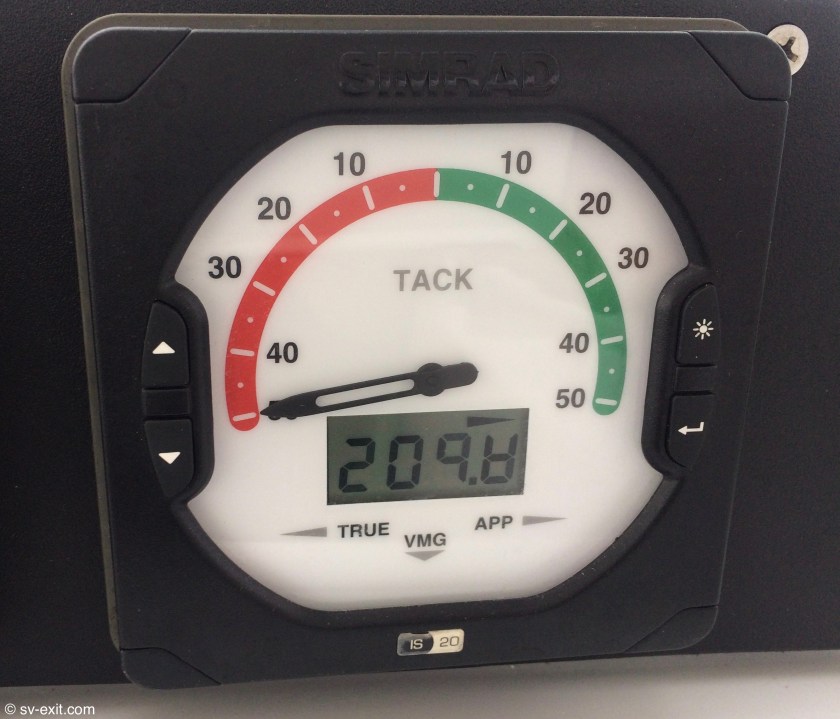
Fifty… seventy five… one hundred plus… we took a photo with the display showing in the 130’s… then almost 210… it topped out around 220 knots. What the fuck?!
Never expected to see this number on the wind speed indicator
We were later told that this was probably the result of electrical interference from the nearby lightning storm.
At the time, passing through the cut as the storm unleashed itself and the wind indicator went mental, it all seemed like another Bermuda Triangle moment.
Fortunately, as the storm passed, so too did the drama.We were able to let the genoa back out and kill the engine.
But, before long we were rolling our eyes as winds that had died down to less than five knots challenged whether we could continue much further without firing the engine back up.
We were thankful when Crab Cay appeared.Shortly after we were safely at anchor.
Uncertainty of promising skies…
…interspersed with ominous signs
Prepping for an offshore passage is quite a process. Properly getting everything physically ready also seems to help get us mentally ready. Stowing and/or securing everything above and below deck; getting meals ready; monitoring weather; engine checks; course plotting; preparing for potential sail changes; it goes on and on… and different weather expectations initiate different Def-con status levels.
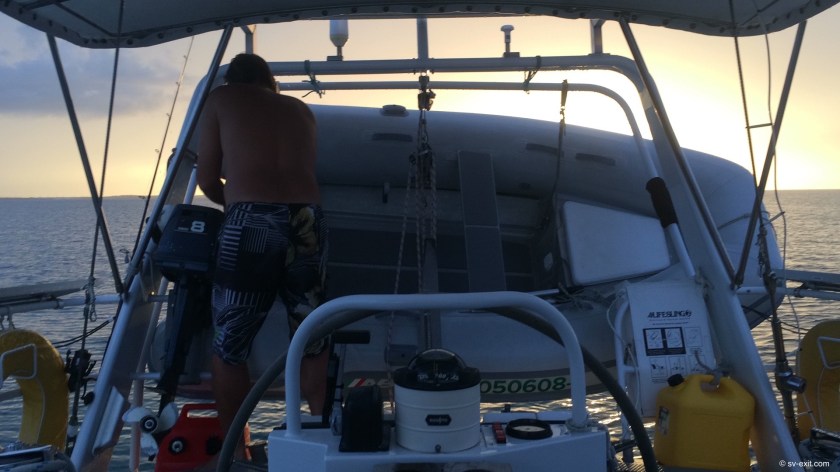
In addition, different decisions equate to different risk levels, expectations of conditions, and costs/benefit analysis. For example, we have a number of options with our dinghy… Option#1 – Tow the dinghy behind us; easy but high risk of loss or capsize. Option#2 – Hang the dinghy from the davit; ok for good weather but a breaking wave could take out our entire arch. Option#3 – Deflate dinghy and secure on deck; probably the safest option but a huge pain in the butt and really clutters the deck. Option#4 – Cinch the dinghy up against the arch to prevent breaking waves from swamping the dinghy and help protect the cockpit.
Getting the dinghy ready at Powell Cay
After an extra day of getting things ready aboard Exit while still anchored at Crab Cay, we made one final push of another eleven miles to Powell Cay, setting us up to depart through the nearby inlet the following morning.
We had finally decided on Option Two – jump north through the reefs from the last of the Abaco cays and make a run for the Georgia border.
This would give us nearly a straight shot to the St. Marys entrance.Cumberland Island was about three hundred fifty miles northwest of our current position at Powell Cay.Over a hundred miles further than our longest passage so far, which had ironically been after our last our last departure from Cumberland Island in February, when we ended up stuck in Cape Canaveral with fuel tank issues.
The distance was not really a concern.Our biggest trepidation came from the uncertainty of possible sudden thunderstorms and squalls, something we had gained a healthy respect for over the past few months.
We’d be in much more exposed open seas, well farther from any land mass.Any thunderstorms or squalls that materialized right on top of us would just have to be dealt with.There would be no bay or harbor to duck into, providing us a safe haven to await the passing of any nasty weather.
With a conservative approach, keeping a vigilant watch in the cockpit, checking our radar often, and reefing our sail immediately if something looked like it could be developing, we felt confident our decision was sound.
Things look promising the night before departing the Bahamas
One of the things you don’t like hearing aboard a sailboat while you are relaxing in the cockpit, or any time for that matter, are the words I smell propane…
Kris has a superhuman sense of smell.Oftentimes, this is a source of great annoyance for me.Occasionally, it saves my life.
Four days ago we dropped anchor at this spot, having found a suitable space amongst all the boats in Marsh Harbour, Great Abacos Island.It was just eighteen miles north of Sandy Cay, where we had finally gone for our first boat-based fun diving excursion, on a boat that was actually our own.
Our time in Marsh Harbour had been largely uneventful.A good opportunity for re-provisioning, laundry, even a drama-free fuel and water top up at the dock of the Marsh Harbour Marina.
Marsh Harbour on the charts
My 52nd birthday, on June 9, was quiet by choice. Kris was kind enough to disregard her general vegetarian disgust for raw pig flesh and cooked up bacon… yes BACON… for my breakfast… an odoriferous treat that must have had the occupants of every boat in the area salivating.
For lunch was lionfish.Yes, I finally got to taste lionfish.Tami had gone spearfishing, a couple of days after taking me out, and speared a number of lionfish, which she then gave to me as a birthday gift to try. I would have to admit that, for a fish sandwich, something a bit more solid and flakey would be preferable. However, prepared raw in a ceviche, the lionfish was delicious.
The rest of the day was quietly spent drinking with Kris in the cockpit… a not-at-all unpleasant afternoon by even the highest standards.
The day before we planned on picking up anchor, while we were in the cockpit, Kris asked me if I smelled propane.I sniffed and, as I often do when asked by Kris if I smell something, shook my head, shrugged my shoulders, and replied Nope… I don’t smell anything.
The second time, she was adamant that there was no doubt she smelled propane, but concluded that it must be from one of the other boats anchored nearby.
The third time, Kris was done fucking around.She stood up and, obviously having decided this was a mystery she was going to get to the bottom of immediately, walked straight up to the bow.
She opened one of the two bow lockers on deck, where our two propane tanks (used for the propane stove) are securely stored, looked back with wide eyes and firmly announced… It’s definitely coming from here… and it’s hissing!
Shit… Visions of a mushroom cloud forming above the just detonated forty six foot long aluminum cased propane bomb…
Step one… turn off the damn propane.
Step two… apparently never test for propane leaks with a lit flame.Hmmm… not sure about the necessity of that warning.Kind of seems to me right up there with “don’t test to see if a lake is frozen by walking on it” or “don’t hold a gun to your head and pull the trigger to verify it’s not loaded”.
I guess it’s extra protection offered for the benefit of people you’d find on a long list entitled Darwin’s Survival of the Fittest – Top Evolutionary Longshots.
Step three… after heeding step two and not blowing yourself up, get a squirt bottle filled with a liberal amount of dish soap and water. Squirt the soapy water on every fitting, hose and connection and watch closely.Any leak in the propane line will begin to bubble up, immediately revealing it’s location.
Surprisingly, there were two separate leaks.One was a hose…leaking at the factory seam where the metal fitting joins the rubber hose.The other was a threaded brass fitting that was leaking at the connection.
The hose was toast.No spares aboard.But the fitting could be readily repaired.
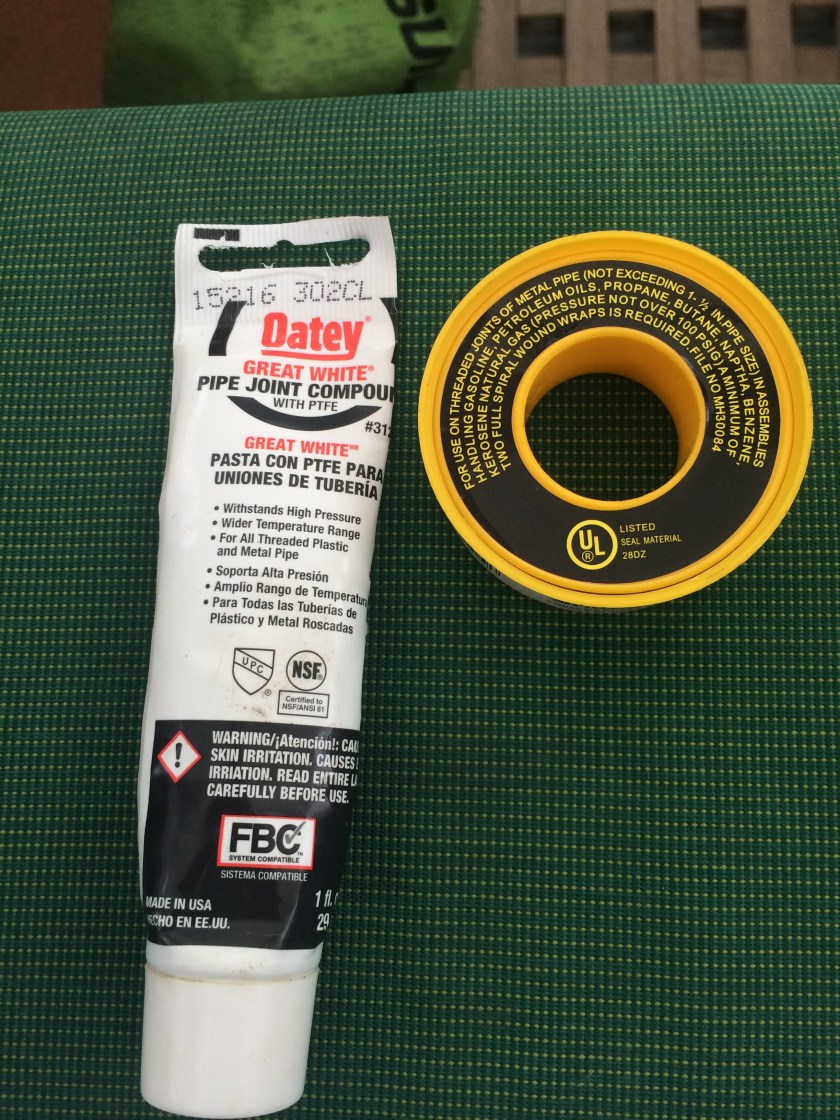
Unfortunately, I lacked both a supply of propane fitting tape as well as the self-confidence needed to assess, undertake, and safely resolve propane repair issues, a potentially lethal outcome of which I was fully aware.
Fortunately, S/V Avigna was anchored only two boats away.Of course,Jay had both the proper materials and self-confidence to show me what needed to be done.
Sealant and teflon tape specifically for propane/fuel applications
In the end, after the fitting had been repaired, everything tested, and the belowdecks rooms fully aired out, our propane system was back in action.Without a spare, the leaking hose could only be disconnected, leaving one hookup that could be switched between the two tanks as necessary… sweet.
Jay also expressed confidence that: Exit was probably not in any real danger of becoming a bomb…
Whew…
Sure… any instance during which movement of a hose or fitting causes propane to hiss out needs instant attention.
However, Exit’s aluminum bulkhead behind the propane tanks provides substantial protection, and the bow locker in which the tanks are stored is integrated as part of the aluminum hull, isolated, and well vented.
In Jay’s humble opinion, the worst that could happen is you blow the aluminum locker hatches clean off the deck.
…Reassuring… I think.
At that very moment, it was not lost upon me that I am occasionally reminded of the misunderstanding which occurred when I was in the fourth grade resulting in my parents being summoned to the principal’s office amid reports of their son being involved in the attempted building of a bomb on school grounds… exaggerations and misrepresentations… Fake News, if you will… certainly outside the scope of this blog…
With a couple of great dives, and four now nearly empty tanks, we had succeeded in temporarily satiating our ever-increasing need for a scuba fix.
We had met back up with Jay and Tami, aboard their catamaran S/V Avighna, just outside Little Harbor.Giving each other lots of space at anchor, but moving from anchorage to anchorage at a similar pace, we had gotten to spend quite a bit more time together.
S/V Avighna anchored in the distance
Though fishing from the Mothership or dinghy had, so far, remained relegated to the list of things still yet to try, I was determined to change that.
When we purchased Exit, among the extensive inventory of equipment already aboard, were two fishing poles, quite an inventory of fishing gear, and even two spearguns.
I had never been spearfishing.Frankly, as a scuba diver I had always considered it rather a rather unsporting way to catch fish, and never really been sold on it’s appeal.
However, Tami loves to spearfish.And when she offered to take me along, I couldn’t resist.
And, I must admit, after joining her for an afternoon, though not a complete convert, I do have a more enlightened and enthusiastic perspective.
One of the factors which had made me very leery of fishing from the transom of Exit with a pole or hand line, was the inability to control what potentially bit on the hook.I would be absolutely mortified to realize I had inadvertently hooked a shark, swordfish, or ray… not to mention a turtle… or dolphin (which I have been told are far too smart for that).
Even the possibly over-optimistic prospect of catching a fish I would be happy to eat but was fifty pounds more than I could consume before it spoiled lingered in the back of my mind.
As a conservationist, I have no problem with the idea of consuming certain fish I have caught myself.It reality, it is probably a more sustainable method than a limited consumption of fish caught exclusively by commercial fisheries.
Yet, the idea of simply fishing for sport, catching fish species already struggling on the brink of extinction, or catching a fish large enough that the majority of it would go to waste, were all possibilities I had no interest in pursuing.
Spearfishing turned out to be much more challenging than I had ever imagined.Without the benefit of scuba gear (illegal in many places including the Bahamas), the challenge of breath-hold freediving in tandem with beinglimited to the use of what is called a Hawaiian Sling (similar to a large slingshot, but lacking the lock and trigger mechanism of a standard speargun which is also illegal in the Bahamas), increased the odds for the fish exponentially.
Fish are obviously far smarter than they appear.As I quickly learned, they have a uncanny ability to sit in seeming obliviousness while you snorkel nearby.But as you approach, with the intent of making them your dinner, they suddenly seem to become much more aware of your presence and movements.Staying just outside the range of the Hawaiian Sling’s spear, which is no more than a couple of meters, they seem to mock air breathers repeated feeble attempts to hunt in their environment.
Tami’s prime target were lionfish.Beautifully adorned with streaming fins, each containing a venomous needle at the end, we had seen thousands of these scuba diving in SE Asia, and had never seen them on a restaurant’s menu.We didn’t know they were edible, and would have been appalled to see them being served.
However, in the Bahamas, lionfish are an invasive species which, at some point in history, human meddling introduced to the area.With no natural predators to control their numbers, the ravenous and aggressive lionfish quickly began to overpopulate and threaten the health of other local species.
Eventually, the Bahamian government recognized the problem and put lionfish on a hit list, to be culled whenever found, if at all possible.
The fact that lionfish are not only edible, but tasty, makes for a unique opportunity.Good, and free, mealsthat directly and immediately aid in Bahamian conservation efforts… gotta like that.
As it turned out, we didn’t see a single lionfish during the entire day Tami took me out spearfishing.On one hand, not seeing the lionfish was a bit disappointing.On the other, I guess it was a positive sign that their numbers were finally being brought into check in some places.
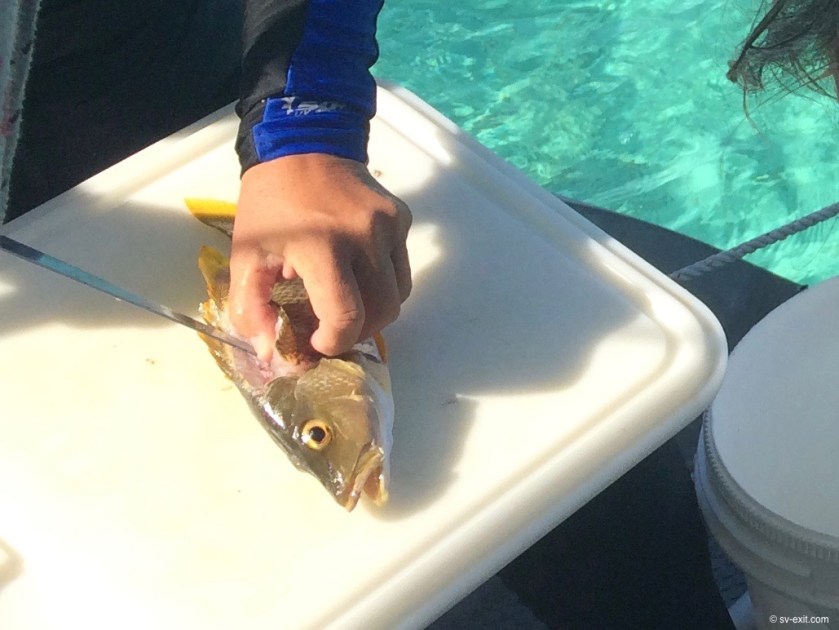
By the end of the day, I had two snappers of very modest size to show for all my efforts.Just enough for some fresh-as-you-can-ask-for ceviche to go along with sundowners, as well as one filet to fry the following evening.
Utilizing nature’s resources… rewarding and free!
At some point, I still intend to get out the fishing poles and try my luck.However,obtaining a Hawaiian Sling may prove to be a much more workable strategy.
The ability to actually pick and choose what you are fishing for has obvious merits.
The foresight of knowing exactly the type and size of a fish before committing to killing it would appear to be a much more responsible and sustainable approach to fishing.
Tami was a legend to let me accompany her on her spearfishing expedition.I have a newfound respect for the skills required and an appreciation for the advantages of the method.
My own technique as a spearfisherman, as Tami can testify, is suspect at best.With a substantial amount of practice, I may someday have the ability to rely on the sea to provide dinner… but for now it’s far more likely to come from the grocery store.
Despite all the hype, The Devil’s Backbone (or possibly we were far enough west that it was more A Minor Demon’s Hipbone) provided no drama, though we did decide to motor through it (sorry Dena and James).
By 2:00pm, we were sailing in the North Atlantic with an incomprehensible fifteen thousand feet of ocean beneath our hull. The water color is an indescribable shade of blue. We had raised our sails and killed the engine as soon as we cleared Ridley Head Cut, and didn’t need it again until we were approaching Little Harbor, Abaco fifty nautical miles later.
Ten to fifteen knot winds from nearly behind us, a slowly building swell, and lots of sunshine made for a great day of sailing.We didn’t see another soul on the water the entire day.
Little Harbor was settled in 1951 by Randolph Johnston, an renowned artist/sculptor who had detached from society by sailing away aboard a schooner with his wife and three sons.After sailing into the harbor,they decided it was the perfect place to stop.They lived in a nearby cave while they built a thatched home and eventually set up what is still the Bahamas only bronze foundry so Randolph could continue his sculpting.
His sons still reside in the compound and continue the sculpting tradition.Pete’s Pub, a laid back outdoor beach bar, and The Gallery, which displays/sells bronze sculptures cast in the local foundry, were both built by son Pete Johnston.
As we entered Little Harbor Inlet the surrounding water quickly lost its inky electric blue color, reflecting the depth change from five thousand feet to five hundred…
… to fifty…
… to five.
We chose to anchor outside Little Harbor in the much larger bay it faced into.This turned out to be a good decision as Little Harbor, limited in space to begin with (as the name suggests), was already pretty full to the gills with occupied mooring balls and a scattering of rather sad looking sailboats.
Wide open bay with Little Harbor directly off our bow
After a couple of days we moved four miles north to Spencer Bight and anchored just outside a small nature reserve.
Sunset BBQ
Chillin’ on deck
For the first time, we managed to raise the anchor, move to a new anchorage, and get the anchor set, all without ever having to fire up the engine.Typically, running the engine to charge the batteries while using the power hungry windlass while picking up anchor, and using the engine when anchoring, backing down to properly set the anchor is the norm.But, as an exercise, it was rewarding to know we could do it if necessary.
In addition, it finally looked as though a dive excursion was in the cards for us.
About two miles away from where we were at anchor, the park had set up mooring balls for dinghies and small boats to tie up to while snorkeling.
We did a preliminary dinghy reconnaissance mission to Sandy Cay, around which nearly a dozen mooring balls are stationed.
After tying off, we hopped in the water with fins, mask and snorkel.The conditions were good and the visibility was probably between ten and twenty meters.
For the first time since arriving in the Bahamas, were blown away by what we saw underwater.
Lining the edge of a vast sandy channel, about ten meters down, was an remarkably healthy reef system.The population of hard and soft coral, as well as fans and sponges, was extensive and diverse.Also present was a wider variety and abundance of fish than we had seen during the past three months combined.
In thirty minutes of snorkeling, we managed to see a large nurse shark cruising through, a bonnethead hammerhead shark foraging at the edge of the sandy channel (the first time we had ever seen this species), what we suspected was a Caribbean reef shark passing by, as well a meandering green turtle.
Impressive!
We were exhilarated at the prospect of finally doing some exploratory scuba diving.We had long anticipated diving as being an activity we could undertake regularly while living aboard Exit, but alas, it had not yet happened outside the occasional use of tanks to facilitate work on the boat below the waterline.
This provided a perfect scenario to beta test our as-of-yet untried mobile dive possibilities.
While the potential to scuba dive while living aboard a sailboat is certainly appealing, the actual logistics involved in scuba diving from your own boat are much more complicated than it might initially seem.
Without having a dive shop to provide a dedicated and spacious dive boat as well as captain that remains aboard, either the Mothership has to be able to be properly secured at the site, or everything has to be fit into a dinghy less than ten feet long which still needs to be able to be secured at the site.It would be hard to imagine a more sickening feeling than surfacing from a spectacular dive only to realize that your dinghy or, even worse, your sailboat had drifted away.
The existing mooring balls at the site were not set up for boats larger than about twenty feet, which meant we’d be diving from the dinghy.
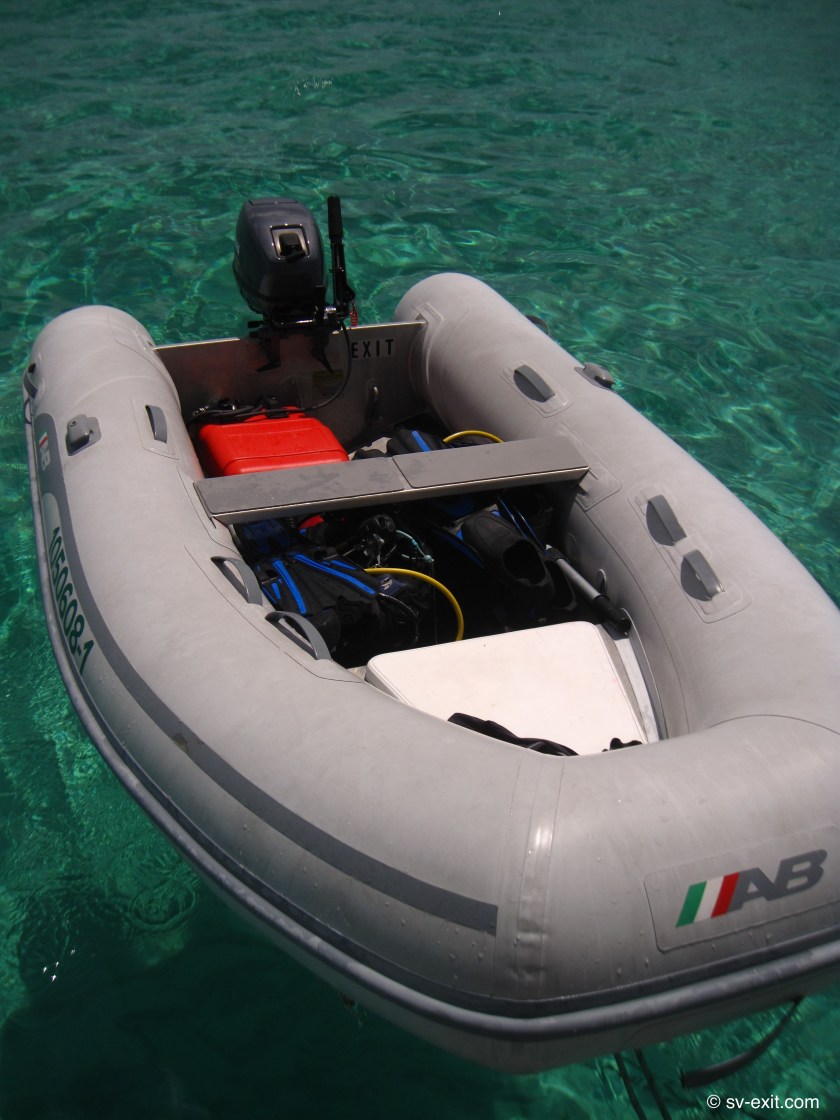
A tight fit
The distance from Exit to the mooring balls was about two miles.I don’t think the old 8hp Yamamama, running on only one of two cylinders, ever would have made it with two people and all the dive gear aboard, even limping along with no chop on the surface.
Y’mama, on theother hand, with all fifteen of her horses available, was up to the task.Two miles each way… not a problem.We even managed to get up on a full plane loaded with two people and the dive gear in choppy water.
The new outboard, a bit of a luxury in just getting short distances to and from shore, turned out to be an absolute necessity for diving.
Once we had reached the mooring balls and tied off securely, we geared up and returned to the world of fun diving.
After hundreds of unaccompanied dives in SE Asia, we felt completely comfortable on our own without a guide.Now it was even more rewarding to be doing it from our own boat.
Just over a hundred minutes later we surfaced back at the dinghy, air still in our tanks.It was good to see we still had it.
While the bonnethead shark didn’t made another appearance, we were graced with the presence of a two meter nurse shark, a juvenile grey reef shark, a green turtle, and a number of very large spotted eagle rays that passed gracefully back and forth over the sandy channel repeatedly, right next to us.
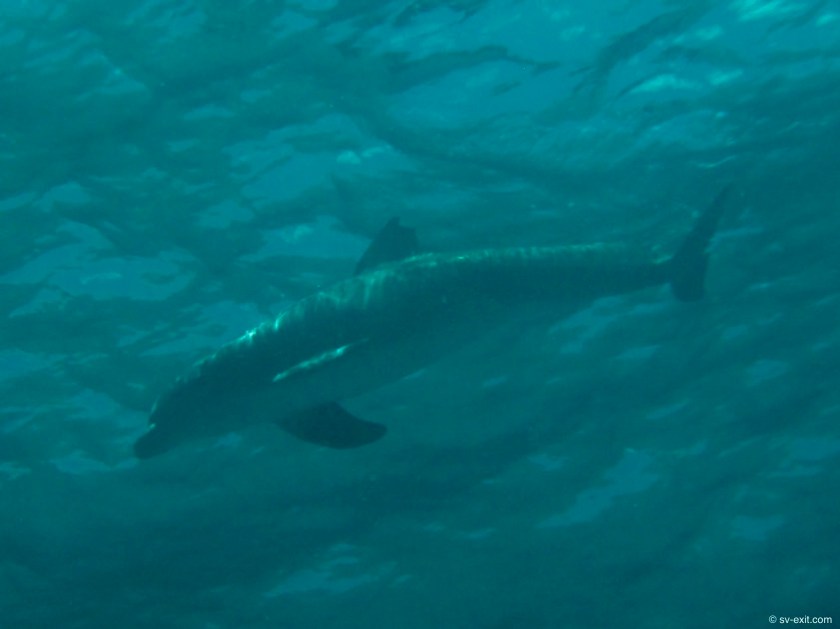
Furthermore, a pod of dolphins, numbering between a dozen and twenty, approached us from further out in the channel and passed by.One of the more curious dolphins briefly broke ranks with the others to come check us out and show off with a short display of underwater acrobatics… amazing!!!
Overall, the dive was excellent.Certainly not as much weird macro stuff that we had become spoiled on in SE Asia, but well worth the effort involved.Good enough that we went back the next day for another dive.
Tank fills are a logistical challenge yet to be sorted out.Until we figure out a way to convert our unused washing machine into a dive compressor, we will have to get tanks filled at dive shops as the opportunities arise.
Nevertheless, we felt reenergized and somewhat redeemed to know that diving had, once again, made it’s way back into our itinerary of current activities.
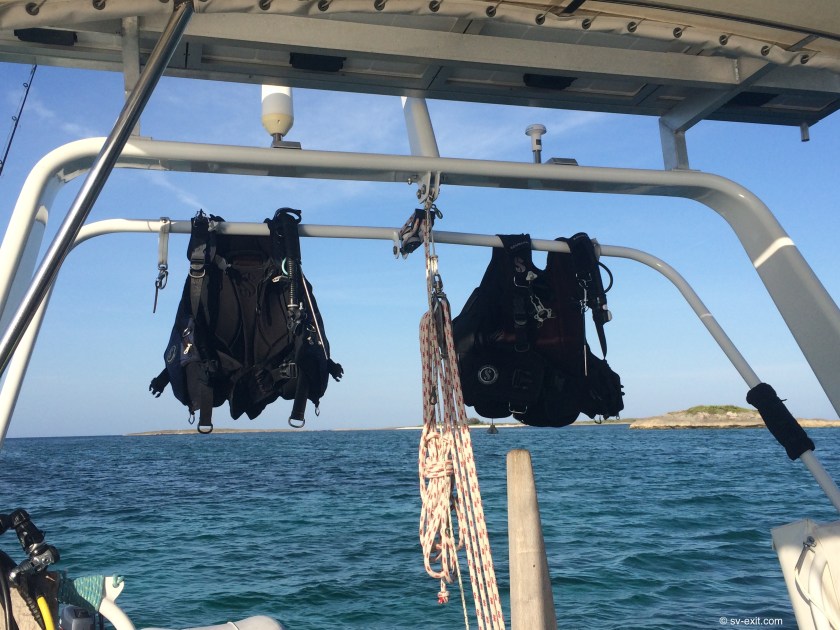
BCDs drying means Kris and Steve diving… me likey.
Before arriving at Spanish Wells, located on St. George’s Cay in the northernmost area of the Eleutheras, we had thoroughly enjoyed four relaxing nights at anchor just off the beach of tiny Egg Island, the only boat there for almost the entire time.
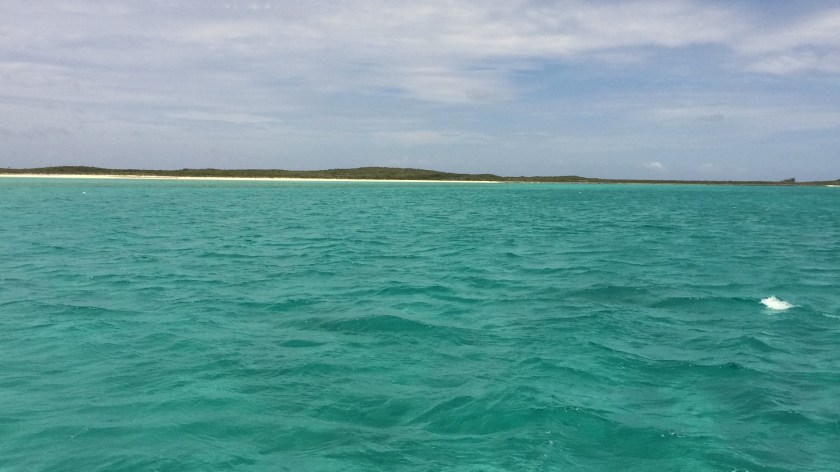
At the far eastern edge of an impressive fifteen mile long reef system wrapping around the northern tip off the Eleutheras, Egg Island is nothing more than a pinpoint on the charts.Only a mile long and less than half a mile wide, it is roughly a five hundred foot ribbon of inhospitable rocky and overgrown land encircling a salt water pond and marsh.
But along the southwest edge is a small bay, it’s final five hundred feet stretching at depths of less than ten feet, which funnels onto a sandy beach.At night, an army of mosquitos patrol it, but during daylight hours it provides a perfect setting for afternoons on the beach.
As long as the southeast winds held, we had good protection, and could tuck ourselves far enough in to minimize the swell felt farther out.
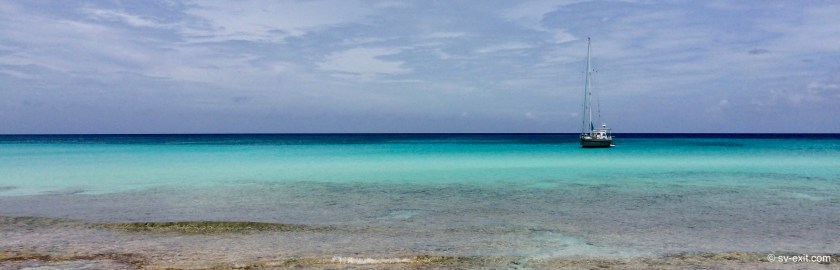
Largely alone, aside from the occasional passing charter fishing or snorkeling boat, anchored just off an isolated island, we savored both the isolation and the view.
During one excursion to the island, Kris discovered a fascinating small bird scurrying about on the beach. Every time Kris would move in one direction the bird commenced with a very pronounced show, feigning injury to try to distract Kris and hold her attention. It appeared to be acting as a live decoy, we could only surmise it was trying to keep us away from its nest and probably young… amazing.
But as the winds began to shift, we quickly felt the change in surge.It became evident that a forecasted increase in winds needed to be heeded as fair warning to relocate.
In fact, the last night we spent at anchor at Egg Island, both a catamaran and a squall passed through that gave us our first real feel for just how quickly thunderstorms can build and how intense they can be.The ominous clouds materialized and stacked up within minutes, giving very little warning.Then, within seconds of feeling a cool breeze pick up, Mother Nature unleashed a maelstrom of wind and rain upon our location.The wind speed increased from single digits to thirty knots in less than a minute, and the torrent of rain dumping down reduced our visibility to less than one hundred feet.
Caught out with full sails up, the result could be catastrophic.Fortunately, we were already at anchor.Our anchor chain and snubber line, pulled as taut as if we were backing down on it with our engine revved to 2500rpms, groaned and creaked.
Yet still, Exit held fast.
Fifteen minutes later there was an eerie, dead calm all around us.But the message was loud and clear… don’t get caught out here when the weather conditions shift.
Just after the squall passed through
Five miles to the east, not quite halfway between Egg Island and Spanish Wells, Royal Harbor was the easy choice.It was not as picturesque as our surroundings at Egg Island but the half-mile by thousand foot harbor, accessed through a small inlet, offered three hundred sixty degree protection with land reaching up nearly fifty feetall the way around it.
We had dropped anchor in Royal Harbor for a night before heading to Egg Island, so we returned and waited out the overnight winds with a small handful of other boats.
However, aside from the appeal of isolation, we found very little that grabbed our attention.
360 degree protection inside
The inlet to get out
It also didn’t help that it had taken us so long to get favorable enough winds to jump over from the Exumas. Upon our arrival, we were already at the northern most point of Eleuthera running out of land that we could point our bow towards.
We hoped to do some diving.But a wreck just to the south of Egg Island we had considered had been all but pulverizedby hurricanes, and the reef system we were next to had proven quite challenging to suss out by dinghy.The diving would still have to wait.
For us, Spanish Wells seemed to be the catalyst for our decision that the Abacos offered more appeal.
Our cruising friends Tami and Jay had already been exploring Eleuthera before we arrived, having made the leap across the Sound nearly directly from Georgetown.And exchanging texts with them regularly, we found that their perspective was that Eleuthera had largely been a disappointment.They had already concluded that, unfortunately, Eleuthera seemed to be much more like Florida than the Bahamas and they were ready to move on as well.
From Spanish Wells, we had two options.
The first was to take a slightly longer route, which involved returning to Egg Island for a night and then leaving early the following morning.This route would afford us the ability to circumvent the extensive and reputedly treacherous reef system which stretched across the northern side of Royal Island.
From where we were at anchor, just outside Spanish Wells, the Abacos lie just over fifty miles away.With an early start, we could sail there by nightfall.But we would have to pass through the shallow reef system fringing the north side of St George’s Cay before reaching the relative safety of the deep water just beyond.
An ominous sounding section of that reef reputed to have claimed many boats had been given the name The Devil’s Backbone.
We had read numerous warnings that navigating this area without a hired local pilot was to give fate the finger, and even the most capable captain unfamiliar with the navigable channels was begging to run aground or sink their boat.
We were quite dubious about the idea of ignoring the emphatic warnings of mariners.
Yet Ridley Head Cut, the small section of reef we needed to get through, was just at the outside edge of the Devil’s Backbone;everything we saw on both paper charts and our Navionics software seemed to indicate that there was nothing that warranted any particular concern.
The channel, though unmarked and narrow, was straightforward enough.At it’s narrowest point, it bottlenecked briefly to a width of about seventy five feet wide between the coral heads…Wouldn’t want to try it using exclusively a line of sight and paper charts; but our Navionics gives us pretty spot-on live reference of exactly where we are, relative to the charts.Also wouldn’t be foolish enough to try in poor conditions or poor visibility.
But, on the morning of our departure, the sun was shining and the surface of the water was absolutely smooth.
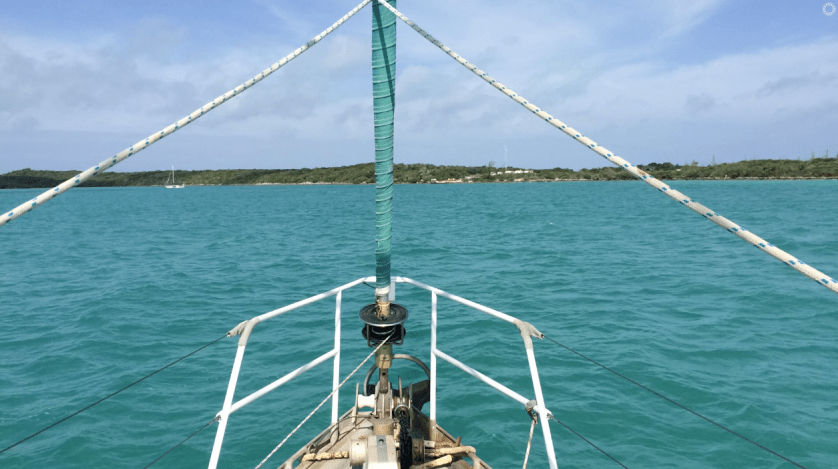
Passing Ridley Head
Through Ridley Head Cut
Kris keeping an eye on Navionics
Clear of the Devil’s Backbone
Possibly a momentary lapse of reason in which we succumbed to the dangerously slippery slope of cocky complacence; or possible evidence of a moment of evolutionary advancement having occurred in our sailing self-confidence…
As I stood lookout from the bow, Kris stood at the helm, carefully adjusting the wheel as she compared what she saw on the iPad in front of her running Navionics to what she saw in front of and around us.
A couple of minor turns here and there… the dark coral heads seemed far below…
Fifteen minutes later we were through the cut with depths below us quickly progressing from a hundred to beyond a thousand feet.Inside the cut, our depth had never registered shallower than twenty feet.
By avoiding the other route… a day saved.
Under the right conditions, trusting your instincts can be better than listening to the herd.
I’m sure the Spanish Wells pilots are a knowledgable and experienced lot, and I’d not sail inside the Devil’s Backbone without their assistance.But I would have felt pretty damn stupid coughing up one or two hundred bucks to have gotten piloted through there.
But when you’re standing atop a forty six foot sailboat that is being pushed along completely sidewise by a thirteen knot wind in a channel of water not more than one hundred feet wide, it seems far, far too fast.
*****
We had already taken the dinghy ashore the day before in order to take a look around and pick up some much needed provisions.
Spanish Wells was picturesque.A small community with immaculately tended yards and gardens, well kept houses which all appeared recently painted with bright and cheery colors and planter boxes in the window, it had a very sleepy but approachable feel to it.
Our five days at remote Little Egg Island had been spectacular, but incoming squalls and shifting winds had eventually forced us to move to Royal Island, which offered better protection in exchange for uninspiring scenery. It made sense to head for Spanish Wells as the weather settled.
At anchor Royal Island, Eleuthera
We also needed to suss out the marina situation, as we were almost out of fresh water (our rain catch efforts had proven all but fruitless since leaving Georgetown) and we also wanted to top off our diesel tank.
From where we were at anchor, the approach to town required us to navigate inside of a very narrow channel, not more than one hundred feet wide and approximately half a mile long.Depths of only a couple of feet awaited anyone who strayed outside of either side of the channel.
Once at the island, the narrow channel continued, with the town hugging the water’s edge on the right.Eventually, as the town dwindled away on the right, the channel began to grow more narrow and shallow, eventually offering access to only small power boats.
The dock that we could fuel up at didn’t have water and the marina that had water didn’t have fuel which meant two separate stops… not ideal.
We have learned again and again that our highest stress levels and and greatest risk are achieved docking Exit.
The mindset of many boaters is that docks are the safest place to be.Any problem… get me to a dock and all is well again.A sanctuary that offers protection and connection with the world.
For us this couldn’t be farther from the truth.
In fact, in our opinion, docking is nothing more than a conscious and intended (though controlled) collision with something hard… something we try to avoid, as a rule, if at all possible.If there’s any way we can accomplish a task without putting Exit in direct contact with a solid object, well then, that sounds like the preferred method for us… every time.
Water and fuel are the two necessities that sometimes require us to forgo this train of thought.Lugging five to six gallon jerry cans (plastic jugs) by hand via the dinghy is sometimes an option, but simply is not very practical if we need 200 gallons of diesel and/or 200 gallons of water.
The threshold at which tying up at a dock to accomplish this outweighs the effort involved in small quantity transfers utilizing multiple trips is obviously not absolute.However, I can say without any hesitation, that threshold seems to increase after almost every docking experience… even the smooth ones seem to age me rapidly!
Our situation at Spanish Wells was such that we needed almost 200 gallons of water and the dinghy ride was nearly two miles each way.
We like to think that we are constantly evolving into wiser and more savvy sailors/cruisers with every passing day we live aboard Exit.We had purchased two six gallon water jugs while at Georgetown so we could fill up every time we docked at the public dock (which also had what seemed to be the Bahamas only free of charge potable water spigot on the dock).
However, now, with only two six gallon containers aboard, the math indicated it would take us fifteen trips to fill up our fresh water tanks… a total of thirty miles in the dinghy… not very realistic.And putting just a bit of water in the tanks didn’t make sense as water sources here can be far and few in between (with the next one possibly being even more difficult than the last).
Which left us one option… a controlled collision with a solid object… docking.Poop.
Our approach to Spanish Wells in the Mothership, the half mile long hundred foot wide channel, should have been interpreted as the litmus test towards whether we should proceed or abort.
As we entered the channel, a massive ferry appeared from the opposite direction.Thankfully, it stopped just before committing at the other side, allowing us to pass by.
We continued with the intention of stopping at the fuel dock.It should have been a pretty straightforward docking except for the thirteen knot winds coming from our port side.The narrow stretch of land covered with trees to our left helped to buffer the wind; however, the sailboat that pulled up to the fuel dock moments before we arrived left no alternative.
With the limited space to maneuver and winds to contend with, there was no way we could hold position until they pulled away so we continued on, at least temporarily aborting the less critical fuel fill.
With Kris stoically at the helm, we pushed on until we neared the marina dock that had the water we had really come for.
As we approached, we hailed them on the VHF radio.They verified where we needed to tie up and confirmed that someone would meet us on the dock to help with the lines.As the dock grew nearer and nearer, we could see where we needed to go, but there was no sign of the dock master.This would be an unassisted effort.
Both fenders and dock lines were already in place, something we learned early.However, the exact placement of fenders on the boat is always something that can be a bit tricky to determine, based largely on the layout and construction of the dock.
This dock was not very boat-friendly.And dock construction is a make or break prospect… literally.
It amazes me how many docks seem to be constructed with very little regard for the boats for which they are intended.
Well thought out docks (obviously by people with boats, or at least knowledge of them) utilize materials and construction designs which are forgiving to boat hulls and minimize risk of damage.
Some of the best are floating docks, which raise and lower with the tides, offering a consistent height.A dock platform sitting higher than a boat’s decks negates the effectiveness of using fenders, which should really be attached at the hull of of the boat.Boat owners that tie off their fenders to the stantions or lifelines are simply begging to have their stantions torn off if the fenders get snagged.
This risk of fenders getting hung up on something is greatly increased when the outside edge of the dock is not in a straight line, usually due to a dock designed with it’s support posts extending beyond the dock platform.
As a boat reaches the dock, any remaining forward momentum allow the posts grab the fender as it passes.If you’re lucky, the fenders squeeze around the posts.If you’re unlucky, the ropes tying the fenders to the boat snap.If you’re really unlucky, the fenders stop short and the ropes hold; but the stantion or lifeline you were foolish enough to secure the fender to get ripped right off the boat.
Oftentimes the posts are a bigger diameter than the fenders, which means the fender really is of very little benefit.It either catches on the posts, or, between posts, dangles ineffectively a few inches away from the dock edge while the boat’s hull scrapes alongside the posts.
In addition, some sort of bumper system or padding installed on the dock’s edge indicates that the marina taking your money is somewhat concerned about your boat’s well-being.
At the very minimum, rope wrapped around the exposed posts provide some protection.Rubber bumpers are a real blessing, though some curse the black streaks they can leave on the boat’s hull.I’ll take the streaks any day.
In this case, there was nothing.
With an aluminum hull, we generally fair much better than a boat made of fiberglass when it comes to damage caused by docks.
However, the sure sign that a dock was constructed by an idiot is when the dock supports extend beyond the platform, AND the big bolts which hold everything together aren’t even countersunk into the wood of the support posts.
This sadistic approach results in diabolically exposed domed stainless steel bolt heads lurking on the side of the post facing the boat.
Despite the wind and absence of anyone to assist at the dock, Kris cooly performed a textbook docking maneuver, and we glided slowly up alongside the dock.
Unfortunately, the dock was built by an idiot.
As I tried to get a line secured around one of the posts, and push off so we didn’t end up with our bow (and anchor extending just forward of the bow’s edge) pushed into the exposed support posts by the wind, a sickening scraping sound emitted from twenty feet behind me as the midship section of our hull slid alongside one of the posts farther back.
It was the unmistakable sound of metal on metal… the head of a bolt grinding along the side of our hull…
Fuck.
We had just been tattooed by, the ironically named, Yacht Haven Marina with a vicious, and permanent scar to remind us of the day. (Sidenote: Lashing wooden 2x4s to use as rub rails between our fenders would alleviate a lot of the problems with problem docks… however, that system is only beneficial to the boat that already has them set up prior to needing them…).
Shortly thereafter, the dock master sauntered up.A nice guy, and certainly not involved in the marina’s dock design; so we decided to refrain from a commentary and chose to just get our water and get the hell out of there.
Fifteen minutes later, with water tanks once again holding their two hundred gallon capacity, at a cost of fifty cents per gallon, we were ready to head out.
The wind was going to make things challenging.But, we felt, with the assistance of a push off from the dock master, we could edge over to the other side of the channel utilizing the small opening to a stream.
As long as we didn’t go too far and run aground, we concluded that there should be room to back up and turn around in a dicey three-point turn, getting us going back in the other direction, as the channel ahead narrowed and shallowed, which eliminated the option of simply continuing forward much further.
That was the plan.
What we didn’t count on was the thirteen knot wind, buffered by the island and tree cover still to our left, would be funneling straight down through the opening created by the stream to our left.So, while we able to successfully get off of the dock, as soon as we approached the mouth of the stream the wind immediately began to intensify.
Kris managed to get Exit perfectly positioned at the mouth of the stream without touching bottom.But as soon as we stopped, as she started to back us around, the wind caught our bow and began pushing us around much more quickly than we could react.
She couldn’t power forward, as we were still too close to the bank opposite the marina dock, and the wind was shoving us sideways until we were almost broadside in the channel.
Without bow thrusters (to push the boat from side to side), forward momentum was the only thing that would give us steering.And with the channel only one hundred feet wide, we were going to run straight into the dock we had just left before gaining that momentum.
As Kris struggled to bring us about, the wind continued to push our bow around until, before we knew it, we were broadside in the channel, entirely at the mercy of the wind.
One knot of speed may not seem that fast…
But when you’re standing atop a forty six foot sailboat that is being pushed along completely sidewise by a thirteen knot wind in a channel of water not more than one hundred feet wide, it seems far, far too fast.
“Shit…shit…shit…” emerging from Kris’ mouth in the cockpit.
“Fuck…fuck…fuck…” emerging from my mouth on deck.
The dock master, helplessly watching from the dock, trying to yell out and signal suggestions.
As we begin drifting, a man on a power trawler tied up in a slip on the next dock down, pokes his head out and, peering at us, asks “Are you trying to dock here?”
To which I respond, “No, we’re trying to turn around.”
All he can say is “Oh.”
…surreal.
With everything unfolding both in slow motion and high speed simultaneously, I can only stand on the deck and watch.
In a moment of sheer determination and brilliance, Kris manages, with a combination of wheel turns as well as forward and backward gunning of the engine, to regain control of Exit, bringing us fully around so we are finally facing the correct direction.
I realize I have stopped breathing, instantly aged a number of years, and quite possibly just shit myself.
As our heart rates slowly began to drop, and the color in our faces began to return, we looked at each other, fully realizing just how close we had come to disaster. Just the day before there had been a multi-million dollar mega-yacht tied up along the outside edge of the next dock down, which we had just nearly missed.
Still shaken by the dock departing fiasco, we continued down the channel until we, once again, found ourselves at the fueling dock.
We looked at each other and, without any need for discussion, both mutually declared that there would be no more docking attempts that day.
Screw the fuel.
Without slowing, we passed by the fuel dock and pressed on, wanting only to get back to our anchorage.
But Spanish Wells was not finished with us yet.
As we reached the edge of town and prepared to enter the narrow entrance channel, a mahoosive mega-yacht pulled into the channel at the opposite end and started steaming down the center towards us.
Undoubtably, there was no room for us to squeeze by.
We immediately slowed.We were at a spot that opened up much wider with mooring balls and a couple of boats to the right of us, just before the the channel bottlenecked back down, so we tried to tuck ourselves to the side, allowing room for the Mega-yacht to pass.
But we were now clear of the stretch of land and tree cover opposite the town.With no further protection from the winds, now coming from our right, as we came to a stop Exit’s bow once again began to immediately drift to the left pushing us sideways.
We momentarily contemplated trying to grab a mooring ball to hold our position, but we really weren’t prepared or well positioned for that, so Kris said to hell with it and just let the wind carry us fully around until we had come about one hundred eighty degrees, facing the town again.
Exasperated, we powered up the engine and found ourselves once more heading into town, past the fuel dock for a third time.
Fortunately, there is a second channel to and from town on the left, located between the fuel dock and the marina we had gotten water at, so we ducked out of there opting to take a longer route back to our anchorage.
As we departed, we unleashed a string of expletives directed at the Mega-twat, which it turned out, took the exact same course.It turned out they had cut through town only to avoid navigating this longer route around.
Eventually we were back at anchor with two cold therapeutic beers in hand.
Our final assessment of Spanish Wells… beautiful in appearance but rather dark beneath it’s surface.
We subsequently learned that Spanish Wells used to prohibit black Bahamians from being on the island after dark.I don’t believe this is still the case but am unsure when the practice was discontinued.Apparently, the white population of Spanish Wells is comprised of five family names and three hundred years of inbreeding hasn’t helped.
Speaking with the white locals, at first we couldn’t place what initially seemed like a very strange “cajun sounding” accent.Eventually, it dawned on us that the accent we were hearing sounded incredibly South African.
Further research uncovered numerous references to Spanish Wells racism (both historical and prevailing).
The one conclusion we drew with absolute certainty… those visiting Spanish Wells via a boat not equipped with bow thrusters are vehemently advised to do so by dinghy.
And if you take the Mothership in, be exceptionally wary of the dreaded Yacht Haven tattoo.
As for us, an increase in our inventory of fresh water jerry cans is in the very, very near future!
It’s hard to fully process that it’s been a full year since we first stepped aboard Exit in 2017.
“Exit” selling herself May 26, 2017
At that time, we had resigned ourselves to the assumption that Exit was not in the cards for us.Though we had been drooling over her for over a year every time we looked at the listing online, she always seemed just out of reach of our budget.Not to mention the fact that an offer had already been made by other potential buyers.
We boarded her only with the intention of further educating ourselves regarding options we needed to consider as we continued hunting.
This was the opportunity, once and for all, to get past her.As had been the case with every other boat we had looked at, we fully expected to realize that she was not nearly as magical and majestic in reality as she looked on paper.
Get aboard, see for ourselves, and then keep looking (a process we were growing both frustrated with, based upon our seeming lack of progress, as well as fearful of, based upon the prospect that we simply couldn’t find the right boat despite the fact that we really didn’t know what we were looking for).
We couldn’t have been more wrong.
And once you know something beyond a doubt, there’s no going back.
In this case we both knew, without any doubt, she was the boat for us.
Then, stunned at this realization, from the moment we called Pete at Swiftsure Yachts (and were told that, despite an offer already being in place, we had the option of putting in our own offer since nothing was set in stone yet) the crazy whirlwind began to materialize.
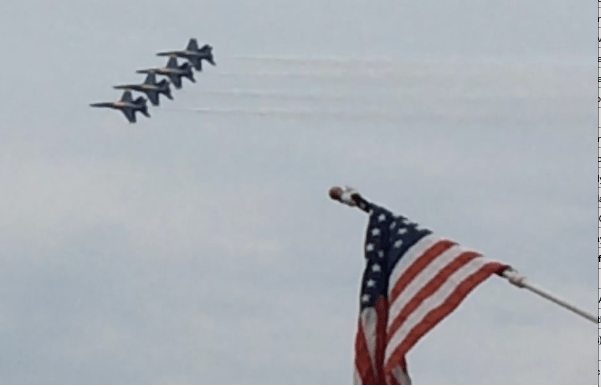
Watching the Blue Angels flying above Annapolis after calling Pete at Swiftsure
The perfect view…
Flying over the Navy goalposts
A whirlwind that eventually carried us to this point.
A million things could have turned out differently.
Not being religious or superstitious, fate does not get the credit here.However, I firmly believe in circumstances sometimes providing rare opportunities.And if capitalized upon, those opportunities can cash in on results that, in hindsight, make things seem as though they were simply meant to be.
Had we not hopped on a train to the East Coast to look at other boats…
Had we not decided, since we were already in the area, we might as well see Exit in person…
Had the previous offer already been accepted…
Had we started playing our own negotiation game with the current owner and ended up with a rejected offer ourselves…
So many paths that could have led us away…
And yet, here we are…
… May 26, 2018 – one year later at Little Egg Island, Eleuthera, Bahamas
Sometimes the world sucks.Sometimes it fucking rocks!
The process of backtracking made things much more simple than our initial exploration of the Exumas had been.
Not having to thoroughly research every day’s course in advance, uncertain of how far we could get and what would find when we arrived, made for substantially less anxiety.We were already familiar with the logistics and could pick and choose with much greater certainty.
We had the opportunity to stop at a few places we had missed our first time through, like Lee Stocking Island and White Point at Great Guana Cay (which had been rudely occupied by a mega-yacht last time).
From Lee Stocking Island to Great Guana Cay
Yet, for the most part, we utilized mostly the same destination anchorages along the way… Fowl Cay, Shroud Cay, Highborne Cay.
Fowl Cay foul weather
Fowl Cay all to ourselves
Getting to know the locals
Got any food?
Twilight snubber check
Better company on Shroud Cay this time
Our intention of crossing over to the Sound side and jumping over to Eleuthera didn’t materialize as quickly as we had hoped.Fairly strong winds shifted direction, allowing the only option for making Eleuthera from farther south to be under engine power… something we didn’t want to do.
However, while it previously took us nearly a month to get from New Providence to George Town, reversing our direction we found ourselves back at Rose Island in less than two weeks time.Instead of short jumps of ten to fifteen miles, with days and days spent at anchor once we had reached a new location, the priority was to keep moving until the wind became more favorable to make the jump over to the Eleutheras.
One of the biggest sailing challenges we now faced was that of downwind sailing.Our experience for the past nine months had largely been heading into the wind.
Exit loves a breeze coming directly on her beam.She flies along comfortably and the sails are relatively easy to trim.
As we head into the wind, she takes the extra forces upon her hull and rigging well.She’s heavy enough that we can pound into some pretty sloppy seas (she can certainly handle them better than we can), but the big genoa really starts struggling to stay filled once we get much inside of sixty degrees of true wind angle.She does well on a close reach but extended close hauls into waves can be an exhausting prospect.
Sailing downwind has its’ own science to consider.When sailing into the wind, air passes across a properly trimmed sail and creates lift, which helps to propel the boat forward (exactly the same principal utilized in aircraft wings).However, as the wind comes from further and further astern, the sail begins to be pushed by the wind more than it is pulled along by it.
Properly setting sail trim while broad reaching or running dead downwind has become our new challenge. To anyone reading this who considers this basic stuff, I apologize in advance if my ignorance becomes painful to bear at times.
For the experienced sailor, one of the pleasures of sailing Exit is utilizing the exhaustive combinations of trim adjustments that can be made with all of the onboard gear.
For the learning sailor, one of the frustrating, bewildering, and vexing realties of sailing Exit is utilizing the exhaustive combinations of trim adjustments that can be made with all of the onboard gear.
With time, hopefully we’ll actually be able to utilize some of the extra downwind gear we have aboard, like whisker poles, spinnakers, and reaching poles, as well as rigging up a proper gybe preventer, all designed to make downwind sailing easier and less prone to disaster.
But, for now, it’s about trying to maximize our sailing efficiency without the further complication of too much additional equipment.
We find that, as our true wind angle starts to move farther aft than 140-150 degrees (approaching the stern), the genoa simply can’t get enough wind to stop luffing and flapping around.It’s a combination of just too much sail, wind angle, and the main sail creating a severe wind shadow that the genoa sits in.
There comes a point where the genoa has to be partially furled in to reduce the area of sail we’re trying to fill, or the main has to be reefed or repositioned (reducing it’s effectiveness) to get out of the way of the genoa.Bringing in one or the other entirely may be the most effective approach.We found sometimes just running the genoa at full power was more effective than two sails working inefficiently.
Running dead downwind (with the wind directly behind you), seems like it would be the easiest sailing of all.In fact, it appears to me to be rather complicated, and the profound risk of a dreaded accidental gybe is always nerve-racking.
When the wind moves from one side of the boat to the other, the very large and heavy boom located under the main sail and attached to the mast, has to change sides.
If the wind is passing across the bow (a tack), this boom movement tends to be rather controlled as the boom is usually already positioned much closer to its’ center point.
If the boat has been on a beam or broad reach (wind perpendicular or aft), the main sail is sheeted much farther out to the side.
Before the wind is allowed to come around the stern (a gybe), the boom must first be sheeted in to minimize its’ movement.If it is sheeted in prior to gybing, when the wind catches the other side of the main sail, the boom will swing across to the other side of the boat in a controlled manner.
On the other hand, if the crew doesn’t first sheet in the main, as the wind crosses to the other side of the mainsail, the boom, sitting far off-center, is hurled across to the opposite side of the boat with a tremendously deafening and bone jarring crash… an uncontrolled gybe.
Even worse is an accidental gybe.For an unprepared crew, the swinging boom can be lethal.If it doesn’t break equipment or bones, it certainly clears the deck of anyone…
Obviously, sailing dead-downwind creates the highest risk of having the wind inadvertently shift from one side of the stern to the other.But, with the sail sheeted out, nearly perpendicular to the hull, it takes a serious change of angle for the wind to get behind the sail.
Experimenting with different sail configurations dead downwind became the norm… main only… genoa only… wing and wing (with main and genoa fully out on opposite sides) – challenging without a pole and risky without a preventer.
Wing and wing running dead downwind
We quickly found with the boom sheeted out that far, it was not the wind that caused as many problems as did swell and waves.It seemed ridiculously dangerous and equipment jarring when, every time a swell would roll the boat from side to side, the mainsail momentarily relaxed and then reloaded causing a violent jolt in the boom.
We temporarily rigged up a primitive preventer, a line secured to the back of the boom that we ran forward to a cleat, to prevent the boom from swinging back every time we rolled in the swell.It wasn’t adjustable from the cockpit, but it did the job and saved a lot of wear and tear on the equipment.
Our last jump in the Exumas, less than forty miles from Highborne Cay to Rose Island, started as a beautiful day of sailing downwind at six to eight knots of speed, with everything seeming to click. By the end of the day, we were taking eight to ten foot swells on the beam as we angled towards Rose Island’s bay… Yowsa!
Always a learning process and an ongoing experiment in progress…