For fifteen years, Exit spent her winters hauled out at the Lyman-Morse boatyard in Maine.
Having been told numerous times, by many different people, that Maine was the perfect place to be sailing in autumn, it was high on our list of potential destinations during the fall of 2017.But, alas, the timing simply didn’t work out.
By the time we were ready to leave the Chesapeake last year, it was already November.Shifting winds and plummeting temperatures dictated that south was the only direction we would be sailing.
Now, ten months later, we had sailed right past New York City with the steadfast determination that we were going to get to Maine this year.We could always stop in the Big Apple when we returned south. If we didn’t press on, we might not make it again.
Having spent more than half her life in Maine, Exit was as much at home here as anywhere.
We were stricken with how much the coast of Maine reminded us of the San Juan Islands, back in our own stomping grounds, the Pacific Northwest, where we had both spent most of our lives.
It was easy to see why so many people had recommended we come here.It was also easy to see why our broker Pete had ultimately recommended starting in the Chesapeake Bay instead of Seattle.
In some ways, Maine represented the best preparation the East Coast could offer for much of what would be expected if we ever sailed up the coast of Washington State.
Rather than sandy beaches, jagged shorelines and rocky crags comprise most of the endless bays, inlets and shores of thousands of islands.An amazing variety of both evergreen and deciduous trees, now just beginning to show the first colorful signs of fall’s approach, interweave and merge together into dense forests running all the way down to the water’s edge.Long, rubbery tendrils of deep red seaweed, swaying in the current, can be seen just below the surface of the dark, cold water.
This was very different from the Chesapeake, with it’s softer slopes and endless places to drop the anchor (or run aground) in chocolate colored water.
Also, it was much different from the white sandy bottom of the Bahamas which could be easily seen below infinite shades of blue, crystal clear water that looked and felt more like a bathtub than an ocean.
Both the Chesapeake Bay’s very forgiving, mucky, muddy bottom as well as the sandy bottomed Bahamian Banks rarely reached deeper than twenty five feet, even miles from shore, offering solid and consistent holding to confidently anchor in.
Here, in Maine, safe and/or feasible places to anchor are much farther and fewer between.As much as ten foot tidal exchanges resulting in monstrous shifting currents, and rocky bottoms scoured by millennia of water movement, can create treacherous conditions for even the best ground tackle and anchoring techniques.
It is not uncommon for depths immediately off the shoreline to be thirty to fifty feet which can, at times, put you uncomfortably close to unforgiving rocky shores.
Disconcertingly near the rocky shore on a mooring ball at Seguin Island
Even if you find a spot with good holding and enough room to swing at anchor, that’s getting to be two to three hundred feet of anchor rode required for adequate scope during even normal conditions
Conversely, fifteen foot depths at high tide may not be adequate to keep your boat off the bottom at low tide if the direction of a building wind opposes the currents and waves start kicking up.
A two mile wide channel between islands may run three hundred or more feet deep at its’ center.
All of these factors combine to make New England anchoring an adventure, both educating and humbling at the same time.
But, before you even have the opportunity to attempt setting anchor, you must first successfully navigate your way through never ending minefields of lobster pot buoys which seem to blanket Maine’s waterways, whose lines lurking just below the surface patiently await the chance to snag the prop of any inattentive captain’s vessel.
In spite of its’ formidable and sometimes apparently inhospitable challenges, Maine is a truly gorgeous andbreathtaking wonder to behold, especially from aboard a sailboat, proving the whole experience to be well worth the effort it demanded.
We departed P-Town, MA with the plan to detour slightly out of the way of our intended one hundred fifteen mile plotted course to Seguin Island, ME to pass over Stellwagen Bank.Just north of Cape Cod Bay and east of Boston, this twenty mile long plateau, surrounded by depths of two to three hundred feet, rises to within less than a hundred feet of the surface.
Apparently, it a a prime location to see whales during this time of year, as evidenced by the fleet of whale watching boats that depart P-Town every day, brimming with tourists who have paid $60 each to be taken to Stellwagen Bank for that very purpose.
What better situation than to have your own boat to do just such a thing?
We chalked up $120 to our “credit fund” (we have a running semi-joke that every time we do something aboard Exit ourselves rather than paying someone else to do it for us, that money goes into a theoretical “credit fund” which we feel much less guilty about spending later), and headed for P-Town via the Stellwagen Bank, on what we hoped would be a whale sail.
Of course, one very important lesson we have learned over years of diving is that absolutely the best way to maximize your chances of NOT seeing something is to go out with the intention of seeing it.
Consequently, we saw not a single whale that day.
However, any disappointment was diluted over the course of the twenty four hour passage, during which we spent over twenty of those hours under sail power alone… most relaxing and rewarding.
As we came within about ten miles of reaching Seguin island, I spotted a shark at the surface that seemed to be feeding on something.
When we turned Exit aroundunder sail, it immediately seemed like an impromptu man overboard exercise, only we were trying to get back to what we thought was already a carcass.
After a couple of tacks and gybes it became very clearly evident that, unless we intended to make this a rather drawn out exercise, we had best fire up the Perkins and douse the genoa.
Moments later, as the relative silence of our environment was replaced by the rumbling of the diesel engine, supplemented with the intermittent splashes of raw cooling water sputtering from the engine’s exhaust port, we approached what we thought were the remains of something.
The shark was no where to be seen…
The object was pinkish… it was roundish (like a big piece of ham)… it definitely had a gaping hole on one side…
…it was not dead.
But, then again, it had never been alive… because it was only a faded red boat fender… cue: game show “you just lost” sound effect here.
It looked like a huge, floating hunk of meat.Even the shark had taken a bite.In actuality, it was just floating garbage lost or abandoned by another boater.
On behalf of a species that had polluted far too much of the ocean, we now felt obligated to at least retrieve it from the water.
Though it was someone else’s litter, it would now become our garbage to deal with.A small attempt at reconciliation with the planet.We need to get a swimming pool cleaning net to help us snatch up rubbish that we see afloat.
At last, after numerous attempts, we managed to snag the fender with a boat hook and get it out of the water, where we unceremoniously threw it in the dinghy to await eventual disposal into a dumpster where it becomes someone else’s problem.
A less noble adventure that occupied the remainder of our time as we approached Seguin Island was a battle we found ourselves waging against the dark forces of biting black flies that had suddenly invaded our vessel.Possibly residents of the local lobster boats, temporarily stationed as sentinels on the lobster pot floats that surrounded us, dozens and dozens now flew about inside the cockpit, endlessly annoying, attacking, and biting us.
Armed with our trusty fly swatter Fly-calibur, the cockpit became a killing field.By the time we reached Seguin Island, dozens of fly corpses, smashed and broken, littered the floor of the cockpit underneath the teak grate.
It’s a fine line between bold……and stupid.
All the while, we were also having to constantly change course, dodging left and right to avoid the infinite number of lobster pot floats scattered in every direction. Oftentimes they couldn’t be seen until we were nearly on top of them.
In the cockpit, it sounded something like, “Lobster pot to the left… ouch!Fucking fly…. Oh shit… back to the right now… ouch!Where’s Fly-calabur?Do you see that pot just ahead?Ouch!Ha… got you fucker…”
…cue Benny Hill theme song here.
However, while managing to successfully navigate without running over a single lobster pot, ultimately, we were unable to fully repel the invading flies. We subsequently found ourselves involved in repeated skirmishes that occasionally broke out aboard.
I have heard of Boston, MA being referred to as Bean Town.So upon hearing the nickname for Provincetown, MA (located at the very tip of Cape Cod, just opposite Boston on the mainland), I naturally assumed it was either a tip of the hat or a slam towards Bean Town… or Pea Town.
Wrong.In actuality it is apparently simply P-Town… just a shortening of the name.
And, though we only spent a few days in P-Town, we had an incredibly enjoyable time.
Plenty of partying and socializing with James and Dena, both ashore and aboard our boats; exploring the beaches and the town; and planning our next steps occupied most of the time.
P-Town certainly has a conspicuously visible LGBTQ population and visitor base to it. I say this as an observation only, without any judgement or implications intended.
Pairs of men and women walking hand in hand… gay pride messages and slogans on t-shirts hanging prominently on the walls of souvenir shops… even a huge banner displayed overhead across the main street advertising performances of the musical Broke-la-homo.
I actually consider it quite refreshing to see that a community, in the heart of historically colonial and Puritan America, can be so open-minded and open-armed in this time of Trump-endorsed (and oftentimes Trump-initiated) overt narrow minded prejudice and paranoid bigotry.At least not everyone is crazy.
At the same time, I should consider how ridiculous it is that open-mindedness and acceptance within a community could be considered a refreshing and noteworthy distinction, as opposed to just being the norm… maybe most people are crazy.
Since moving aboard Exit, we have seen dolphins in the water around us fairly regularly… always a welcome sight that brings smiles to our faces as well as an immediate time-out from whatever we are doing to more fully appreciate and revel in the moment.
One morning, sitting in the cockpit while at anchor, we were flabbergasted to see what had to be a pod of well over a hundred dolphins meandering through the bay.
We immediately hopped in the dinghy, motored to a location a few hundred yards in front of their path, shut off the engine and waited.
As they approached and eventually passed by on all sides of us, we watched with the giddy enthusiasm of children on Christmas morning.
For well over an hour, we repeated this process again and again.
Eventually, as the pod worked its way towards the far side of the bay and appeared to be slowly headed back in the direction of the open ocean, we began to have more difficulty getting ahead of them.
Opting not to motor straight into the pod, as some other boats which had begun to congregate were doing, we decided to return to Exit, content to have had the opportunity for such a magical experience.
After a few days of exploring, re-provisioning, and relaxing, it was time to once again lift anchor and move on farther into the heart of beautiful New England.
To get to Cape Cod, we decided to motor through the Cape Cod Canal rather than sail back in the direction from which we had just come and navigate all the way around the outside of the Cape.
A minimum of one or two hours of engine use during the thirty miles between Buzzards Bay and Provincetown, via the canal, made far more sense than the nearly two hundred mile sail all the way around the outside (still one hundred thirty miles if you were daring enough to thread the needle behind Martha’s Vineyard, Nantucket Island, and Nantucket Shoals).
Onset sunrise
From Onset, the key was to time our departure to coincide with favorable currents.The ninety minute trip through the canal was only possible for us if we were traveling with the current, which exceeded a staggering four knots in the most constricted spaces of the canal.
There was a two hour time limit to complete the passage, turning around was not allowed, and sailing was prohibited… rules established and enforced by the patrolling Canal Control authorities.
Dena and James were already underway (as was always the case – I am not known as an early riser by any stretch of the imagination) by the time we started to pull up anchor.
Aside from the hard left hand turn we had to make into four knot currents from a very narrow channel to get into the main channel leading to the canal, and a large barge coming from the opposite direction once we were inside the canal which through up a wake that still had us bouncing around on confused waves for many minutes after it had passed, the journey through the canal was without drama.
The most exhilarating part was the speed we were traveling at.Though we were forced to motor through the canal, the favorable current we were riding on had us zipping along at between nine and ten knots of speed in places.
When we reached the other side of the canal we had officially made it to Cape Cod Bay.
We could see Dena and James not too far ahead.Nomad’s sails were already up.They hate using their engine even more than we do (Dena would not so affectionately refer to it as the infernal combustion engine).
Our own wind speed display indicated less than five knots of breeze to work with, but we had plenty of time to cross the bay to reach Provincetown by sunset.We were already tired of listening to the drone of the engine so we turned into the wind, got up the main, unfurled the genoa, and shut off the engine.
As is so often the case, just as we finished getting the sails up, the wind died off even further.It was now less than two knots and our forward movement had all but ceased.
In an absolutely classic moment, the radio crackled to life with James’ voice.
“Exit…Exit…Exit…this is sailing vessel Nomad.You appear to be dead in the water.Can we offer any assistance?”
With a smile I replied, “Nomad…Nomad…Nomad…this is sailing vessel Exit.This is how fast we go when there is no wind.”
After a brief silence, James voice came back over the speaker with a chuckle, “Oh… we’re running our engine.You guys are our heroes.”
Hmmmm…
Needless to say, within about five minutes we had the engine running and ended up motorsailing for half an hour before the winds creeped above five knots, allowing us a quiet five hours of sail time and a brief deck to deck conversation as we eventually caught up to Nomad.
We crossed Cape Cod Bay in about six hours, reaching Provincetown, which is tucked just under the curl at the very tip of Cape Cod, by mid-afternoon.
They have converted the entire area around the main docks to mooring balls, which are either private or have to be paid for to use; but we were able to find a spot on the west side of the bay with fifteen feet of depth, good holding, and plenty of space.
It made for about a ten minute dinghy ride each way… oh well.
As we were setting the anchor, we realized the boat next to us was aluminum.Though we don’t purposely seek out other metal boats, we find a disproportionate amount of time that we are in the same anchorage, we end up near each other… a strange coincidence.
Even more strange was a third aluminum boat and a steel trawler which anchored next to us over the next couple of days… metal heads unite!
We arrived at Onset, MA on the 18th and planned to pass through the Cape Cod Canal at the next opportunity, which would give us access to Cape Cod. We were just awaiting a more favorable schedule of currents, which would allow us to get through a rather tight chokepoint from our anchorage and into the channel that would take us to the canal.
Plenty of time to chill out and plenty of time to catch up with friends.
Photo by Dena
One evening’s shore excursion with James and Dena, which found us caught in a torrential downpour, led us to Marc Anthony’s Pizzeria.Though the pizza itself was the ultimate highlight, the true entertainment came when someone named David failed to appear at the counter to pick up his pizza, despite his name being called out repeatedly.Finally, after some time, with the entire restaurant chanting his name loudly in unison, a very embarrassed David sheepishly slinked up to the counter to claim his dinner.Some people are just idiots.
The guy responsible for getting David connected with his pizza
Onset also showed us the generous hospitality we found in Cuttyhunk.After a local fisherman passing by Exit stopped and had a brief conversation with us, we were amazed to see him return later with a gift of a dozen or so quahogs (a type of hard clam native to the eastern shores of North America) he had collected.Though Kris (who isvegetarian) opted out, James, Dena (also both vegetarians who still eat seafood), and I enjoyed deliciously fresh quahogs on the half-shell upon Exit’s transom later that evening.
Less hospitable was the very large Osprey (magnificent birds of prey that can be seen all along the eastern coast) who decided the top of our mast offered the best vantage point in the area to occupy.It resulted in our wind indicator once again lying on its’ side. This is a phenomenon we seem to experience every few months.At least in this case it was a really cool bird that was the culprit instead of a lowly seagull… or a buzzard.
Regardless, it meant that once again I had to go sixty two feet up in the air to the top of the mast and reset the position of the wind indicator.On the plus side, every time I go up the mast it seems to become a less daunting and intimidating task.I don’t think I’ll ever relish the duty, but it is encouraging to know it can be done with a low fear factor.Still, I won’t be following Benjamin’s lead by utilizing free-climbing tactics to shimmy up without being attached to any lines.Call me me chicken… call me old… I’m happy just to not be called a corpse.
After departing Block Island on August 15, we headed for Cuttyhunk, our first destination in Massachusetts.It was the one year anniversary since we had splashed Exit inMaryland, a day comprised of seven hours of sailing without any engine noise… nice.
We arrived already aware of the fact that nearly the entire inner bay of Cuttyhunk was occupied by mooring balls.So we anchored just outside the breakwater, where we found very few boats and plenty of space.
Looking outside the breakwater
For the first time this year, our Rocna didn’t grab the bottom on the first try.A thick bed of long sea grass just below us prevented the anchor from digging in.We found ourselves drifting backwards within close proximity to a mega-yacht. Though it was never that close a call, it was amusing to to see the very concerned expressions on the faces of two crew standing behind the window of the bridge… certainly a turning of the tables.
We moved to a completely different area and had no trouble on the second try… anchor beers well deserved.
Without the tourist traffic of Block Island, Cuttyhunk provided a quieter stop to explore.Oysters on the half shell and clam chowder on the docks made for a proper New England experience.
We found the residents to be very boater friendly.
While wandering ashore, we happened across an unoccupied golf cart with a large crate of fresh corn.Above the box was a sign indicating one dollar per ear… honor system payment into a box.Though we subsequently found corn for less money at grocery stores in other locations, we thought it was money well spent at the time.
At Block Island we had seen tables set up outside some of the residences, where free fresh vegetables from private gardens were offered to those passing by, but our timing had always been poor and any vegetables were already long gone.
The day before we left Cuttyhunk, while we were heading back to Exit in our dinghy, we were approached by a man in a small power boat.Initially, I thought he was trying to get around us so I slowed down and steered out of the way.
We were a bit confused when he slowed down, pulled up alongside us and asked if we needed any maple syrup.We thought he was trying to sell it to us until he handed us a bottle, said it was homemade by his family, and told us it was a gift… awesome!
Again and again, we find these random acts of kindness (free syrup in Cuttyhunk, free rides offered in Charleston, our guardian angel Ray in Nassau) to be among some of the most rewarding exchanges we have while cruising.
It was at Cuttyhunk that we finally met up once again with our cruising friends and soulmates Dena and James (aboard S/V Nomad), who we hadn’t seen since they dropped us off at the dock in Carolina Beach after our road trip to NYC which was over eight months ago.
Now, we were in the same place at the same time again.In fact, it was James who had suggested we jump the Gulf Stream from Georgia and head straight for Long Island.
At the time, it had seemed overly ambitious and beyond our capabilities.
In the end, we had taken the plunge and done just that… and were ecstatic that we had. Now, they rolled into Cuttyhunk a day behind us.
James and Dena have been both an inspiration for us, as examples of two committed individuals living on a very limited budget who have proven for over twenty years that living aboard a sailboat was an attainable goal, as well as being a wellspring of knowledge regarding how to actually do it.
They were the first full-time liveaboard sailors we met after arriving at Back Creek just outside Annapolis right after we purchased Exit.It also became immediately evident that they were of the very same mindset as us.
Being able to re-connect with them was energizing, to say the least.We could once again enjoy each others’ company swapping stories, as well as get lots of advice.They have always shown real interest and been exceptionally patient and helpful, especially considering how inexperienced we are.
They continually express how impressed they are with Exit’s construction, and have repeatedly assisted us in better understanding her.In addition, they offer endless moral support and help us to gain confidence.Having two people with their experience tell us that we display good judgement, decision making skills, and resourcefulness regarding sailing carries a great deal of weight and is quite reassuring.
After so many years living aboard a sailboat, they have an unfathomable number of stories.We were thoroughly amused to be told that, for them, it is unique to know two people who have an equal number of interesting stories to tell as well.
Now, after nearly eight months, it was invigorating and exciting to have finally caught up with our likeminded liveaboard friends.
Fortunately, East Coast liquor stores were well stocked with Kraken rum, James and Dena’s drink of choice to which we have become converted connoisseurs of.
Block Island walks a tightrope, maintaining its small island identity with a permanent population of only one thousand people while hosting a remarkable ten to twenty thousand visitors every day (mostly day trippers arriving via high speed ferries).
Our first impression was not favorable, though it was based entirely upon a unanticipated introduction involving hundreds and hundreds of boats occupying the bay in which we were trying to find a spot to anchor – far too much sensory overload for two people who had just spent nearly a week alone on the ocean.
Ultimately, we came to a very different conclusion.
Block Island beggar
Mystic Whaler sails through the anchorage
Anchorage rainbow…
…just off the bow
Block Island sunset
As we were wandering around on our first day ashore, we stumbled across a music festival that was underway near the waterfront.It was called Conservefest, and was dedicated to raising money and awareness regarding Block Island’s sincere efforts towards conservation.
We learned that the anchoring restrictions of some areas of the bay were aimed at preserving the sea grass beds imperative for local marine life.
The island also carefully monitors water quality in the bay, an especially important task considering the number of visiting boats.
One could make the argument that the extensive field of the mooring balls is largely a strategic source of revenue for the community.However, it also helps to prevent potential damage caused by irresponsible or poorly executed anchoring practices.
Our arrival at Conservefest was perfectly timed to coincide with the performance of a band called Z Boys.Though we had never heard of them before, they absolutely blew the other acts off the stage.For nearly an hour, the guitarist, bass player, and drummer put on a stellar and smoking performance of original instrumental material.It was reassuring to see that the power trio is still alive and kicking in rock music.
Concerfest 2018
Z Boys
However, our primary focus initially was to get our depth gauge sorted out.After troubleshooting multiple possibilities, we had concluded that it was almost certainly the transducer itself, mounted to the underside of the boat via a through hull, that had to be the problem.
As it seems is always the case, we had to wait through the weekend before being able to locate replacement parts. After endless phone calls on Monday, we located a supplier who could ship us a new transducer immediately.It shipped out on Tuesday and we received it on Friday.
After a quick switchover, there was an oh shit moment when the depth gauge still showed nothing but dashes.But after further checking, we discovered it was merely an adjustment in the systems setup menu that needed to be configured for the new transducer.
Our depth gauge was back in business… and it read forty five feet… holy crap!
We also had the bonus of meeting one of James and Dena’s friends Benjamin, single-handing aboard his sailboat S/V Crackertale.Not only was he a great character, but also an exceptional rigger.We were able to get a clean bill of health after he thoroughly inspected Exit’s rigging, which included him scrambling up the built-in mast steps in fifteen knot winds without even the assistance of the Bosun’s chair or any safety lines… another holy crap moment.
We spent nearly two weeks at Block Island, and had the opportunity to wander around other parts of the island, including a great hike out to one of the lighthouses at the end of a sandy peninsula occupied by a family of relaxing seals.
Today has just become yesterday.Tomorrow has just become today.July has just become August.
As I sit in the cockpit, a striking waning gibbous moon, still fairly low in the sky and only three nights past full, shines brightly through the dodger window.It’s brightness is the only thing partially obscuring the millions of stars which veil the night sky above.Not a single cloud can be seen from horizon to horizon.
The moon casts an intense and coruscating beam of light across the surface of the unsettled seas, leading from directly under the moon straight to our boat.Though it is purely the result of optics relative to our position, it has the appearance of a spotlight… Mother Nature in control of an imaginary light board at a concert, with Exit as the onstage soloist.
A depth gauge is among the four screens on the instrument panel front of me, illuminated in a soft red light to minimize the effect on our night vision.Normally, it would be displaying only dashes as we are sitting over a staggering five thousand feet of water (it’s depth limit is well under a thousand feet).However, now it blinks sporadically, repeatedly showing depths ranging from thirty five to sixty feet.Is it a pod of dolphins?Kris heard the unmistakable blow of one surfacing a short while ago before our watch change.Maybe a whale… or just a mundane school of fish.Whatever it is, something has been tracking underneath us, shadowing our movements for the past hour.Quite eerie.
The loud creaking of the reefing line in the boom is constant, as it strains under the loads created by winds approaching twenty knots.Just as constant, though much more subtle, is the hum coming from our autopilot Jeeves every time he makes a steering adjustment to maintain our course.During the past eighty four hours, he’s been remarkably well behaved.Bit of down time… now he’s back in the game.
Occasionally, the disconcerting noisy snap of the mainsail or genoa sail overwhelms all the other sounds, as Exit rolls back and forth in the motion of the swell, causing the sails to relax as a roll to one side releases the load, and then snap and bang as the roll back to the other side reloads the sail with wind again.
Every now and then it is significant enough to send a vibrating shudder throughout the boat.If it is allowed to advance out of control, it could tear the sail or even break the boom, so it must be heeded as a plea from the boat that a course adjustment or sail trim is in order.
Powerful roars erupt from the water around us, sounding not unlike a passing semi-truck on a highway, as a passing wave breaks or is crushed underneath the weight of the hull.
I have my jacket on for the second night in a row.It’s been six months since the damp night air on deck carried enough of a chill to warrant wearing one.
We glide through the night, floating atop a feisty sea at between six and eight knots of speed, a welcome turnabout from earlier in the day.
We had started the engine at 7:00am, unable to maintain even one knot of speed, and it’s droning noise had carried on for seven hours.Quite the departure from the previous three days which had been absolutely brilliant sailing.
In fact, apart from a two hour stretch on the second day, when a passing storm forced us to run the engine as we passed fifty five miles offshore from Cape Fear, this morning was the only time we had run the engine since raising anchor three and a half days ago.
Though we had been struggling somewhat with our sailing angle, we had managed to run the engine for less than ten hours of the eighty four hours we had been underway.For us, this was a big deal.
Now, under the power of our sails alone, the unnatural engine noises are replaced by far more organic sounds I much prefer.
Our friend James, aboard S/V Nomad, expressed to us that three days offshore was merely enough time to “go feral”. We still hadn’t quite deciphered the precise subtleties of that idea but were getting the gist of it.Four days is what it takes to really get into a rhythm on an offshore passage as far as sleeping, eating and watch schedules, as well as getting to a point of coming to a state of Zen one-ness with the boat.
Eee-ahh… Eee-ahh… Eee-ahh…
The moment of reflection vaporizes instantly as the annoying London police car sound blares out again… Jeeves is tired.
Back to the reality of constant challenges that come part and parcel with cruising aboard a sailboat.
Fortunately, a reset is all it takes this time, averting the need to rig up our backup autopilot, Schumacher, as we eventually had to do between St. Marys and Charleston.
For us, this is truly a passage of passing states in the Atlantic.
Not just in the sense of nonstop passing of geographical states while fifty to eighty-five nautical miles offshore since departing Charleston… South Carolina, North Carolina, Virginia, and Maryland… with Delaware, New Jersey, New York, and Connecticut still to come before reaching our destination of Block Island, Rhode Island.
But also a continual passing of states of mind along the way – from bliss and elation to exhaustion and frustration.
******
We set out from Charleston, SC at noon on July 28th with as promising sailing conditions and forecasts as we could hope for.Nearly a week without major storm fronts forecasted anywhere along the East Coast; only the occasional unforeseeable thunderstorm or squall which is part and parcel to this time of year along this coast.
Our Navionics program said this would be a seven hundred nautical mile passage… more than twice the non-stop distance we had ever attempted previously.Six days and change…
From the ship’s log:
July 28: 11:45am – Anchor up.Making for Block Island, RI – 699nm @ 5 days 19 hours; Forecast is fair weather with <20 knot winds for a week
18:00 – Winds SSW at 10-12 knots; swells have increased to 3-4ft.
22:00 – Killer full moon if the ominous building clouds would just give way.
July 29: 00:30 – No rain but 20-25 knot winds blew through during Kris’ two hour 10-12 watch.Having to delay pushing toward Gulf Stream to steer away from big swell.Wind currently SW at 16-18 knots.Winds making 4-6ft. seas surly and stacked up with some 6-8 footers passing through.
01:30 – Daggerboard down now; trying to keep waves more astern.Wind SSW at just under 20 knots.Seas are still very snotty with the occasional 7-9 foot monster crashing by.
04:20 – Winds <15 knots and seas settling slightly.Just saw first ship lights of the night on horizon; currently 50nm offshore
By 8:00am, the winds had shifted south and dropped below ten knots, and the seas had settled to between two and four feet.
We were even visited by a pod of dolphins.
The afternoon proved to be quite challenging.Winds that constantly changed speed (from below five to over fifteen knots) as well as shifting direction, in addition to a two hour squall that forced us to run the engine, resulted in us continually having to change course and adjust our angle, relative to either the wind, or swell, or both.
During our second night, we finally became aware we were fully inside the coveted Gulf Stream currents.In a “south-ish” wind of only seven knots that was shifting all over the place, the speed indicator in our cockpit displayed a sad three to four knots of boat speed.
Yet, when we checked the chart plotter (which monitors speed over ground via satellite GPS, instead of utilizing the paddlewheel under the hull which the cockpit speed indicator uses), we found our actual speed to be ranging from five and a half to seven knots.
We were picking up two and a half knots of speed with the favorable current… yes!!!
Throughout the night, things proved to remain interesting.
There is a ship’s log entry indicating:
02:30 – Spent last hour making sure we didn’t get run down from behind by a 1200 foot ship moving at 15 knots;Never received an answer to our repeated hails on VHF – obviously no one on watch.Have turned on transom light and been shining a light on our sails… thanks M/V Gerd Maersk… good seamanship.
An hour later we passed by Cape Lookout.Though we had been seventy-five nautical miles offshore all night, the shoals of Cape Lookout, stretching outward far from the coastline, sat less than forty miles off our port side.
By 4:30am, as my watch ended, winds had finally climbed above ten knots.That, as well as our better than two knot Gulf Stream boost, had combined forces and we were currently racing along at an impressive eight knots.
We had spent most of the the night flying under a full moon.
Kris, who had the previous watch, definitely got the shit deal on that one.She had enjoyed the privilege of sitting through over two hours of rain and slop… bad luck there.
During our third day, we started seeing a lot of boat traffic, which had been conspicuously absent up to that point.
At one time, we were converged upon by a two hundred foot Coast Guard cutter, a six hundred foot freighter, a thousand foot container ship, in addition to three other ships… eek! We found ourselves threading a needle in an ocean of endless expanse.
WTF???!!!
Later our AIS display looked like we were at the outer edge of a literal armada of ships. We were relieved, after recalling a conversation we overheard on the VHF not long before, to decipher what we were actually seeing on the screen as local fisherman using AIS to track and identify their fishing gear, not individual ships… whew.
Still, that had to be a mess of fishing nets out there just to starboard. Best to avoid those as well…
Another challenge we faced was the fact that we had been cursed for days with an almost nonstop stint ofcloud cover, severely limiting our solar charging capabilities.
Sailing for days on end is something we aspire to do.However, the downside of sailing for days on end involves not getting any sort of battery charge from the engine.While we are underway, the electronics we run tax the battery banks much more quickly than while we are anchor…
Not a problem if the solar panels are bathed in sunshine during the day.But after experiencing extensive cloud cover for days in a row, we start running a power deficit that the solar panels can’t keep up with.
So, for only the second time since installing our solar panels in February, we had to run the genset for the sole purpose of charging our house battery bank.The previous situation was due to a week of rain and clouds while we were at anchor in the Bahamas.
I had recently calculated that, since February, our solar panels had generated nearly 35,000 amp-hours of power.The genset would have needed to run for over twelve hundred hours to create that same amount of battery charge. That’s about a thousand dollars in diesel fuel, alone.
The solar charging system install had already proven to be worth more than its weight in gold.
If we finally had to fire up the generator as a result of sailing in cloudy weather instead of motoring, well then… so be it… no brainer… no problem.
With the autopilot being one of the primary offenders in the category of offshore energy consumers, in the future, we may just have to do more hand steering, especially when it’s cloudy out.
As midnight approached on our second night, Cape Hatteras was about forty miles behind us, putting us right about at the halfway point of our passage… three hundred sixty miles… a solid six knots averaged consistently over sixty hours.
We were impressed with ourselves.
One hundred fifty six nautical miles in a twenty four hour period was a record for us. It was only the second time we had broken the one hundred fifty mile marker.Plus, it had been almost entirely under sails alone, aside from the two hours we had decided to run the engine during the storm.
However, as is often the case, our luck would not hold out.
The free push we had been receiving from the current quickly began to dwindle away.As the Gulf Stream veered to the east, the four knots of current we had been riding on dropped down to only one knot.
Around 10:00pm, a fleet of a dozen or so passing fishing boats had been clearly visible in the distance.After that, we didn’t see a light from another boat anywhere on the horizon all night.
By 7:00am, the winds, which were only about forty five degrees off our stern, had died to less than five knots.
Offshore morning storm clouds
Unable to maintain more than one knot of speed, our steering became sluggish and we struggled with the two to five foot swells coming from the same direction as the wind.
Any option of just sitting and drifting until the wind improved was ruled out.Without steering, we would end up helplessly bobbing around in the swell until we were taking far too big of waves directly on our beam.
Eventually we acknowledged that we needed to call on the Perkins for assistance.One important compromise we have learned over the past year is that, as cruising sailors, we may strive to do things a certain way; yet, when push comes to shove, everything aboard the boat is a tool to be used at the discretion of necessity or safety.
Not using the engine when it’s needed, based upon principle, is perhaps more block headed than using the engine when it’s not needed.It’s just another resource in the tool box… maybe the question more often should be am I currently using the best tool for the job at hand?
The wind direction had forced us to angle farther west, towards the coast, than we had wanted.With the engine now running for the foreseeable future, we tried to push farther back offshore.
After seven hours of motor-sailing, the winds finally increased to above twelve knots.Though we could sail again without the relentless drone of the engine, we were once again having to point ourselves far too much in the direction of Maryland instead of New York.
Another compromise we’ve learned is sometimes the wind just won’t cooperate, and you have to accept that.We were seriously starting to consider the possibility of heading on in to the mouth of the Chesapeake.
The last thing we wanted to do was resort to motoring all the way from Maryland to Rhode Island; but we also had very little confidence that we would find winds more favorable to get us north once we were inside the Chesapeake.
We weren’t ready to give up yet.As long as we could keep moving in a reasonably forward direction, we would continue on and remain patient.
The strategy at this point was to just try to keep sailing.
Possibly a blessing in disguise, our navigational dilemma was temporarily put on hold when Kris discovered a large nylon washer on deck, near the mast.It was obviously broken… it was obviously for a big bolt… big bolts hold together big things on the boat… not good.
Further inspection revealed the washer to be from the bolt securing the boom to the mast, or the gooseneck; the same bolt Kris had discovered had lost a nut while we were at anchor in Marsh Harbor.
In Marsh Harbor, the bolt had unscrewed itself halfway out of the mount, leaving the boom hanging precariously.Fortunately, we had been able to get the bolt re-threaded through the mount and secure the nut back in place.Even more fortunately, it had been caught before we had gone sailing again.
Now, one of the nylon washers had split and fallen out while we were underway, leaving an un-tightened nut on a bolt that kept our boom from falling off… a boom currently under the load of a mainsail in twelve knots of wind… not good.
I found a spare washer in the locker under the salon table I refer to as The Hardware Store. The repair seemed pretty straightforward.Much less dicey than the last time, since the bolt was still in place.
The big question was could I do this while we were sailing at five knots, with the mainsail up?
As long as the boom didn’t get shoved around once I took the nut off, it seemed like a quick fix.So I told Kris to manually take the helm… and keep the boom steady… please.
The nut came off… Kris kept the boom steady… the washer went on… Kris kept the boom steady… the nut went back on… Kris kept the boom steady… Voila!Another crisis averted.
In addition, an important point was reinforced:while underway, periodic inspections of the equipment, rigging, and deck area, even (and especially) in rough conditions, helps to maintain the safety of the ship and crew.
Confident that the boom was, once again, secure, we could turn our attention back to trying to keep Exit headed in the right direction.
We spent the entire rest of the evening and night adjusting our angles of sail to compensate for wind shifts.Over twelve hours, our heading changed from pointing towards the entrance of the Chesapeake, to headed for New York Harbor, to pointing due east into the Atlantic Ocean, and eventually back towards Block Island.
By morning, we still hadn’t given up.However, winds approaching twenty knots and swells that were building again to upwards of five feet were forcing us to rethink our approach.
Our biggest shortcoming had been an inability to sail dead downwind (with the wind directly behind us) under many conditions… our inability for sure.Still unsure how to safely deploy the reaching pole for the genoa, we oftentimes couldn’t keep that sail from luffing.And without a preventer rigged up, the boom and mainsail crashed and banged around far too much in many situations.
Our few previous attempts at a wing and wing configuration (both sails fully sheeted out on opposite sides of the boat) had been marginal, at best, as we were never really able to get the sails even approaching perpendicular to the hull.
But necessity breeds ingenuity.
If we could just sort out running dead downwind, our course would be perfectly lined up with Block Island.What was needed was a bit of open-minded experimentation.
We agreed that trying to figure out how to rig up the fifteen foot reaching pole on a pitching deck, while moving at six knots through very confused seas in fifteen to twenty knots of wind, sounded like a recipe for disaster.We would have to forego that part of the experiment for now, and rely on partially furling in the genoa to keep it from luffing if necessary.
After some discussion, we rigged up a temporary preventer.It was a line, just tied off near the back of the boom and run to a forward deck cleat.I still had to go forward any time the boom was adjusted to release and re-secure the line to the cleat. Primitive… but functional.
The preventer eliminated almost all of the boom movement and sail noise caused by our rolling motion in the swell; and, even more importantly, eliminated any risk of an accidental gybe.
With at least ten knots of wind, we found that we could keep the sails filled with minimal slapping, and move comfortably dead downwind with three to four foot swells chasing us.
We sheeted both the main and genoa farther out than we ever had before.
This became a game changer for us. Suddenly, we had the option of running dead-downwind, something that had caused us nothing but grief up to this point.
We experimented with the wing and wing setup throughout the afternoon, as the winds slowly climbed to above twenty knots.
At least one reef in the main overnight had become standard practice for us.We figured it was better to potentially lose half a knot of speed overnight to insure we didn’t get caught unprepared if a squall hit, or have to wake the sleeping off-watch person to deal with an increase in the winds.
Tonight, as the sky offered up another spectacular sunset, for the first time we put a second reef in the main before furling in the genoa.
The winds had climbed to between twenty five and twenty seven knots, and six to nine foot seas were described in the ship’s log as downright stinky.
With no certainty as to how the night would progress, we had to plan for the worst and hope for the best.We weren’t sure if the winds would increase, and these were the most intense winds we had ever experienced off anchor.Kris expressed more than a small amount of trepidation regarding the current conditions.
But, with two reefs in the main and no genoa out, we should have been good for up to forty or fifty knots, so we felt confident that we were solid with how much sail we had out.After re-setting the main sail and preventer for the night, we rode out winds upwards of twenty knots through the night.
As an extra storm precaution, we had even removed the midship dorades (scoops to allow wind below decks) and replaced them with covers to further reduce any potential points of entry for the ocean.
As it turned out, the winds never increased above twenty seven knots.It was more than we had ever sailed under.But, especially with the winds behind us, it ultimately turned out to be quite digestible.
By far, the most intimidating element was the swell that continually rolled in from behind us.
I realize that NOAA’s wave assessments can be quite distinct from reports sourced from the average sailor.NOAA rates waves on a scale based upon average wave height, of which 50% of the waves are higher than.But, as an “average sailor”, I must confess that it is actually those waves in the above-fifty-percent category that really grab your attention.
So when I say, waves came up behind us that were seven to nine feet, I am not trying to stretch my semantics into a salty yarn.
Following swells, not all but some, crested above our stern arch and davit while we were in the trough of the swell… a structure which stood just above my head level… which stood six feet above the deck… which stood three feet above the water… nine feet in total… chasing us down from behind.
Fortunately, we were maintaining six knots speed, barely slower than the passing swell.
Consequently, instead of following waves breaking on our stern and pooping the cockpit, we were picked up by the rising swell and, as it passed underneath us, we surfed back down the other side.
This delicate balance continued throughout the night.
With the rising sun came another day.We had maintained confidence in Exit and she had delivered.After sailing for twelve hours straight with winds in excess of twenty knots (reaching a high of twenty seven), we had, once again, learned about Exit’s capabilities.
For us, it was an open ocean storm with unlimited potential for disaster.For her, it was home.
Day six seemed to be the day we fell into a real rhythm.Two days prior we had struggled so much with wind that we began to doubt we’d make it past the Chesapeake Bay entrance.Day five had been a great day of sailing; but experimentation with running wing and wing, as well as winds between 20-27 knots for twelve hours had made for some tiring, daunting, and stressful periods.
By mid-afternoon of our sixth day at sea, we were only fifty five miles southeast of New York Harbor.We had settled into a comfortable stride, and hadn’t used the engine in forty eight hours.
As the sun set on what would most likely be the last night of our passage, the winds once again picked up to over twenty knots.
Flying along at between six and eight knots, our speed made the five to six foot swells that approached from our stern quarter feel remarkably smooth.Inside of smashing through them, or being tossed from side to side as they rolled passed, we surfed atop the waves as they passed underneath us.Considering the conditions, we were experiencing an unbelievably effortless sail.
To cope with all of the shipping traffic, New York has three traffic separation zones just outside the harbor, extending out in different direction.Each zone is ten miles wide, with an incoming and outgoing lane separated by a stretch of ocean median.Large ships are required to navigate within these lanes.Two of the zones end approximately forty miles outside the mouth of New York Harbor.The third continues all the way around Cape Cod and into Boston.
We were far enough offshore that we only had to cross the third, and northernmost, traffic separation zone, which we anticipated could be somewhat nerve racking and tense.
In actuality, while we watched shipping traffic, displayed on the AIS, moving in the lane opposite ours, we saw no boat traffic in the lane we currently occupied during our entire crossing of the separation zone.
The only exception was what appeared to be a fishing boat playing chicken with a huge freighter about five miles away from us.Watching on the chart plotter, it looked as though the smaller sixty foot boat made three separate attempts to cut just in front of the passing freighter.Eventually, the captain must have decided tonight was not a good night to die, as he finally acquiesced, and ultimately made a course change that brought him around behind the freighter… a much smarter maneuver.
We anticipated that we would get to Block Island around noon, or early afternoon.However, at 4:30am we misjudged what we thought was a final gybe that would bring us directly to the New Harbor channel.
Swell direction and wind shifts contributed to the error.But, more than that, it probably came down to the fact that, after six nights at sea, we were just a bit loopy in our timing.Ultimately, the result was nothing worse than a few additional gybes required to zig-zag into the channel and a bit later in getting there.
Considering it had been an epic sailing passage, we were adamant that we were going to sail the rest of the way, and not fire up the engine just to shave off a few extra hours.
After all, we had come eight hundred twenty three nautical miles in one hundred forty nine hours, and used less than ten gallons of diesel the entire time – a much better result than our Navionics estimate which calculates projected fuel consumption based upon an assumption that we would be motoring the whole way, or one hundred forty gallons!
Our arrival at Block Island, RI provided one of those sensory overload moments which seem more and more common on the boat.
After spending six days eighty miles offshore completely by ourselves, a crowded anchorage provides a dizzying array of information, noise, distractions, and hazards to try to process.
But, as far as crowded anchorages go, this was one of the most crowded we had ever experienced.There may have been a thousand boats in the bay.
I said to Kris, barely joking, it’s like traveling for six days, only to arrive at your destination… a Walmart parking lot.
We had been recommended this place by Dena and James, on S/V Nomad.As like-minded souls, we trust their judgement and perspectives.They wouldn’t steer us wrong.
What we obviously needed was a long nap, a few cockpit cocktails and a trip ashore to gain a better appreciation.
But, first, we needed a place to anchor.
Considering New Harbor is approximately one mile long by half a mile wide, there is a lot of space.However, in addition to the sheer volume of boats, Block Island residents have taken a very virtuous and honorable approach to conservation, prohibiting anchoring in certain sections of the bay.
We weren’t about to slalom through the entire bay looking for the perfect gap.
And, we had one further problem.Even after returning to depths our charts indicated were less than four hundred feet, then one hundred, then seventy, our depth gauge still only displayed dashes.
Depth gauge no worky… shit.
We asked a couple of people on the decks of boats we passed alongside of what depth the gaps next to them were… forty plus feet.We had never anchored in water deeper than about twenty five feet. Even at that depth, just under a 5:1 scope was the best we could do.
The decision was made to drop the hook, back down on the anchor at 3000rpm (instead of our usual 2000rpm), and keep an anchor watch overnight if we weren’t confident by then.
After the anchor had been set, I dropped a lead line off the stern with forty feet of line on it.It didn’t touch the bottom… not ideal at all.This meant we were at a 3:1 scope, at the most… half of the minimum we’d like.
In spite of that, we sat in that spot for twelve days and held fast.Even given the option of moving a few days later, we opted to stay put.
Though we would never do that again if we could at all avoid it, it was reassuring to know that our ground tackle was solid enough to carry us through.
Chalk another one up to the Rocna anchor and half inch chain.
I seem to recall hearing about two guys who worked at a boat yard eating the barnacles they power sprayed off the bottoms of boats.Either they didn’t get paid shit for wages, or they had some pretty expensive habits, or a lot of child support to cover.
Even edible, barnacles must taste horrible.I’ve never seen them on a menu or in a grocery store… and I’ve seen some pretty weird shit for sale.So they must taste worse than the weirdest shit you actually can buy.
The boat’s anti-fouling paint that they attach to can’t be healthy to ingest, either.
Not confidence inspiring… I’ll pass.
Too bad.
Because our tiny upside-down plot of barnacle farmland (or more accurately, farm-metal-plate) produced a bounty of ripe-for-harvest barnacles that would have filled dozens of five gallon buckets.Enough to feed the anchorage and probably half the marina as well.
Cleaning the underside of the hull in the Bahamas was a far different experience.The water was amazingly clear, so I could see what I was doing and everything around me.Oftentimes, the water we were anchored in was shallow enough I could stand on the bottom while cleaning the boat.
Furthermore, in the Bahamas, it was mostly a bit of stringy algae growth that was being scrubbed off with a plastic bristle brush.Only the occasional barnacle had to be popped off.Even when we cleaned the underside for the first time, and we had spent the past five months on the east coast, there was surprisingly little growth.
Here in Charleston… way, way different.The water turbidity here reminded me of Washington state, where we learned to dive; visibility ranging less than a yard near the surface and not more than six inches within a few feet down.
I will admit, the Ashley River water temperature was well warmer than I expected.Warmer even than the Bahamas (which ironically seemed colder than I expected).I never found myself cold, even diving without a wetsuit.
The current, on the other hand, was a serious challenge to deal with.Gearing up, and getting into the water during a slack tide, really made little difference.The fact that cleaning the entire underside took nearly nine hours, over one and a half days, meant that I was in the water for the full range of currents.
Even though Kris was not going to get wet, this was definitely a two person job.
We had rigged up two extra lines with snap-shackles, and clipped them to the D-rings on my BCD.
One was tied off to a deck cleat at the bow, that Kris would release before taking in or letting out more line, then re-secure to the cleat.Basically, I hung from this line in the current under the boat.
The second line was a signal line.One tug meant let out more line… two tugs meant bring some line in… three tugs meant there was a problem.
As I slowly worked my way along the underside of the hull, Kris paid out an appropriate amount of line, and then tied it back off again.
In addition to working around the lines, I had brushes and scrapers tied off to my BCD with strings that seemed to constantly dance around in the current, just in front of my mask.
A handled suction cup we found on the boat, which seemed like a brilliant idea to stabilize oneself against the hull, turned out a complete failure.Apparently the aluminum hull has too rough of a surface for the suction cup to make a good seal.
When it repeatedly detached from the hull at even the slightest pull, it was quickly discarded where, it too, spent the dive dangling around at the end of the string to which it was attached, continually getting in the way.
Knowing the Maxprop zinc replacement would be the most difficult task, given the need to remove and replace the screws, as well as clean the area where the zinc would be mounted, I made sure that it was done first, while there was no current.
PYI’s prop zinc fit like a glove.Hopefully, the specially reinforced sleeves around the screw holes live up to their reputation, as I don’t fancy having to do this yet again further north.
With the zinc screws tightened down as far as I dared, I returned to the surface and declared the Maxprop zinc issue now resolved for the foreseeable future… Kris cheered.
The prop zinc weight now off our shoulders, we could turn our full attention to the barnacle harvest.While replacing the zinc, I had gotten a much better look at the extent of the buildup.
It was pretty stunning.
The entire underside was completely covered in a carpet of barnacles, at least an inch thick, including the prop, centerboard, and even up well into the centerboard well.
In the beginning, it was possible to hover alongside the hull and scrape the barnacles off with a plastic putty knife.Without any real current, thousands of liberated barnacles literally rained down on top of me as I scraped them off the hull just above me.Visibility was already less than a foot, so the snow like effect of the barnacle storm was rather amusing.
As the current picked up, things got a bit more interesting.It became harder and harder to maintainposition while trying to scrape a specific area.One hand holding the scraper, and one hand trying to hold on to some part of the hull, left no hands to hold either of the lines leading on deck to Kris.Signaling Kris became more and more difficult, as did stabilizing myself on the line I was hanging from.
As the current continued to increase, the barnacles eventually began to cascade sideways as they were scraped off the hull.
Hovering upside down, underwater, in low visibility, with air bubbles (normally going up) and blankets of barnacles (normally going down) both streaming quickly past in a horizontal direction, proved to be quite disorienting.
Ever so slowly, progress was made along most of the area around the prop and the underside.Eventually, I was into the second tank of air, and an entire side was mostly scraped clean.The time must have been approaching six hours when we called it quits for one day.
The second tank was nearly empty as well, but the current had really become the insurmountable obstacle.As the current approached maximum intensity, it became nearly impossible to stabilize myself while I was simultaneously fixed from one point on my BCD to a line, now with quite a lot of tension on it.
Even adding six more pounds of lead to my weight belt, I found that, as the current eventually peaked, there reached a point where I couldn’t even get down anymore.I was being kept in place by the line Kris held, with a wake passing around me as though I was being towed behind a boat, but I simply couldn’t descend.
Without a line to pull myself down with, it was a losing battle.
The rest would have to wait.
The following day, it took a third tank.But, eventually Exit’s entire underside, including the through hulls and centerboard well were completely barnacle-free.
During our previous stop in Charleston, we had never gotten off the boat… too bad in the sense that it’s a bit of a shame to be somewhere and not see any of it; but good in the sense that we got out of Charleston last time a mere forty eight hours before the cyclone bomb hit, which left our good friends who didn’t make it out in time with icicles on their lifelines and frozen hatches.
Now, with both the prop zinc issue resolved and the barnacle epidemic contained, we finally had some time to go ashore.
The neighborhood we wandered through, just outside the University, in the historic district of Charleston, contained some incredible architecture.Civil War era mansions and estates, most in beautifully maintained condition with many converted to apartments and businesses, lined the roads.
Sprawling, gnarled trees over a century old, as well as mature and well-groomed *******and ******, exploding with the color of freshly bloomed flowers; carefully tended yards and gardens; imposingly thick natural stone walls and steel gates with decades of lichen and ivy growth; front doors that lead into open-air side porches; elaborate horse and carriage entrances at some of the mansions; intricate decorative wood and stonework; actual gas lanterns attached to the brick walls of some of the buildings.
All elements that contributed to a real sense of authenticity in the neighborhood.Not a contrived attempt to market something.Rather, a conscious effort to preserve something.
One exploration ashore was ill-timed, as we were the recipients of a lengthy barrage of afternoon Charleston rain.The only shelter we could find was a leaky trolly stop which we hid inside of, drinking a tasty beverage from the one liter Hydroflask container, which I had concocted before setting out.
On the upside, as the rains temporarily tapered off, we sought refuge in a nearby bar/restaurant called Sticky Fingers.It turned out to serve some of the best BBQ ribs and pulled pork I have ever tasted.Nothin’ like ice cold beer, fried pickles, and BBQ when you’re in South Carolina. Oh ya… and a Bloody Mary complete with a pork rib garnish… holy shit!
Charleston also provided us another one of those rare moments of interaction with a really kind person.While we were checking out at the Harris Teeter grocery store, a man approached us and asked us if we needed a ride.
Both surprised and caught a bit off-guard, we were unsure what to say, and stumbled for a response.
He said, You’re boat people, right?
We laughed and confirmed that yes, we were in fact, boat people.
He said he meant no offense, but thought we might want a ride back to our boat, which he’d be happy to do.
Again, we laughed and confirmed that yes, we’d love a ride back to the boat.
As we pushed the noisy steel cart down the outside ramp, full of probably about eight bags of groceries and two cases of drinks (way too much to have carried back, we had figured an Uber was going to be our only option), I turned to Kris and said with a laugh… Wow!We’ve finally made it.Someone picked us out of a crowd as the boat people!
It was as genuine a compliment as I could have asked for.
As Andy (I believe that was his name), drove us more than a couple of miles back to the marina our dinghy was tied up at, I had to ask him what gave us away?
He replied that he was a very perceptive person; but the combination of having our own bags and backpacks, the flip flops, and the tans were the giveaways for him.
He had owned a boat, was working towards retirement in the next ten to twenty years, and had married his wife with the declaration that he was buying a boat again once he retired.
Andy recommended some tours, as well as a few things to do and places to go, dropped us off at the marina, and, after helping to unload the groceries to the dock, headed off.
Exchanges like those can make the uniqueness of a cruiser’s situation really stand out.So often we have to depend entirely on ourselves to accomplish things.When, on that rare occasion an exceptionally kind individual offers to go far and beyond conventional hospitality, it makes the moment even more poignant.
We also met Stephen, aboard his Alden 40 Challenge, who we had anchored next to.For days we couldn’t figure out why his dinghy just sat on his deck.A bit of a recluse, Stephen had motored down after buying the boat in Maine (he said he hadn’t put up the sails since the sea trial), and had been anchored at that spot for the past three months.He hadn’t taken the outboard off the transom rail since he’d arrived, and was currently using his dinghy on deck as a bath tub.
One day, we gave him a ride across the channel in our dinghy to get water at the marina mega-dock.We had brought our two five gallon and two six gallon jerry cans.Stephen, a resourceful guy, proceeded to pull ten empty, half gallon jugs of cheap whiskey from his duffle bag and started filling them at the spigot.
When one of the marina dock hands walked by, he wasn’t sure what to think; so he just kept walking.
During one ride to the dock, Stephen asked me what I thought of Trump?
I said… I think he’s a fucking idiot.
Stephen replied, “Oh.… I’m an avid Trump supporter.I hope that means we can still be friends.”
Hmmmm… not what I expected.
But we now had everything in place… zinc sorted… hull clean… fuel tank full… water tanks full… provisions and beverages restocked…
From Charleston, if the weather held, we would be shooting for Rhode Island, over seven hundred miles away. For at least six days, we would be between fifty and eighty miles offshore.The weather window looked as good as we could hope for.An entire week with no low fronts forecasted along the east coast.
Out of the North River without hitting any mud…I had insisted on a redemption re-match at the helm coming out this time.
Outside the St. Marys inlet there was two to three feet of chop, but fifteen to twenty knot winds behind us seemed promising.
Yet, by nightfall we had been struggling with the sailing for over eight hours, and had slowly extended our distance offshore to fifteen miles.Our adjustments were intended to reduce the overall rolling motion the boat had been experiencing for quite some time, caused by the angle and size of the swell which was now three to five feet, as well as maximize our options for altering our angle of sail if needed.
Even with the winds steady at fifteen knots, the relentless swell pitching the boat back and forth was causing insufferable slapping of the sails as they relaxed and reloaded with nearly every roll.The noise was not only obnoxious, but also an indicator of a lot of unnecessary wear and tear on the sails, rigging, and mast.
Experimenting… main only… genoa only…genoa and main with one reef… genoa partially furled… all still had the same end result.The combination of sailing angle, as well as swell direction and size, made for slapping sails; and altering course seemed the only way to keep the sails filled and quiet.
Even so, we just couldn’t get up any speed whatsoever.It seemed as though the speed indicator never got above three knots during our first twenty four hours.
The following morning, we were visited by two inquisitive dolphins.I have a note in the log joking that,we are moving so slow they must have thought we were a floating shipping container and moved on.
At noon, we found ourselves in the path of a mahoosive thunderstorm.Dark and very ominous looking, elongated and strangely shaped clouds stacked up on the horizon and bore down quickly towards us.
Already fighting to wring even two knots of speed out of our sails, we chose to fire up the engine, drop the main, and furl in the genoa.Within minutes, twenty to twenty five knot winds blasted through and the sea all around us was covered in messy white caps and breaking waves.
Thirty minutes later, the wind had stabilized back to below twenty and we started putting sails up and turned off the engine as the breeze dropped back down to fifteen and then ten.
Later in the afternoon, a pod of fifteen or more dolphins approached us.We weren’t moving any faster, but they seemed much more content to show off for us, staying with us for over fifteen minutes.
Still, we just barely crawled along.Measuring speed at a sailor’s pace, quite different from the mindset of a typical dirt dweller, is something we have gotten more and more used to… yet this was ridiculous.
We suspected that there must currently be a massive barnacle buildup on our hull and prop, causing enough resistance to affect our speed by what seemed to be 30-40%.
We had monitored bottom growth constantly in the Bahamas, and cleaned the hull a couple of times.It was almost spotless when we departed the Bahamas, just over a month ago.
Kris was adamant that I was not going in the water for a look, while we were underway… it simply was not open for discussion.
I was adamant that some sort of visual confirmation was required here.If there weren’t barnacles, then maybe we were tangled up in something that was being dragged along under us.
As a compromise, I climbed down on the transom and stuck my dive camera down in the water with the video recording.I randomly panned back and forth, in what I believed to be the right general direction and then pulled it out of the water and had a look at the video.
The rudder could be be seen, moving in and out of the frame, as though the camera had been operated by someone who wasn’t looking at what they were recording.The prop was beyond the field of view, but bits and pieces of the hull could be seen at times.
Sure enough… the rudder and what could be seen of the hull was covered in a blanket, not of stringy algae, but rather, of solid barnacles that appeared to be an inch or more thick.No doubt about it, this was the primary culprit responsible for our snail’s pace.
The barnacle growth could only have happened while Exit sat at anchor on the North River for three weeks.The river must have an amazing amount of passing nutrients and organic matter, because the speed at which the barnacles attached and grew to the degree they did seems rather remarkable.
In hindsight, we had noticed a startling degree of algae growth on the top ten meters of the anchor chain and snubber as well.It was severe enough that I had to scrape it off with a screwdriver and wire brush before we pulled up anchor.
Underneath that beard of algae is 1/2″ chain
But, for some reason at the time, I never put two and two together, recognizing that our hull would simultaneously be suffering the same fate as the anchor chain.
At the same time, there’s no way we were ever going to be getting into the muddy North River. Even had we recognized the extent of barnacle growth on our hull and how much it would impact our speed, we would have been more than content with moving slow over swimming in water we had seen crocodiles inhabiting…
Eee-ahh… Eee-ahh… Eee-ahh…
Jeeves again.
The barnacle situation would have to wait.At least the autopilot reset this time, but Jeeves had become more and more temperamental on this passage.It was becoming a problem.
At 5:00pm, another thunderstorm descended upon us.Again, we dropped the sails and fired up the engine, not knowing how full-on things would get.Our current inability to achieve any speed under sail made things particularly dicey when the seas started kicking up a fuss.
This storm was not as immediately intense as the previous one had been; the winds never reached twenty knots.But what it lacked in wind, it more than made up for in rain and lightning.
After two and a half hours, it was obvious this was no passing squall; it certainly didn’t appear that things were going to let up anytime soon.We shut down the engine and ran with a double reef in the main and only half of the genoa out, hoping to keep just enough speed to steer, but minimize the amount of sails slapping around in all the messy seas.
At 11:00pm,Jeeves decides he’s had enough.No amount of resetting the system makes any difference.A couple of minutes pass and the alarm triggers again… Reset… Hand steering through the entire night in these storm conditions is going to be brutal… Alarm… Reset… Alarm…
Jeeves is done… he’s thrown in the towel and already gone to bed.
There seemed to be only one viable option, and in my opinion, it did not involve sitting at the wheel in the rain all night.
This was the perfect time to break out our backup autopilot.
A much older Autohelm model, it utilized a small and removable piston style ram connected between the deck and a short tiller attached atop the rudder.We had fired it up during the sea trial for a few minutes, and it seemed to work, but had never gotten it out again since that day.
In the dark of night, aboard a boat surrounded by rain, lightning and super sloppy seas, one is definitely not going to find ideal conditions to try to sort out a backup autopilot.But, hey… it is what it is.
The ram didn’t mount securely to the tiller and, in the end, had to be lashed on with a line.No problem.
However, the geometry of the mounting angles and distances was such that the ram didn’t have enough piston extension to fully turn the rudder as far as it is capable of turning.This would be ok in mild conditions, where the autopilot is only making minor course corrections.But, in rough conditions, when the autopilot is fighting rudder pull, swells and wave action, and struggling to maintain a heading, it really needs the full movement of the rudder to keep up.It either has to work much harder to try to alter course substantially or possibly, in the end, just can’t compensate enough and sets off an alarm.
The conditions were severe enough that the backup autopilot had to work quite hard, given its’ limited control ofExit’s turning radius.Nevertheless, despite any shortcomings, it worked like a champ throughout the night.We were blessed with not a single autopilot alarm during the course of the evening, to both of our delight.
We considered calling the backup Autohelm Otto, but decided instead that Schumacher was more fitting, named after the nickname given to a Indonesian driver we met in SE Asia, all the way back in 2008 (less than two months into our travels after leaving the US, Schumacher drove us safely through the endless winding roads of Sulawesi all night long to deliver us to the location of an extraordinary traditional funeral we were allowed to attend).
At 4:00am, entering my final hour of what had been a very long six hour watch, we were pummeled by our thirdthunderstorm in twenty four hours.
In spite of the intensity of the two earlier storms, this third one stood out as being the most memorable.
The wind, blowing at a steady fifteen knots (it had held consistently above ten knots, oftentimes at fifteen or more for the past day), suddenly ceased entirely.Then, after what seemed to be a brief pause by Mother Nature, momentarily holding her breath, the sky opened up and unleashed a torrent of rain.
Without even a whisper of wind, the deluge of huge raindrops dumped straight down from above in buckets.
And yet, the seas all around us were completely still… like a bathtub.
It was a very surreal moment.The volume of rain coming down.The absolute lack of any wind.The sea as smooth and flat as glass but for the surface disturbance caused by billions of raindrops, their impact on the water generating a loud and relentless sizzle of white noise that surrounded us.
For over an hour, Exit sat… no wind to carry us… no waves or swell to push us… adrift on the ocean in the rain.Not much progress, but no slapping sails and no loud engine either.A fair trade.
When Kris took over the watch at about 5:00am, the storm had mostly subsided, with the rain diminishing and a slight breeze returning.
Just as the sky was beginning to display the first glimpses of another sunrise, I crawled into bed, exhausted, and was sound asleep almost instantly.
Six hours later, I awoke from a thoroughly fitful sleep, thanks in no small part to Schumacher. After tagging in for Jeeves, our new ace in the hole had performed brilliantly all night without triggering a single autopilot alarm.
As I climbed the companionway stairs into the cockpit, I was greeted with yet another surreal scene.
Kris sat in the cockpit with a smile on her face, and promptly introduced me to her new friend – a bedraggled looking baby bird which stood on the opposite bench, not three feet from her.
Apparently it had happened across us hours ago while flying through the storm, and decided to take refuge on the only solid object available to rest upon for miles in any direction… Exit.
After landing, the young fledgling, exhausted from what must have been a confused flight that had carried it twenty miles offshore, seemed content to simply hang out with Kris.
She indicated that, though uninterested in the crackers she had offered, the little bird had rested repeatedly next to her in the cockpit on my flipflop for quite some time, between curious explorations hopping around the entirety of Exit’s deck.
As I hurried to grab Kris’ iPhone, trying to capture a classic moment looking up into the cockpit from belowdecks, with Kris sitting on one side smiling at a frazzled baby bird who stood on the opposite bench looking back, the bird hopped up on one of the lifelines and flew away, towards the coast.
We half expected it to fly back to the safety of our cockpit within a minute or so.Obviously, it had gotten the rest it needed because it kept on flying.We didn’t see the little bird again… maybe it eventually made it home and is currently spreading the story of being rescued by a giant metal island while caught in an offshore storm on the ocean…
By mid-afternoon we were inside the channel approaching Charleston, but still nearly ten miles out from the actual inlet into Charleston Harbor and Fort Sumter.In the log, there is an entry of great exultation for the backup Autohelm last night.
Thankfully, there was no opposing current to be dealt with at the inlet nor along the subsequent five miles up the South Channel and into the Ashley River, as we were still barely crawling along, even under engine power.
We dropped anchor at almost the exact same place we had in 2017, the day after Christmas, when we were here last.It was opposite the Charleston City Marina Megadock, just downriver (or upriver, depending on the tidal direction of the three knot currents) from a fifty five foot bridge we couldn’t get under.
It had taken us two days and four hours to get one hundred eighty three miles… any speed records already in the books were well safe during that passage.
It was self-evident that the barnacles needed to be dealt with immediately… but… the water wasn’t at all clear… the currents were gonna make things a bitch… it wasn’t the Bahamas any more; this was gonna be cold.
I asked Kris if we should inquire with the locals regarding the potential for crocodiles in the Charleston Harbor.
Her response, it was probably best not to ask, made two things very clear.
First, the hull WAS DEFINITELY going to get cleaned here in the Ashley River.
Second, the person doing the scrubbing WAS DEFINITELY going to be me.
Yep… this was not going to be one of those me-only dives that generated a great deal of envy from Kris.

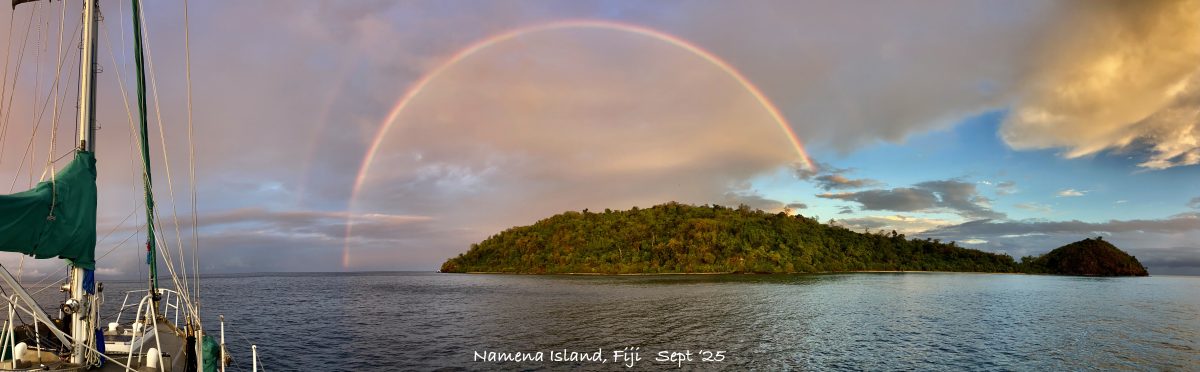
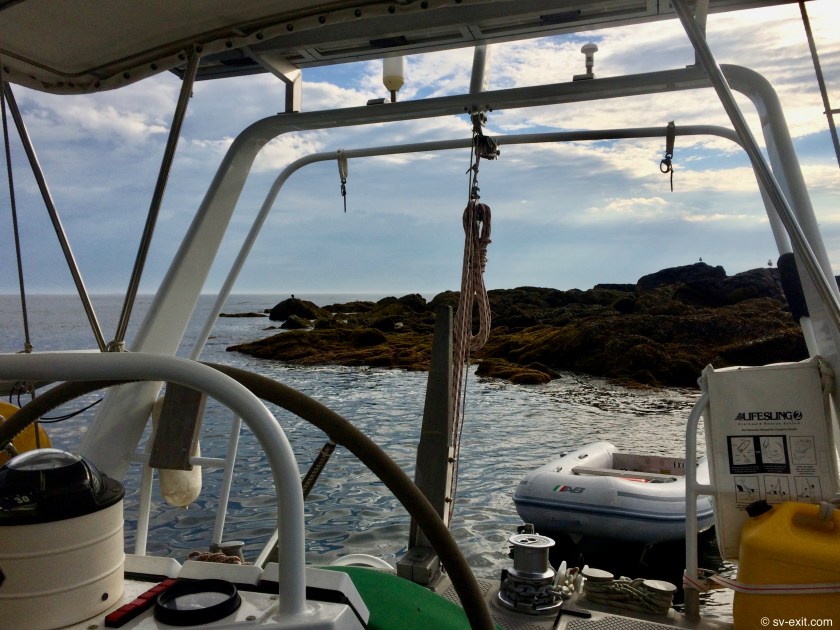


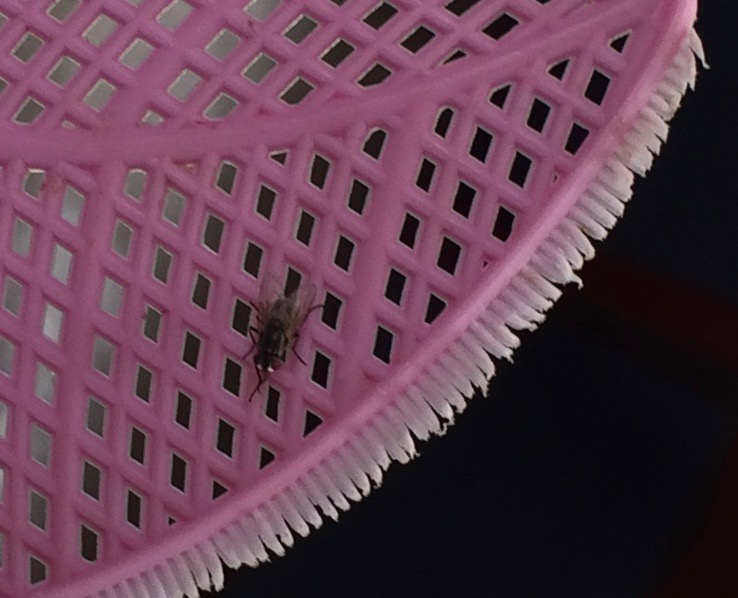
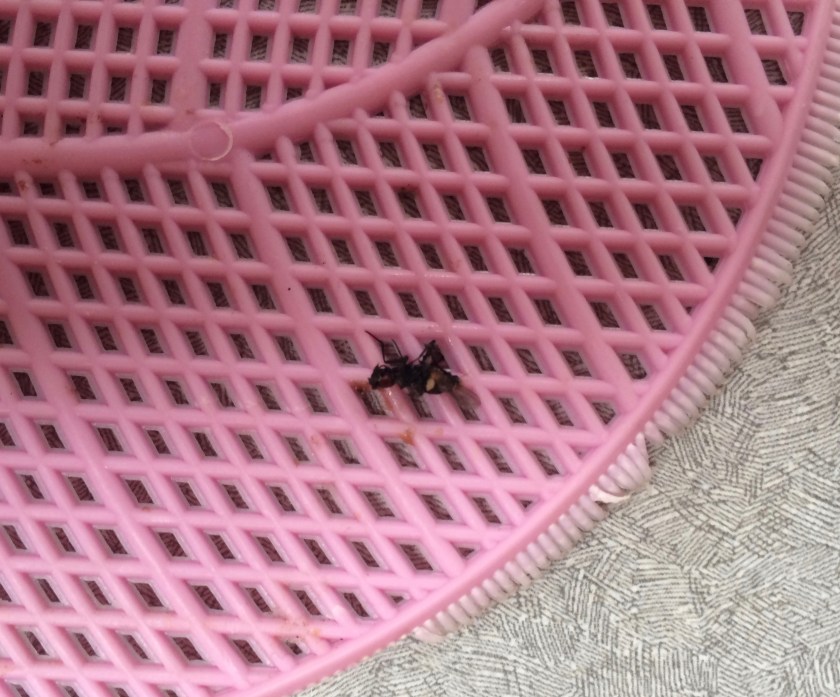


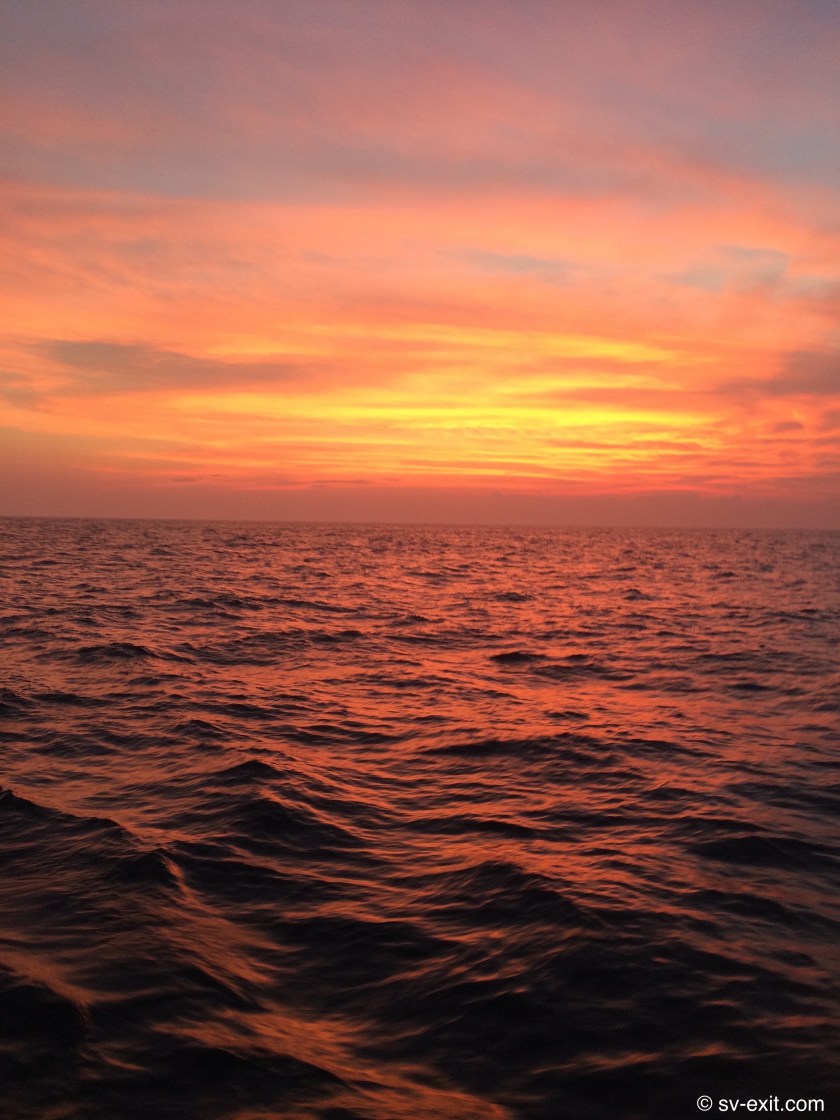


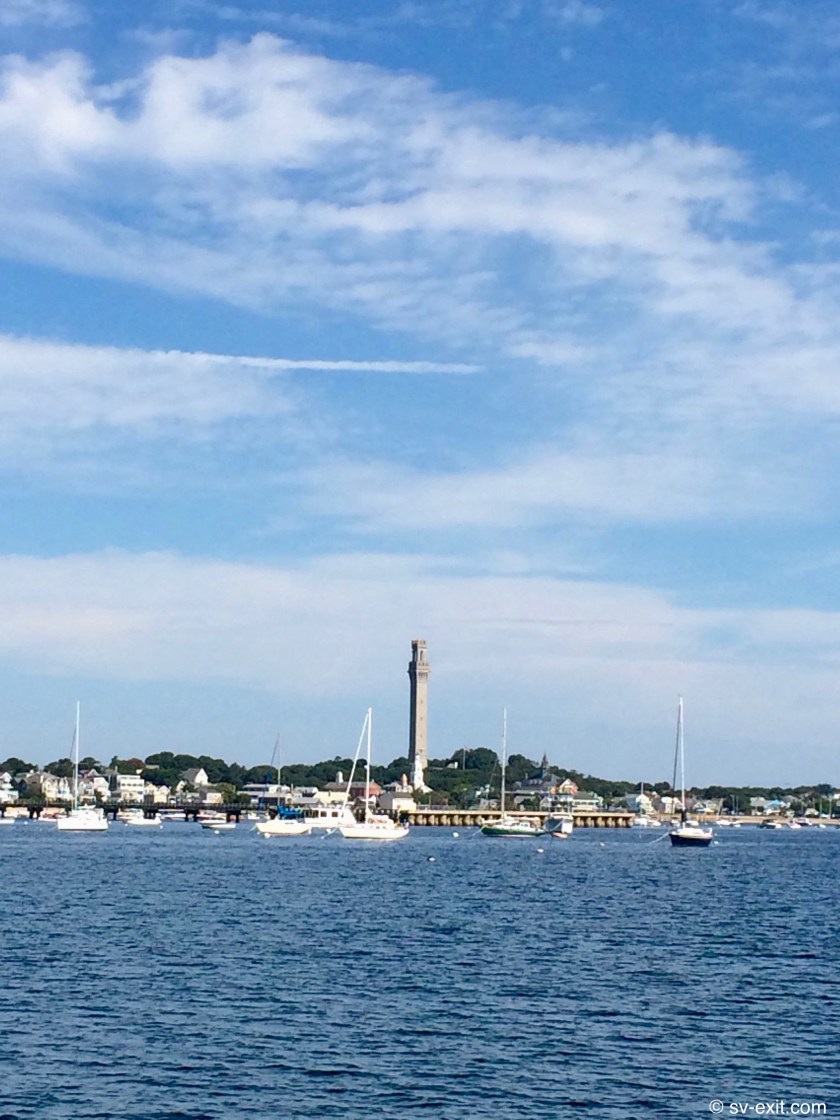



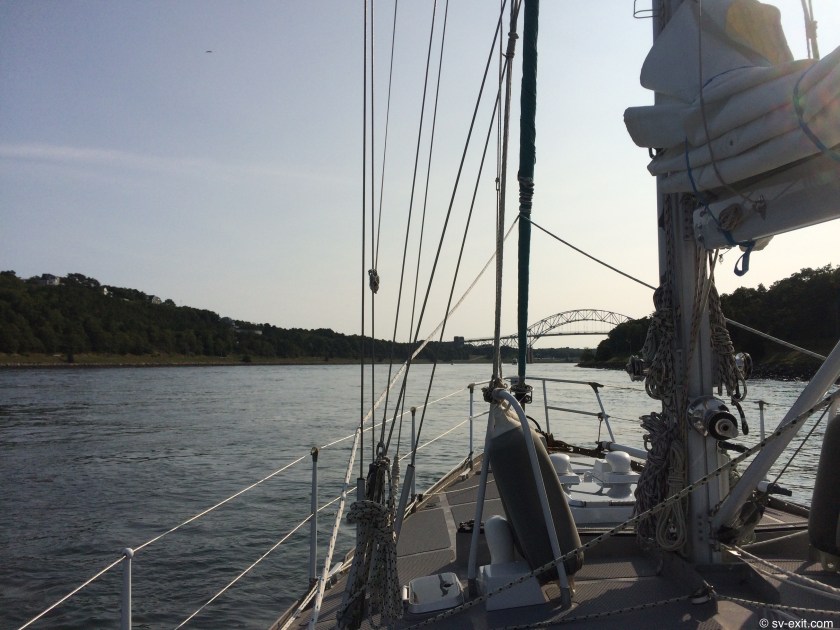
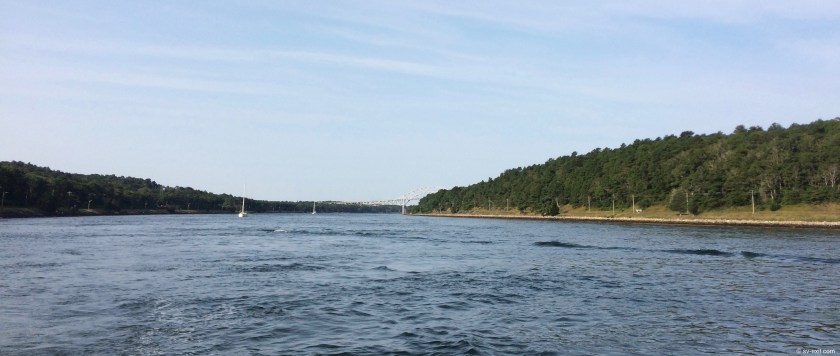
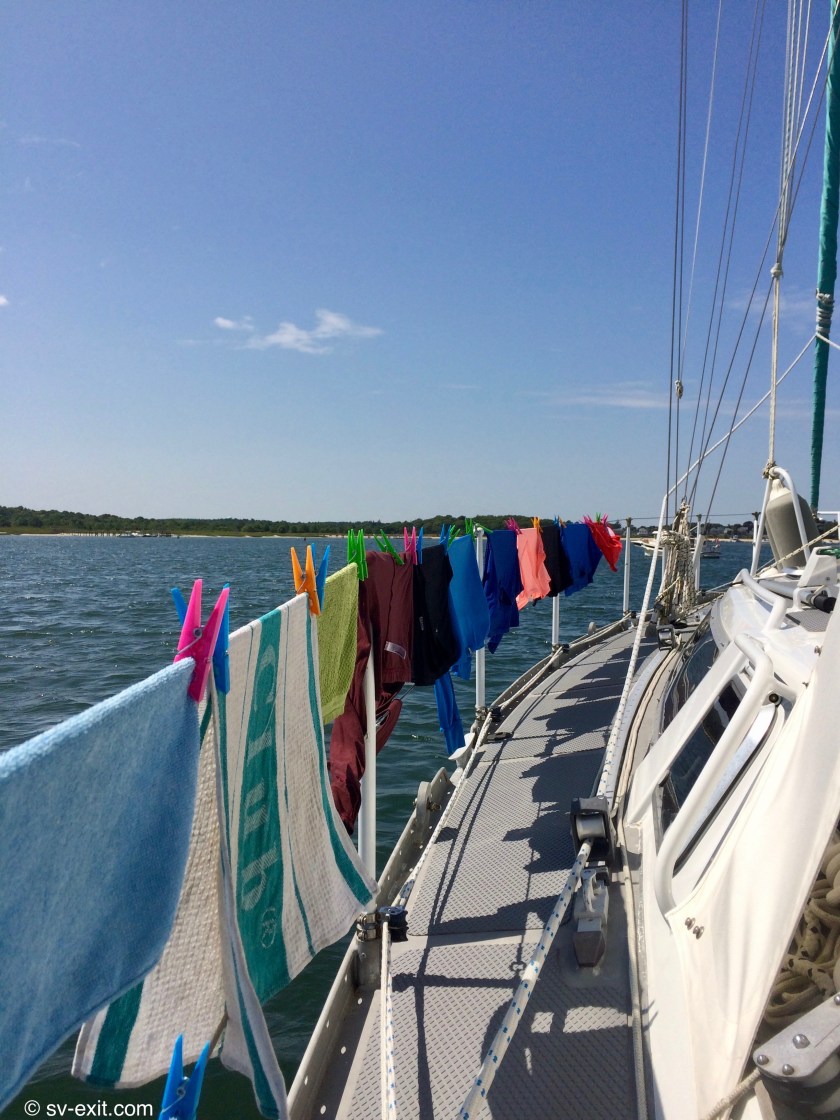
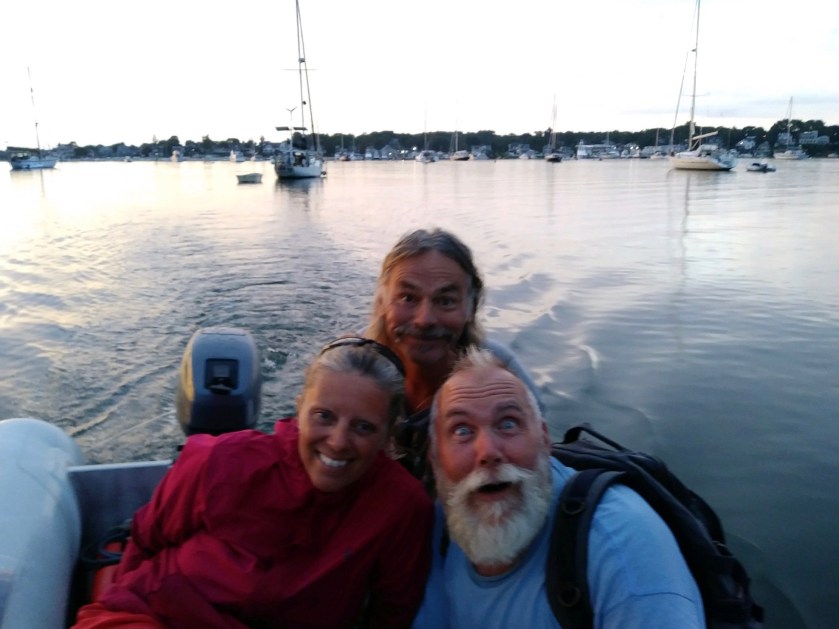
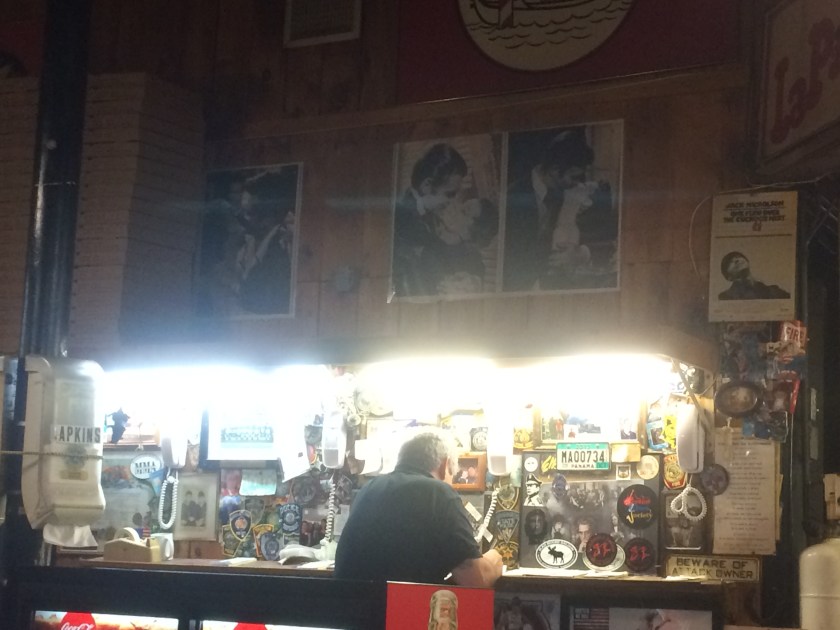


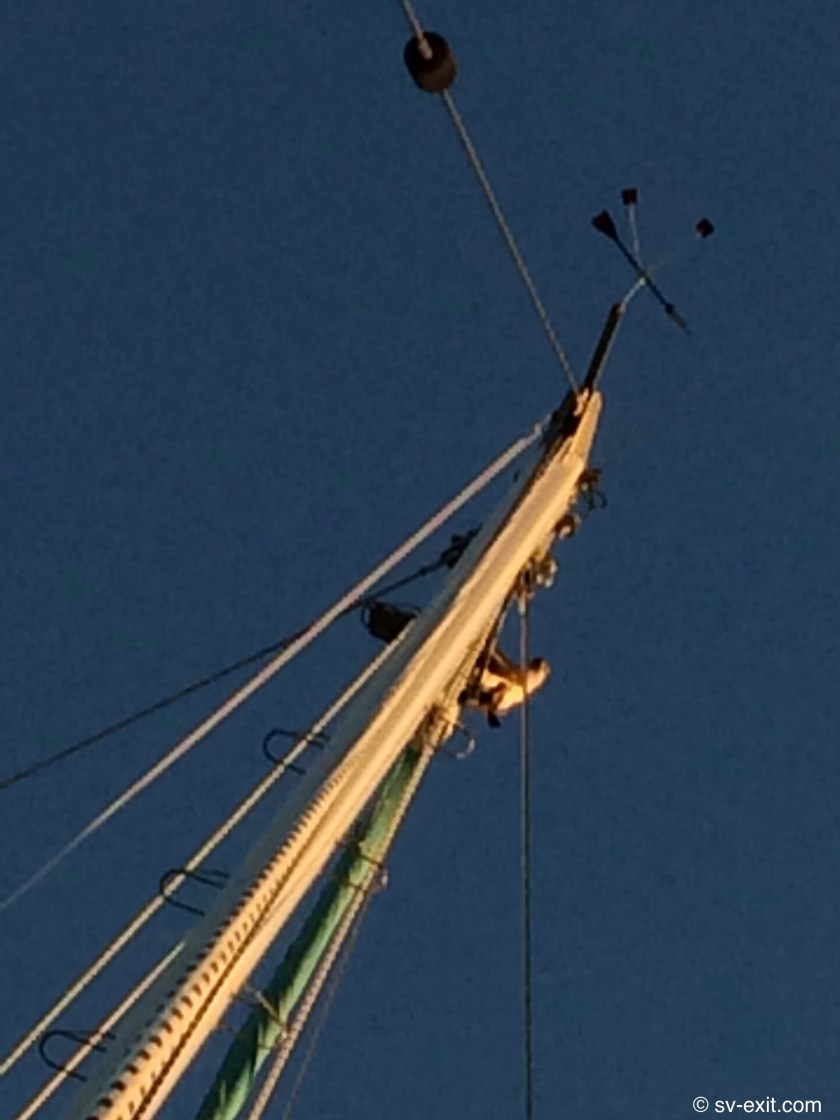
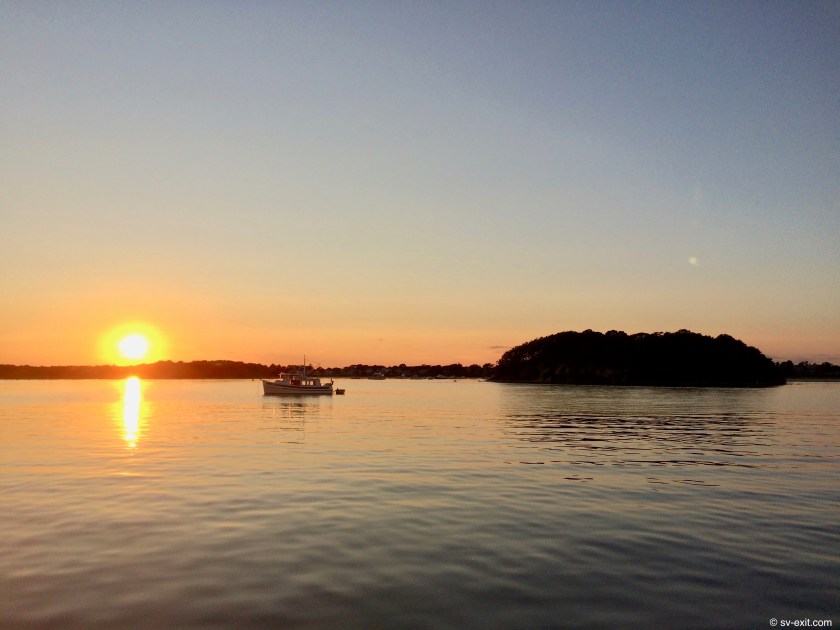

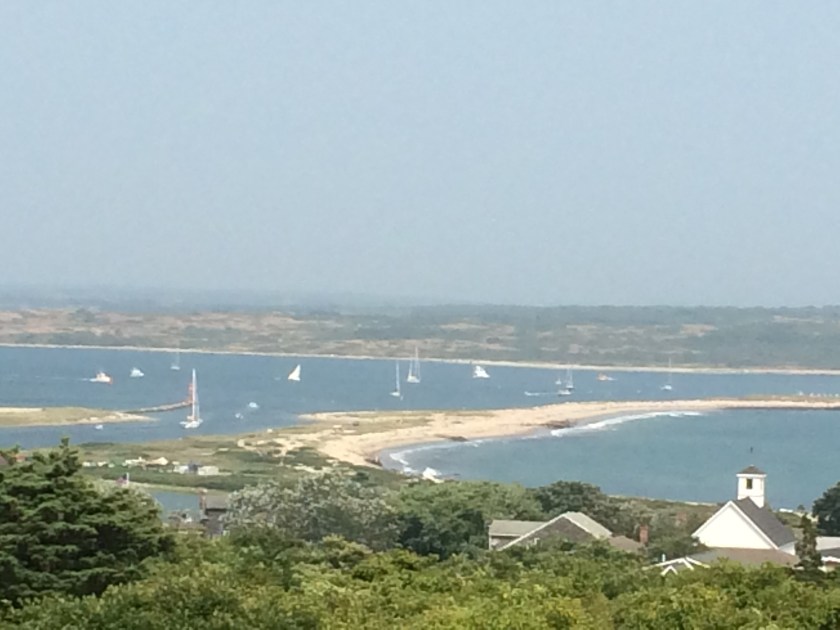

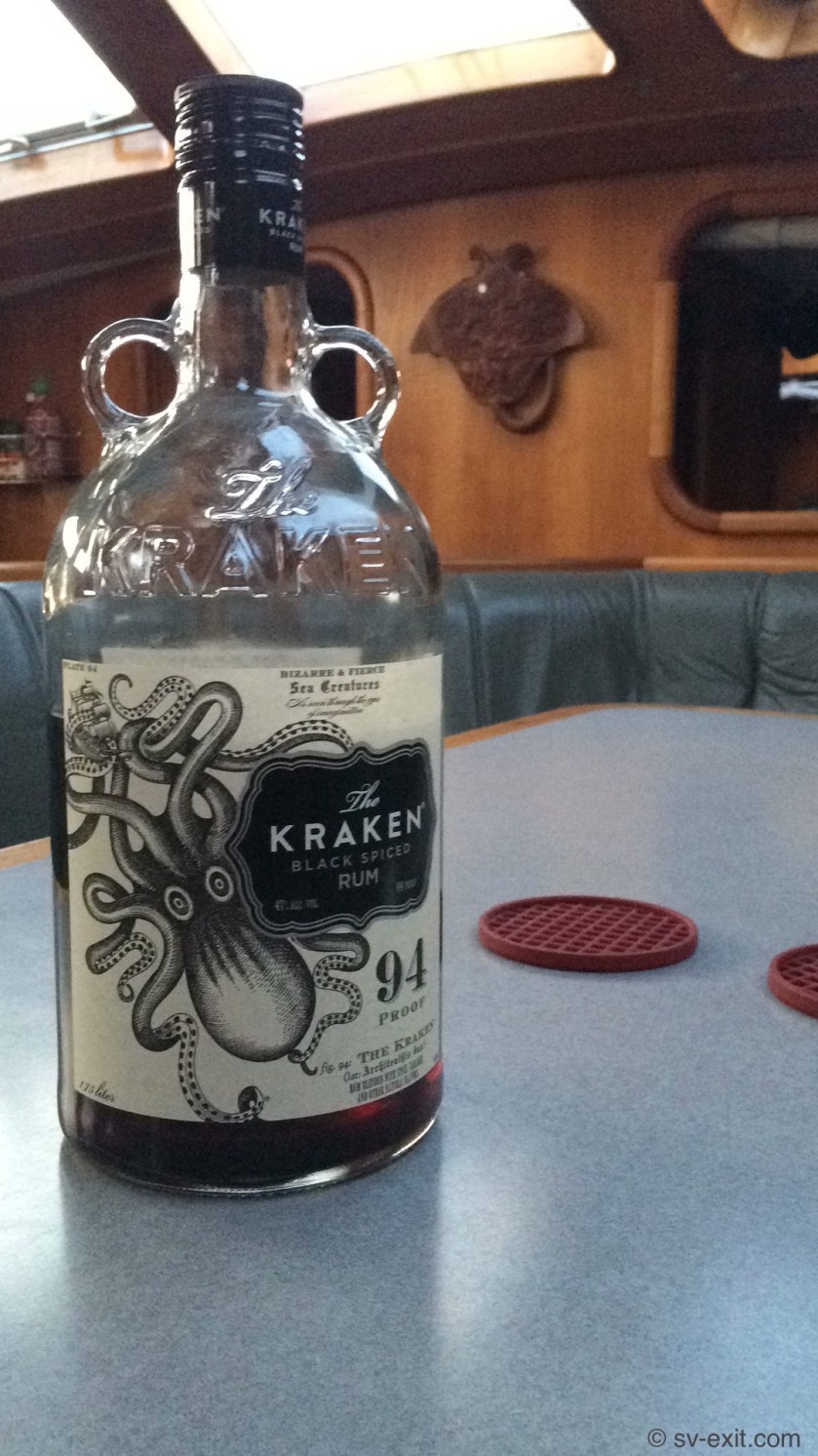


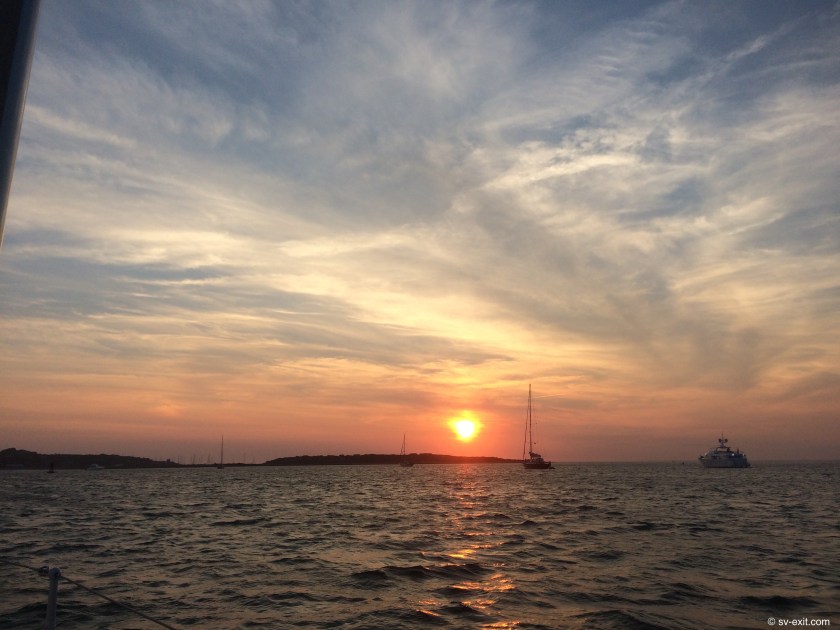


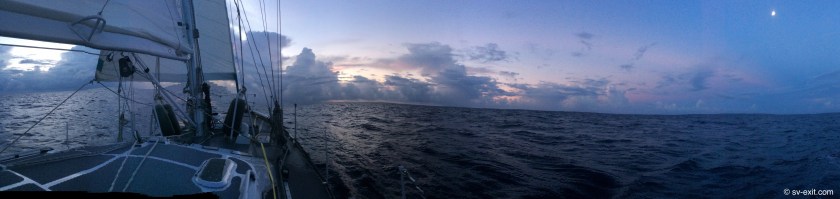


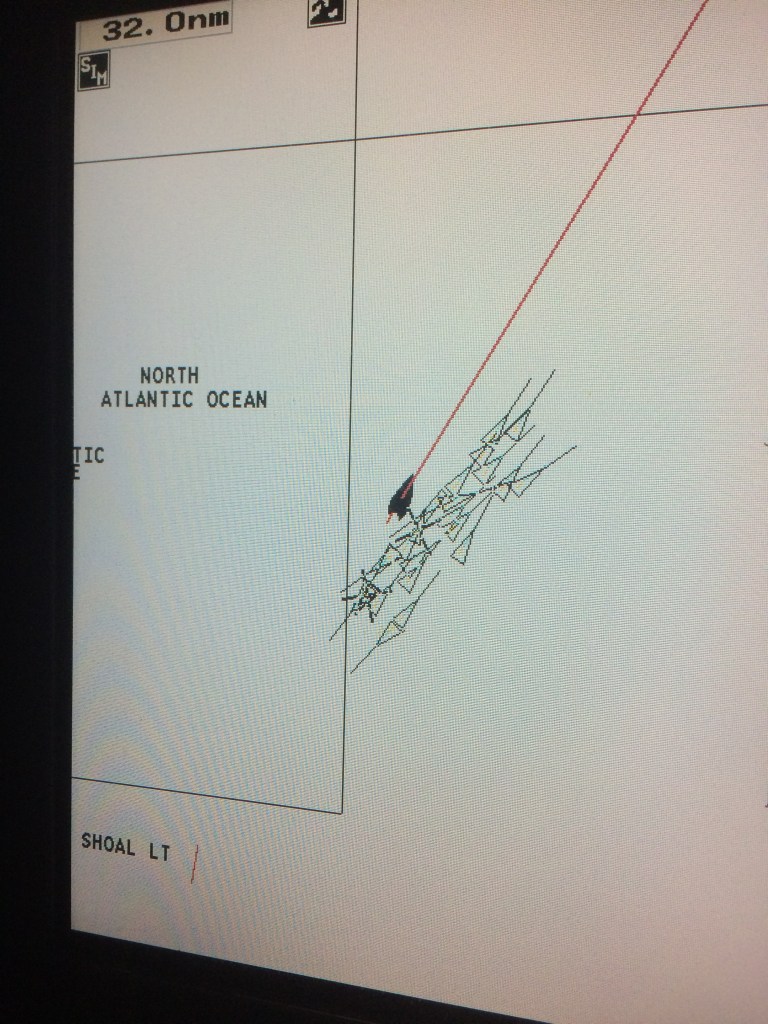



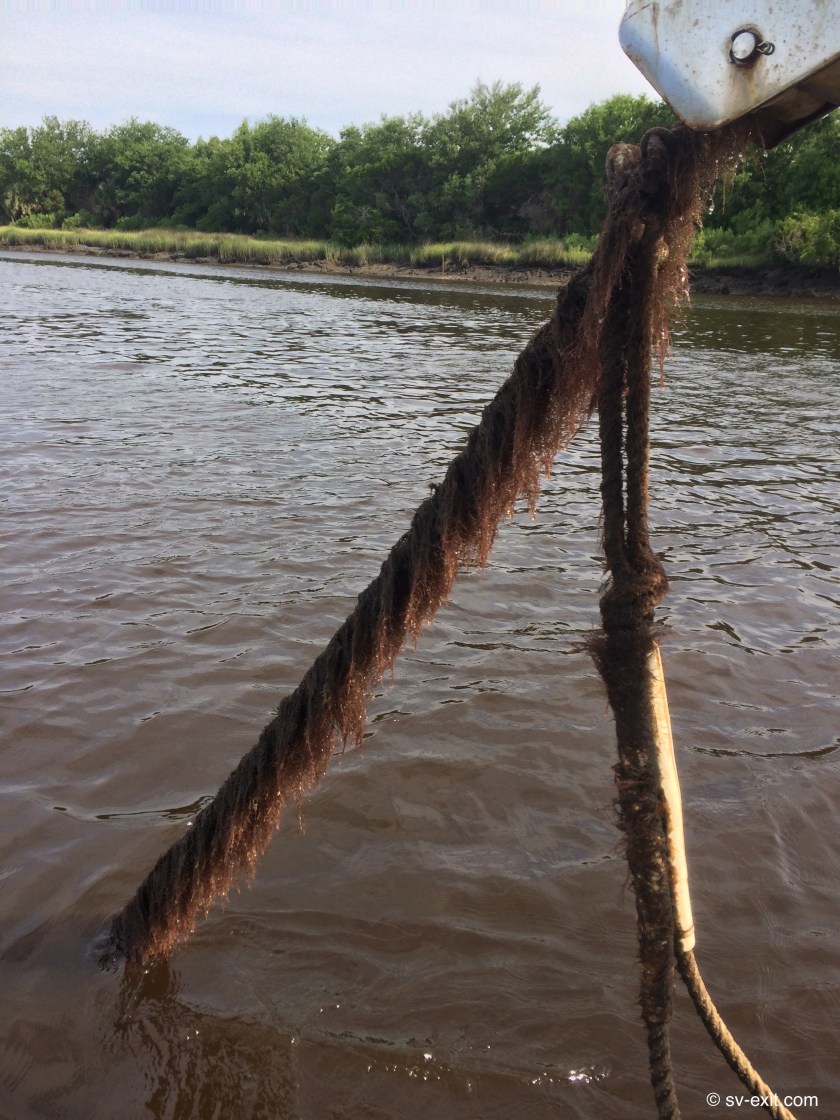
 sv-exit.com