We said we’d learned our lesson about being in Maryland in November last year.
We certainly didn’t envision being back on the hard at Herrington Harbour North.
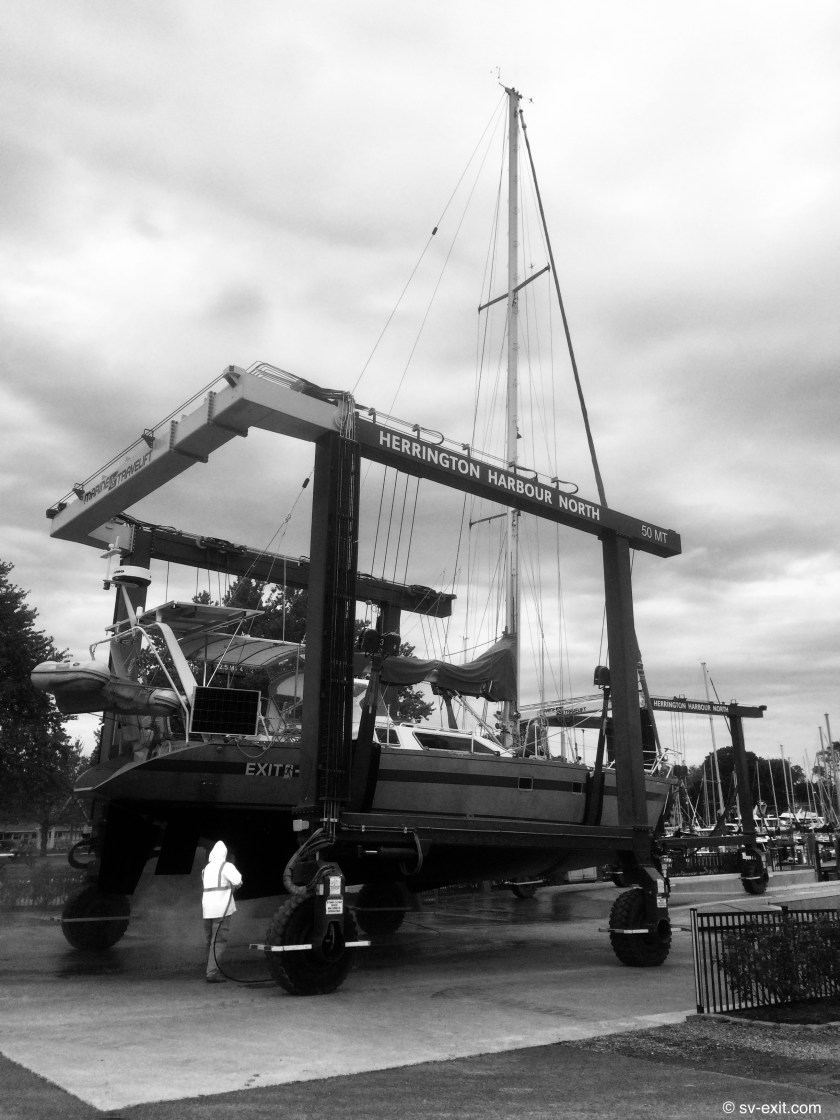
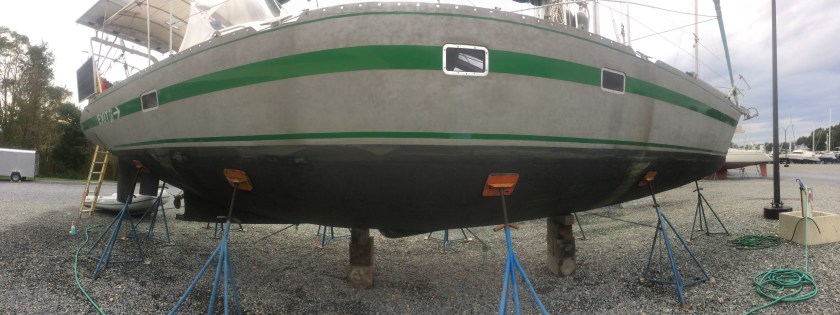
Now, fourteen months after first splashing Exit, things have come around full circle again.Once again, Exit sits awkwardly atop stands with a ladder tied to her transom in the same gravel parking lot, less than one hundred feet from the exact spot she occupied when we lived aboard her for six weeks last July and August.
We are learning that the real challenge to a successful haul out does not necessarily depend upon blindly ticking off a pre-determined list of tasks.That would be the approach of boat owners with either deep pockets, or an end goal of working on their boat rather than sailing it.
The real challenge is getting in and out quickly, as money begins to hemorrhage from everywhere the moment you arrive at the marina.
Inevitably, closer inspections will turn up some surprises.It becomes very easy to spiral into a cycle of pouring more and more money at something or getting bogged down with a list that continues to grow.So, priorities have to be determined and evolve along the way with constant re-evaluations.
For us, the top priority was checking for any signs of corrosion below the waterline on the aluminum hull, and getting any suspicious areas sanded down to bare metal.Mild surface corrosion could then be covered with epoxy barrier coats before applying the final coats of anti-fouling paint.More serious areas of corrosion would have to be discussed.
With Exit now out of the water, we could get a better look at things.Looking out from behind a mask underwater doesn’t tend to offer the best perspective of clarity.On stands however, after a serious power spray, a much clearer picture begins to emerge.
As we inspected the hull, we were surprised to find more spots of surface corrosion than we had addressed last year, but relieved that, overall, everything appeared very mild.
We found ourselves temporarily being sucked towards the black hole of financial implosion as we considered our options.
Option one: pay someone $4000 to soda blast the entire hull, $4000 to apply one coat of epoxy and anti-foul paint, and another couple thousand to have the stripes repainted… undeniably sexy… grand total over $10,000 right there… yowsa!
Option two: do it ourselves.Live with the condition of the painted stripes above the waterline for now. Mostly cosmetic…they could be dealt with later. Sand down all corrosion spots below the waterline by hand and scuff the rest of the paint.Four barrier coats of epoxy andfour coats of anti-fouling paint instead of one… grand total $2000 in paint with another $1000 in incidentals… sold.
As we resisted the gravitational pull of the financial vacuum, we had to resist the expensively easy way out and re-prioritize our list to address structural corrosion while ignoring the more cosmetic aspects.
Repeatedly, strength and safety became our threshold for maintenance and preventative expenses.If it added to Exit’s strength and reliability, we were more flexible in our budget restrictions.Anything that simply looked pretty was heavily scrutinized, and rarely made the cut.
Getting zincs attached to the hull was also at the top of the priority list.But, with my aluminum welding experience being equal to my experience performing brain surgery, bringing in an outside expert was the only option we considered.We were lucky enough to have Quentin of Quentin Fabrications available on short notice who made quick work of the fabricating and welding tasks, as well as touched up the single corrosion point deemed suspicious enough to warrant a quick fill with his welder.
Having Quentin ponder how a twenty six year old boat with no zincs on the hull could have so little corrosion was entertaining.Having him tell us – if the spot he just finished touching up was the most severe corrosion on the hull we had nothing to worry about – now that was most reassuring.In fact, he said most of the corrosion points I asked him to look at had only about a third of the pitting that would cause the Coast Guard to demand repairs on a commercial passenger vessel.Well done Garcia…
A couple of hours and a couple of hundred dollars later, we had the aluminum tabs for a large zinc on either side of the skeg and two additional smaller zincs on the upper forward edge of the centerboard.
Future peace of mind.
Tim and Paula, whom we met here the previous year, stopped by regularly, pointing out things on Exit that either needed immediate attention or generally questioning the wisdom of performing various tasks given the day’s temperature, or humidity, or wind.Tim and Paula were just about to wrap up their seventh year working on their boat which sat on stands on the hard at Herrington Harbour North, before heading back to Alaska for the winter… launch date still to be solidified.
Our spirits were dogged.Our determination was steadfast.
Get in and out quickly.
Most of the things on the to-do list could be dealt with while the boat was in the water, and we had learned quickly that the list never really shortens.
Our only brief distraction came in the form of a mandatory hiatus to celebrate Kris’ fiftieth birthday.With our lifelong friends Shannan and Vicki Schulhauser flying over from Washington State to spend an extended weekend with us in Annapolis, we decided to delay the timing of our launch.
Instead of sailing to Annapolis to meet them, allowing us time to get only one coat of anti-fouling paint applied, we left Exit on the hard and took a boat-break for the weekend. Sadly, this meant that, for the second time in as many visits, we would be unable to get Shannan and Vicki out for a sail on Exit. It will happen… someday.
Nevertheless, thanks to Shannan and Vicki for the epic land-based party… though my gut and my liver always seem to come out severely desecrated!
Returning to Exit after a long needed weekend away from the boatyard, we set out to complete the task at hand… get the final coats of paint applied to the underside, get launched, and get moving south again.
The days when the sun shown were still quite temperate. But the days grow shorter, and the nights are getting long; seems like we’re running out of time (sounds remarkably like a Triumph song).
The frigid East Coast winter temperatures were banging loudly at the door.We just needed to stay focused and make efficient use of our time to get back in the water.
Not enough space and no immediate bailout option… 20/20 hindsight
October 12, 2018
Hurricane Michael, a Category 4 whopper, had already blasted through Florida with recorded winds of up to 155 knots, just 2 knots shy of making it officially a Category 5 hurricane, leaving complete destruction and utter chaos in its wake.It worked its way inland up the eastern seaboard, slowly losing steam but still wrecking havoc along the way.
We had moved from the southern anchorage just outside of Annapolis into Back Creek.Even now, days after the conclusion of the Annapolis Boat Show, there were still boats at anchor everywhere.
Our rule had always been to resist anchoring in overcrowded areas, preferring the solitude and security of wide open spaces over the social opportunities and accessibility conveniences of more densely packed anchorages and marinas.
Over the course of the past fourteen months, our ground tackle had repeatedly proven its worth in reliability; our experiences to date had made us confident in Exit’s ability to handle everything that had been thrown at her.
Before moving to Back Creek, we had successfully completed the unenviable and expensive, though necessary, task of replacing all six of our house bank batteries.After nine months of nearly complete solar independence from our generator with regards to battery charging, we had recently found ourselves needing to run the generator again just to keep up with the quickly depleting bank.
The 12 volt batteries, which were gasping their last breaths, had begun registering minimum voltages of less than 9 volts, barely enough to keep the equipment running. The technical term would be garbage, I believe. Our windlass, a power hog drawing a staggering 70-100 amps for the brief intervals it is needed to bring up the anchor and chain, started requiring us to run the engine for a bit of time before engaging, or it just groaned, barley moving the chain in a power deficit protest.
We were fortunate enough to have arranged the four hundred pounds of batteries to be dropped off at a marina very nearby, allowing us to deliver the old batteries and pick up the new ones via our dinghy. Not easy, but doable.
Now that the batteries had been replaced, everything seemed to be completely functional and all was back to normal.
Yet, we needed to accomplish a number of other shopping tasks, and Back Creek seemed like a much easier location to work from.
Plus, there was the residual weather of Hurricane Michael, headed in our direction.The forecasts predicted 35 knot winds could be rolling through.Just south of us winds were forecasted to be as high as 40-50 knots, so we hoped the projected trajectory was accurate and we would only be subjected to the outside edge of the storm.
Our experience had been that the protection Back Creek provided could reduce wind velocities by fifty percent, which was a very appealing prospect.
So, with some trepidation, we chose to disregard our own rule of avoiding anchoring in tight quarters in favor of an attempt to reduce our exposure to winds in excess of thirty knots (or higher if the storm shifted farther north).
Admittedly, we were way too close for our own liking to the boat to our port side as well as too close to the boat slips of the marina directly behind us.
We were in just over eight feet of water, allowing us a 5:1 scope.Not ideal, but we had ridden out thirty knot winds on only a 3:1 scope at Block Island when we had to anchor in water forty feet deep.We trusted our Rocna anchor and oversized half inch chain to keep us in place.Still, we decided to keep an anchor watch throughout the night, just to be sure.
By 4:00am, the winds seemed to have topped out at about twenty three knots, and we hadn’t dragged an inch.It seemed like all was well.
However, we noticed that the sailboat anchored to our port side seemed even closer than before… uncomfortably close.They didn’t appear to be dragging at all, so we suspected that they had decided to put out more chain as the winds picked up.
With only about twenty feet of separation between our bow and their stern as they swung in front of us, I kept climbing into the cockpit every five or ten minutes to take a look… unnerving, but still unchanging.We weren’t about to try to lift anchor and relocate in the dark with twenty-plus knot winds in tight quarters; and, after more than six hours with no problems, complacency won out over action.
Just as I was just about to wake Kris to take over the watch, things went to shit in a matter of seconds.
As near as we could later reconstruct what happened next, it appeared the sailboat on our left swung completely across our bow in a shifting gust of wind.Because they were only twenty feet in front of us, thirty feet of our anchor chain was now stretched underneath them.
They had to have a draft of nearly six feet, which meant that with only eight feet of water depth, there couldn’t have been more than two feet of water beneath them.
Either their keel or rudder must have tagged our chain as they passed over it, tripping our anchor. Instantly, we were drifting backwards.
Immediately, I woke Kris and we started the engine, but things were already moving in a blur.
Before we could power forward, we were on top of the outer pilings of the boat slips behind us, sideways against three posts.
Kris was at the stern and I was at midship, desperately trying to push us off the pilings, but the wind kept shoving us back onto them.
The tip of an anchor, protruding from the bow roller of a boat in one of the slips, was caught on the inside of our lifeline, and our bow was in serious jeopardy of slipping behind another piling which would have trapped us and shoved us straight into the bow of another boat.
A third boat, whose deck stood about two feet above ours, also had a massive protruding anchor which threatened to either hang up on our stern rail, catch our arch (which the solar panel rack, our radar, and a host of electronics antennas were mounted upon), or tear our rail mounted solar panel clean off.
Kris moved her hand out of the way only a fraction of a second before it would have been either amputated or crushed between the anchor and our arch.
As she fought to power Exit forward, I struggled to push us off and keep our bow from slipping behind the outer pilings and into the docked boats just ahead.
As I repeated a combination of shit..shit…shit, no…no…no, come on…come on…come on, Exit swung out and forward, barely missing the bow roller of the furthest projecting boat in front of us by mere inches.A crunch emanated from just in front of me as the plastic lens of our navigation light, attached to our bow railing, was torn off by the pulpit railing of the boat in the slip.
We were finally free of the slip pilings and docked boats, but our anchor and chain were still out, and I battled to pull them up with the windlass before they caught on something, denying us any control.
With both of us exhausted and rather terrified, Kris perilously maneuvered in the darkness between the other boats at anchor, mooring balls, and markers while I tried to help direct us and figure out an escape route.All the while, the twenty-plus knot winds continued to try to push us back into a catastrophic tangle of destruction.
Eventually, we were able to thread our way through into a small clearing, but still had extremely limited steering ability.
We angled towards another row of boat slips on the other side of the creek.This current location was somewhat more protected, so we weren’t fighting the wind nearly as much, but it really didn’t have the space we needed. At best, if we could get the anchor to set, we’d have a temporary sanctuary we could use to catch our breath and regroup.
But we found ourselves slipping backwards, repeatedly having to motor forward as we drifted dangerously close to the yachts on the opposite side of the creek, clearly demonstrating that the anchor wasn’t setting.The usual rock solid dependability of our Rocna anchor came up short twice.
As we hauled in the chain again after the second failed attempt, a gruff voice, apparently originating from the window of one of the boats in a slip just in front of us called out in the darkness.
Hey, you can’t anchor there.
More than a bit stressed, I snapped back in a rather perturbed voice, I realize that.We’re just trying to temporarily hold position so we can regroup to get through to the morning.
The voice returned.No… there’s no holding there.You’ll drag backwards all night long.
Shit.OK… thanks.
We weren’t about to try to thread our way out passed all the boats anchored and moored in Back Creek, which included a big cat that had dragged anchor for the third time just before our anchor chain got tripped, and was still struggling to reset their anchor yet again.
This left one option… farther back up the creek.
Unfortunately, the same two boats were still anchored back there when we arrived.
Literally backed into a corner, we had run out of options.All we could do was drop the anchor right next to one of the docks and back down as far as possible. But, with no major wind shift and a person in the cockpit standing watch, we’d be good until noon when we could get the hell out of Back Creek.
We’d gotten the shit seriously scared out of us, learned some important lessons, and dodged more than one bullet.
Had we just gone to sleep earlier in the night, it would have been the crunching sounds of us against the dock that we would have awoken to…
Had we gotten tangled up behind the slip pilings or with the boats that were tied up, the damage would have been catastrophic…
Had the anchor chain gotten tangled when it tripped… had the windlass remote not worked when it was plugged in (an occasional malady)… had the battery bank (changed only three days ago) still been the old, tired bank which required a few minutes of charging before the windlass would fire up… we would have been fucked.
Had we not been lucky enough to have lowered the rail mounted solar panels a few hours earlier, or the dinghy was hanging up on the davit at Exit’s stern, the anchor extending from the bow roller we passed so close to would have sheered off the solar panel and ripped into the inflated rubber bow of the suspended dinghy. Upon later reflection, we were pretty sure the dinghy (which had been tied off on our stern) may very well have helped act as a bumper while we were bouncing around on the marina pilings. That same anchor still came within a fraction of an inch of taking off Kris’ hand, ripping the solar panel off the railing, and getting hooked up on our stern arch…
Had the boat that tripped our anchor actually dragged down on top of us, we would have been trapped between that boat and the slips… game over.
Many things could have happened slightly differently with potentially disastrous and devastatingresults to both equipment and flesh.All things considered, we got off pretty easy.
The lessons learned were more re-enforcements of what we already knew rather than groundbreaking epiphanies.
Don’t settle for complacency.
The combination of not enough scope and not enough space is a recipe for disaster.
Trust your gut instincts.We thought about moving back into the southern anchorage in the afternoon.The trade off would have been higher exposure to the wind and waves but more space to work with – more space to put out more chain, more space to swing unfettered, more space to drag, more space to react.We should have trusted our gut instinct.
Trust your equipment.If you don’t, replace it.If the equipment is sound, it will hold you in fifty knot winds with less risk than hard things in close proximity will ever pose.
It was ultimately our own fault that we found ourselves in the situation we did.
A silver lining…? Potentially in how we reacted during the situation.Looking beyond a poor initial decision of being there, at least we were pro-active enough to maintain an anchor watch.In retrospect, I should have started the engine as I was waking Kris to give us an extra few seconds.But, during the entire nail-biting ordeal, we kept cool heads and things never deteriorated into a yelling match of confusion.
It sounds very cliche, but over and over again, there seem to be situations which arise that could be potentially very dangerous or catastrophic events.Given an inner determination that failure is not an option, the only acceptable outcome remaining is to somehow work through the challenges and sort your shit out.
That’s not to say that simply wishing for something will make it happen. But sometimes success has to be coaxed, tricked, improvised, massaged, or even bitch-slapped into existence, given the alternative.
Knowledge and experience help out immensely.Either one can give the background necessary to make informed decisions.But lacking both doesn’t make the solution any less there… it just makes it a bit more elusive.Creativity and tenacity don’t substitute for knowledge and experience, but they come in at a close third and fourth place.
And, though you can’t depend on luck, sometimes you certainly need a bit of it.
With two hundred miles ahead of us to reach the C&D Canal, we departed early from NYC… perfect timing to witness the arrival of one of the US Navy’s alien looking stealth warships as we sailed by Staten Island.We gave it a wide berth as it passed by us in the opposite direction with an entourage of military zodiac escorts to our port side; however, I couldn’t help turning on our radar.Sure enough, the massive warship appeared on the display as nothing more than a tiny blip, no more distinct than even a small marker buoy.
Stealth warship…
…vs. Staten Island Ferry
Lots of boat traffic but no stealth warship
Hugging the coast, we were never more than about three miles offshore.
The only excitement was another bird, no larger than a small finch, which seemed to be well farther offshore than we would have expected (much like we had seen on our passage from St. Marys, GA to Charleston, SC) that decided we needed another crew member aboard Exit.
New crew member or freeloading stowaway…?
Except this tiny bird obviously had high ambitions.It flew straight into the cockpit and landed on the wheel, seemingly to proclaim itself our new helmsman.For about ten minutes, it balanced there; and, as the autopilot made slight adjustments in our course causing the wheel to turn left and right, it appeared comically that the tiny bird was actually steering Exit.
Aftera bit, it flew out of the cockpit, only to return to its perch atop our wheel a few minutes later and resume its hilarious impersonation of a undersized, feathered skipper. Shortly after that, it stationed itself atop the lifeline, now apparently taking over the watch duties.
Eventually, our little comedian must have realized that flying would be a much more efficient and speedy approach to reaching its destination than sailing, and it flew off into the distance, finally disappearing from view.It took quite some time before we were able to stop laughing.
Fifteen to twenty knot winds and favorable currents allowed us to feel like we were flying down the coast for twenty-four hours.Although, in exchange for the fast pace, we reached the Delaware Bay hours ahead of when we had planned and were met with winds that tapered off and opposing currents, forcing us to motorsail for almost the entire ten hours we spent crossing the bay.
During this time, we continually debated whether or not we were going to attempt navigating the C&D Canal at night.Though the canal is rather wide, we were very nervous about what we anticipated would be a mostly unlit and nerve-racking three hours.
A couple of hours before sunset, we began to see the outline of a massive structure in the distance.What we first thought was a huge freighter, slowly materialized into the gigantic cooling tower of a nuclear facility, steam ominously pouring out from its top.There would be no rain collection today, even if the overcast skies decided to make an offering.
By the time we reached the entrance to the canal, the sun had nearly set and we were already having a difficult time seeing where we needed to be going.This solidified the decision that we would drop anchor and wait until morning, when the canal would be a much more friendly passage.
Not long after setting anchor and having dinner, a loud roar in the distance prompted Kris to ask if we were hearing a plane passing overhead.The answer came moments later, when the dull roar was interrupted by a louder noise, followed immediately by what sounded like a boat engine revving at high rpm for a short period.It sounded unmistakably like a boat had just run aground.
As we scanned the darkness, at last we saw what looked to be a flashlight twitching back and forth in the distance. After some time, a boat with a flashing blue light appeared from shore and approached the scene.We were a bitconfused when the patrol boat stopped short of coming alongside the flashlight, and then, a few minutes later pulled away and departed as what appeared to be a Coast Guard helicopter circled briefly overhead.
Intrigued, we turned on the VHF and were subsequently treated to far more entertainment than most people probably found on the TV that night.
As the drama unfolded in the form of confusing lights in the distance and radio exchanges between multiple boats with flashing lights and the shore, we slowly learned what had transpired.
Apparently, a twenty to twenty-five foot jet boat carrying an idiotic captain and three passengers had attempted to enter the C&D Canal at a much higher rate of speed than the darkness would warrant.Either failing to notice or ignoring the brightly flashing green light of a navigational warning marker, they had slammed into one of the earthen jetties jutting out on both sides of the canal entrance, fully running their boat aground… not too smart.
Fortunately, only one person was mildly injured with head lacerations.
The boat with flashing lights was Fireboat #5, which had arrived on the scene, and transported the entire group to a nearby hospital for further evaluation.
We felt rather wise in having made the decision to drop anchor for the night, choosing to abort our night voyage through the canal.Not that we would have run aground on the jetty; but still, we had heard reports that floating debris left over from the aftermath of Hurricane Florence weeks before was still present from the canal all the way down the Chesapeake, and we were grateful that the Coast Guard and marine patrols would not be answering a distress call from us that night.
The following morning we passed the stranded jet boat, still sitting completely dry on the jetty.
For over an hour after entering the canal, we were further entertained by the numerous radio calls from what seemed like every boat following behind us, who hailed the Coast Guard on the VHF to report a boat which they had seen aground at the canal’s entrance.
As we exited the C&D Canal two and a half hours after lifting anchor (awaiting the morning light had also given us the benefit of running with the currents), we found ourselves once again in the Chesapeake Bay.
Annapolis was another fifty nautical miles away, and we had already begun to see more and more of the floating logs and debris we had heard about, so we made the call to stop mid-afternoon, about ten miles south of the C&D Canal, and make the final push for Annapolis the following day.
Furthermore, we had just received a text from our friend Benjamin, aboard Crackertale, who we had first met at Block Island all the way back in August.
We had nearly, but not quite, crossed paths again a number of times since then.Amazingly, he was currently only a few miles away from our present location, also headed for Annapolis.We hailed him on the VHF and agreed to meet on the Sassafras River, right next to where we had planned to anchor anyway.
As it turned out, he decided to continue a bit further on after we had already set anchor, choosing to take advantage of favorable winds and currents that were much more critical for someone sailing single-handed on a small boat with only an outboard engine for supplemental power.It looked as though we would have to wait for Annapolis for the reunion drinks.
When we awoke the following morning, a heavy fog had completely obliterated any visual references in every direction.
Our only previous experience with fog had been departing Port Canaveral, Florida, back in February, just days before we set out for the Bahamas, where we had instantly learned just how daunting and intimidating sailing in fog could be.
With visibility effectively non-existent, we immediately recognized that this was a challenge we had absolutely no intention of undertaking, so we sat back to wait, patiently hoping it would start to burn off.
Not long before noon, the all-encompassing white blanket of fog had begun to lift, revealing the shadowy outline of the nearby shore.Visibility was still less than half a mile, but we had become much more familiar with using our radar over the past six months than we were in Port Canaveral, and felt confident that we could set out with the optimism that the fog would continue to lessen.
Though the radar proved invaluable, it only lessened the degree of intimidation. With senses on high alert, and eyes constantly shifting focus between the radar display and our surroundings, we carefully creeped along.It was amazing how, with the radar, we could still identify not only boats, but also navigational markers and even debris in the water. As long as we didn’t encounter a stealth warship like the one as we left NYC, we should be good to go.
Slowly, we made forward progress.We learned from Benjamin over the VHF that he had lifted anchor before we had, but had second thoughts as the fog thickened outside the bay he was in, and had dropped anchor again to await better visibility.He lamented not having a radar himself at that time.
Four hours later, we were passing the Baltimore channel intersection on the east side of the Chesapeake.The fog had slowly, but steadily, receded and we now had three mile visibility and very calm conditions on the water.
We noted two things: 1) Baltimore was the farthest north we had gotten on the Chesapeake in our preliminary explorations aboard Exit just after purchasing her, before we started heading south, and 2) we had just surpassed five thousand nautical miles in our travels aboard Exit.
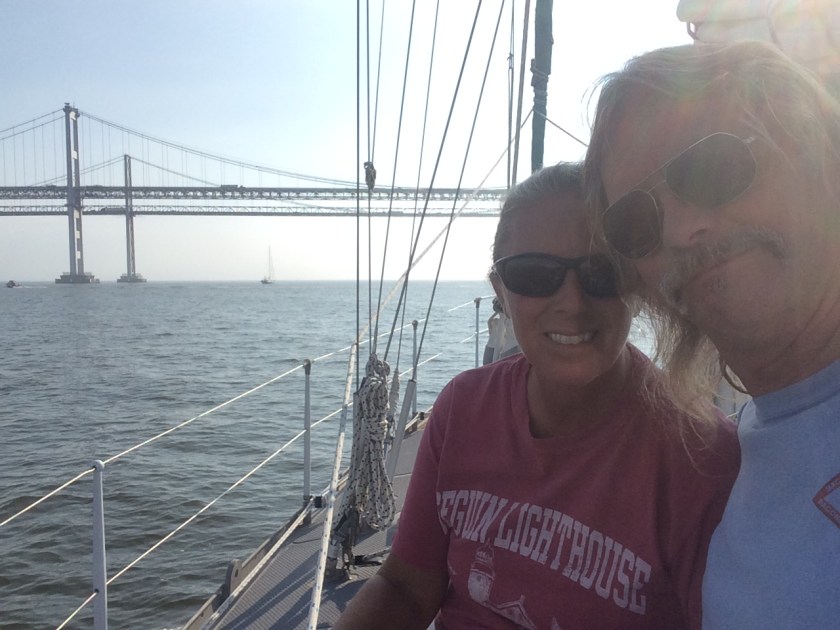
As we passed underneath the Chesapeake Bridge, we felt an overwhelming sense of deja vu.
Two hours later, we arrived at Annapolis.The enormous Annapolis Boat Show was on its’ last day, and boats were everywhere.Back Creek, where we had sat for months while we first tasted the lifestyle of cruising, was chock-full and we ended up having to anchor at the south anchorage in the bay just outside Annapolis.
We had come full circle, back to our old stomping grounds.
An hour or so later, Benjamin sailed up and dropped anchor.Shortly afterwards, he stopped by with his brother and a friend who had met him upon his arrival.He had also brought a half-full half gallon of Kraken rum…
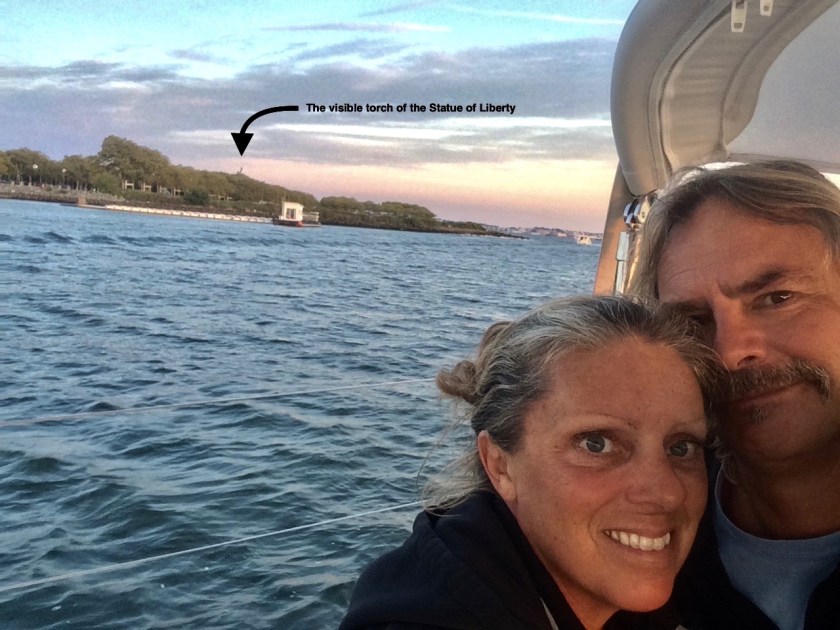
We initially anchored in a small bay tucked away on the southwest side of Liberty State Park.While the anchorage was very protected from the swell of all the boat traffic, it also turned out that the numerous trees lining the park completely blocked our view of the New York skyline as well as all but the head and torch of the Statue of Liberty.We spent one night there before deciding to gamble on a better view.
We weren’t sure if we would be hassled trying to anchor behind the statue; we’d heard it would be ill received.But we figured we’d give it a shot anyway.
Understandably, the area immediately surrounding Liberty Island and Ellis Island is restricted.There is an approximately one to two hundred yard perimeter marked with buoys designated as a security zone; any boats entering this area would undoubtably be quickly visited by a number of heavily armed boats and/or helicopters.There is also a quarter mile wide corridor running behind the island which contained cables and pipelines that we needed to stay clear of; snagging our anchor on a cable which resulted in a power blackout for Lady Liberty would most certainly be frowned upon.
When all was said and done, after setting anchor between Ellis Island and the Statue of Liberty, no one even blinked a eye at us.
There was a bit of swell from all the ferry and sightseeing boat traffic during the day.Nonetheless, it was minuscule price to pay for what amounted to an absolutely spectacular and unique view of New York City.
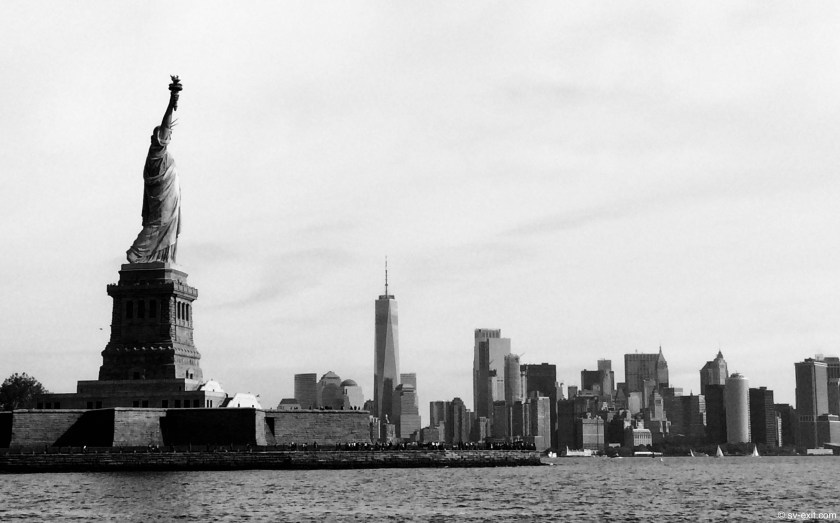
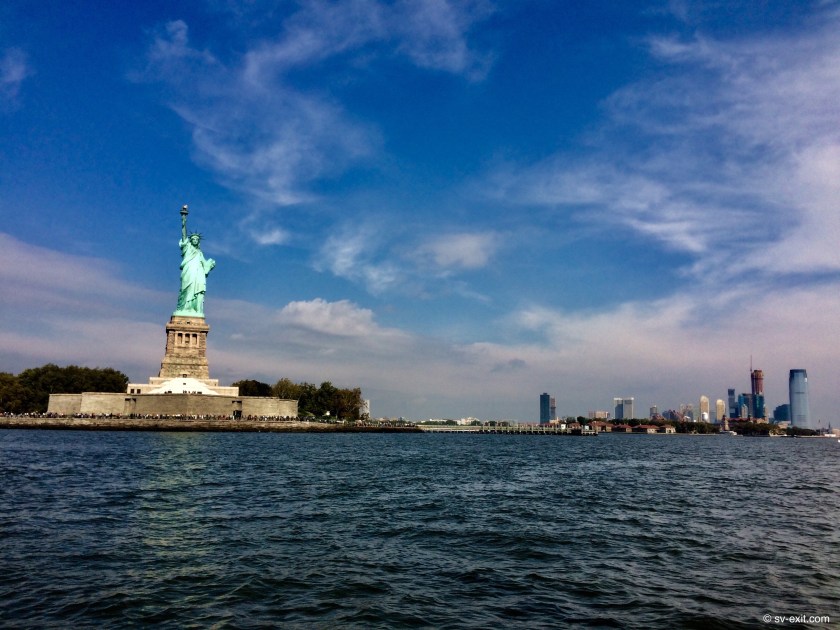
Right next to us, on our right, stood the Statue of Liberty.Just to our left, in the foreground, sat Ellis Island.And just behind that, loomed the amazing skyline of Manhattan.Sitting in our cockpit, we could see the Empire State Building, the Chrysler Building, the World Trade Tower, the Brooklyn and Manhattan Bridges… everything.And behind the Statue of Liberty, in the distance, was Brooklyn, Staten Island, and the Verrazano Bridge, linking the two together.
The view we had during the day was diminished only by the view we had at night.The lit Statue of Liberty right next to us and mesmerizing lights of New York’s skyline behind the dark silhouette of Ellis Island is utterly indescribable.It has to be seen to be truly appreciated.And to be seen from the deck of our own sailboat sitting at anchor made it even more surreal.
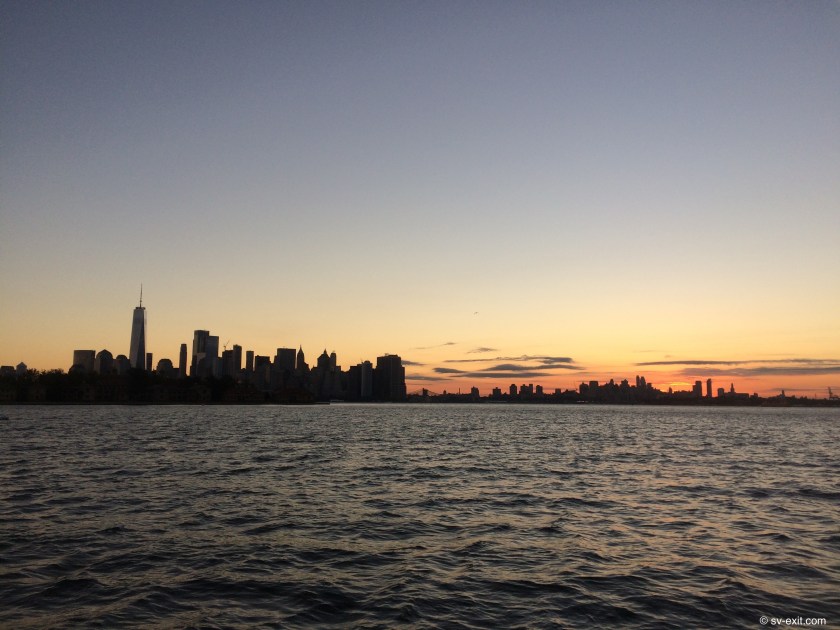
NYC transitioning to night
After a couple of days of utter relaxation aboard Exit, we weighed anchor and headed ten miles up the Hudson River to just off of 79th Street, which gave us access to a marina dock at which we could tie up the dinghy.
It was October 2nd… a particularly special day for us.It marked the thirty six year anniversary of our first date together… the beginning of an amazing journey we never could have imagined at that time.It also marked the ten year anniversary of our exodus from the United States… the beginning of a new way of life, which also held surprises and unfathomable adventures that had completely changed us while, at the same time, had allowed us to remain true to ourselves and each other.
October 2, 2018 – Ten year anniversary of our own liberation
When we reached the 79th Street Marina, we set anchor once again.The fee we paid for access to the dock (and a warm shower) was only a few dollars less than a mooring ball there would have cost.However, Exit was slightly longer than the maximum length and we had heard horror stories of the mooring balls dragging regularly (probably due to oversize boats using them anyway), so we decided that our own anchor was the more reliable and prudent choice.
This put us within walking distance of Central Park, which we visited the following day.The fact that we had been there before, made the return no less impressionable.The park’s endless trails and sights made for a great afternoon of wandering and people watching, despite purchasing one of the worst (and most expensive) hot dogs and pretzels, from a street vendor, that I have ever had in my life.I am not one to typically let food go uneaten; yet, even Kris’ love of pretzels couldn’t prevent half of it ending up in a Central Park trash bin.
This slideshow requires JavaScript.
We also had the bonus of a reunion with one of our Scuba Junkie family.Christina Koukkos completed her Divemaster training at Scuba Junkie while we were there.Though we hadn’t seen her in eight years, we had kept in touch via Facebook, and Christina, who lived in Brooklyn was more than happy to meet us for drinks when we contacted her.
One drink turned into multiple pitchers of beer and dinner.After reminiscing and catching up on each others’ endeavors over the years, as well as current plans, we reluctantly said farewell until the next reunion and took a taxi back to the 79th Street Boat Basin where our dinghy awaited us.
The currents on the Hudson River that night were ripping and we were far too close to the rocky shore for our liking, but any farther out and we were instantly in deeper than thirty feet of water.
So, the next morning, after returning to the marina for a quick hot shower and filling of our water jugs, we once again picked up anchor and returned to our prime location behind Lady Liberty, where we chilled out for one more afternoon and enjoyed the spectacular evening skyline view of New York City.
Now, it was time to get moving again.We had been to Maine, and we had savored the experience of visiting New York City aboard our sailboat.
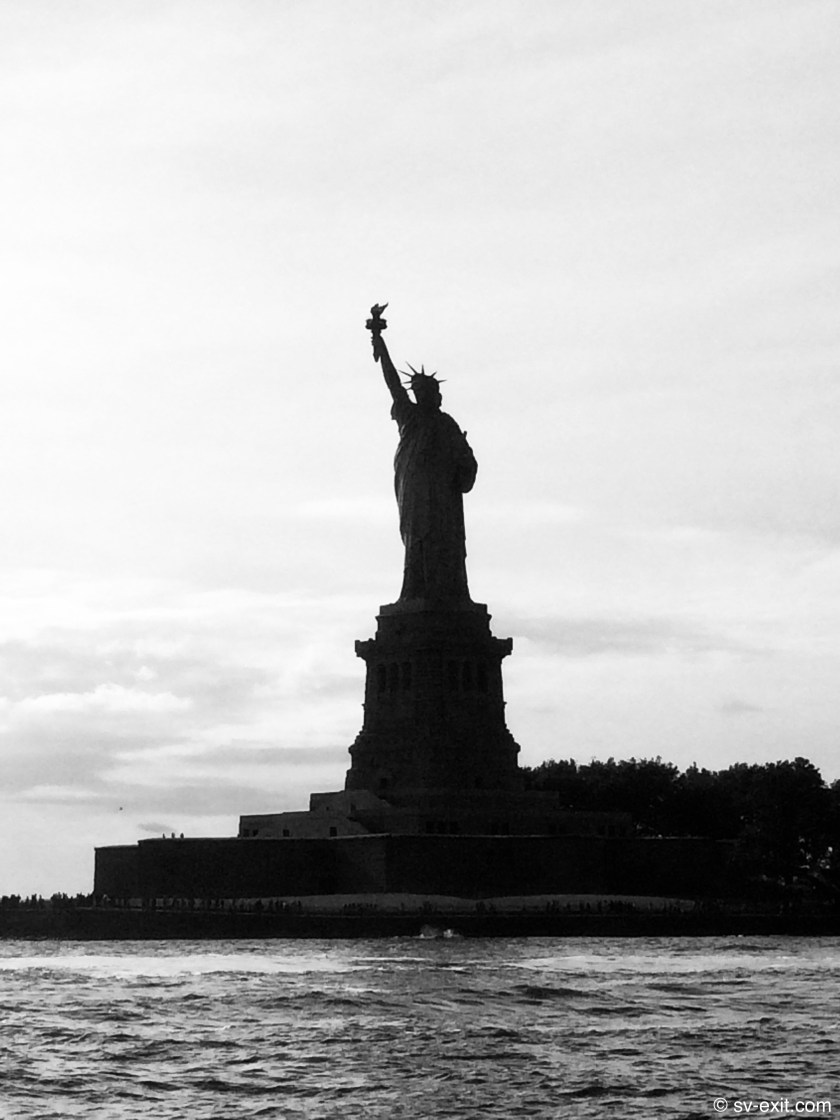
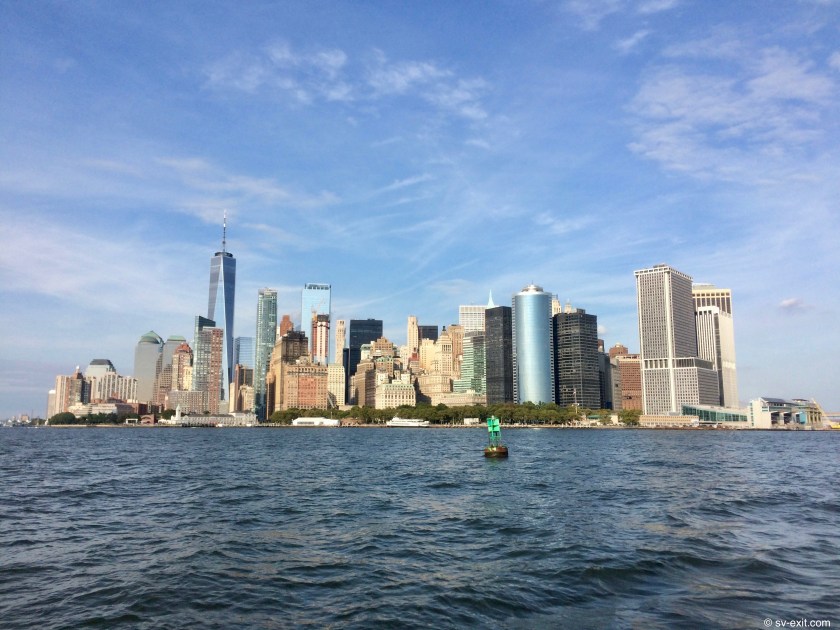
Perhaps the most iconic NYC image we captured
Our haul out awaited us at Herrington Harbour North, with a long list of tasks to accomplish.
From here, we would make a dash for Delaware Bay, pass through the C&D Canal (which would shave about one hundred miles off the alternative of sailing offshore all the way south to the mouth of the Chesapeake Bay and then back up north through the bay), and make a brief stopover in Annapolis.
The heavy rains we had been experiencing provided repeated opportunities for rain catch, thanks to the brilliant design and integration of a gutter system mounted to the overhead solar panels by Tom Chalkley.
However, the rains were a double edged sword.
Simultaneously, while we eagerly collected water without having to leave the boat, we lamented at our inability to charge our batteries with free solar power.And without solar charging, we had to fall back on our diesel consuming generator.
The biggest problem lie in the fact that our house battery bank was dying.The batteries were eight years old and obviously on their last leg.We had begun to have problems with the electronics starting to shut down while we were under sail in cloudy weather or even overnight.The massive power draw from our anchor chain windlass was also forcing us to run the engine for a while before starting to bring up the chain.
We knew the batteries were living on borrowed time when we purchased Exit; now it appeared their demise was growing very near.We had already replaced the two starter batteries in Charleston, SC one month ago when we began to have problems starting the Perkins engine and had to run jumpers to the house bank.
Our boat speed indicator had also become inaccurate again.It was earlier in Charleston that we had also first found barnacle and marine growth on the hull around the transducer paddlewheel to be causing the problem.The growth surrounding the transducer caused turbulence around the paddlewheel which, in turn, affected its’ performance.
Having a functional speedometer was not imperative, but we found it to be exceptionally helpful in the continualprocess of adjusting our sails.We could see increases or decreases in boat speed as we fine tuned both the mainsail and the genoa.Without an accurate speed display, we were having to do a lot of guessing.
We hoped the batteries would last long enough to get to Harrington Harbor North, just beyond Annapolis, where we had purchased Exit and planned to do our haulout.
The speed indicator, on the other hand, was a simple fix.
So, at 7:00am, just before we set out from Block Island, I undertook the “invigorating” task of jumping into much colder water than I would have liked to first thing in the morning to scrub the underside of Exit’s hull right around the transducer.
Thankfully, the job only took a few minutes.Even more thankfully, once we got underway, we were immediately rewarded with a fully functional and accurate speedometer.
We had finally committed to take the Long Island Sound route to New York City, not so much out of fear for inhospitable offshore weather, but rather on the hope that the forecasted wind direction (and anticipated wind shifts) would allow us more sailing than motoring through the Sound.
It did require that we adhere to a rather tight schedule in order to benefit from favorable currents.If the timing wasn’t right, we’d have the current against us much of the way.
As we set out with the Big Apple awaiting us nearly one hundred twenty five nautical miles away, or just over twenty four hours, I noted in the ship’s log:it looks like we will have to really work for the wind, but it’s a beautiful, sunny day; not cold at all.
Erratic wind shifts certainly made the day challenging.At times we found ourselves doing nearly eight knots in eleven knots of wind followed by a struggle to make four knots in fifteen knots of wind.
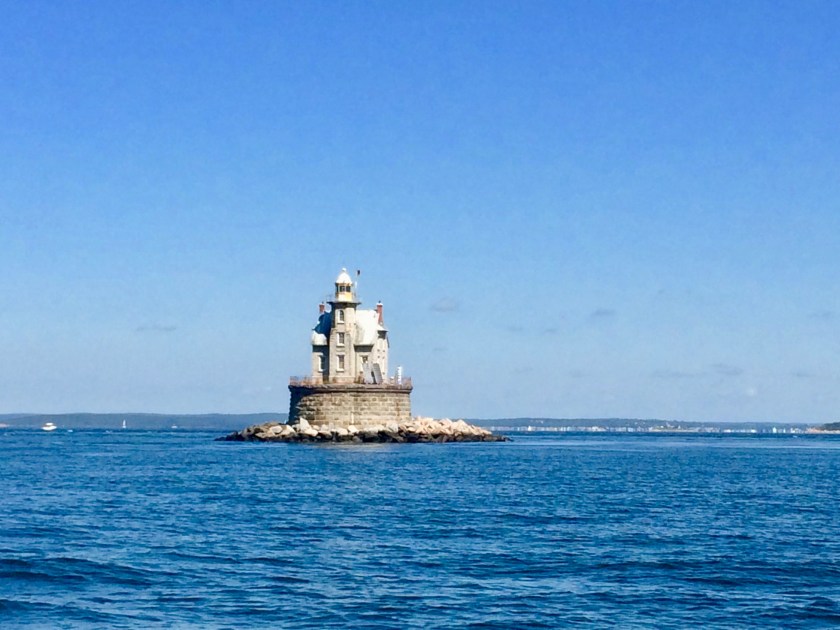
Passing Race Rock Lighthouse, Long Island Sound
At one point, we saw a one hundred twenty degree shift in wind direction with breezes that went from five to fifteen knots in only a couple of minutes time.The wind forecasts we had studied seemed to apply to an entirely different area than we were in.
In addition, currents seemed to vary considerably, which also added to the overall inconsistency of our success at being able to sail rather than motorsail.
Though, to our amazement, we found ourselves nearly three hours ahead of where we anticipated being by evening, we were rewarded with the unpleasant reality that this fact completely screwed up our timing with the tidal currents.
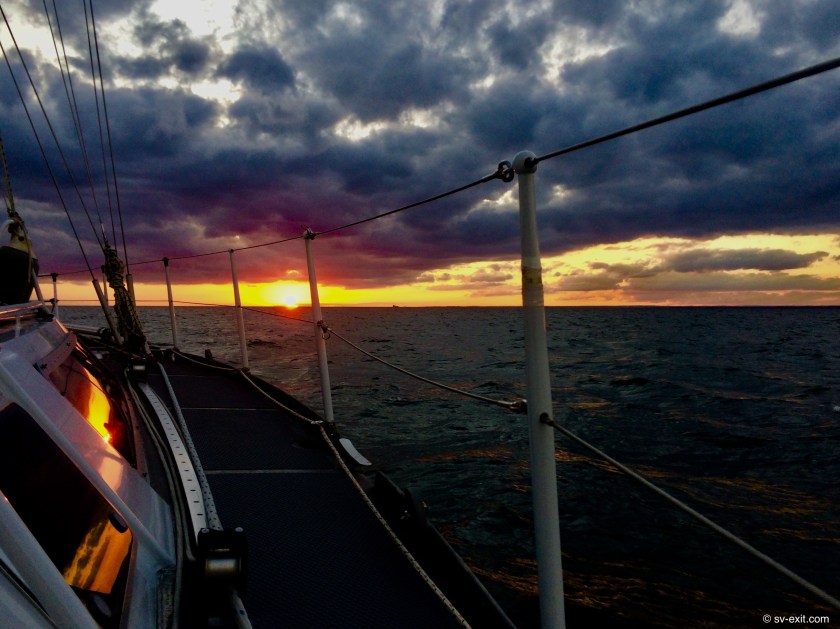
Long Island Sound sunset
Consequently, during our passage to NYC, we ironically ended up racking up close to as many hours running our engine as we had in all the combined time of traveling some twelve hundred miles since we had left Charleston.The only silver lining we could find in this was the fact that our terminally ill battery bank seemed happy with the constant charge being delivered from the engine alternator.
Despite the depressing aspect of so much motorsailing, we were fortunate to not encounter any seriously hostile weather during the entire passage.We even found that the nights required minimal layers of clothing to stay comfortable.
By the time we reached the East River, which would lead us straight under the Brooklyn Bridge to the Statue of Liberty, it was 5:00am, and our schedule based upon currents had gone completely out the window.
We ended up having to temporarily drop anchor until early afternoon, as the currents in the East River reach five knots, requiring a sailboat to pass through only when those currents are favorable.
Long Island shoreline
Throgs Neck Bridge…
Queens on the left, Bronx on the right
While we awaited the current change, in the distance we could see the rough and tumble buildings of Queens and the Bronx on opposite sides of the East River, with multi-million dollar homes lining the shoreline of Long Island right next to us.
Our navigation down the East River proved rather uneventful, though exciting.
We were surprised how little boat traffic we were encountering as we passed under the Bronx Bridge, under the La Guardia Airport landing flight path, followed shortly afterwards by the formidable and intimidating looking prison housed on Rikers Island.
Bronx-Whitestone Bridge
Under the La Guardia flight path
Past Rikers Island… a float prison hospital???
Ruins on North Brother Island
Just beyond Harlem was Hell Gate, a choke point in the river where currents reached five knots and the surface chop resembled an ocean more than a river.It was here that we started having to weave amongst power boats moving in both directions as well as ferries traveling at a staggering rate of speed.
Approaching Hell Gate
During this entire time, as Exit bucked and pitched in the substantial chop of five knot currents battling against an opposing fifteen knot wind as well as the wakes of passing boats, we had the breathtaking Manhattan skyline looming above us on our starboard side.
Through Hell Gate…
maximum current…
…minimum drama
Then, with Hell Gate behind us, we passed first underneath the Manhattan Bridge, followed by the Brooklyn Bridge, upon which we had been pedestrians only nine months earlier.
Before we knew it, the East River spit us out into the mouth of the Hudson River.Just on the opposite side, stood the iconic Statue of Liberty and Ellis Island.
We had made it… aboard our sailboat with New York City all around us… spectacular.
We had made it to Maine, and now were coming to grips with the reality that we weren’t going to be going any further north, or east for that matter.The implacable sound of the ticking clock was quickly being drowned out by the sound of alarm bells.The time had arrived to get moving.
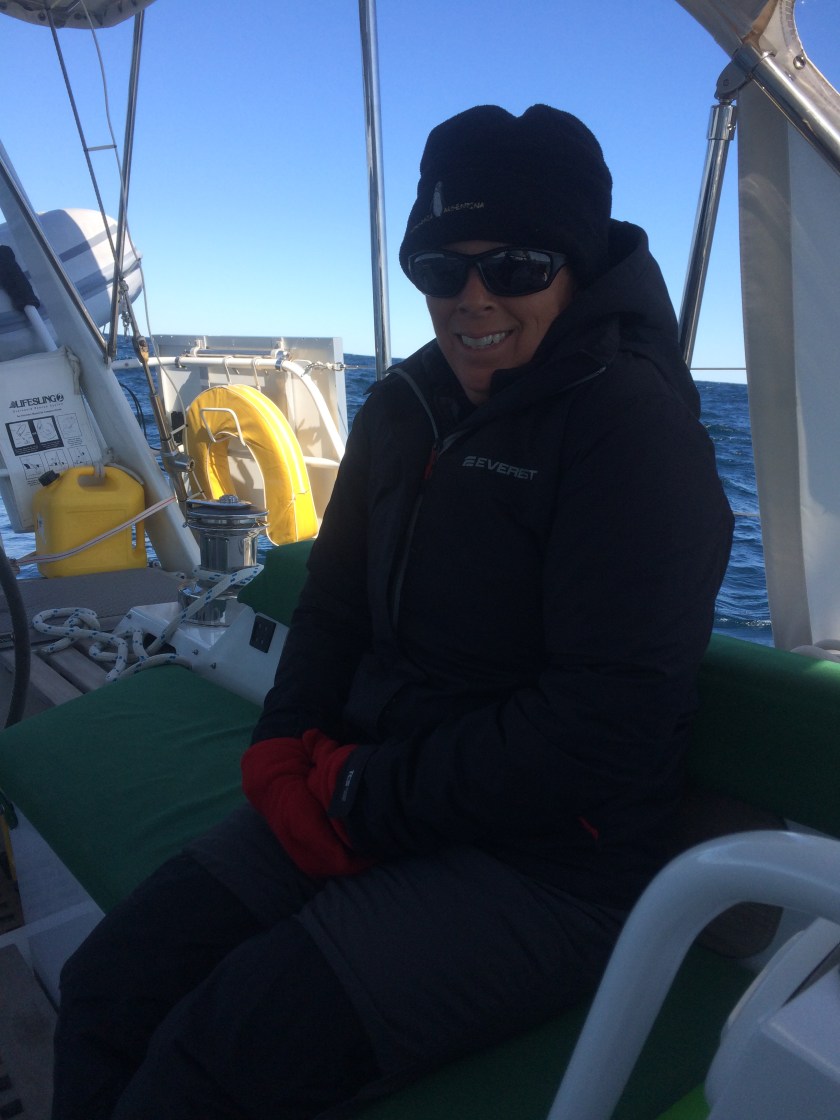
Warm thoughts… cold toes
The plan was essentially to retrace our previous path.Seguin Island, Onset, Cuttyhunk, and Block Island would all provide potential bailout points for temporary rest; but the strategy was to keep moving as quickly, efficiently and safely as possible with Annapolis and then Harrington Harbor North Marina as the destinations.The only detour we had planned was a mandatory stop at New York City.
We ultimately had to make the decision if we were going to get to The Big Apple via Long Island Sound and the East River, or go all the way around the outside of Long Island offshore.Offshore added a bit of distance but afforded the simplicity of us not having to account for shifting currents nearly as carefully as going inside.Changing tides would have a much more profound effect on currents through Long Island Sound, and especially the East River.Three to five knot currents in places on the river would be great as long as they were in our favor.
For now, that question could wait a bit.Immediately, it was all about making a run for Block Island, before a final verdict was needed.
Though we were determined to sail to Seguin Island, the unrelenting fields of lobster pots, combined with a mediocre breeze trying to remain nearly dead on our bow, eventually forced us to surrender to the necessity of supplemental engine power.
We arrived at Seguin utterly exhausted from dodging lobster pots.Concurring that we were not mentally prepared to continue overnight, we decided to grab a mooring ball there for the night. In truth, that decision had probably already silently been made long before our arrival at Seguin.
There was only one other boat there, and it left the bay just as we were approaching… awesome.
However, conditions today were much rougher than during our previous visit.Waves were breaking over the submerged rocks at the tip of the of the rocky peninsula that made up the east side of the small bay, right next to our mooring, resulting in rather substantial swells entering into the bay.We were mostly abeam of the swells, causing Exit to roll back and forth continuously.
Seguin Island
On the mooring ball again
Definitely “a bit rolly”
Dena and James had also left Robinhood Cove, and arrived at Seguin shortly after we did, proudly sailing aboard their new sailing yacht S/V Cetacea.
Technically, the name hadn’t been officially changed from Island Moon, so James jokingly referred to themselves as Island Buffoon on the VHF. Nevertheless, Cetacea was technically a sailing yacht as Dena and James had purchased a small oriental carpet which sat at the bottom of the companionway steps (apparently the sole factor that distinguishes a sailing yacht from a sailboat)… pretty posh.
We were quite keen to have one final big shindig together, as this would likely be the last time we would see our sailing soulmates for quite some time.On the other hand, we were much less keen about going through the hassle of getting the dinghy’s outboard engine out of the locker, where it was stowed, and hoisting it into the dinghy.The solution:we dropped the dinghy into the water and commenced with a special forces style assault of Cetacea, rowing like hell through the waves.
Dena secured our dinghy painter to Cetacea as we came alongside and promptly declared Kris TheQueen of Understatement. Kris had indicated to them over the VHF that conditions in the bay were “a bit rolly” not too long before.
Copious amounts of Kraken were consumed, and a raucous time was had by all.
But, alas, in due course it became time to make our way back to Exit to prepare for our departure the following morning.Sad but enthusiastic “until next times” were exchanged and, with much effort we eventually managed to haphazardly and semi-effectively row back to Exit.
Early the next morning, Cetacea had already sailed away by the time we untied from the mooring ball.It would be regular texts keeping us in touch until our next meeting.
We set a course for P-Town.Though the rhum line we were following was straight, the track we made on our plotter looked more like a rum line.It zigzagged erratically, like a drunken sailor.Only, in this case, it wasn’t last night’s rum that was to blame; it was the damn lobster pots.
We’ll forever remember Maine for its ruggedly beautiful landscape, guarded by a never ending gauntlet of lobster pots.
As we approached Cape Cod Bay, we decided to bypass P-Town entirely, opting instead to head straight for the Cape Cod Canal.
Ten to seventeen knot winds allowed us to sail for twenty one of the twenty three hours it took to reach the canal entrance.Then, to add to a perfect day of sailing, that night a stunning full moon lit the way for us.
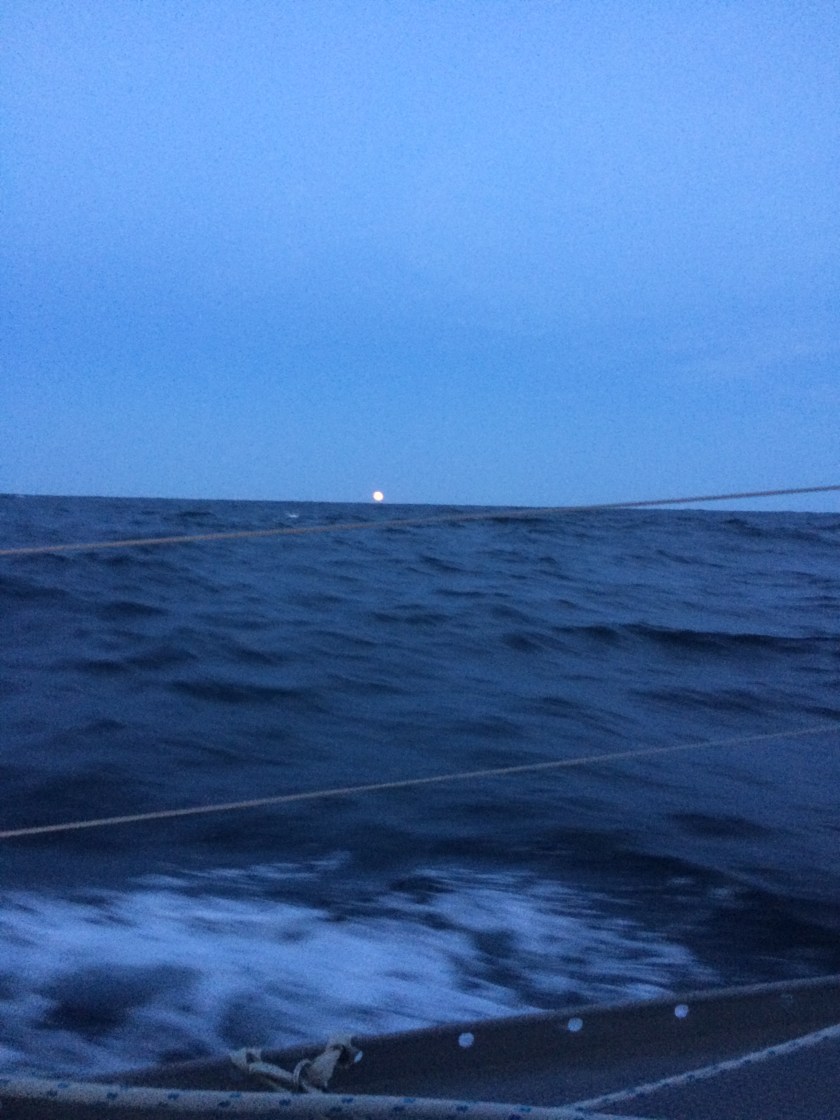
Full moon rising right at sundown
We arrived at the canal entrance a couple of hours after sunrise; but an opposing current forced us to drop anchor for two hours in a bay just off the entrance while we waited for the current to shift in our favor for our trip through the canal.
Just before noon, we set the anchor at Onset, in almost the exact same spot we had occupied one month before.
We still had plenty of provisions and a nearly full fuel tank, so the next day all we needed to go ashore for was a quick fill of our four water jugs to supplement the rain catch we had gotten the night before, as well as a return trip to Marc Anthony’s Pizzeria.
When we departed Onset we headed for Block Island, the last stop in our push for New York City.Once again, a following breeze between ten and twenty knots allowed us to sail almost the entire fifty seven miles.
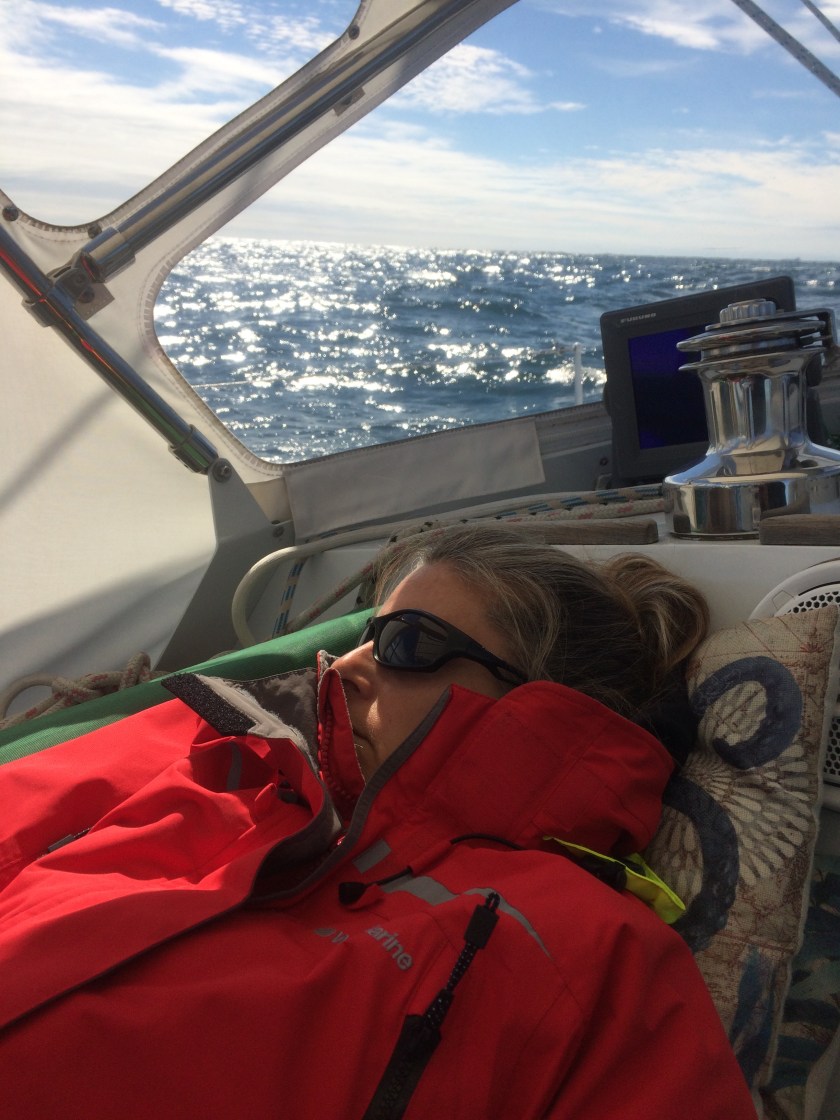
Kris trying to absorb some sunshine during the off-watch
Just before the sun began to set, Exit entered the large bay of Block Island, known as the Great Salt Pond.We were flabbergasted to find that, instead of the hundreds and hundreds of boats we had encountered previously, we were now one of only four boats anchored in the entire bay.
While we sat in the cockpit enjoying sundowner drinks, Kris pointed out that, without all the ambient noise created by thousands of people aboard hundreds of boats, we could actually hear the surf on the the opposite side of the small island.It was a completely different experience this time.In many ways, it seemed like a completely different place.
Heavy rains forced us to delay our departure from Block Island for an extra day; not a problem.We had been making good time and it looked like we would still make New York City by the end of September.
It had started as a faint spectre, barely perceptible if you really listened.
But more and more recently, it had moved into the foreground, becoming impossible to ignore.
The shifting colors of the leaves on the surrounding trees, from green to brilliant reds, oranges and yellows, had slowly been creeping further down the trees.
Evenings in the cockpit had been all but abandoned, not because of a lack of stunning sunsets or an excess of descending mosquitoes, but rather descending temperatures.
So far, we had only fired up the heater one night for an hour, but the discussions regarding not needing the heater were becoming far more frequent… a therapist might interpret this as denial.
An extra blanket was brought out for the bed.
Louder and louder the ticking grew…
We had decided that Harrington Harbor North… ground zero… where it had all first come together, made the most sense for our haulout.We knew, from experience now, it would provide access to just about everything we would need when it came to materials or services.It was the logical choice.
We were certain (often a risky perspective) that our time on the hard would be shorter than last year’s six weeks.One to two weeks seemed reasonable.However, we also had intimate experience with the potential can of worms being opened up nearly every time we set out to do something on the boat.
A few surprises followed by a few delays… always keeps things interesting.
Our biggest concern was making sure we got south of the Chesapeake earlier than we did last year.
By the time we left Annapolis on November 12, the cold had taken a firm grasp.It chased us all the way to Norfolk, where we found ourselves stranded for the week after Thanksgiving.Now, even if we left Harrington Harbor by November 1, it would be pushing it.
Which meant getting to Harrington Harbor by mid-October was imperative.If we counted on a relatively painless procedure with the haulout, we had no more than three weeks to reach Deale, MD.
The sound… growing louder… incessant and persistent.
… the worst possible sound for a sailor to hear.
Not wind… or waves… or creaking lines… but, rather…
One of the many bonuses we found after purchasing Exit was the extensive library that was left aboard.A book entitled A Cruising Guide To The Maine Coast summed up Robinhood Cove with the following observation:You won’t have much company of the human kind, but the mosquitoes might throw you a party.
Not only humorous, we found this to be an astonishingly astute statement.
The main part of the bay, approximately a half mile in diameter, was occupied by dozens of unoccupied boats tied to mooring balls, just off Derektor Robinhood Marina.To the south, Robinhood Cove narrowed to not much more than a thousand feet wide, but extended for more than three additional miles.
It was along this stretch that we found Dena and James at anchor aboard Nomad.We dropped anchor slightly farther south of them, the only boats there except for a small power boat and another sailboat, both unoccupied and sitting on mooring balls.
There was certainly cause for celebration.
Dena and James had just committed to buying a Baba 30 and had already started the process of finalizing the purchase.In addition, James had previously corresponded extensively with a guy in California, named Ed, who had been following their blog Sovereign Nations for quite some time.Ed was convinced he wanted to buy Nomad, and was currently flying over to take a look at her there in Robinhood Cove.
If they successfully made both deals happen (buying a new boat and selling theirs simultaneously), it would be pulling the proverbial rabbit out of a hat.We had written this same scenario off as virtually impossible when we were still looking at boats eighteen months ago, leading us to buy a boat well beyond our initial capabilities… a decision which we have not regretted for a moment.
While we chilled out, awaiting the final thumbs up that they could begin moving aboard their new sailboat, currently named Island Moon, we enjoyed the tranquility of near complete isolation, with the exception of the regular traffic of seals passing by.
Much less social than the numerous dolphins we had grown used to seeing further south along the East Coast and in the Bahamas, the seals always kept their distance from us.For the most part, the solitary head of a seal, possibly glancing over at us as it passed by, was the extent of our contact.Occasionally, a splash in the distance would reveal to us the presence of one leaping part way out of the water as it hunted through a school of fish.
Overall, we ranked the dolphins as far cooler… but we still always greeted the seal with a “hello” and a smile.
Once Dena and James solidified the purchase of their new boat, they were able to begin the arduous task of moving their belongings from one boat to the other by dinghy.Though, in the end, one load was all our dinghy was needed for, we made certain to provide maximum assistance in the boat-warming party department.
Dena & James on S/V Cetacea
One day, we made the mistake of procrastinating our storm preparations on Exit when a weather advisory for potential gale force winds was issued.The first blast of wind hit us while we were still securing things on deck.
Trapped between the opposing forces of a two knot current pulling in one direction and thirty knots of wind pushing in another, Exit momentarily listed precariously to one side as she struggled to find a balancing point.
One of the stern rail-mounted solar panels, which had not yet been lowered and secured, swiveled upward as it was caught by the gust, causing its support strut (a $5.00 Walmart extendable squeegee) to slip out.A loud bang emanatedfrom astern as the panel swung back down against the stern rail.
Looking back from amidship, it took me a few seconds to process what had happened.Then I saw the squeegee bobbing on the surface of the water, drifting quickly away from us.
For some unknown reason, our dinghy was still in the water, with the engine still mounted, tied off to the transom (normally we would at least stow the engine in case the dinghy flipped or we needed to sink it during a storm).In this case, it was fortuitous.
I quickly gained Kris’ no-contest-consent more than approval (she is typically much better at distinguishing between rationally improvised quick responses and poorly thought out, foolish, knee-jerk reactions) before hopping in the dinghy to retrieve a $5.00 squeegee in rough waves and twenty five to thirty knot winds… hmmmm.
With the precious squeegee recovered, we hunkered down and waited out the rest of the wind in the security and comfort of the cabin below, knowing our Rocna anchor would hold fast and hoping our rusty and decrepit chain would hold (James had staunchly insisted that we need to replace it sooner rather than later).
Fortunately, Robinhood Cove provided enough protection that we never saw winds higher than the initial onslaught that hit us right at the beginning.
We thought we had come out completely unscathed until we realized that we had foolishly left the aluminum bench for our dinghy on Nomad’s deck when we helped Dena and James move to their new sailboat.
A search of Nomad quickly confirmed that the bench was indeed light enough to be lifted up and carried by the winds we had experienced earlier.A more lengthy dinghy-based search and recovery mission along the shoreline for more a mile in both directions proved fruitless, confirming only that, if aluminum dinghy benches even do float, ours never made it to shore.
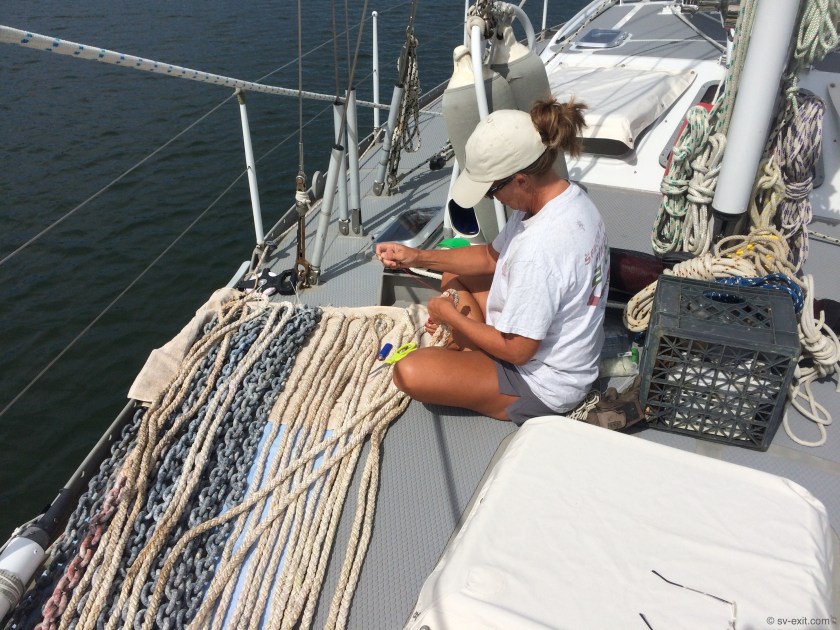
After the storm, we became even more determined to get out anchor chain sorted out.
It had confounded us for months.
The quantity of rust the chain was shedding on the deck both created an absolute mess as well as stained the aluminum, on deck as well as running down the side of the hull where a rust streak marked the location of the deck drain.
Some of the wear points in the chain links were substantial.It had now gotten to a point that, when setting or bringing up anchor, the chain was beginning to chronically jump out of the gypsy track (both a safety as well as equipment damage concern).
James had described the condition of the chain as a critical safety issue.
The challenge: as a French built boat, Exit was equipped with a windlass set up for 12mm chain.
The problems:
12mm anchor chain is unbelievably difficult to get in the States.
Goiot discontinued our windlass model years ago and has no current parts or information support.
We haven’t been able to find a replacement gypsy allowing us to switch over to half inch chain.
Obviously, we can’t be at anchor while we replace the chain.
The variables:There is 145 feet of spare G4 chain in the bow locker that was lashed to the secondary anchor.It appears to have never been used.The Lyman-Morse Boatyard, who maintained Exit for fifteen years, has a record of Exit receiving half inch chain in 2015.
The theory:The chain skipping is potentially due to a worn chain as well as some wear to the gypsy itself.Half inch chain is closer to 13mm than to 12mm.Hopefully, the potential wear in the gypsy will accommodate the slightly over-sized chain.
With more time than money, we committed to pursuing the potential option of a free resolution to the ongoing chain dilemma.
After digging some of the unused (and previously untouched by us) chain out of the locker and fitting it to the gypsy, we concluded: it was possible that maybe we could unconvincingly verify that the half inch chain might feasibly work in the current windlass gypsy.
A few days paying to be on a nearby mooring ball gave us the ability to experiment.
Cleaning out the rust and dirt from the chain locker
Moment of realization… I may be stuck!
We pulled the entire new chain up on deck, measured and marked it, and did a few additional experiments to try to bolster our confidence that the chain fit on the windlass correctly. Definitely G4 chain… stamped right on the links. Seemed to be 1/2″ diameter… seemed to have never been in the water. Seemed to fit the windlass gypsy better than the old chain.
We were ecstatic to learn that the extra 165 feet of line already spliced to the end of the chain was actually unused 5/8″ yacht-braid (a quite expensive line designed specifically so it could be run through the gypsy just like a chain.
Three hundred ten feet, or nearly one hundred meters, of anchor rode… sweet… as long as it works.
Marking the new anchor rode in five meter increments
Our first hurdle appeared as we tried to disconnect our Rocna anchor from the existing chain.Not only were both screws on our $75 Lewmar swivel completely seized in place, but they were also completely stripped.The only way the swivel was going to come off was with a hacksaw.
I suspected it could take me thirty hours to completely saw through two stainless steel pins larger than half inch diameter.Surprisingly, it took less than thirty minutes.
Swivel connection to the anchor
Hacksawing through the pin
Success!
All that keeps us attached to our anchor…
We had already foreseen the predictable calamity of, after having just cut free the chain, watching our precious unsecured anchor slide off the bow roller, splash into the water, and promptly sink to fifty feet.We had already taken precautions.
James and Dena, who came by to lend assistance with connecting the new chain to the anchor, laughed when they saw the anchor, secured not only with two separate lines to the bow roller and deck, but also attached to a spare halyard hung from the top of the mast… possibly overkill.
As for the now useless swivel, we were stuck.We couldn’t find the same swivel anywhere in the area, and were told alternatives would cost hundreds of dollars.
Using a shackle in place of the swivel was an option.Both methods have their proponents and critics.Ask a group of surly sailors:when connecting an anchor to chain…swivel or shackle? Then stand back and watch the entertainment begin.
After locating a shackle, already aboard, that James and Dena assured us was more than sufficient strength, James helped get everything attached properly.It was agreed that, for the long term, it would be best if we used a slightly different bow shackle; however, everything was golden for the immediate future.
Rather than use Loctite, which would be a bitch to break free in the future, we followed our Sailing Gurus’ recommendation to mouse the threaded pin with stainless steel wire, preventing any possibility of it inadvertently backing out, but still allowing us to get it off easily when it came time to switch to a different shackle.
Before getting off the mooring ball, we lowered the anchor where we were, as a test run.Though the chain jumped slightly on the way out before the anchor hit bottom fifty feet below, it worked like a dream on the way back up. Our confidence began to grow that we had actually found a solution which had been on the boat the entire time.
We returned to our original anchor spot and dropped the hook.This time it seemed to work even more smoothly as the chain was paid out.
Woohoo!We were now brimming with enthusiasm.Our rusty chain was secured in the bow locker (where it would stay until we were 100% sure we didn’t need to use it as an emergency fallback) which meant that our rust stain woes were nearing an end pending one final removal process of the current stains.We had a brand new G4 anchor chain that was twenty five feet longer than before.We had an extra one hundred sixty five feet of unused 5/8″ yacht-braid attached to the end of that chain which had been confirmed was perfectly safe to deploy if needed (which also ran through the gypsy).Our gypsy seemed absolutely content running with the half inch chain.And, to top it all off, we still had two thousand dollars in our bank account that would have been spent otherwise… gotta like that.
True, at some point we would need to acquire additional chain for our secondary anchor.But, at least it wasn’t an emergency (we had never had the need for a second anchor during our first year aboard Exit); and it appeared that half inch chain was now an option as well.Happy days!
Shortly afterwards, we received word from Dena that Ed was going to pull the trigger on Nomad… he was buying the boat immediately.They had pulled off the impossible – successfully buying and selling two boats, in the same location, in less than one week’s time!
True magic… no sleight of hand, no safety wires… our heroes.
There was undoubtably cause for big celebration, which the four of us undertook in fine form.
Other than Derektor Robinhood Marina (and a restaurant above the marina office), there were no facilities for miles.Fortunately, since the boat Dena and James were buying was on a marina mooring ball, they had access to the marina showers and courtesy car, which meant plenty of opportunities for provisioning.
When they rented a car for a few days, we tagged along for a much appreciated one day road trip, an excursion to explore Portland and Boston.We may be seeing a pattern developing… a reunion with Dena and James mandates a bit of Road Trippin’.Lobster rolls in Beantown… yum!But what’s with all the mayo?!
We also had plenty of time to explore farther up into Robinhood Cove by dinghy, which slowly transformed into more of a creek and eventually a marsh.
The last project we felt compelled to do prior to a haul-out, which was now becoming imminent, was an attempt to clean our dodger and bimini covers.
Though very durable, a year on the water had begun to take its’ toll on the Sunbrella material.The bright white had slowly morphed to a dull and dingy gray, eventually starting to show the black specks and dark stains of the relentless assault from the elements. Now, even shades of green were becoming visible in places… algae.
Without fully removing either the bimini or dodger cover, we spent the better part of two days carefully applying and rinsing a bleach/water mix, trying to minimize dripping on the teak or aluminum (generally a no-no on both). Though we were dubious that anything short of a complete removal of the covers from the frames, followed by an aggressive cleaning off the boat, would have satisfactory results, we decided to give it a try.
During the process, Kris saw a post on one of the cruising forums, asking for advice on cleaning bimini covers.Kris replied with a summary of what we were doing and how it seemed to be working.
Forty eight hours later, with the bimini and dodger covers fully dry, we were stunned at how clean they looked, almost new even.It had turned out far better than we had imagined possible.
Later that evening, while we reveled in the cockpit drinking sundowners, beaming with pride and basking under the cover of our now gloriously clean dodger and bimini covers, Kris read a followup post on the cruisers network which lamented…
… Just had to replace my bimini and dodger covers.The bleach ate through all the threads.
Kris closed the laptop and we made another toast.You can’t win ‘em all but some successes taste extra sweet.
Our destination of Linekin Bay was only eleven miles away, so it afforded us a late start… something I thoroughly enjoy whenever possible.
However, heading nearly into the wind with very little wind, not to mention a plethora of lobster pots to navigate through, made for especially difficult sailing.
Even if we did get the engine shut off for a while, sailing through the pots quickly became exhausting and stressful.The autopilot was on standby; manually steering by hand was the only way forward.
Also, sailing inside a true wind angle of less than sixty degrees gave us very little ability to steer to the right to miss lobster pots without losing all our speed and steering as the sails luffed, or having to tack completely around to a different point of sail.
In the end, we found ourselves having to do a lot of motorsailing… those dastardly lobster pots.
And it seemed that, as we got closer to land, the numbers of lobster pot floats kept growing exponentially.It reached a point that it appeared they had been placed more with the intention of catching boats than lobsters!
We passed right by the very popular Boothbay Harbor without even blinking, precisely for the reason that it was very popular… more of a destination for the marina and mooring ball dwellers.
Our intended anchorage was Lewis Cove, just around the opposite side of Spring Point.It appeared that it would be much less crowded, yet still easily within walking distance of all the facilities located in Boothbay.
A sound idea… but we crapped out on the actualization of that plan.
In Lewis Cove, we were delivered three strikes – mooring balls everywhere, lobster pots everywhere, and low tide depths of greater than thirty feet anywhere there was a gap between balls or pots.We would have to find an alternate location.
After nearly an hour, we settled on a quiet corner of the bay further north… no lobster pots, no mooring balls in the immediate vicinity, and depths of fifteen feet.
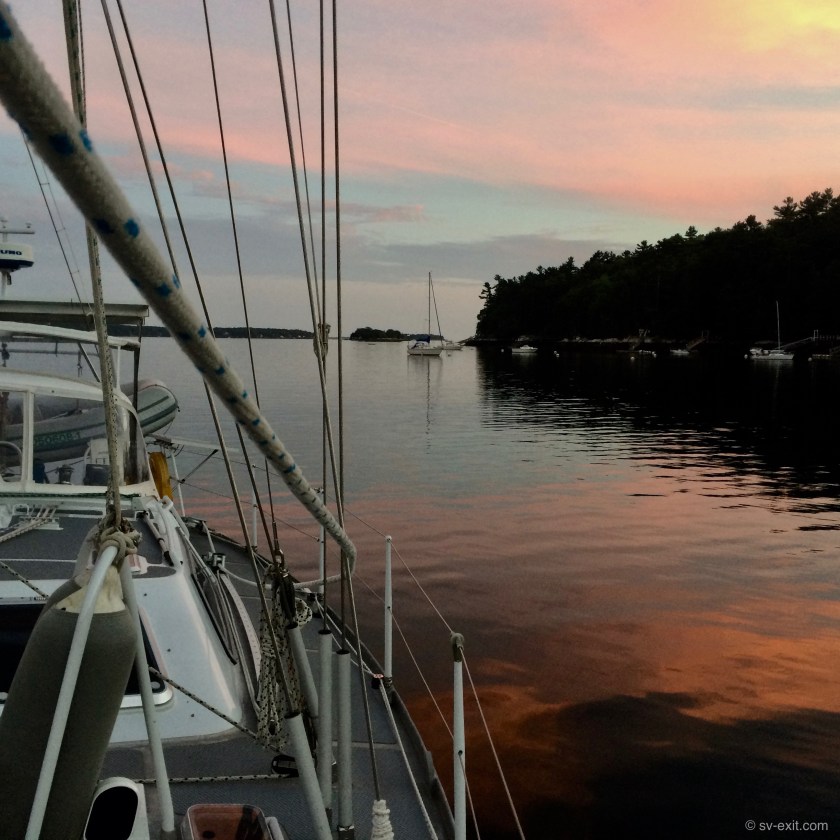
Immediately suspicious and skeptical, we were wondering what we were missing.However, the anchor set perfectly and all seemed good.We had our own secluded spot, with very few houses along the shore and only a handful of unoccupied boats on nearby mooring balls.The only uncertainties were shore access and whether we were miles from any facilities.
A dinghy ride to one of the private docks netted us twenty two gallons of water, after gaining permission from a man of few words who didn’t seem to entirely get why we were anchored so far away from civilization without access to a car… oh well, free water is free water.
A bit further along we found a public dock with dinghies tied up to it.However, an exploration of the area uncovered only one small general store with nothing we needed.I passed on the $25 lobster roll.
Trying to give Dena and James all the space they needed to work things out, instead of being a distraction, we spent three peaceful nights at Linekin Bay.
During that time, we met a immensely friendly local resident named Charlie, who stopped alongside Exit in his dinghy.He gushed compliments at us for our choice of boat, pointed out that cruisers almost never anchor here as it’s so far away from anything, passed on information regarding lobster fishing as well as advice aimed at avoiding being fouled by the lobster pot lines, and gave us permission to fill up with as much water as we could hold using the spigot at the dock we had gotten water from earlier.
Once again, we were amazed at the hospitality and helpful nature of some people we stumbled across.
Even stranger was the exchange we had when we were visited by two women and a man rowing a pair of kayaks.They had seen our hailing port of Pullman, WA on the transom and couldn’t resist coming over to talk to us.
We were stunned to learned that the man and woman were actually from Pullman, on vacation in Maine visiting their friend (the third person).They had lived in Pullman for fifty years and, though we did not know them personally, we immediately recognized the street they lived on.
Then, as if that wasn’t enough of a small-world-holy-shit-moment, further conversation revealed that their daughter Jennifer and I had actually graduated in the same high school class!We have had some pretty bizarre crossing orbits in our travels, but that one has to be near the top of the list.
Later that afternoon, we received a text with the news we had been anxiously hoping to hear.Dena and James were buying a new boat.Woohoo!
We immediately decided to lift anchor the following day and head straight for Robinhood Cove, just twenty nautical miles to the west… right after filling our water tanks.Thanks Charlie!
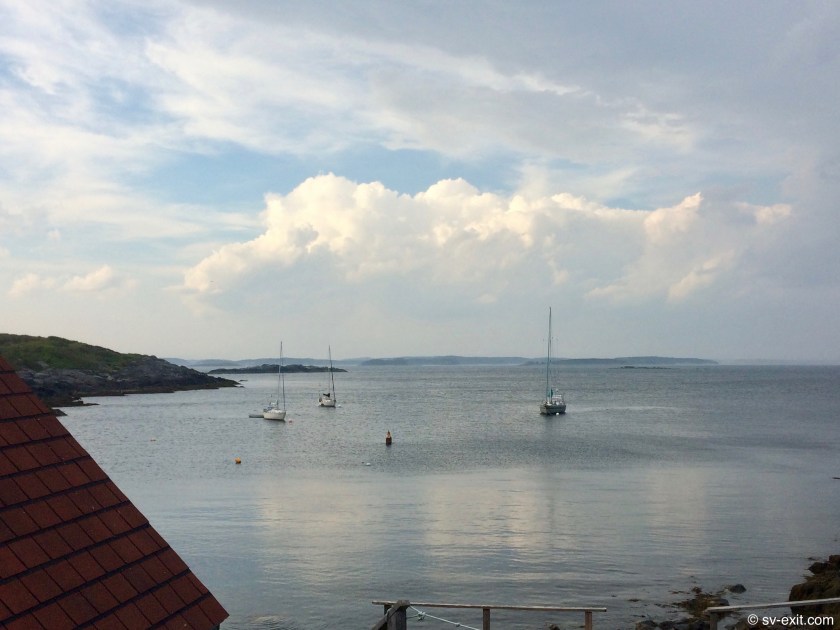
The tiny island of Seguin only has a small bay measuring approximately five hundred by three hundred feet.There is also a power cable running across the bottom through the middle of the bay, which supplies power for the fifty three foot tall lighthouse standing regally atop Seguin Island.
Fouling your anchor is bad enough… causing a lighthouse blackout while trying to bring up an anchor caught on the lighthouse power cable would most likely bring down all kinds of grief upon us.
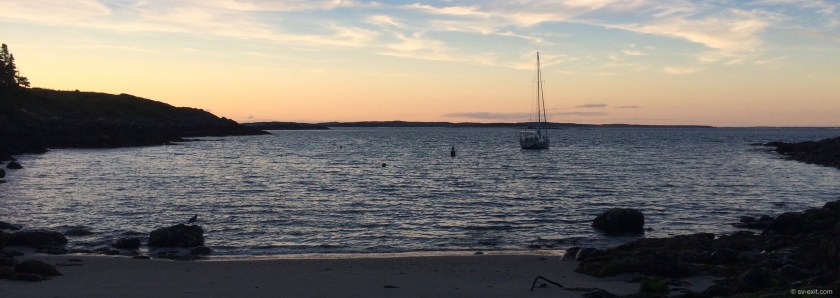
Fortunately, a non-profit group called the Friends of Seguin Lighthouse have set up, and maintain, a handful of free mooring balls in the bay.When we arrived, there was room alongside another sailboat and small trawler.It was the first mooring ball we had utilized since Carolina Beach last December, when we went on our epic road trip to New York City with Dena and James.
By the time Dena and James arrived at Seguin there was only one other boat in the bay, the rest obviously there for just a day trip. Essentially, we had the bay all to ourselves… sweet.
We took our dinghies ashore and climbed the path to the top of the island, one hundred forty five feet above the bay where the lighthouse, museum, and Lighthouse Keeper’s residence are.
The Seguin Lighthouse was commissioned by none other than George Washington in 1795.Originally built as a wooden tower, it was constant exposure to the elements that eventually forced its’ reconstruction sixty two years later using granite brick.
By necessity, lighthouses are often built in inhospitable, dangerous, or remote locations.The Lighthouse Keeper, tasked with the imperative of keeping the light shining at all times, especially in the worst weather, had to endure those conditions year round.The mystique of a courageous individual, living in solitude, acting as the guardian and protector of sailors by warning them of impending dangers, has a very powerful resonance in the human psyche.
But, like so many of the once truly iconic paragons of classic Americana that now reside only in history books and stories, the Lighthouse Keeper has all but become extinct.
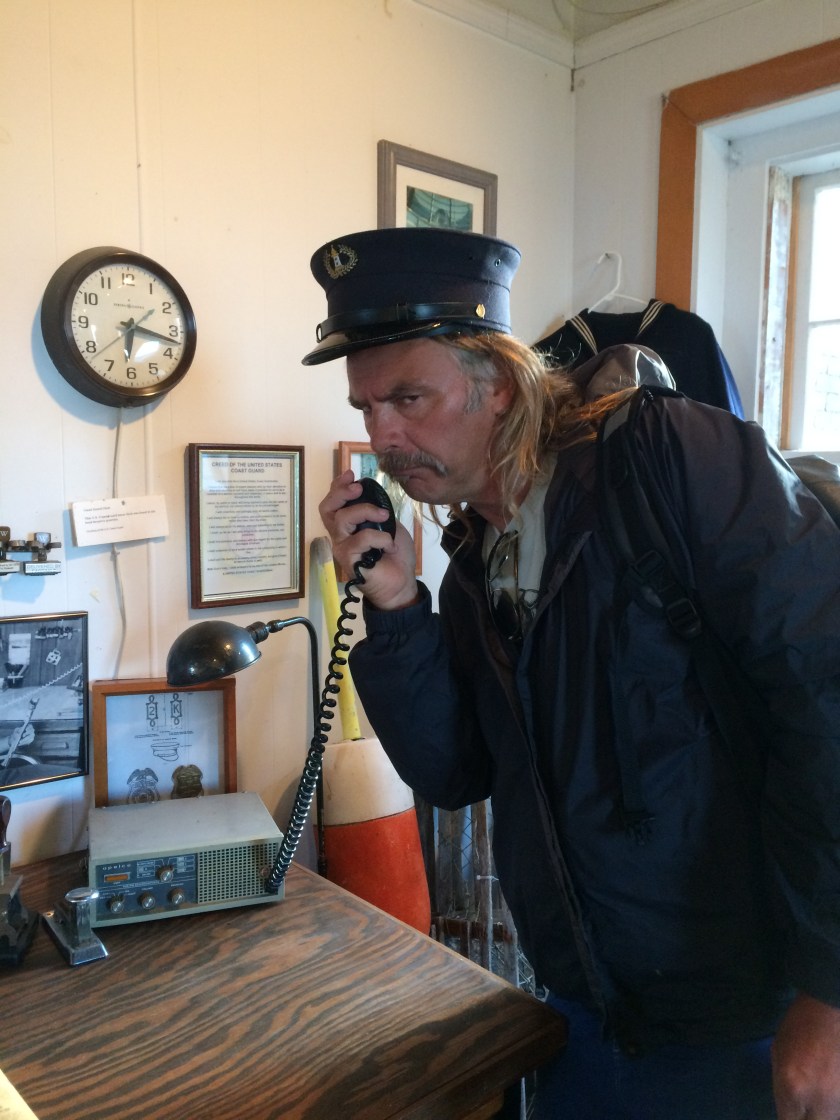
Today’s role of “Stoic Lighthouse Keeper” played by Steve
Alas, almost all lighthouses are now fully automated, as was the Seguin lighthouse in 1985.
Nonetheless, the Friends of Seguin Lighthouse do a brilliant job of maintaining the facilities largely through volunteer efforts.During the summer months, the lighthouse is also tended by two volunteer Keepers who live at the residence, keeping up the grounds and trails, giving tours, and looking after the museum and shop.
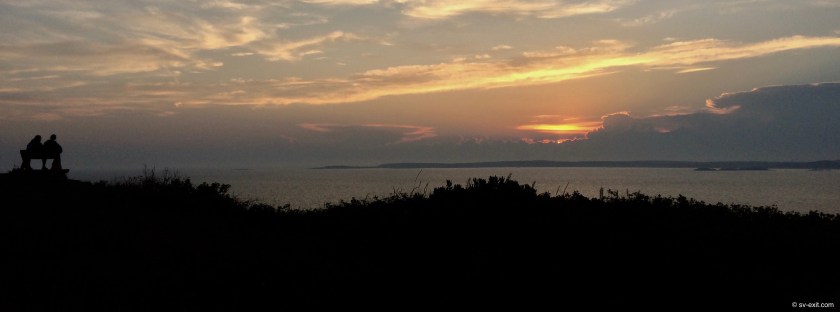
The volunteer Lighthouse Keepers enjoying a sunset
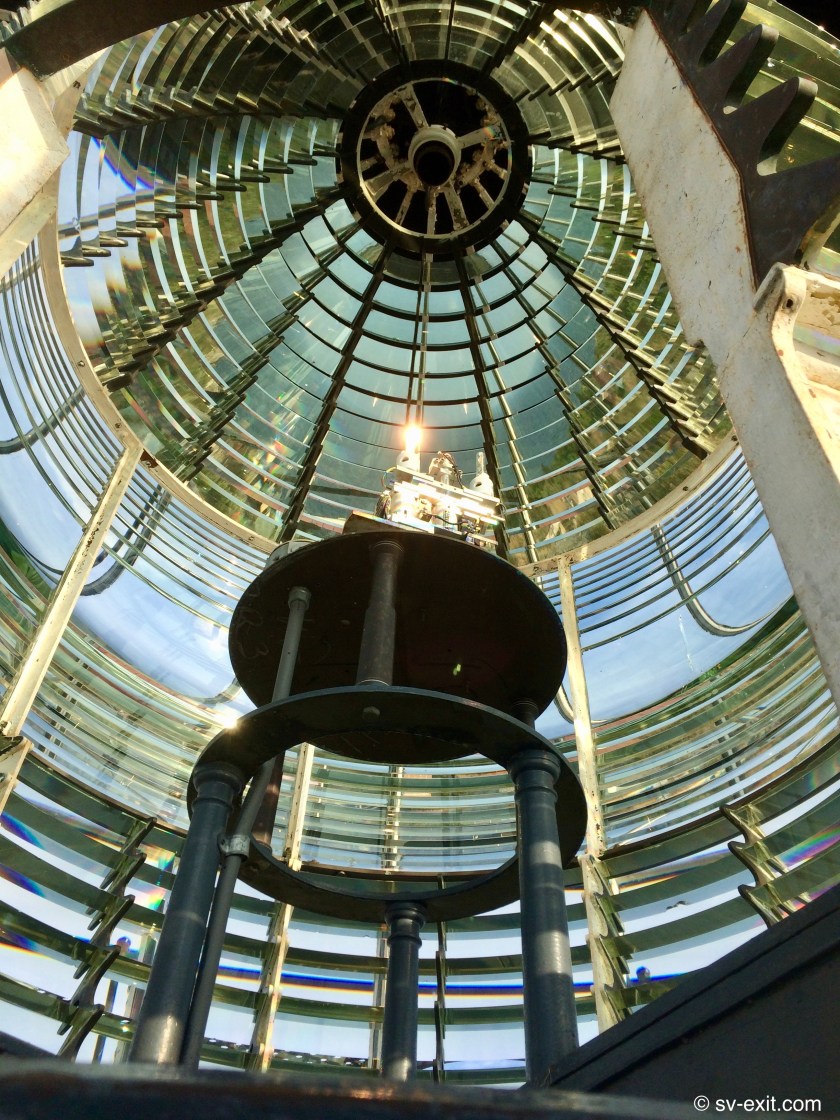
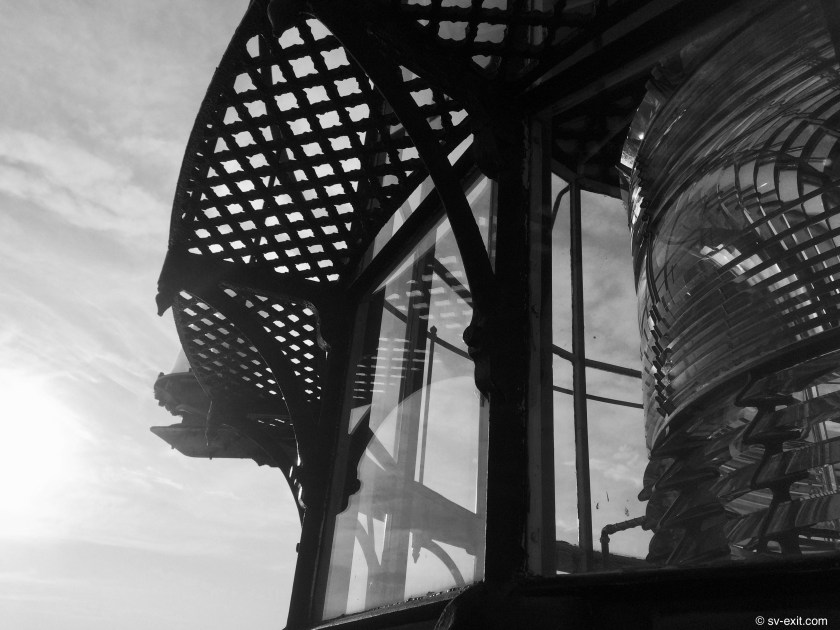
Though we arrived at the inopportune moment the volunteer Keepers had started making dinner, they were still kind and patient enough to take us up to the top of the lighthouse tower, letting us see the incredible First Order Fresnel lens, answering our questions, and chatting in the yard with us for quite some time.
Returning to Exit, the night degenerated into a haze of Kraken-inspired conversations, stories, and laughter between the four of us.
Dena and James sailed off their mooring early the next morning.They were making a sprint for Robinhood Cove, only about fifteen nautical miles away, where they had the exhilarating and distinct possibility of both buying and selling a boat at the same location.If they could pull it off, it would be accomplishing what we thought would be an impossible task.
We stayed at Seguin Island for one more day so we could explore the many footpaths that spider out from the lighthouse grounds.Some paths led us to striking, rocky beaches pounded relentlessly by waves.Others to breathtaking vistas looking out over sweeping expanses of ocean and the shores of Maine to the north.
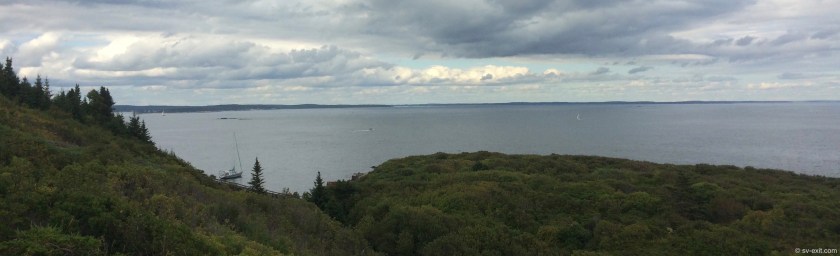
One of the paths took us to the northern tip of the island, where we could see Exit, at anchor in the bay next to us, as well as seals swimming through a channel fifty feet below us.
That same path had endless wild blackberry plants growing alongside its’ edges, which we collected and savored as dessert that night.
Mmmmm… free dessert.That may be $6.00 for the credit fund…




































 sv-exit.com