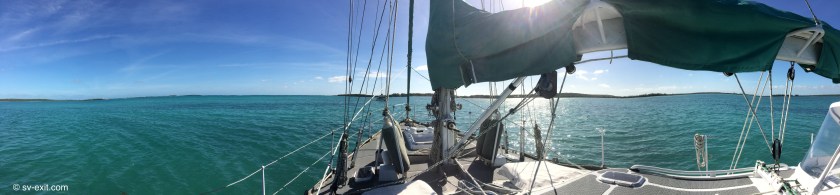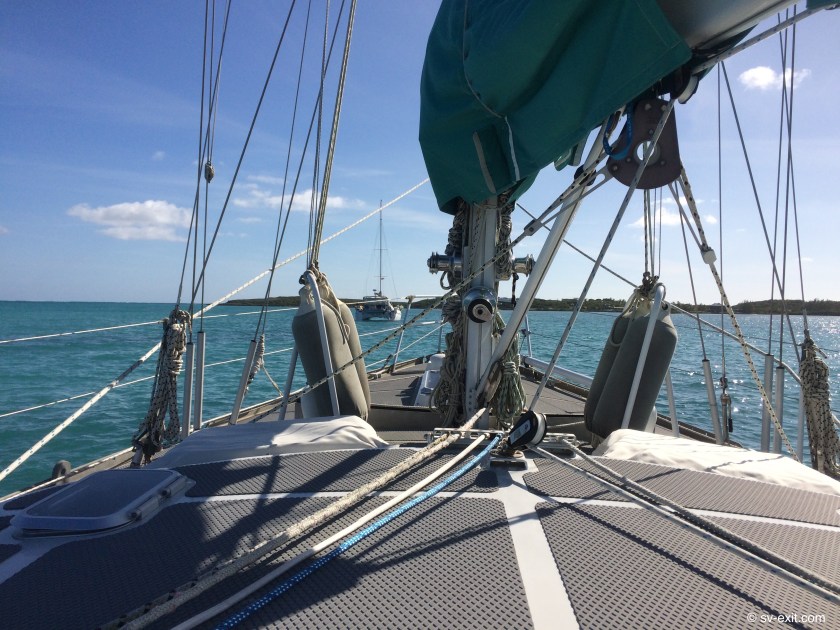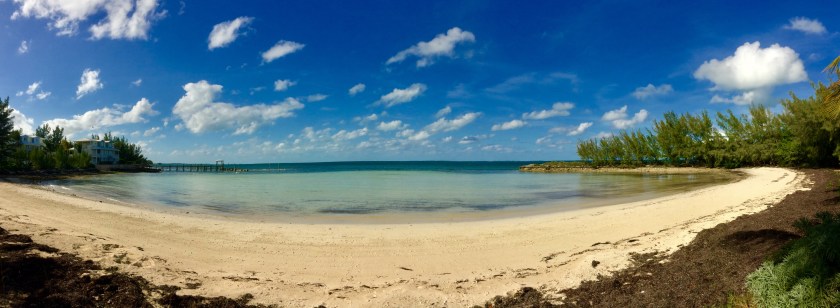
Windward Passage – Bahamas To Jamaica

March 27 – April 1, 2019

To say the weather forecasts for the areas we have been in over the past four months have been inconsistent in their accuracy would be a gross understatement.

Wind directions ninety or even a hundred eighty degrees off from the forecasts.   Five knots winds when twenty-five were anticipated; or, much worse, twenty-five knot winds when five was expected.  One weather model spot on last week completely misses this week or visa versa…

The best bet is that the wind is coming from the direction we are trying to go.  The best predictor of rain is Kris putting laundry on the lifelines.  Laundry on the lifelines… rain coming for sure.

We had heard that the Windward Passage, the body of water separating Cuba, Haiti and Jamaica, could be notoriously like the Gulf Stream in its ability to quickly stack up nasty or even dangerous conditions when building wind directions oppose continually shifting currents.
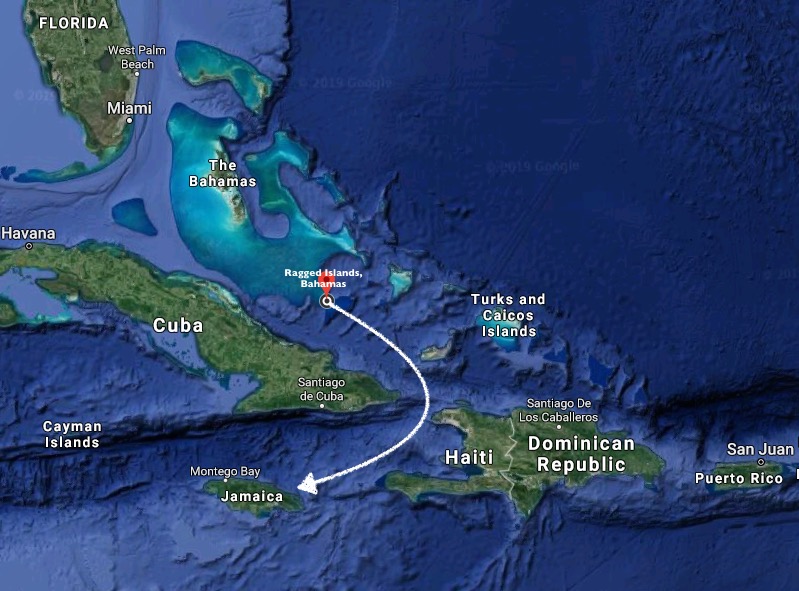
ToJamaicaGoogleMap

Our strategy was similar to what we had used in crossing the Gulf Stream at Hatteras / Cape Fear… respect the stories you hear and shoot for a window that risks excessively calm conditions that may force motor-sailing over excessively breezy conditions that cause you to shit your pants.

Jamaica was just under four hundred nautical miles away, slightly more than three days sail.

Our departure Wednesday morning was greeted with very calm seas.  Unfortunately, the wind was only seven to nine knots, and it slowed down from there.  

By mid-afternoon, the wind indicator hovered at two knots, and our Perkins engine was the only thing carrying us over perfectly flat waters.

We would have been more than willing to sit; the surface conditions were certainly conducive.  However, in the end we concluded that getting down to what we saw as potentially the diciest section of the Windward Passage, the area directly between Cuba and Haiti, while the wind was minimal was ultimately in our favor, even if we had to sacrifice a bit of diesel to achieve that.

We managed to shut off the engine for a spell, content to wring three to four knots of boat speed out of four to six knots of wind speed. 

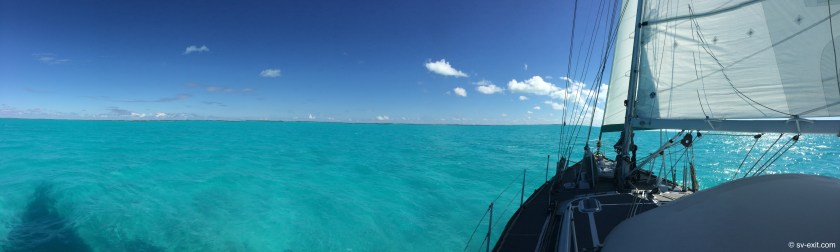
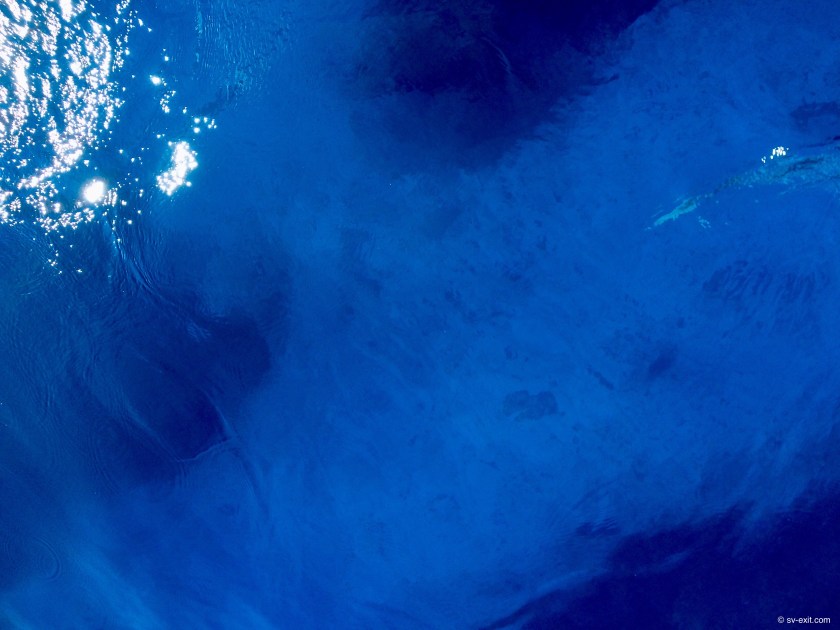
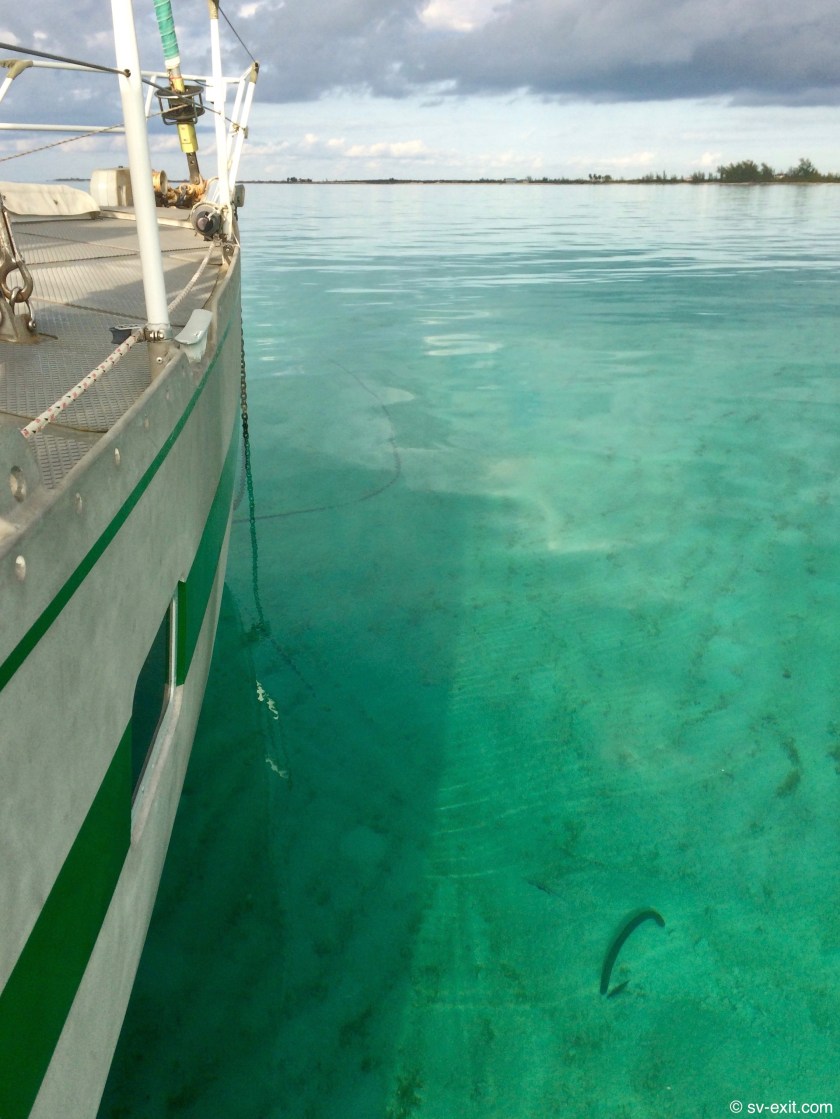
As we passed clear of Columbus Bank, and the floor of the ocean fell dramatically away from a depth of forty feet towards eight thousand feet, we could clearly see the shadow of Exit cast on the ocean floor more than one hundred feet below!  A short time later, we crossed over the edge of an immense drop off.  And then suddenly there was nothing below us but amazing shades of blue… split by beams of reflected sunlight trying to pierce into the depths.

And, once again, the ocean’s surface all around us was a magical shade of indigo.

Though we wrestled to keep the sails filled, in the end, to our dismay it was largely diesel power that propelled us until the following morning.   The display on our weather chart indicated we were right in the middle of the only area for hundreds of miles that currently had breezes of less than five knots (just our luck).

By 3 a.m., the engine had been running for nearly ten of the past twelve hours.  We were ready to concede that our plan was not viable as things stood.  With no wind, there was no way we were going to motor four hundred miles to Jamaica.  A slight detour farther to the east would put us at Great Inagua, where we could get provisions and wait until the winds returned.  Or we could head slightly farther north and make for a tiny dot on the chart called Hogsty Reef.

Hogsty Reef is a minute atoll barely breaking the ocean surface in the middle of the open Atlantic.  The coral walls that comprise its outer ring plummet down thousands of feet while inside the depth is only about twenty feet.  Because of its exposed nature and zero protection, the location is tenable as an anchorage in only the calmest of conditions… like now.

We decided to roll the dice.  If we had to motor, it would take seven extra hours both ways, which would suck.  But it would also provide the perfect conditions for anchoring overnight.  For now, we could raise the sail and kill the engine, content to move along at a slow pace.

Its difficult to describe exactly how it sounds after being underway all night long offshore under engine power, to finally shut the engine off and, under only sail power, think wow… what a difference.  Only to realize that the propeller still spinning beneath the hull is creating its own noise… so you momentarily put the transmission in reverse creating near absolute silence and immediately think WOW… WHAT A DIFFERENCE!

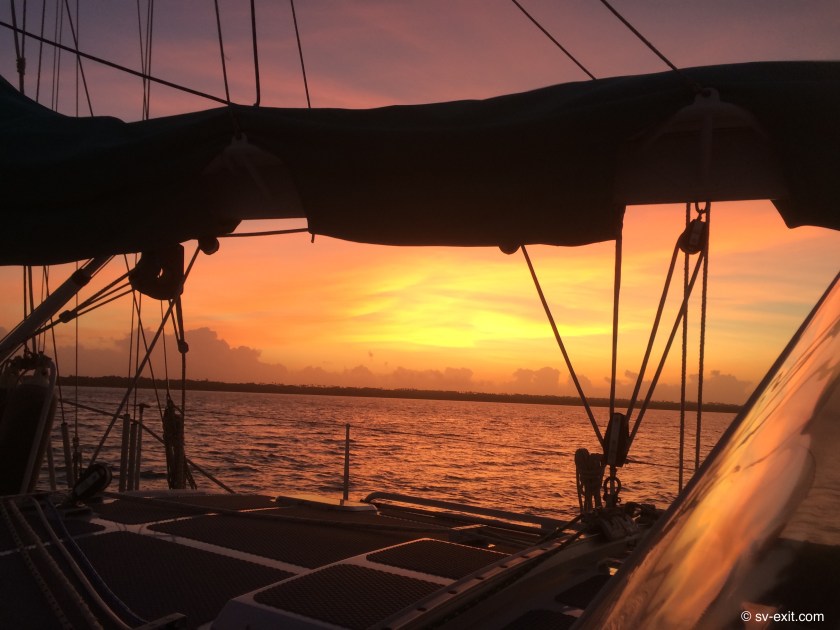
A six a.m. sunrise and a new day…

After the previous night, even seven to nine knots of wind seemed like a gift.

By nine a.m., we had definitively altered our course to Hogsty Reef (prior to that we had been experiencing more of a non-committal steering in the general direction of Hogsty Reef).  A choice had been made.  No increase in wind in the forecast for the next couple of days… new plan.

However, less than two hours later, that new plan disintegrated.

NNW winds picked up out of nowhere to the tune of fifteen to seventeen knots… holy shit!  And, just like that… wham!  We’re doing better than eight knots speed over ground.  Only, the seas are starting to kick up quite quickly.

It didn’t take long to realize the Hogsty Reef option had just been taken off the table… bummer.  On the up side,  the engine was off and we were flying along with only the genoa out.

The upside of downwind sailing is undoubtably comfort level.  Fifteen knots of wind from behind feels more like ten, and sliding atop three to six foot following seas is preferable any day to pounding through four foot waves while getting hit with fifteen knots of wind on the nose!

We altered course away from Hogsty Reef.  The current surface conditions would never allow for anchoring and would take a while to settle back down again even if the wind dropped off.  For now, we could return back to a course towards Jamaica and reassess the conditions as we passed Great Inagua.  If the wind died again, we could stop there.

Yet, when we unfurled the genoa and shut down the engine just after eight a.m., we had unknowingly set the stage for the rest of the passage to Jamaica.  For the next fifty four hours, we ran mostly within forty degrees of dead downwind under power of sails only.  Our engine didn’t get used again until we were about to enter the bay at Port Antonio, Jamaica.

What a difference twenty-four hours can make in our log entries…

9:00 – Winds appear to be dying over next couple of days; making for Hogsty Reef
10:30 – Making for Matthew Town on Great Inagua. Squalls making sea conditions untenable for Hogsty
13:00 – GPS track looks more like someone learning controls on an Etch-A-Sketch than a sailboat but back on course for Jamaica mon!
17:50 – Brilliant sailing for past six hours; what a change from this morning. In 10,000ft. of water.  Approaching Windward Passage.
1:45 – 13nm off the coast of Cuba (1nm outside Cuba’s territorial waters)
10:00 – Now in the Caribbean Sea – may be first time Exit has been in this part of the world.

By 1:30 that afternoon we had rounded the southeastern tip of Cuba and passed within thirty five nautical miles of Guantanamo Bay, plenty close enough for us.

We’d been seeing fifteen to twenty knots of wind for over twenty four hours and it would remain like that for the next twenty four hours. Exit sped along comfortably atop the three to six foot following seas, which looked uglier than they felt.

As we approached to within nearly ten miles of Jamaica, an ominous stretch of very dark clouds lined up across the horizon, directly in our path.  Almost as though a final gauntlet was being thrown down before we would be allowed to reach our destination.

But our radar revealed that we were actually looking at a very deceptively narrow band of storm clouds.

Slowly, in the distance… through the hostile looking, though largely benign, cloud cover… a dark mass began to appear low on the horizon.   As it began to take form, the color slowly shifted from gray to green.  The cry “land ho” went out.

Jamaica!

As we approached Port Antonio, we were immediately struck with the stark contrast the lush, green, mountainous terrain before us provided against the low lying, often inhospitably rugged and desolate Bahamas we had just come from.

Once inside the East Bay, conditions completely calmed down.  As Kris circled around while I dropped the mainsail, she had to dodge a large number of coconuts, branches, and rubbish that was floating about in the bay.  Initially, this seemed a bit shocking to us, until we realized it was the result of river runoff from the nearby mountains.

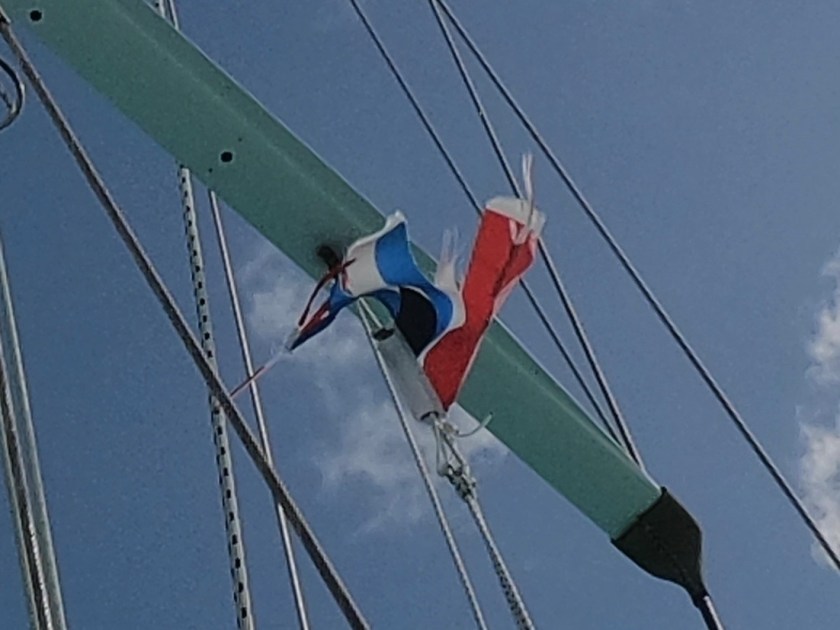
Our Bahamas courtesy flag, flying under the starboard spreader (which was now little more than a patch of torn cloth) had already been replaced with the yellow quarantine flag, which we had to fly until we cleared Customs.

In the Bahamas, we were able to anchor, then have one person dinghy ashore to visit the Customs office and Immigration office, where all the paperwork was dealt with.

In Jamaica, the Customs and Immigration officers come to your boat… slightly intimidating the first time, to say the least.

We had to tie up at the dock of the Errol Flynn Marina, run by the incredibly helpful and hard working Dockmaster George.

Clearing in turned out to be a rather painless process.  About ten pages of forms and paperwork to be filled out.  A visit from the Customs officer.  A visit from the Immigration officers.  No searches.  No hassles.  A lot of questions.

Then, after clearing in with the officials, a visit from a Jamaican named Presley who can help with whatever you need… Work on the boat?  No problem mon.  Go on a tour?  No problem mon.  Jamaican courtesy flag? US$10.  Enough ganja to fill a mason jar?  US$50… a weed magnet.

*****

Wandering around Port Antonio… a somewhat edgy but very friendly town that reminded us a lot of Semporna in Malaysia.

Not a cruise ship destination at all, Port Antonio felt more isolated from the typical tourist hustle… more laid back and certainly more authentic.

It just so happened our arrival coincided with the final days leading up to the local election.  A much more festive and involved affair than anything we would ever see in the States, we got to experience music booming across the water of the bay until dawn for our first four nights.

A bit annoying?  Possibly… but certainly better than the gunshots we heard people in Kingston got to listen to.

Local recommendations proved worth their weight in gold when it came to choosing the best jerk shacks to visit.  Oddly enough, it was a little shack called Piggy’s Jerk Center for incredible jerk chicken.  But Honest John, fifty-four years young cooking jerk pork for thirty-two years, proved the master.  And not just jerk pork… jerk wild boar.  My tongue was on fire while my stomach was in Heaven.


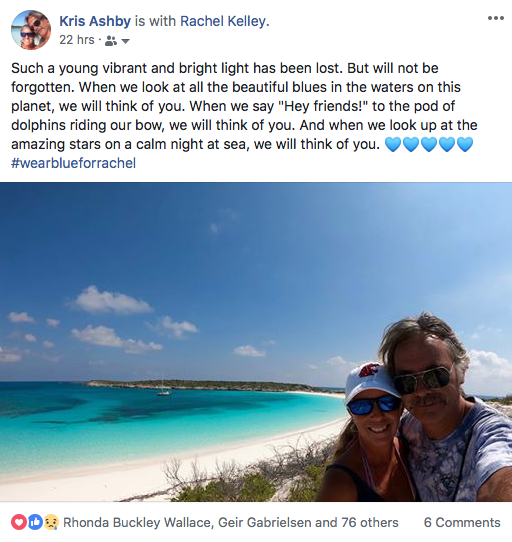
Out Of Communication But Still In Touch #wearblueforrachel

RachelFacebook

March 23, 2019

The Ragged Islands, Bahamas.

The southernmost point of a seventy-five nautical mile stretch of cays nestled in the wilderness.  With the exception of two islands, they are unpopulated.  

Explorer Chartbook refer to the Jumentos Cays and Ragged Islands as “little dots on a small-scale chart.  Not the same as being in the middle of the Pacific Ocean, more than a thousand miles from the nearest land, but still the middle of nowhere.

The epitome of a communication black hole.

Our last cell tower reception had been March 8, when we left Salt Pond, Long Island.

The first cell tower we would see is located in Duncan Town on Ragged Island, the only settlement in the Jumentos Cays and Ragged Islands, and the only place cell service was even a possibility.  

Currently, we were at anchor about ten nautical miles north of Duncan Town, just outside of cell range.

After two weeks of being at anchor in bays almost completely to ourselves, or maybe with one other boat in view, we found ourselves, possibly unfairly, quite annoyed at the small armada of four boats that had appeared in the distance and were in the process of anchoring next to another boat in the bay next to us.  

It was the same group that had also invaded our space nearly a week before, at one point approaching us in their dinghy to ask if we had left the pair of sparkle covered flip-flops, being brandished in one of their hands, on the nearby beach.

To be fair, they currently were a bay away; and the greater victim was certainly the poor boat already at anchor that they all plopped down next to.  Harmless enough… just bloody annoying.

Yet, we had been hearing one of these four boats yammering endlessly on the VHF since Long Island a month ago.  They always seemed to be contacting other boats, discussing and relaying the day’s activity schedule and immediate future plans.  Even at 6am, we would hear them calling in to Chris Parker’s weather broadcasts on the SSB radio.  

During the previous weeks we had grown tired of hearing the immediately identifiable and thoroughly grating New Jersey accent every time the voice crackled through the speaker.

And here they were again… instead of heading back to George Town, which had been the tentative plans relayed during earlier radio communications.

It was the eventual drone of an outboard engine that alerted us that visitors were approaching in a dinghy… the same guy who had asked us about the sparkly flip-flops… great.

However, this time, instead of flip-flops they brought a cryptic message:  Has anyone been in touch with you?  We were told that attempts were underway to contact you regarding the death of a friend of yours in Indonesia…

We had heard nothing.

We immediately picked up anchor and made for Southside Bay at Ragged Island, near Duncan Town and the area’s only cell tower.  But, upon our arrival, we discovered that there was no cell signal.  We had heard days ago that there had been no cell service for days.  Apparently, the problem had not yet been resolved.

Almost immediately, we were hailed on the VHF by the sailboat anchored next to us.

They asked the same question…

They then told us that they had heard that a request to locate S/V Exit had gone out on a SSB net broadcast days ago regarding the death of someone we were friends with in Indonesia.  A sailor we had met earlier, while anchored near us in Thompson Bay, Long Island, was listening to the broadcast, recognized our name, had relayed our earlier position to the net moderator, and was sending word to boats in the area to keep an eye out for us.

Fortunately, though cell service was down in the area, our Iridium Go! was now functional, allowing us to send and receive basic emails through a satellite connection instead of cell tower service.

After several email exchanges to a number of perople, a clearer picture began to materialize.

Tragically, one of our Scuba Junkie family, Rachel Kelley, whom we had worked with in Malaysia for nearly five years, had just passed away.  

Rachel had returned to the U.S. after being diagnosed with cancer during our last year managing Scuba Junkie.  After a hard fought battle, she had made an amazing return to Scuba Junkie and Mabul Island last year to resume teaching diving.

Sadly, her health took a turn for the worse, and her condition deteriorated quickly enough that emergency evacuation was just not possible. 

Rachel passed away on March 15, 2019 in Kota Kinabalu, Borneo, with both family and friends at her side.

Rachel was an inspiring individual with an immense heart.  She could surgically admonish someone’s political opinions while, at the same time, lovingly pet Scabby Pete the cat.  Her commitment to teaching made her not just an incredible dive instructor, but also an energizing mentor.  As a Scuba Junkie, she was not only friend, but also family.

Her final dive was far too soon; she was far too young.  Those of us who had the incredible fortune of knowing her are better for it.  We are all less without her.  Her laugh was all it took to brighten a room.

And while we mourn Rachel’s passing with a heavy heart, we are simultaneously inspired by the Herculean effort that was put forth in getting word of this information to us.

A number of Scuba Junkie family (we love you Ric, Rohan, Lydia,  Amanda, Dani, Simon)  tried to get through to us via text message, Facebook, email, etc., but we had been without signal for almost two weeks.

Dani, who was at SJ when we first arrived in 2008, reached out to a yacht captain/dive friend in the Virgin Islands, who checked our blog site and posted a request for assistance on the Bahamas Cruisers Facebook page.  Word made its way to the Cruiseheimers Net on SSB radio, where it was heard by S/V Imagine in Thompson Bay, Long Island. 

Strangely enough, S/V Imagine had spoken with us weeks ago while randomly passing us at anchor in his dinghy.  Now, he updated the SSB net of our recent location and passed word through the local morning cruisers’ net on the VHF.  

Someone else who received the VHF net replied that he had seen us anchored in the Jumentos Cays and we should be within the Duncan Town cell tower range within a few days.

Meanwhile, we had emailed our friends Christian and Mary, aboard S/V I Wanda, inquiring about the SSB broadcast.  They contacted the net moderator and informed him they had made email contact with us.  That evening, the sailboat that had hailed us on the VHF when we arrived at Ragged Island, S/V Dot’s Way, contacted the SSB net and updated them as well.

Though the circumstances certainly were heart-rending, thank you to every single person who played a part in the effort that went into getting this devastating information to us in the North Atlantic Ocean, in the middle of nowhere, smack dab between Cuba and Long Island, Bahamas.

 💙💙💙💙💙 Rest In Peace Rachel.

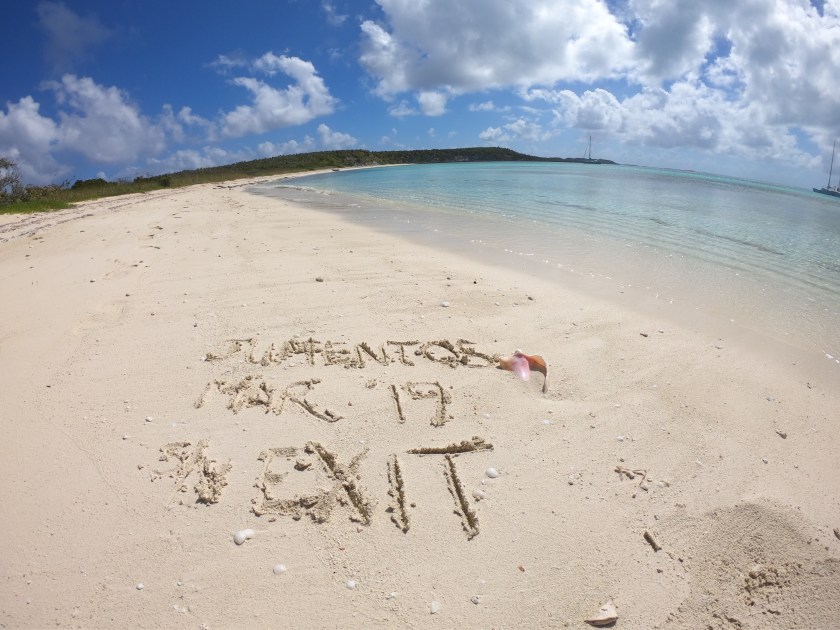
Jumentos Cays & Ragged Islands

March 8-22, 2019

DCIM100GOPROGOPR0557.JPG

We departed Long Island bound for the remote destination of Jumentos Cays and Ragged Islands.

Once again, we stumbled across the Ancient Maritime Equation we first saw last month:

This time:

Seems to only occur when the wind speed equals 14.1 knots… hmmmm.   May require further studies…

There were repeated warnings not to undertake a journey to this area without first being entirely self-sufficient.  

A combination of bad weather, bad luck, or bad decisions out here could prove unforgiving.

We had a full tank of diesel (enough to motor twelve hundred miles, or 10 days straight, if needed), two months normal supply of petrol for the outboard, enough propane to last at least four months, a potentially endless supply of fresh water (thanks to our new Spectra watermaker) as well as more than fifty lockers packed with provisions, beverages, tools, equipment, spares and things we still couldn’t identify… seemed to us like the fucking definition of the word self-sufficient.

We were not in the middle of nowhere… but we continually got the feeling that the the middle of nowhere was just around corner from us at any given moment.

Isolated.  Exposed.

For the most part uninhabited, we were more likely to come across goats on the islands than people.

No Bahamas Defense Force.  No Coast Guard. No marinas.  No services. 

Currently, we found we were one of maybe ten or so sailboats in the entire area.  I can imagine that, not too many years ago, the Jumentos Cays and Ragged Islands didn’t have more than a half dozen or so sailboats visit during an entire year.

Buena Vista Cay has a population of one.  Duncan Town on Ragged Island, at the very end of the chain, with a population of less than one hundred, represents the only settlement between Exuma and Cuba… and it is closer to Cuba (only sixty miles away) than George Town (it’s own country’s nearest significant population).  Everything else… unpopulated.

Our arrival at Water Cay was rewarded immediately with what appeared to be an inquisitive bull shark swimming under us just after we had set the anchor.

A challenging climb in flip-flops up the steep, scrubby hill just beyond the beach provided a perfect view of the anchorage in a bay all to ourselves… nice.

Three days later, we picked up anchor and moved to Flamingo Cay fourteen miles, or about three hours, away.

We experienced a classic moment as we approached Flamingo Cay.  We could see a boat already at anchor in the distance and a catamaran making straight for the anchorage from the opposite direction.

The race was on.  There was no fucking way we were going to let this cat slip in just ahead of us and lay claim to the prime location we inevitably would want to anchor at.  It was hard to tell with the opposing angles but it looked like we would arrive just barely ahead… yes!

Our pirate intentions gave way to laughter as we eventually realized that the cat was actually S/V Avighna.  Tami and Jay had arrived at the same moment we had!

For us, Flamingo Cay holds the distinction of being the first anchorage requiring five tries to get a good anchor set.  Four different locations.  Even the patches of sand were not more than six inches deep over marl and rock that the anchor just scraped across the top of.

Eventually, we got an anchor set we were happy with, as did Tami and Jay, although they ended up two bays over before finally locating a spot their anchor would dig in. 

We spent five nights at anchor at Flamingo Cay.  

A dinghy excursion to a nearby cave.

Explorations ashore to the beach. 

Though flamingos are one thing you will no longer find on Flamingo Cay, tiny red shrimp, once both a food source as well as the source of the resident flamingos’ pink coloration, are still to be found in some of the inland pools.

And finally… healthy coral and an abundance of fish to be found!  The best we have seen in the Bahamas since scuba diving in the Abacos last year… which meant lobsters to be had just weeks before lobster season ends here in the Bahamas on March 30… yipee!  

And sharks, sharks, sharks… woohoo!

Sadly, we had to bid fair winds and following seas to Tami and Jay for now, as S/V Avighna returned to Long Island… but the upside of sad farewells is the fact that they come at the end of happy reunions.

More than a week since arriving in the Jumentos and still yet to see our first permanent structure, much less an inhabited island.  Nurse Cay… with a tiny little bay.  Just enough room for us to tuck into a get out of the surge as long as the wind doesn’t shift, putting us way too close to the rocky shoreline on either side.  

The only other souls to be seen are aboard a small fishing boat sitting at anchor a few thousand feet further outside the bay.  They waved at us as we passed by earlier.

Twenty four hours later we would learn that the fishing boat was from Long Island and had been in the Jumentos for over a month.  Manny, captain of the fishing boat, had motored over in a skiff to inquire if we had any tobacco.  He had run out and his deck hand was growing quite surly as the incoming mail boat which would drop off a new supply was not due to arrive for another day. 

Wanting to provide assistance to a fellow mariner, it saddened me to break the news that, alas, I had no cigarettes or cigars aboard our boat to offer.  All I had was an unopened pack of rolling papers…

Immediately, Manny’s eyes lit up.  

He asked if I would be willing to make a trade.

Considering I was speaking to a fisherman who had been here for a month… naturally, I expected fish to be at the top of the list of available trade commodities he would have to offer… instead, he pulled out a big bag of weed.

Immediately, Steve’s eyes lit up.

On a beach in Bali… in the countryside of Thailand… at a campsite in Australia… on the streets of Mexico… on the North Atlantic Ocean in uninhabited Jumentos, Bahamas… a weed magnet.

During a search for better protection from potential shifting winds (something we seem to continually be trying to out-guess here as our sources for weather forecasting this year have been mixed, at best), we passed right on by Buena Vista Cay, missing our opportunity to meet the one resident there, and only resident of the Jumentos Cays/Ragged Islands not living in Duncan Town.  

We ended up at Double Breasted Cay, which had been highly recommended to us. 

Nice… except the winds never really shifted; and we had to deal with a pack of buddy-boaters who had traveled together into the wilderness from George Town, invaded anchorages as a horde, and utilized the VHF as a preferred substitute for social media and text messaging.  

However, the radio only required that you push a button when afflicted with diarrhea of the mouth instead of actually typing your thoughts, allowing you to have an even more random spewing of irrelevant thoughts…

We made a strategic move less than three miles away to what turned out to be one of the most peaceful and picturesque anchorages we have stumbled across to date.  

Johnson Cay already had three boats anchored in its nearly completely enclosed horseshoe bay when we first passed by a few days prior… way too tight for our liking.   But now they all picked up and moved seeking more protection from the predicted wind shifts. 

When those winds never shifted, it left a perfect anchorage completely empty right next door to us… score for Exit.  Which left us with a couple of days to ourselves in an epic and completely secluded anchorage.

Even better snorkeling here than at Flamingo Cay.  The sharks were not one bit shy… 

But, after a couple of days, the wind eventually did shift with some sporadic squalls.  Which left us with an ultimately drama-free though bouncy evening of experiencing just how quickly, with a bit of wind, two to three foot waves can stack up into an anchorage exposed to the open ocean.

Though the breezes tapered off the following morning, we opted to avoid a potential revisiting of the previously bouncy night with a thirty minute move to the much less picturesque though much more north-protected anchorage of Man-O-War Cay.  

Turned out unnecessary.  The wind never picked up again so we didn’t need the northerly protection.  We traded out our sharks to snorkel with for a small herd of goats on the beach… ouch!

Hog Cay.  Quite nondescript with the exception of a very large and strange looking marine creature that we happened across which appeared stranded in the shallow waves of the beach.  Eventually we concluded two things:  1) it must be some kind of nudibranch…  2) it must not be so rare as we saw two more shortly thereafter.

At least we had a huge space all to ourselves… well, for a while.

Then a sailboat anchored in the bay next to ours.  The nerve of some people… and only one bay away.  Then our favorite armada of buddy-boats came and plopped down next to the boat in the other bay… had to feel sorry for that guy!!!

But to end on a more positive note… a riddle: 

What do you call it when the depth gauge and wind speed indicator read the same?  A Bahamas Phenomenon…
or a Baha-menon-dat-dahhh-dat-dada…Baha-menon-dat-dahhh-dat-da…”  
Am I the only one with the Muppets in my head right now…? 
Hey… fuck you!  Comedy is not pretty!

Drinking Water From The Ocean

DCIM100GOPROGOPR0155.JPG
First departure through Joes Sound cut

March 7, 2019

We had not grown tired of Long Island in the least.  Quite the opposite; it was one of those places that you could easily find yourself continually making excuses as to why you needed to stay.

Like Cat Island, it had come to represent a slice of the Bahamas we had been searching for… a place that felt like something more than simply Florida’s backyard playground.  Not the imagery of resorts, marinas, and attractions catering to passing tourists.  Real people stuck in living real lives.  Fiercely proud people who had, for generations, been been carving out an existence on these islands which occupy the very edge of development and “mainstream” travel.  The same people who had been helping those around them carve out that same existence at the same time.

Both qualities, capable independence and magnanimous hospitality, seemed to be a common thread woven into the fiber that makes up these tiny communities.

Still, we were both in agreement that it was time to move on.  

When you are enjoying yourself, the difficult decision of moving on seems counterproductive.  You travel to seek out enjoyable places, so why leave once you reach one of those places?

Sometimes, you have to remind yourself that the only reason you arrived at the location you are currently enjoying so much, is because you made the decision to move on from the previous location.  

However, our general intention to continue pushing east as the opportunity arose was meeting resistance.  Loosely, the plan was to work as far east as possible utilizing erratic wind patterns early in the year before the prevailing south-easterlies set in, which would force us to start heading south with the intent of getting below a Latitude of 5ºN for hurricane season. 

It was becoming more and more apparent that the prediction of Chris Parker (SSB radio’s weather guru for boaters), that the prevailing SE Bahamas winds seemed to be setting in early this year, was coming true with a vengeance. 

This didn’t leave a lot of options for us from southern Long Island.

Motoring, which is always at the end of our list of options…

Push northeast; but we would likely be putting ourselves in a corner, trapped by southeast winds with only southeast to go…  

Forego any further attempts to get any closer to the Caribbean, and make for Cuba, Puerto Rico, or Jamaica…

Make for a tiny chain of largely uninhabited islands less than a day away called the Jamentos and the Ragged Islands, ultimately still leaving all the options on the table…

As we continue to move further and further away from the safety net of marinas, supply stores, and easily obtained resources, we find a necessity to become more and more completely self-sufficient.  We are constantly forced to second-guess and re-evaluate… what is the weakest link at any given time?  

Though we feel confident that, even in remote locations, people will offer whatever help they can, we also feel adamant that traveling into more remote areas depending on other people, because you are poorly equipped or ill prepared, is foolhardy.

Fortunately, we have not found ourselves in an area so remote we have been unable to secure fuel or basic provisions if needed.  Largely, it’s about having the foresight not to get close enough to running out of something that creates an emergency by topping up when the opportunity arrises.

With full fuel tanks (diesel, petrol, and propane), full water tanks, and recent provisioning, we should be able to go at least a month or more before needing to replenish something (with the obvious exception of fresh produce).  

And yet, time and time again, we find ourselves most concerned about fresh water.

The two hundred gallon capacity of our tanks sounds endless.  

At one gallon per person per day, that would last three months… Spartan.  Basically, minimal drinking/cooking water and cleaning everything with salt water.  We know people who do it but it amounts to survival living.  

At the average dirt dweller’s consumption rate of one hundred gallons per day per person, we’d run out of water every day… silly.

Five or six gallons per day for both of us, our current average fresh water consumption rate living aboard Exit, affords us some luxuries within frugal constraints, and also makes water a monthly concern.

Not a problem in places like the United States, where free potable water can be obtained from a spigot on every dock.  

Our travels through the Bahamas became our first initiation into the reality of having to buy the drinking water we were filling our tanks with.  

Without city-plumbed drinking water, fresh water wells or reverse osmosis watermakers are a very limited commodity.  We found that, when available, marinas would charge anywhere from twenty to fifty cents per gallon. Not cheap… but still available.  

And understandable, when you have multi-million dollar pleasure boats wasting hundreds of gallons of fresh water to clean the salt off their decks.

However, as we explore areas with less and less development, even obtaining drinking water becomes a bigger and bigger issue. 

The water from a tap is simply not potable, and drinking water is bought only by the bottle.

We thought rain catch would be the answer.

In theory… a no brainer.

In practice… at best, we’ve not been able to collect even half of our consumption over the course of a month.  More like ten to fifteen percent has been the average over a year’s time.  With different geographical rain patterns or better rain catch methods that might change; but for now… it is what it is.

Which leaves us:

  1. Carrying free water as far as needed when available
  2. Buying water when necessary
  3. Scrambling to catch never enough rain when it falls from the sky
  4. Living with self-imposed militant water restrictions
  5. Potentially dying of thirst in the middle of the ocean
  6. Considering the alternatives…

When we purchased Exit, there was already an installed watermaker aboard.  It was a French made Aquaset… twenty five years old… looked almost unused… rated at twenty gallons of fresh water production per hour (seriously high capacity for its size)… listed as needing service by the previous owner.

Turns out water makers don’t like to sit unused for long periods and we eventually learned this one hadn’t been turned on in over fifteen years.

Still, we didn’t give up. 

Optimistically, we left the rather massive contraption in place, undisturbed in the engine compartment and under the floor, where it had resided for a quarter century, largely sight unseen.

Numerous people who know far more about electrical, mechanics, and watermakers in particular, said this is a serious watermaker, but it’s not gonna be worth trying to revive… shit.

Apparently, the watermaker was rated to run on 350V (which the original generator on Exit must have been)…maird.  Those crazy French.

It would cost at least a thousand dollars in parts, filters, and membranes (not including any labor) to find out if the Aquaset would ever make water again.  At that point, it could cost another two or three times that to get it fully functional… shit. 

Or it could be pronounced dead on arrival… shit.

*****

Salinity in ocean water is measured as TDS (total dissolved solids) in parts per million (ppm).  Though it takes salinity levels of about 1000ppm to actually taste the salt, anything above 750ppm is unhealthy for drinking.  The World Health Organization considers water to be potable, if total TDS do not exceed 750ppm. 

Desalination of water on a scale compatible with daily use requires specialized pumps and filters, adequate power, adequate space, religious maintenance, and a healthy bank account (this intentionally excludes hand held survival watermaker products here – if you are afloat on a life raft, pumping by hand for hours to make water is considered survival; if you are trying to wash dishes, it is a ridiculous life style choice…).  

Replacement options were daunting… $5-10k were numbers that were bouncing around… the appeal of 12-volt systems seemed obvious – our solar panels would recover the battery draw; but 12V water makers either generate much less fresh water or have much higher energy consumption… 230V would give us maximum volume of production without the battery concerns but would force us to use the very generator we were trying to minimize feeding more diesel to… at least 12V could rely on the solar when available but fall back on the generator to charge batteries if needed… unless the power drain was too much… or the output so low the watermaker had to be run for hours every day… watermakers ranging from three to thirty amps of electrical draw… watermakers ranging from two to twenty gallons of hourly production… arrrrrrgh!

Lots of info… no clear choices… everything is a compromise… easier to not make a decision and keep your money in your pocket for now… 

… and deal with monthly fresh water concerns…

… still on Long Island… time to move on…

… but the Jumentos and Ragged Islands have no water available… sigh.

Enter the mysterious stranger… the unforeseen variable… the wild card… circumstance… the hand of Fate…

A passing comment from Jay over a week earlier regarding a used watermaker having recently been sold at Salt Pond’s local hardware and marine equipment store prompted us to inquire about used watermakers when we stopped by to ask about fishing spears.

After being introduced to Craig Fox, a Salt Pond local resident as well as owner and manager of Seafarer Marine Supply, we learned that, yes indeed, he did happen to have a used watermaker that had just become available.

The 2015 Spectra Newport 400 MKII, a 12-volt system well beyond anything we would have remotely considered new, had been installed aboard a boat that was the unlucky recipient of a lightning strike in Florida.  After an insurance settlement that replaced the entire system, the previous owner (a good friend of Craig Fox) gave the system to Craig hoping that he could sell it and maybe make a little money.  Craig refurbished the fried system with an entire new electrical board, DC motor, and membrane.  Though $12,000 new, this particular used 2015 model was priced lower than a lesser performing model we might have considered.

Spectra has a reputation for manufacturing some of the quietest operating watermakers in production.  Furthermore, at about one amp of energy consumption for every gallon of fresh water produced, Spectra watermakers are among the most energy efficient on the market.

Around fifteen gallons of fresh water produced per hour; enough to not be making water for hours and hours every day… perfect.

And, to top it all off, the Newport incorporates an automated fresh water flushing system.  After a session of making water, it back flushes approximately seven gallons of the fresh water it has just produced through the filters and membrane, cleaning out all of the salt water.  This procedure extends the life of a $500 membrane from one year to as much as a decade or even more. 

Normally, a watermaker that isn’t run for three days has to be “pickled” (a process involving chemicals which has to be followed religiously to prevent the membrane and filters from going bad).  Fresh water flushing the system every five days prevents the need to use or “pickle” the system every three days, making it more foolproof, simple and less prone to membrane deterioration.

It had the potential to nearly pay for itself in saved membrane replacement costs alone… sweet.

Realizing the necessity for having a watermaker aboard was more of process to reach that realizing the necessity for solar power.  Still, in the end, a year’s experience delivered us to that conclusion. 

We knew it was going to happen… it was just a matter of when.

Now, once again, circumstances seem to have landed us on the doorstep of our dear old friend Opportunity.

And so, after what could more accurately be described as a year long process rather than an isolated discussion, we decided to bite the bullet.

While Tami and Jay sailed for the Jumentos and Ragged Islands, we spent the following week installing a watermaker.

We were adamant that we wanted to install the new system outside of the hot environment of the engine compartment, where the previous one had been located.

Generating precious extra space in the engine compartment by removing the old watermaker, as well as some leftover bits and bobs from the original engine driven refrigeration compressor, was a bonus in and of itself, but it was a trade-off in giving up some storage space in the starboard aft berth, where we ultimately decided to locate the new system.

The task of determining where to locate the various watermaker components, relocating the contents of already full lockers now earmarked for said watermaker, running some new hoses and electrical, not to mention actually installing the new system proved much less problematic and troublesome than we anticipated.

No doubt, having the through hulls already installed and a reference from the layout of the previous watermaker made things much easier.

No doubt, having Craig’s expertise and skills proved invaluable in keeping things as painless as they turned out.

In addition, his decades of experience as a local fisherman and contractor, as well as the fact that he showed up at our boat every day in his own twenty foot skiff, meant that he had no problems doing work aboard Exit while she sat at anchor.

No docks or marinas necessary… nice.

In the end, the system integrated perfectly into what looked like part of the original boat design.  The process of switching out watermakers, all within the confined and very limited space belowdecks of a sailboat at anchor, proved daunting but achievable.
Above and beyond all of the other considerations, resides the peace of mind factor.  Creating a situation where water is no longer a monthly concern is priceless.

Not unlike the situation we found regarding installing solar on the boat: a painfully difficult upfront investment sets the stage for achieving a significant increase in self-sufficiency, while simultaneously contributing to achieving a significant decrease in stress levels.  

With the solar charging system, it was a decision that has been absolutely without regret since day one.  Hopefully the watermaker will follow in the same footsteps.

Living aboard a sailboat…

…harnessing the wind’s energy to travel…

…harvesting power from the sun…

…drinking water from the ocean…

…on the move, off the grid…

…modern primitive…

…life is good.

Long Time At Long Island

LongIslandBahamas
Heading for Thompson Bay, Long Island, Bahamas

February 28, 2019

Tomorrow is already March.

It has been exactly two years since we finished our tenure with Scuba Junkie.  Those last two years have put us on an entirely different trajectory from anything we ever could have anticipated.  We were already on an obscure orbit taking us well off the beaten path; suddenly it became an even more obscure orbit on an even less travelled path.

We’ve now been on Long Island for going on six weeks.  It’s nice for that to have been a voluntary decision.


After arriving at Long Island on January 17, we decided to anchor overnight at Hog Cay.

Jay and Tami, cruising friends aboard S/V Avighna whom we met last year in the Exumas, had raved about Long Island.  In fact, they were already here in one of their favorite anchorages, Joes Sound, within view of Hog Cay.

Furthermore, their good friend Ashley, who we had met last year at Georgetown, was  scheduled to arrive at Long Island in less than a week.

After the parts fiasco we had in Marsh Harbour, which resulted in our coughing up an extra US$600 to FedEx for duty fees we shouldn’t have been charged for and likely would never see returned to us, we had decided to take a different approach… smuggle the parts in via a mule.

Okay… that’s a bit of an exaggerated overstatement.

However, the reality is that any non-essential, non-engine parts shipped to the Bahamas ARE subject to 40% duty in addition to the 12% VAT tax.

That being the case, tourists traveling to the Bahamas by plane can carry virtually unlimited parts, electronics, equipment, you name it – without causing even the raising of an eyebrow.

Fortunately, since Ashley was already coming, we just had to get the highest priority items to her doorstep before she boarded the plane.  Our priority items making the list which had to be both available and portable, were:  a replacement heat exchanger tube stack (a three foot long bronze cylinder that goes in the Perkins engine cooling system), a new digital battery monitor, and another SD card for our PredictWind system (screw you Nassau Customs, where our first SD card is probably still sitting on a shelf somewhere).

We joked that Ashley would certainly be questioned by authorities… the bronze tube stack, digital display battery monitor, and SD card – looking remarkably like a metal pipe bomb, detonator, and transmitter code…

…nobody batted an eye in the end.

Go figure.

And while we can joke that Ashley was our smuggling mule, the fact is we can’t say enough about how much we appreciate her effort.  Without her assistance, a number of issues either never would have been resolved, would have cost a ridiculous amount of money to sort out, and/or would have taken stupid amounts of time to wade through.

But that is jumping well ahead.

Ashley wasn’t due to arrive for nearly a week.

We decided to take advantage of the north wind to get us the twenty or so miles south by sail to Thompson Bay and the Salt Pond community so we could explore that area of Long Island.  In a few days, when the wind shifted back to the south-east, we could return to Joes Sound to see Tami and Jay, prior to Ashley’s arrival.

Just before we left Hog Cay, Tami and Jay appeared in their dinghy, offering a welcome bottle of wine and a delicious boudin sausage.  Absolutely amazing!!!

After a brief visit, we made for Millers Bay, towards the southern side of Long Island, where we enjoyed a wide open anchorage all to ourselves.

IMG_1677

As an added bonus, we were literally at the back door of Chez Pierre – a tiny resort and restaurant run entirely by a lovably feisty and very French-Canadian elderly gentleman with a magic touch in the kitchen.


The use of a rental car for a day allowed better exploration of other parts of the island and its dramatic coastline.

IMG_1735
Deane’s Blue Hole – the world’s deepest known salt water blue hole

After a few days, we decided to head back north.

ANCIENT MARITIME EQUATION…?

On February 6th, sailing from Thompson Bay back to to Hog Cay, we stumbled upon what we could only assume was an ancient maritime equation.  It appeared that adding our current boat speed to our current depth revealed the true wind speed… hmmmm… I assume I am not the first person to have noticed this…

Ancient maritime equation...?
Boat Speed + Current Depth = True Wind Speed

It doesn’t seem to always be the case… I’ll have to gather further data on this…

Coincidence…?  Ha! I think not…

Looking on the charts, the channel into Joes Sound looked scary as Hell.  The charts indicated a narrow and shallow channel with fast current, hard bottom, and less than three and a half foot low tide depth, unsuitable for boats wider than fifteen feet… certainly not for the faint of heart.

The fact that it was high tide, and we knew that S/V Avighna (a cat with far more beam than our fourteen feet two inches ) had gotten through repeatedly with no trouble, seemed of small consequence as we approached the channel, which looked tiny.

Eeek!

We had already been advised:  don’t go in at low tide; best not to go when the current is ripping either in or out; favor the rock wall on the right side which is deeper; the left looks more forgiving but is much more shallow; hug the floating marker at the end of the entrance to avoid the sandy shoal that cuts across the whole channel; once past the shoal turn quickly, it shallows up quickly on the other side.

The actual experience:  nerve-racking though uneventful… commit, then trust your instincts and what you see, and refer to the Navionics display continually.  It certainly helped that we had Tami and Jay in their dinghy just ahead of us to pilot us in our first time navigating through the channel.

Having successfully passed through the channel unscathed, we were rewarded with one of the most picturesque locations we have ever anchored in.

DCIM100GOPROGOPR0151.JPG
The prize for successfully navigating the channel

In short order we were also introduced to three of the key players (and really cool people) in Joes Sound:

Earl Wilson – A Joes Sound local and one of the friendliest and most kind-hearted people we’ve ever met.  Governor General, Fish & Game Warden, as well as full time caretaker of Hog Cay (privately owned by the Graham family who owns a large chunk of northern Long Island)

On a “Jeopardy Final Question” side note:

Earl was once the keyboard player for the one-hit-wonder “Baha Men”.  He accidentally cut off one of his fingers, resulting in his departure from the band, just before they landed this huge hit…  

[Sound of buzzer]… Alec… What is “Who Let The Dogs Out?” … ouch!

Pat Harris – Honorary Mayor of Joes Sound.  A New York/Long Island native who has been sailing most of his life, coming to the Bahamas for decades, and living on a pontoon houseboat in Joes Sound for a number of years in the winter.  During the summer he runs the historic sailing yacht ‘Ventura‘ in New York Harbor.

Mitch Hale – Earl’s best friend. An American farmer/rancher/hunting guide from Oklahoma who has also been coming to Long Island for decades.

DCIM100GOPROGOPR0147.JPG
Pat, Earl and Mitch (L to R)

Hog Cay, just south of Joes Sound, is a private island.  Earl maintains everything on the island, including a very rare flock of around four thousand nearly extinct West Indian Whistling Ducks which they protect and feed.  He has also, without a college education, installed electricity as well as an amazing reverse osmosis water system (which he kindly let us use to fill our tanks with fresh water!).

Luckily, one day Peter Graham (grandson of Mr. Graham) and Earl took us (Jay, Tami and Ashley along with another cruising boat) on a private tour of the beautifully kept up island.

On another day, we were ecstatic to hear word that a young manatee that frequented the area was in the small private harbor on Hog Cay.  Earl invited us to come over for a swim.  It was amazing!  The first manatee we have ever seen, much less swam with.  Kris named him ‘George’.  Apparently it comes by regularly to drink fresh water from the hose they have run to the edge of the dock.

Unbelievable!!!

DCIM100GOPROGOPR0347.JPG
Sundowners on Lucy Cay

*****

Another car rental offered the opportunity to explore areas on the northern end of Long Island.

However, when four boats made a simultaneous amphibious assault into Joes Sound on January 30th, all with the intention, it appeared, of anchoring together, the area instantly become stupidly overcrowded.  We decided it was time to pick up anchor and head south again, back to Thompson Bay for a while.

There was always dinghy access to Tiny’s Bar, which we visited on several occasions…

Tiny’s Bar!  In fact, the first time we arrived at Thompson Bay, we only had $15 in cash.  The only ATM on the entire island is thirty minutes away by car and most businesses accept only cash.

Tiny’s had $4 beers, which meant we had enough for one round.  Inevitably, after we finished those beers, the bartender/owner Jason asked if we wanted another round, prompting us to explain our cash situation.  Jason thought for a second and then walked around the corner, producing a five dollar bill he explained someone had dropped earlier and not picked up after it had been caught by a breeze.

Five hundred pennies from Heaven… sweet.

It all ended up being a moot point a short time later when Jason offered to open a tab for us so we could get dinner as well.  Hmmm… fifty dollars in credit for a couple of deadbeats at anchor in the bay who could leave more easily than get to an ATM… go figure.

A perfect example of Long Island’s hospitality.

Needless to say, we left the five dollar bill for the next thirsty cash-poor sailor… gotta pay that forward.

Other Salt Pond hospitality?

Basil Fox, has a private dock which he allows boaters unlimited access to use as a dinghy dock as well as a nearby cement structure at which cruisers can dispose of bagged rubbish absolutely free of charge… righteous.

Or, when we visited the Salt Pond liquor store, the owner left her store, and brought us back two big bowls loaded with chicken and grits from a wedding celebration BBQ across the street.

Everywhere we went on Long Island, like Cat Island, were locals who went out of their way to greet you, offer pleasantries, or provide help when possible.

And, above and beyond all that, we got a lotta shit sorted out over the past six weeks:

  • Finally figured out our PredictWind weather software along with our Iridium satellite connection which will allow us to receive weather updates offshore once we’ve lost cell signal.  And what of the PredictWind SIM card we had given up on in Marsh Harbour?  A new one smuggled into the Bahamas duty- and bullshit-free by our parts mule Ashley.

IMG_1878

  • Our blog, which had been relegated to a mere laptop journal while a million other things took priority every day for two years, is finally up and running, and even nearly current.
  • Replaced our engine heat exchanger tube stack (diagnosed as needing replacement in Marsh Harbour by Basil) thanks to Ashley’s hand delivery of parts to avert another engine parts duty crisis and Jay’s mechanical assistance.  Jay also helped to re-align our alternator pulley which was creating excessive amounts of belt dust.  Jay is amazing!!!
  • Substantial repair of our genoa thanks to Tami and Jay’s sail repair skills and Tami’s expertise on their onboard vintage Pfaff 130 sewing machine.  The UV protective cover (which Kris had already re-sewn a year before in Port Canaveral) was coming apart again.


  • Installed a new Victron Energy digital battery monitor (again, thanks to Ashley for the delivery and Jay for the installation guidance) which helped solve battery charging mysteries we had been experiencing ever since replacing our house battery bank.  Our old monitor continued to tell us that our new batteries weren’t taking a full charge.  Thankfully, the Victron proved that the discrepancy resided in the old monitor… not the system.  Very important considering this rather simple looking device (in actuality a quite sophisticated calculator) is our only link to monitoring our battery system.  Without close monitoring of electrical use  and current state of charge, we risk both a shortfall of electricity and reduced lifespan of very expensive batteries.
  • Kris re-lashed the bimini cover after we discovered it wasn’t attached properly to the frame.
  • A thorough scrubbing of the outer hull below the waterline (much easier than it was in Charleston).
  • Got our visas renewed at the Long Island airstrip.  Our deadline was down to one week left on our three month visa.

Ultimately, we owe Jay and Tami a huge thanks for helping us to sort through all of our questions, insecurities, and shortfalls.  They provided not only endless advice and assistance, but also materials, tools, and hands-on demonstrations, even sailing a day out of their way to come back and perform in-the-field triage on our genoa, with the sewing machine they have aboard.  Not to mention the fact that it was a blast simply hanging out with them.

And again, a big thanks to Ashley for dealing with the hassle of bringing stuff to us.  It was great to see her again as well.

After all that, hopefully our Bahamas courtesy flag is the only thing we will need to replace in the immediate future.

Bahamas courtesy flag - terminal condition
More of a discourtesy than courtesy flag…

I realize I probably just hexed us with that last comment…

Oh… and what to do with an old underwater camera housing chronically leaking water through the control button o-rings…?

Obviously… retire the housing…

The solution…?  Add a GoPro to the pile of things you have Ashley bringing with her from Florida… woohoo!

And, what does one do immediately after acquiring a GoPro?  Why… go up the mast, of course!

*****

Though the volume and diversity of marine life in the Bahamas would certainly not be described as abundant, the water color, clarity, and temperature still make for some worthwhile snorkeling.

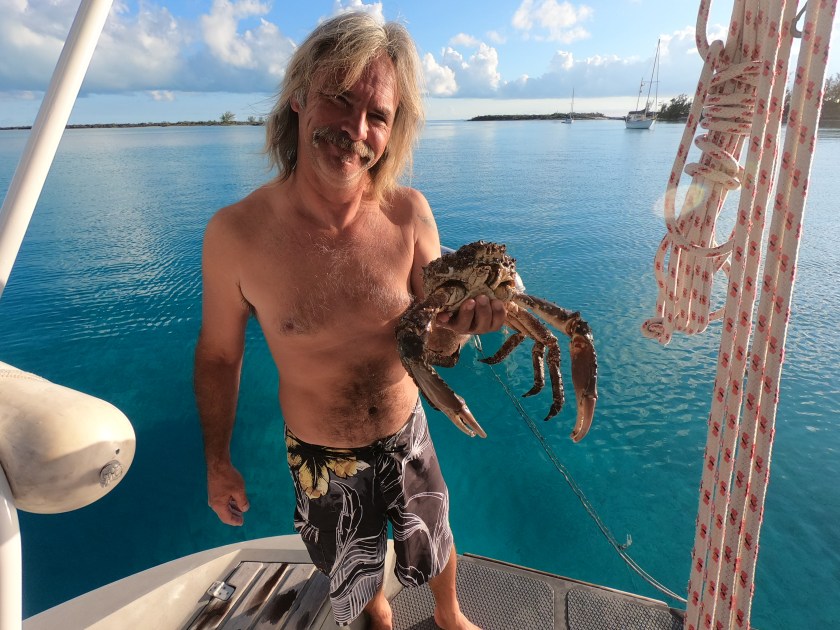
One day, after being rewarded with a large crab for my spearfishing efforts following a long dinghy ride to some of the more distant reefs and bommies, Pat (who, after decades of spearfishing here, votes crab as the best tasting seafood in the Bahamas) led us up one of the mangrove creeks to explore an area worthy of a National Geographic photo spread.

DCIM100GOPROGOPR0493.JPG

And, while lacking in some marine species, the Bahamas clearly has some mahoosive sharks that seem to know exactly where the fish cleaning is done.

*****

As January turned to February, and February prepared to give way to March, we went back and forth along the Long Island coast.  Down to Salt Pond (Thompson Bay), back up to Hog, Cay, into Joes Sound, back to Salt Pond, up to Millers Bay, back to Joes Sound, back to Thompson Bay…

After spending over a month at Long Island, we found Long Island locals to have the very same endearing and unique charm we had only found just recently on Cat Island.  It was funny when we mentioned that to an American expat who stopped by the boat, we were told, “Ya, but they’re weird.  They’re into that voodoo stuff on Cat.”

Everyone’s got their own interesting take on things…

How would we sum up Long Island?

A Thompson Bay sunset…

Thompson Bay, Long Island, Bahamas 2/3/19
Thompson Bay sunset 2/3/19

… and an official Joes Sound toast offered by three best friends Earl, Pat, and Mitch on Valentines Day 2019…

JoesSoundToast2/14/19

Joes Sound Toast:

(Repeat after me)
Here’s to us!
Who’s better than us?!
Damned few!
And they’re all dead!

… and maybe a movie…


Drifting Over Tartar Banks

IMG_1616

January 17, 2019

Though our shakedown cruise to the Bahamas last year was unbelievably eye-opening, inspiring, and educational for us, we were left with very mixed opinions regarding the Bahamas itself as a destination.

Thankfully, Cat Island had afforded us the opportunity in 2019 to rethink those perspectives.

After nearly two weeks, I don’t think there was a single local we crossed paths with who didn’t say hello, wave, or honk as they passed by.  Certainly among the friendliest islanders we’ve ever come across, in all our travels.

Now, we were headed to Long Island…with a tiny detour.

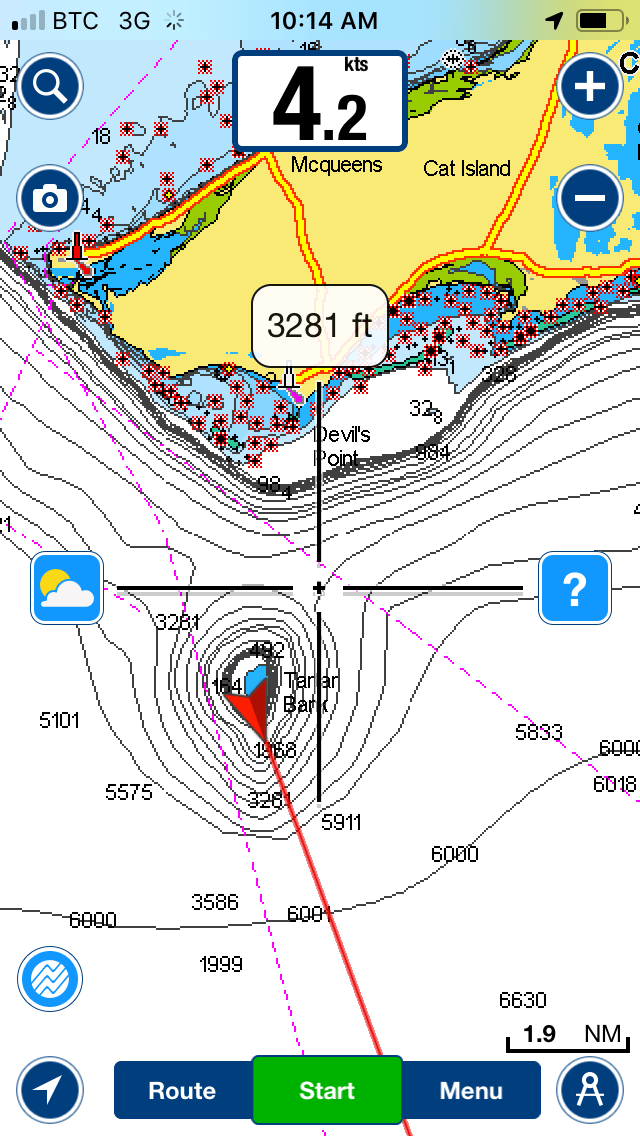
Just south of Cat Island the ocean depths plummet to three thousand feet less than a mile off the coastline.  Though the rest of the Atlantic Ocean in that immediate area quickly drops off to six thousand feet as you continue heading away from Cat Island, one small pinnacle climbs to within forty feet of the surface.  It is called Tartar Bank.  With the tip of this underwater mountain no more than about a half mile long and quarter mile wide, on the charts it looked mighty intriguing.


It reminded us of Sipadan Island, the Pinnacle of Life, in Borneo, Malaysia.

IMG_1614
Looking down 40-50ft. from the surface

Now someday… maybe… we may reach a point that we can go scuba diving from the transom of Exit while she is underway…

That point has not arrived yet.

Too many things in the what if category that have dire consequences immediately following.

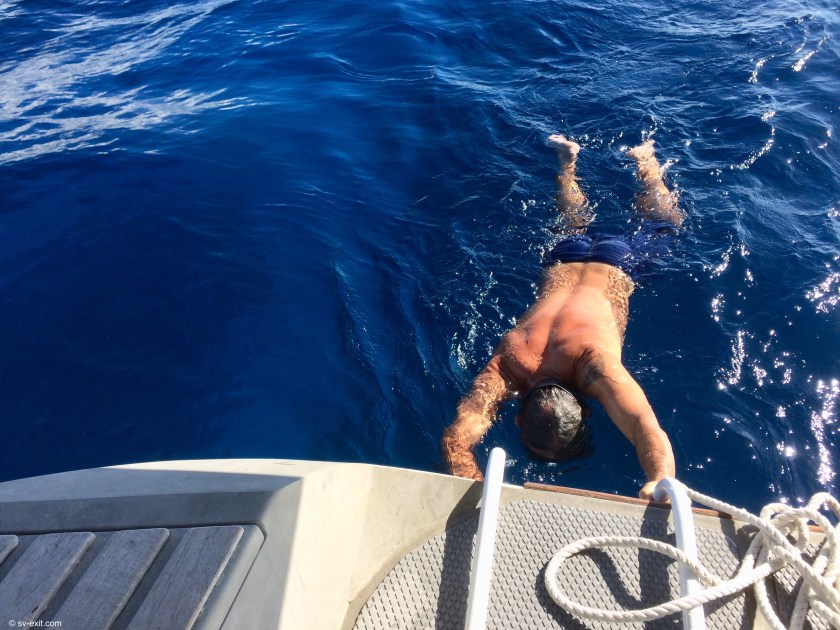
We settled for drifting over the top of the pinnacle while I snorkeled on the surface with a line nearby.

IMG_1612
Open ocean snorkeling

We had heard that the fishermen came out here all the time.  We had heard that researchers came here every spring to gather data on the elusive Oceanic Whitetip sharks (one of only three shark species that Jacques Cousteau admitted being nervous to dive with).

Possibly a cleaning station (like the thresher shark Mecca of Malapascua, Philippines)?  Or a feeding area?  Or a mating area?

We looked.

We saw…

…nothing.

Another time of year… maybe a big party.

Right now…?

…a whole lotta empty space.

Oh well.  We tried.

IMG_1627
Long Island arrival

Bahamas Redemption: Cat Island

January 15, 2019

Our return to the Bahamas had begun to seem less a triumphant march and more a quiet limp.  Since leaving Annapolis, we found ourselves plagued by minor mechanical issues which, in turn, had become the source of continuous delays and frustrations.

First the alternator in Norfolk, VA… then the water pump immediately after that, once we reached the Abacos, Bahamas.  The problems have not been exceptionally severe.   However, the solutions seem to be either elusive, painfully slow, or slippery and difficult to get to the bottom of.

Add to that a lukewarm feeling about our previous Bahamas experience.

Part of that shortfall certainly resides in our previous travels which have left us with some big shoes to fill when it comes to amazing experiences.  That may leave unrealistic expectations on our part at times.

Admittedly, we have had some incredible experiences in the Bahamas.  On occasion, we have met some unbelievably friendly, hospitable, and helpful individuals.

The range of water color here certainly is unlike anything we have seen in all our travels.  However, despite the color and clarity of the water, we have largely been flabbergasted by the relative lack of marine life in most places.

Sadly, all of the mega-twats (mega-yachts), charter boats, cruise ships, not to mention the overall elusiveness of finding any kind of a unique Bahamas culture, have again and again led us to the conclusion that much of the Bahamas seemed like a giant sandbox in Florida’s backyard rather than a separate country (and I have previous expressed my affections towards everything Floridian, or Flacidian, as I prefer to say).

Like so many other places on the planet, the original inhabitants of the Bahamas (the Lucayans) paid the ultimate price for European exploration.  “The Lucayan dividend from their first contact with European man was extinction within a quarter of a century… through mass abduction into slavery, ‘white man’s’ diseases, and starvation” (Waterway Guide – The Bahamas, 2016).  Not surprising when you have aristocrats who convey the message, “with 50 men, you could subject everyone and make them do what you wished…” (Christopher Columbus, in the Bahamas, 1492).

The Bahamas family names present today are largely those descendants of either slave holders or slaves.

*****

By the time we finally worked through our water pump issues in Abacos, we were already looking to move on, utilizing the Bahamas merely as a stepping stone to get somewhere else rather than a destination in and of itself.

We had been intrigued about getting to Cat Island and Long Island last year, though they had remained just outside of our grasp.  Now they both fell within our current trajectory, so it made sense to give them a shot.

Looking back, we are so happy we made that decision.  It would not be an exaggeration to say that, for us, both Cat Island and Long Island proved to be redemption for the Bahamas.

While we could find unoccupied and isolated anchorages in other places, these were the first places we arrived at that felt truly off the beaten path.  

No mega-twats at all… in fact very few boats in general.

Remarkably friendly people… warm, welcoming, hospitable, and willing to go well out of their way to help out.

*****

CAT ISLAND

Our overnight passage from Abacos to Cat Island, which had us sailing atop 15,000 foot North Atlantic depths through squalls producing 25 knot winds and buckets of rain, seemed like a bit of a gauntlet to run… a cover charge for Cat Island, if you will.  A continual line of cruise ships on the horizon re-enforced that perspective.

Nevertheless, we made it unscathed and no worse for the wear.

The next morning, as we headed for the southern end of Cat Island, a pod of exceptionally curious and playful dolphins hung around for a very long visit, riding Exit’s bow wake and darting back and forth all around us.

Instead of stopping at the more popular (and populated) bay of New Bight, we continued another few miles to Old Bight, and anchored a thousand or so feet off the beach.  We made a conscious effort to place ourselves so we weren’t blocking the sunset view of the guests of Rollezz, the only resort on the beach for miles, which we had heard was very friendly towards cruisers.

IMG_1397

Over the course of the following week, we learned just how much of an understatement that really was.

The entire time, we were the only boat at anchor in the bay.  In fact, the nearest boat was four miles away in New Bight.

Carl and Yvonne, the proprietors of Rollezzz, have taken a secluded slice of Cat Island and created a perfect resort retreat – a small operation run by dedicated locals with the sole intent of providing a perfect holiday experience for Cat Island’s visitors.

Thought we were not guests at the resort, we were invited on three separate occasions to stay for dinner, free of charge.  They allowed us to simply hang out at the resort; they engaged us in extended conversations; they offered rides; they helped sort out a rental car; they were absolutely amazing.

The rental car allowed us to wander freely about the island…

…as well as visit the Hermitage.  Ordained by the Church of England in the early 20th century, with a background in both theology and architecture, Father Jerome came to the Bahamas and, with bare hands and faith, set about repairing storm-devastated churches.  The Hermitage, built by Father Jerome, was where he spent the last seventeen years of his life.

There was a guest book inside.  Oddly enough, it was signed by a family from Spokane, WA, who had been there less than one month prior… small world.

Dinghy explorations to the beach or the mangroves…

Local fisherman Raynold and boat captain/police officer Kenneth helped us to pay back some of the good will offered by Rollezzz with lobsters Raynold caught free-diving to donate for the group dinner on our final night at anchor in the bay.

More than likely, we would have stayed longer, but shifting winds had now made the beach a lee shore, and swell coming from the west had nothing but open ocean to build upon.  At dinner that night in the Rollezzz restaurant area, the guests looking out at Exit joked that our mast looked like an antique pendulum-style metronome going tick-tock-tick-tock… back and forth.

We have been told on more than one occasion that our tolerance for rolling at anchor is quite high.   Yet, in this instance, one night was more than enough for us to decide to relocate to New Bight, which offered better protection.

New Bight also offered the opportunity to haul hundreds of pounds of water hundreds of yards from a filling station to our dinghy on the beach in a rather ambitious water tank top-up project…

Enjoy the local food, drink, and celebrations…

Exploration…

Sunsets…

IMG_1509
Cat Island sunset January 11, 2019

Finally, after ten days, though we could have easily stayed much longer, we decided it was time to pick up anchor and head for French Bay, about three and a half hours away at the south end of Cat Island.  From here we could stage our departure, leaving the remaining seven and a half hours to Long Island possible to be done during daylight hours, which were still limited between 7am and 4pm.

Picking up anchor was a relatively simple task.  We were literally sitting on top of it, as though it had just been dropped off he bow roller…

New Bight anchor

Along the way we did a quick dinghy deployment to try to get a couple of shots of Exit underway… any deployment while under sail will have to be an endeavor for future consideration.

IMG_1586

Three and a half hours later we were at anchor in French Bay.  Not another boat in sight. Private bay… private anchorage… sweet.


Trials and Tribulations (or Bad Luck and Bullshit)

January 5, 2019 

     If I were a devoutly religious person, I might begin to brandish the notion that I am obviously being tested by a higher power… tested in my faith… tested in my resolve… tested in my something.

     But I’m not…

     If I were the President of the United States, I would decree that the Democrats and CNN are to blame for it all.

     But I’m not (thankfully)…  so I’m just gonna call it bullshit and bad luck.

     Our return to the Bahamas seemed like a triumphant victory.  We had spent the hurricane season exploring the Northeast coast, got shit done on the boat that needed doing, and managed to break free of the clutches of the U.S. once again, despite its’ best efforts to distract, delay and discourage us while simultaneously separating us from all of our money.

     After our alternator delay in Norfolk and our subsequent decision to press on rather than spend the time to sort out additional spare parts, it was certainly ironic to arrive at the Bahamas realizing that one of the first orders of business would be to sort out parts.

     The issue with leaking coolant was not an immediate emergency but it obviously needed to be dealt with more sooner than later.  Complete failure of the cooling system would make the engine inoperable and could instantly create an emergency situation.

     Living aboard a sailboat, we are continually reminded that, while a particular situation may not be that significant nor its’ resolution that painful, on a boat the process of getting from a particular situation to its’ resolution can often be significantly painful… inevitably it will, at the least, be more complicated.

     Such was the case here… baby steps… progress… delays… setbacks… frustration… baby steps… progress… delays… setbacks… frustration…

     Oftentimes I find it quite difficult to convey the essence of some of these logistical minefields.  The following is a blow by blow account of the whole process as it unfolded.  This is how a rather minor problem with our engine morphed and evolved, eventually turning into a nearly six week ordeal to resolve:

11/21:

    • Arrive at Powell Cay from Norfolk, VA just as the sun is setting

11/22:

    • Chill out recovering from five day offshore passage & wait for milder wind conditions to move

11/23 – 11/25:

    • Move 14 nautical miles to Green Turtle Cay as it has the easiest access to Customs/Immigration which must be cleared before doing anything

img_1099

  • Have to brave 20-30kt winds in dinghy to clear Customs/Immigration on Friday so we wouldn’t have to wait through the weekend for them to re-open… EEEK!  (Side note: got hit with unanticipated charge of $300 for new cruising permit because we hadn’t returned within 90 days of leaving Bahamas… ouch!)
  • Start diagnosing engine coolant leak (a much slower process when trying to avoid completely disabling engine allowing for a potential emergency move if needed)
  • Awaiting calmer winds to get to Marsh Harbour which will have better overall facilities available
  • Side note: Kris has managed to access an ESPN Internet feed allowing us to stream today’s WSU Cougar football game through our stereo… Go Cougs!

11/26:

    • Move 23 nautical miles to Marsh Harbour
    • Further diagnostics today and the following day convinces me that the freshwater coolant circulating pump is ultimately the source of the problem (again, this is a slow process based upon a reluctance to completely disassemble everything leaving us unable to run the engine in an emergency).  The realization that replacing the water pump would require removal of the timing belt and numerous pulleys put this beyond my scope of comfort.  Part of our learning evolution is realizing when you are in too deep to go it alone… time to bring in outside help.

11/28:

    • We contact a Bahamian named Basil based upon multiple recommendations that he is the best diesel mechanic in Marsh Harbour.  He is available to come to the boat on the 30th.

11/30:

    • Basil comes out via our dinghy and confirms the water pump is, in fact, the problem.

12/1:

    • Parts are ordered from Trans Atlantic Diesel in the U.S.   They estimate 3 day delivery to Marsh Harbour.

12/4 – 12/11:

    • Parts arrive in Nassau – this is the start of an excruciatingly slow Customs/Duty clearance
    • Multiple calls made to FedEx over the next week by Kris to arrange required paperwork (which, incidentally,  was already attached to the outside of the box), and sort out endless bullshit that prevented Customs from releasing the package.  No amount of jumping ahead of potential problems by providing documentation in advance or chasing down issues with multiple phone calls seemed to accelerate this brain-numbing process.
    • Multiple weather fronts roll through Marsh Harbour.  Over the course of the following week, we clock more than 720 degrees at anchor due to wind changes
    • Side note:  During this time Kris ordered an SD card for a satellite connection allowing us to get weather updates offshore.  The card is shipped from Europe and is mistakenly shipped to Turks and Caicos.  After Kris receives a call from the accidental recipient, the card is put back on a plane to Nassau.  It appears that, despite the mis-ship, the SD card may reach us before the engine parts.
img_1127
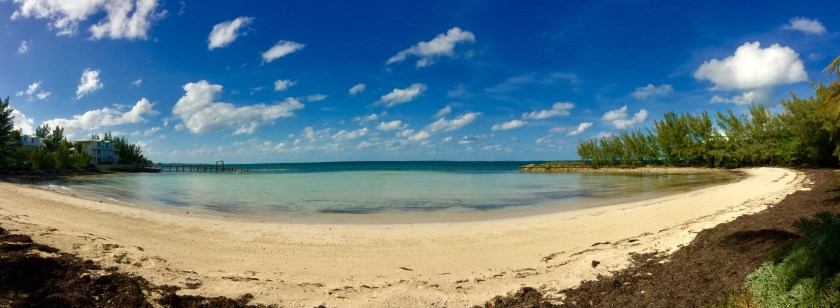
Secluded beach discovery outside Marsh Harbour

12/12:

    • FedEx tracking indicates engine parts to arrive Marsh Harbour by 6pm today

12/13:

    • Three mile walk to FedEx office (they don’t deliver to a boat at anchor).  Turns out parts didn’t get on the plane in Nassau… come back tomorrow.
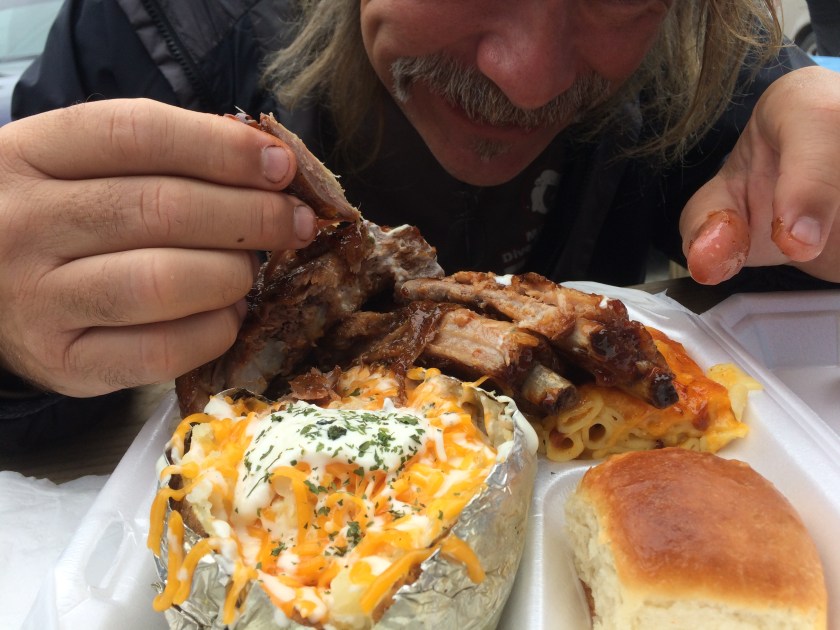
    • The silver lining:  ridiculously tasty ribs and a fully loaded baked potato from a local food shack.
img_1207
Get in my belly…

12/14:

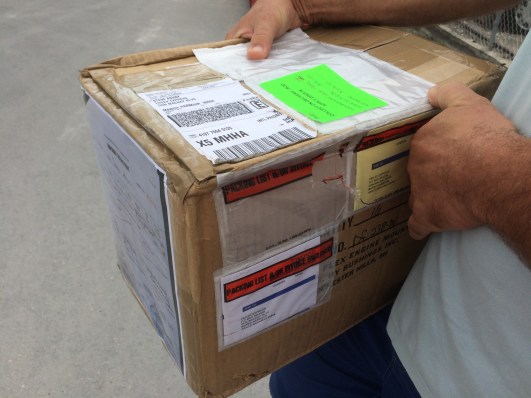
    • Parts are actually in our hands after our second three mile walk to FedEx in 24 hours.  This includes some additional spare parts we opted to acquire while available (see… we’re learning).  Parts cost is approximately US$900…
    • PLUS an additional $700 duty on the FedEx bill… holy shit!  The official FedEx line is there was no clear indication this was a necessary part for our engine despite all the documentation and explanations to the contrary (a part necessary for our engine to run is exempt from all duty and should only be charged the 12% VAT tax).  Kris would initiate a refund claim that still had not been resolved three weeks later.
img_1143
The long awaited parts

12/15:

    • Basil came on Saturday and partially finished repair.  At Basil’s request, we have moved Exit into a slip at one of the marinas.  Understandably, the risk of bringing out tools on a dinghy as well as a more readily available access to getting on and off the boat for potential trips to the hardware store or other possible scenarios makes this request seem most reasonable.

12/16:

    • Sunday – no work day

12/17:

    • Basil finishes pump replacement but we have to wait 24 hrs for sealant to set before starting engine

12/18:

    • Start engine and everything seems good
    • Celebration pizza at Snappa’s Grill

12/19 – 12/22:

    • Big wind blows though with 25+kt winds over next couple of days
    • We make the mistake of sitting through this tied up in the marina.   Taking it up the ass with our stern to the waves made for a very uncomfortable few days.  The idea that being tied to a dock in a marina provides extra security is largely a myth.  The boat is trapped in a slip, secured with multiple lines that prevent it from banging around like a pinball.  Swinging freely at anchor, bow to the wind, is almost always going to be a better situation as long as you have adequate chain out and room to swing (lesson learned).
    • Sometimes you just have to go with the flow…

12/23:

    • Move 20 nautical miles to Spencers Bight anticipating heading offshore for Christmas
  • After setting anchor, it becomes apparent that we still have an engine problem.  A quick inspection reveals that the timing belt has shifted so that it is hanging a quarter inch over the edge of the gears it runs on and is now melting a track through the timing case cover.  Big problem… shit!

12/24:

    • A call goes out to Basil.  He offers to drive to Little Harbour, which is five miles away from our current location but the closest point at which we can pick him up by dinghy.  Trying to be courteous of the holidays, we tell him to wait until after Christmas.  As it turns out, Basil is unavailable to come the day after Christmas, and an increase in winds means we can’t get to Little Harbour until the 29th.  Consequently, we sit out a wind storm that reaches 35 knot wind speeds (the biggest we’ve ever seen at anchor) in completely exposed conditions with a largely disabled engine.  More than a bit daunting; nevertheless, Exit performs brilliantly and keeps us perfectly safe.  Ironically, it was probably more stressful in the Marsh Harbour marina with lesser winds. The only casualty – our snubber (which acts as a shock absorber between the anchor chain and boat) took quite a beating and ended up barely making it through the storm.
img_1298
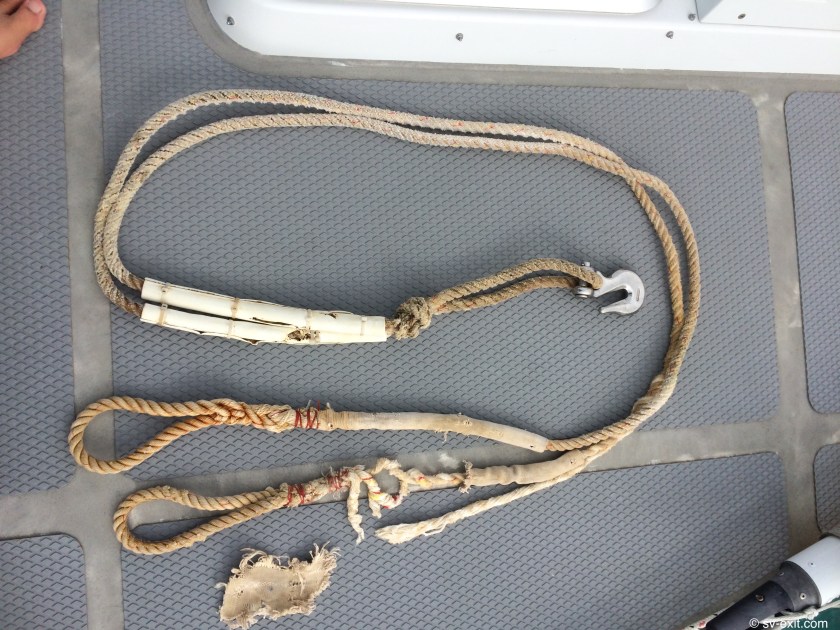
35 knot aftermath… time for a new snubber
  • The pleasant distraction from it all with Christmas celebration: fondue (and steak for Steve), eggnog with Kraken rum (yum!) and cinnamon rolls with rum frosting (yum-yum!) topped off with a laptop showing of the classic The Grinch That Stole Christmas (the original, of course) and holiday greetings from family and our old Scuba Junkie friends Ewan and Lydia (who just got engaged!!!) in SE Asia… nice.

12/29:

    • To Little Harbour mid-day

12/30:

    • Sunday, no work done
img_1307
Endless space to anchor…
img_1311
… yet there always seems to be a catamaran that drops anchor directly in front of us!

12/31:

    • Basil comes out but can’t sort things out entirely o the boat.  The crankshaft gear is not aligning properly on the crankshaft causing the timing belt issues.  He brings crank pulley and gear back to his shop to try to better determine the cause of the misalignment.

1/1:

    • Basil unavailable today. We decide to get the hell off the boat for a New Years celebration and go for a dinghy excursion/picnic into the mangroves for the day.

1/2:

    • Basil successfully reassembles everything.  After some wrestling and adjusting, the engine starts and runs perfectly.  He doesn’t want to charge us for the extra two days but we insist on giving him $100 for each of the two days he came to Little Harbour.  Despite the crankshaft misalignment issue, we feel that Basil has been very accommodating in his schedule to help us out, very capable in his work, very friendly to deal with, and very fair in what he has charged us.

1/3:

    • Engine is officially sorted out.  Hallelujah!!!!  We move 2.5 miles to Lynyard Cay to reduce the swell we are feeling from a shift in the wind

1/4:

    • Move another 2.5 nautical miles back to Spencers Bight to stage for our offshore jump to get the hell out of the Abacos… finally.
img_1337
An endless supply of amazing Bahamas sunsets

1/5:

    • Heading offshore for overnight passage to get to Cat Island, which we were unable to reach last year.
    • Side note:  As for the SD card that we thought would arrive before our engine parts – it’s still sitting in Nassau Customs.  Kris’ many phone calls have all been frustratingly unsuccessful at getting the card released.  In the end… fuck it.  We left it behind.  Maybe we can get this sorted out from elsewhere but our recent experiences with Customs leaves us with little optimism and a rather cynical aftertaste on our tongues.

*****

     Overall, a rather benign engine issue that resulted in six weeks of wading through bad luck and bullshit to finally resolve.  December 2018 will certainly go down in the books as Livin’ the Dream…

The big bonus of all this…?  Lots of stuff checked off the to-do list during all the down time – gearbox and engine oil change, fuel and oil filter changes, re-varnishing in the salon, expansion of Kris’ multi-planter garden, baking bread, and a plethora of other bits and bobs… there’s always a positive in there somewhere, even if you have to dig a bit to find it.


Back In The Bahamas

December 9, 2018

A week at anchor in Norfolk, VA sorting out engine charging issues ultimately led to us replacing our alternator.  In light of that, we considered securing a spare fresh water coolant pump, starter motor, and fuel lifting pump before leaving the States again.

Instead we seized a less than optimal weather window and made an offshore break straight for the Bahamas.  Light and erratic winds made for a lot more diesel consumption than we would have liked; but better than crazy wind and storms which we seem to have just missed.

The thirty-plus knot winds that hit the day after our arrival at Powell Cay, Abaco confirmed that we had just threaded the needle.

Unfortunately, during our five day passage en route to the Bahamas, coolant leaking into the bilge heralded the last gasps of our fresh water pump… of course.

On the upside, while underway we had the privilege of seeing humpback whales, green turtles, pods of Atlantic Bottlenose and a pod of Spinner dolphins riding our bow wake, as well as a Mola Mola (Sunfish) hanging out at the surface… amazing!

Unique firsts?  Pausing for a quick bath while adrift in 15,000 feet of water… our own private three mile deep bath tub.

Not to mention a mysterious floating balloon ball we happened across.  We never determined exactly what this strange thing was doing hovering just above the surface, but we dubbed it the “CF is awesome” space debris after a message someone had scribbled on the underside of the balloon.

Two weeks at anchor in Marsh Harbour to sort out parts and repair our water pump is not ideal.  However, we have friends who weren’t able to get out at the same time we did, and they’re still waiting for a favorable forecast to make the jump.

It is said that live aboard cruising is a synonymous with repairing your boat in exotic locations.  Not sure Marsh Harbour qualifies as an exotic location but, hey… it’s not Norfolk!

Marsh Harbour beach, Abacos, Bahamas - December 2018
Marsh Harbour beach, Abaco, Bahamas – December 2018

Deja Vu

IMG_0966
Back Creek’s beautiful whisper that winter is coming

November 12, 2018 

     One year ago today we made the bold statement, as we were setting out from Back Creek bundled in layers of clothing covered by our brand new and yet untested West Marine foul weather gear, that we would never be caught sailing so late in the Chesapeake again.  

     We only got out four days earlier this year… never say never.

     After successfully launching Exit concluding our first haul out, we took the painful step of making a left hand turn instead of a right as we departed the channel leading away from Herrington Harbour North.  

     Which meant we were going north, not south.

     Though the facilities at HHN were impeccable, its’ remote location made provisioning runs without a car impossible, and it seemed we had begun to wear out our welcome regarding courtesy rides from the office staff. 

     Back Creek was only a day away and made a lot more sense for final provisioning.

     Finally, on November 8, with fuel and water tanks full, food lockers re-stocked, and a sexy new bottom (on Exit, that is) which we did not plan on seeing again until we reached warmer water, we set out from Back Creek and didn’t drop our anchor again until we reached Norfolk, VA. nearly twenty four hours later.

     Sailing non-stop to Norfolk meant we got there in a day instead of the week we spent nonchalantly meandering there last year.

     Taking into consideration that we were in the Chesapeake Bay rather than the open ocean and we had not seen winds greater than twelve knots since we weighed anchor at Back Creek, we decided to forego our own rule of putting a reef in the mainsail for the night.

     Our typical philosophy was that, though the reefed main generally cost us about one knot of speed, a situation in which building winds during the night required us to put in a reef would force the off-watch person out of bed to help out (overnight we don’t leave the cockpit go on deck while underway in anything but the most benign conditions if the off-watch person is sleeping).  The resulting ten or so miles lost overnight with the main reefed was worth the peace of mind and better rest.

     As the winds that night kicked up to twenty knots and the seas became exceptionally sloppy, I found myself noting a reminder in the log book… Reef at night, damn it!

     As we cleared the Norfolk inlet channel into Hampton Roads Harbor the following morning, we found ourselves once again approaching Willoughby Bay (or The Hornets’ Nest as we had dubbed it last year) and the narrow channel leading into it that Kris had repeatedly vowed never to pass through again after our previous encounter with the wonky-placed marker and the muddy bottom.  Except this time, we had a twenty knot wind on our beam that would be trying to push us sideways.  

     We agreed that, with such a tiny margin for error at the shoaling spot, it was foolish to try to navigate the channel given the conditions.  Even if we followed our previous track exactly, and the shoaling hadn’t shifted in the past year, the wind on our beam would make it virtually impossible to hold a course at the slow speed we’d be traveling. 

     Without another anchorage option and little chance of the wind diminishing anytime soon, we’d have to find an alternative route into Willoughby Bay.

     Our Navionics chart indicated a small channel existed on the west side of the bay, paralleling the shore alongside the Navy Base, though as we approached it, we were hard pressed to identify any markers.  We decided a blind entrance into the wind was preferable to the side winds we’d encounter in the other channel.

    So, with rain pelting down in twenty knot winds, Exit bucked and bounced through the chop as we creeped slowly along the channel, straining to see the next marker in front of us.

     Tense… but uneventful.

     Thirty minutes later, we were swinging on our anchor in almost the exact same spot we were nearly a year ago.

     During our last running of the engine, we had realized that we weren’t getting any charge to our house batteries.  The solar panels and generator seemed to be working fine; it was just the engine charging that seemed to be lacking.  Further diagnostics ruled out possible suspects until I was left with the conclusion that it had to be the alternator.

     Of course, with the weekend upon us, we were in limbo until Monday.  On a boat, it’s almost always about the waiting.

     After gaining permission from a nearby marina to tie up our dinghy Monday morning, an Uber ride placed us at the front door of an electrical shop.  Their bench test of the alternator revealed that just about everything inside was fried.

     Time for a new alternator.  Fortunately, they had one on the shelf.

IMG_0982

     Unfortunately, they didn’t have a starter for us to get as a spare as well.  We have been struggling with the notion of just how many spare parts we should be carrying.  Exit already had shitloads of spares aboard when we purchased her, and we feel like we are better equipped with spare parts than most.  Yet, still, there is always the sense that we should have an extra one of these, or a spare one of those… just in case.  

     Ironically, this feeling seems to intensify after a breakdown… especially a breakdown for which we didn’t already have a spare, which inevitably takes at least a week to sort out.

     On the other end of that tug of war rope is the difficulty of arranging deliveries. We don’t anticipate a week long delay so we don’t start the process early.  By the time a week has passed and we realize we could have arranged a delivery, it’s too late to start.  Hence, we tend to snatch up what’s available at a given time, and always have a long list to refer to when the opportunity arises. 

     The never ending circle… limited space and money for spare parts… having a spare part aboard seems to dictate that part will never break… the part that breaks inevitably will be one you don’t have a spare for… every breakdown prompts a review of the list of spares present/needed… every delay caused by a breakdown reminds you how much you want to be moving again… every time you get moving you have to make do with what you have onboard… rinse and repeat.

     We got pretty lucky with the alternator.  The parts were in stock locally, reasonably priced, and we were able to complete all the diagnostics and repairs without the expense of bringing in a mechanic.  Even so, the process took about a week to sort out, from start to finish.

     Instead of sitting around for another week waiting on additional spare parts, the decision to get moving again once the alternator was switched out was fairly easy to reach.  Especially here in the Hornets’ Nest, which is a central hub for activity if you’re a naval helicopter doing exercises, but not remotely near anything a visiting person on foot could possibly need or want.   

     Waiting out crap weather for a couple of days gave us time to finally narrow down the endless choices we faced  until we were left with two immediate options to choose between.

    Ultimately, our goal of accessing the Pacific Ocean via the Panama Canal seemed premature to shoot for in the short term.  Crossing the Canal is a February to May prospect, and this seemed like too soon a commitment to enter the vastness of the Pacific Ocean for our experience level.  Maybe next season…

     Heading back through the Bahamas towards the Caribbean, getting as far east as the prevailing winds would allow, with the intent of working our way back towards Central America to get south of the hurricane belt by July seemed appealing.  It also left Puerto Rico, Cuba, Haiti, and Jamaica as options to explore if the winds simply would not cooperate with a southeastern trajectory to the Caribbean islands.  

     Minimize the limits and maximize the options… perfect.

     So… Option One was to inch south down the ICW, debating the perfect location, wind and weather conditions to jump across the Gulf Stream back to the Bahamas.  We could continue to utilize opportunities to restock provisions and acquire spare parts… essentially keep spending money.

     Option Two was to take advantage of the small space between schizophrenic storm fronts which seem to be prevalent right now, jumping straight off from Cape Hatteras to make a break for the Bahamas from the north instead of eventually from the west.  The winds were forecasted as light and erratic which would probably mean more motoring than we’d like.  On the other hand, big winds and fierce conditions around Cape Hatteras and Cape Fear were much more concerning to us than no wind at all, so it looked like our chances of getting pummeled were minimal.

With the risk for high winds off Hatteras being minimal, one of the biggest challenges would be deciding where to cross the Gulf Stream, which widened considerably and became much more erratic just off Cape Hatteras.  If we were really lucky, it looked as though we could even possibly catch the advantage of a favorable minor countercurrent pushing south towards the Bahamas once we crossed 33ºN.

GulfStreamCurrents
Estimate of Gulf Stream currents direction and strength

     The relentless storm fronts and inconsistent winds we’d been experiencing already made Option One seem like an arduous undertaking; it would take forever to work our way south.  Option Two was the obviously appealing choice; quick and direct.  But once we cleared Cape Hatteras, there was a lot of empty space to cover.  We’d be two to three hundred miles offshore in an ocean two to three miles deep… daunting.  Five to six days estimated.  There would be no where to duck into if the weather turned surly.

     Not a perfect weather window for sailing but as close to a guarantee as we could hope for in the weather forecasts that no major front would be passing between the Chesapeake Bay and the Bahamas for the next seven days. 

     Small window… big commitment…  

     Option Two it is.


Sovereign Nations

Just another WordPress.com weblog