Out Of Time

October 6, 2019

Given the opportunity, we probably would have been happy to have sat through the rest of hurricane season in Honduras, comfortable with the knowledge that the Rio Dulce was only twenty-four hours away if the weather really became threatening.

However, Honduran Immigration would certainly not have been so keen on this strategy.

We had already burned two-thirds of our ninety day visa in Guanaja.  Though we had really enjoyed Guanaja’s isolated feeling, Roatan placed us more in the grip of civilisation (as much as an island could), making repair parts and provisions much more readily available.  

For a payment of forty Lempiras (about US$1.60) to a local family, we were allowed to tie our dinghy up to the semi-derelict sailboat Cap. Herwith, which gave us access to land as well as inexpensive dinghy security… no one would be allowed to mess with a dinghy that provided ongoing income potential for the family watching it.

The dirt road leading up and over the hill brought us to a paved road which, in one direction, led us to the windlass mechanic we stumbled across.  In the other direction, just down the street, was the grocery store Eldons, which turned out to be one of the best stocked stores and most reasonably priced stores we had seen since leaving the States.

Now, after two weeks in Roatan, we had gotten our windlass working and were thoroughly stocked up on provisions.  However, we were down to only two weeks of our visa remaining before we had to be out of the country.

Two weeks in Roatan had been enough… we were well ready to move on.  Roatan has the feel of being mostly a short term tourist destination.  The cruise ship industry is obviously one of its major targets, and it shows.

On one hand, we were amazed and inspired by the conservation work being done by Sherman Arch and his family.   Nearly four decades ago, they opened a wildlife reserve right next to where we were at anchor in French Harbor.   While most of the space is dedicated to iguana preservation and conservation, they have a number of rescued toucans, parrots, turkeys, and even a monkey onsite; as well as a large space at the dock with huge tarpons.  Oddly enough, they also have dozens of lobsters which can freely enter and exit the enclosed area that we watched moving back and forth.  

On the other hand, right next to this protected area is a cay that was purchased and opened as a “watersports park” by an Iranian businessman.  You can rent jet skis, go horseback riding on the beach (actually just being led around on horseback by a staff member waist deep in the water), play on enormous plastic water toys, and visit caged tigers and lions among other endangered animals.

We were anchored, literally, between the best and the worst of humanity.

DCIM101GOPROGOPR3032.JPG
At the Iguana Reserve with Exit at anchor and French’s Cay Animal Prison in the background

Sherman Arch was an instrumental force in persuading the government to convert a football field size area, on the opposite side of the bay, into a marine protected area where fishing, including the removal of conch and lobster, is prohibited.  They patrol the area themselves.

He was visibly mortified when we described to him what we had recently seen snorkelling there; what appeared to us to be signs of cyanide fishing within the protected area – dozens of otherwise healthy octopi, eels, wrasse and other small fish dead or dying in the sand.

Despite the fact that we were well ready to clear out of Roatan and head for the Rio Dulce, we were hoping that the weather gods would be slightly more cooperative.  For weeks now, continuous fronts coming from Africa had sucked almost all of the wind from our area as they passed north of Cuba.  Forecasts had given us no more than a couple of hours of wind at a time; and any stretches of good sailing wind seemed to arrive without warning (often with accompanying squalls).

Initial information suggested that continuing to Utila, the third of the Bay Islands, might be problematic when it came to clearing out.  If customs and immigration officials turned out to be difficult to organise in Utila, as was rumoured to be the case, it could force us to return to Roatan to clear out with both the clock ticking as well as the wind against us… not a pleasant prospect.

But, after talking to a number of people, we eventually decided the concerns were unfounded.  

So, instead of moving to the even more populated West End of Roatan with S/V Samba Pa Ti and S/V Off The Grid, we opted to head for Utila.  Even if we had to to motor, at least it was in the right direction and would break up the monotony of motoring all the way to the Rio Dulce.

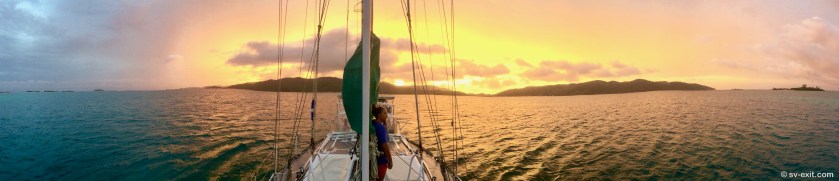
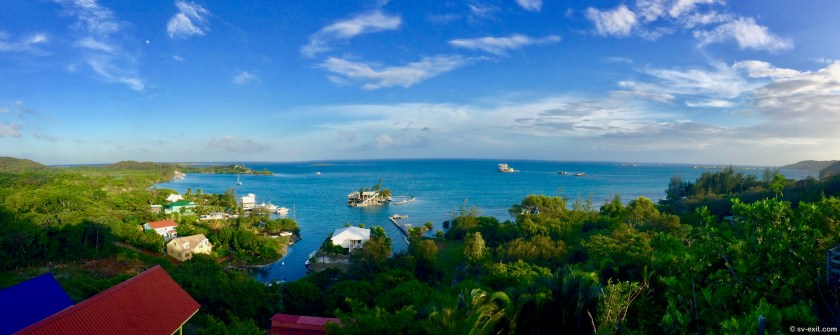
So, after one more beautiful Roatan sunset…

…we set out on a clear day, with zero wind.  The nearly smooth ocean surface allowed us to see a surprising amount of detail on the seabed nearly one hundred feet below.  

On the down side, no wind meant we motored the nearly six hours to Utila.  Still, in a bay with only one other sailboat at anchor, we found an equally beautiful sunset and possibly the best Long Island Ice Tea Kris has ever tasted (complete with conservation-minded metal straw!!!) at the bar Mango Tango, which we were anchored right next to.

Immediately the feel of Utila seemed well better than that of Roatan.  More than anything, it reminded us of the backpacker vibe of Thailand.  

Instead of the cars of Roatan, and unlike the lack of any cars in Guanaja, Utila opts for what seemed to be a compromise… golf carts, as a primary mode of motored transportation.  This meant that, once S/V Samba Pa Ti and S/V Off The Grid caught up with us, a road trip around Utila via golf cart was well in order.  Given the driving environment, and especially the close quarters in town, Josh deserved major credit for volunteering as wheelman all day.

As for scuba diving, the option of getting tank air fills for three dollars each in Utila — as opposed to the ten dollars per tank Roatan had tried to extort from us — meant scuba diving was back on the menu… which meant we even had the opportunity to take our friend Craig, from S/V Samba Pa Ti, for a dive.

As it turns out, Utila is the place to be if you have a musical itch that needs scratching.  Our first day ashore, during a conversation with an expat in one of the bars, we were told to stop by open mic night at Sea Breakers, which we did.

And, while it did feel good to pick up an electric guitar and sit in for a handful of songs/jams, I would have to confess that meeting the bartender Johnny turned out to be much more fruitful than meeting the owner, whose guitar playing skills were only marginally better than his listening skills, which were non-existent.

Rhino’s Beergarden and Delicatessen was actually the place that raised the bar to a new level when its came to phenomenal music, great company, fantastic food, and ice cold German beer!  The owner, Reiner, who had opened only one month ago, was not only able to pour a perfect glass of beer, but also cook an insane spaetzle dish with German sausage, bake delicious homemade pretzels, and play a mean guitar.

After an impromptu jam session during our final visit to Rhino’s, Reiner insisted that the  photo he took was destined to be hung on the Wall of Fame/Shame.  I left a guitar pick as a pledge that I would return someday to sign the photo.

Still, after ten days in Utila, we found ourselves holding visas that were on the verge of expiring.

Not something to fuck around with, despite what you might be told by Guanaja shady expat character “a.k.a. John Smith” who sailed into Honduras years ago, ran out of money, and now lives aboard a derelict boat, unable to leave the country not only because his boat’s not seaworthy, which is the case, but also because he owes the Honduran government thousands of dollars in fines for overstaying his visa… smart guy.

Even extending our visa in Honduras was something we had ruled out.  Based upon the C-4 agreement between Honduras, Guatemala, Nicaragua, and El Salvador, we worried that extending our visa in Honduras might result in our Guatemala visit being limited to thirty days on our entry stamp.

Not worth the risk… it was time to move on.

So, with only three days left on our ninety day visa, we painlessly (comparatively, at least) cleared out with the official at the Honduran immigration office as well as customs at the Port Captain’s office next door.

Somehow or another we had managed to avoid the lion’s share of grief and headaches during our stay in the Bay Islands — headaches which seemed to fall square on Craig, of S/V Samba Pa Ti.   A chronic and catastrophic fuel line failure coming in from Roatan; being pickpocketed on the island of Utila; having his dinghy stolen while tied up to his anchored sailboat (at least it was recovered twelve hours later); and, finally while clearing out, getting saddled with a monetary fine by the Port Captain for an expired registration document… talk about shitty luck.

Having already learned to recognise that, at best, a minimal sympathy for electrical windlass issues were to be expected in the rather large world of sailing woes, my mouth remained zipped tight.

Windless & Windlass-less

September 20, 2019

In some ways, living aboard a sailboat full-time is a world apart from life ashore.  In other ways, the guy on the boat next you is no different than a dirt dweller’s next door neighbour.

Take, for instance, the idea of necessity versus luxury.  Oftentimes the only distinction between the two is whether I have it or you have it… if I have it, it’s out of necessity.  If you have it and I don’t, it must be superfluous.

We don’t have a bow thruster; therefore, we deal with it.  We certainly could use one every now and then, but we don’t consider one a necessity.  To the contrary, we actually find a great deal of satisfaction in successfully working through a situation without having to rely on a bow thruster.

On the other hand, we do have an electric windlass, and certainly consider it more than a luxury.

But tell someone who doesn’t have an electric windlass that yours is broken… the chances are nearly one hundred percent that you will elicit exactly zero sympathy from them.

*****

After an uneventful six hours travelling from Guanaja to Roatan, we opted to anchor at Lime Cay Bight, which was completely undeveloped except for a few houses and Mango Resort, with its five colourful overwater bungalows.

Our Rocna anchor typically does much better in sand than grass, which has a tendency to get piled up in a big mound, preventing the anchor’s tip from digging in properly.  However, after leaving the Bahamas, we have found it much more challenging to find good patches of sand to anchor in.  More and more, we find ourselves searching bays covered in turtle grass.

Such was the case with Lime Cay Bight.

After unsuccessfully searching for the right combination of depth and bottom composition, we eventually had to settle for multiple attempts to set the anchor in turtle grass.

On occasion, the deck connection at the bow for our windlass remote control acts up.  You push the up button… nothing.  You push the down button… nothing.  Shit.

The seemingly arbitrary feisty behaviour is, no doubt, the result of mild corrosion which is inevitable given the location’s exposure to the elements.  Sometimes it requires nothing more than a wiggle; other times a more thorough cleaning is needed to get it working again.

To complicate the challenge of repeated attempts to set the anchor, the windlass connection decided to play up as well… not very nice of it.

Normally, wiggling the connection either works or you get nothing.  Worst case scenario, if necessary, we bail out on the remote control at the bow and operate the windlass from the cockpit, which can get tricksy.   Either it’s difficult to see what’s happening, or Kris operates the windlass from the cockpit while I am sorting things out at the bow – not something I like to do (there are many stories of nine fingered sailors who have had their hands too close to a windlass and chain being operated by someone else.  Not ideal.

However, something else was going on as well.

Intermittently, the click of the solenoid could be heard, which seemed to indicate that the connection was okay but the windlass was not engaging (much like the click you hear when you try to start your car and the battery is almost dead – ignition on… no starter).  Doble caca!

Finally, after multiple attempts and an ongoing dialogue of swear words with myself, we were able to get a good anchor set with our ailing windlass.

And though Manny, the owner of Mango Resort, was very friendly, the resort was officially closed for September.  Like so many other people, he reminded us that very few people come visiting at this time of year… ya, ya… we know.

This left a bit of dinghy exploration and snorkelling to be done as off-boat activities, but nothing more.  We hadn’t gotten a chance to fill our tanks since our last dive, so going for a dive was off the table.

We ended up waiting five days for enough wind so we could sail the ten miles to French Harbor instead of motoring.  During that time, I tried to do a bit of diagnostics on the windlass.  However, I was hesitant to dig in too deep, not wanting to chance having the windlass die completely while we had no nearby access to any services whatsoever.

In theory, our windlass can be operated manually if necessary, but I have never been able to get the damn thing sorted out for a multitude of reasons.  Which leaves hauling up everything by hand.

Now, I realise I’m no spring chicken, but I do consider myself in better-than-poor shape, and I have never been timid about breaking a sweat.  What I don’t understand is the physics that makes a half inch chain more than twice the weight of a three-eighths inch chain.  I’ve already had a science teacher tell me that’s impossible but, like electrical voodoo, I believe it to be true.

Regardless, hauling up the ground tackle by hand would be my fallback plan, not the primary strategy.

When the wind finally picked up, we managed to get the anchor up with our still debilitated windlass and make it to French Harbor, where we found more visiting sailboats than we had for the previous five months combined!  This included three people we met briefly while at anchor at Michael’s Rock on Guanaja – Josh and Sarah, aboard S/V Off The Grid, as well as Craig, back aboard his boat S/V Samba Pa Ti, who had just been joined by his daughter Zoe.

Now that we were back amongst the civilised world, with access to hardware stores, mechanics, and other resources including Internet, the windlass issues could be properly dug into, hopefully with a happy resolution.

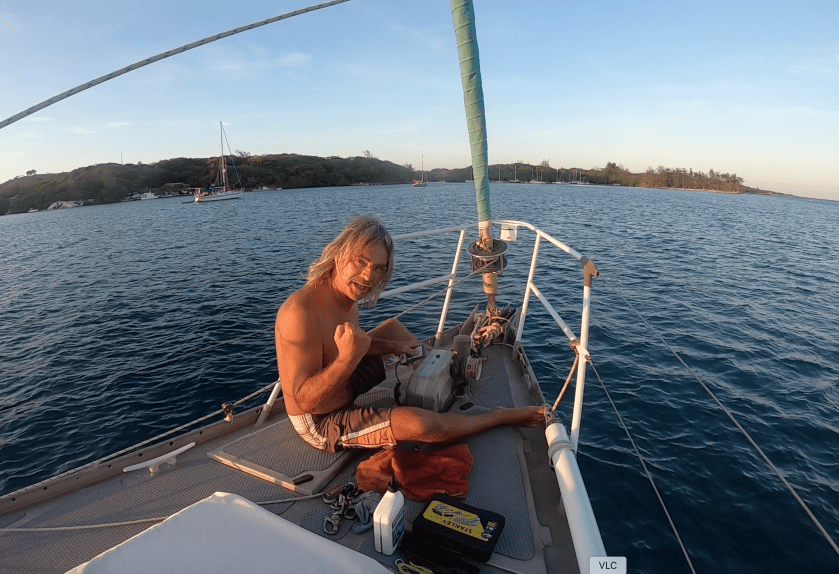
Armed with a multimeter, Nigel Caulder’s Boat Mechanic’s Bible, and an Internet connection to get real-time advice as needed, Exit’s Chief Engineer (me) commenced with diagnosing corroded connections, burned connectors, and overheating wire.  After quite some time, I emerged from the fray with a sneaking suspicion.  As a final act of confirmation, a battery was hauled up on deck and jumped directly to the windlass motor… nothing.


After twenty seven years residing at the bow of a boat, the windlass motor itself appeared to have finally given up the ghost.

Tablespoons of black powder, the remnants of the carbon brushes, poured out of the inside when we opened the motor… not good.

If we couldn’t get the motor repaired, chances are we’d have to replace the windlass entirely… I’m guessing a $3000-4000 prospect for an electric windlass… Eek!

But, a windlass motor is not that different from a starter motor, and identical to the motors which raise and lower the lobster traps on the local fishing boats… so, it’s not like we’re trying to locate a brain surgeon… stay optimistic.

After asking a few people and posing a few questions to forums, we had a very general area that a mechanic could possibly be found in with an even more general description of how to find him.  After a while of walking, and looking… and asking, and walking… we stumbled upon an open door of an unmarked building.

The entire inside of the room was essentially a huge pile of used mechanical and electrical parts with a few poorly defined paths running through, surrounded by shelves and tables piled high with more parts.  The guy behind the counter looked to be in his  twenties.  Possibly, the guy who just writes up the work orders… possibly, the mechanic.

His English was non-existent.

Our Spanish is pretty limited.

Where is the bathroom…?  How much for the beer…?

Pretty graspable stuff.

¿Permisso los pollos en el autobus?  Are chickens allowed in the bus?

Can even pull that one off…

But… The up and down positive electrical connections on my boat’s windlass motor have a direct short across them… can you fix this?  How much will it cost?  How long will it take?… Hmmmm. 

We did our best to communicate back and forth.  In the end he told us to come back in three hours.

I tried to clarify… Maybe get an estimate in three hours?

He tried to clarify… Maybe fixed in three hours.

As we walked away, Kris was not even remotely convinced.  Just leaving our windlass motor with a random guy we can’t even communicate with, eh..? Ok…really..?

It seemed like less of a gamble to me.  Whether this kid went and got the old man in back… or he was the fourth generation mechanic who actually performed the miracles, this room full of broken parts was not a graveyard of repair failures… to me it looked like   the product of years of salvage and scavenging work… parts to be used in the future.  Any repairman, not worth his weight in gold, would not have been in business long enough to gain this calibre of an in-stock parts inventory.

The motor was where it needed to be.  The question was simply, could it be revived or would it, too, become part of the shop’s spare parts inventory pile?

Three hours later, we poked our heads back through the doorway.

Sitting in a vice, sporting a brand new coat of glossy black spray paint, was our motor.  The middle post already had the black clamp from a set of jumper cables attached to it.  Arial (????), who turned out to be not just the cashier but also the Dude, touched the red clamp to one of the other two posts and the motor whirred to life.  Then he touched the other and the motor reversed direction.

Hallelujah!!!

He had documented the procedure with photos of various damaged parts that had been discovered during the surgery.  Lots of problems… Still… it lived.

And… the big question…

?Cuantas cuesta?  How much is the cost?

He writes on a piece of paper… three… two… zero… zero.  Three thousand two hundred…

Processing… processing… processing…

Wait… thirty two hundred Lempiras.

That’s… a hundred twenty dollars.

Sweet.

Fortunately, the reassembly process proved easier than the disassembly process.  And, though Jay (one of my electrical voodoo witchdoctor/advisors) had run the math and recommended we up-size the cabling gauge running to the windlass, we could delay that until after we reached the Rio Dulce.

So… the moment of truth…

When the up button was pressed and the chain began grinding its way up… and the down button started letting the chain back out…

… a true Johnny Bravo… VICTORY!… erupted from my lips.  Back in business!

RoatanWindlassRepair

To those sailors who haul up their ground tackle by hand, I salute you, oh salty dogs… and I promise to never bring up the existence of Exit’s stern anchor electric windlass in any bar conversation!

Amazingly, we have whittled away all but only about two weeks of our ninety day Honduran visa.  We don’t have long before we will be forced to clear out and head for Guatemala.

Now if we could just get the wind-less bit sorted out.  A twenty four hour motor to Livingston is exactly what we want to avoid.

Nervous Locals

IMG_2855

September 9, 2019

After arriving to Guanaja on July 10, uncertain as to whether we should even stop here to clear in or continue onward to Roatan, we now find ourselves finally departing only after spending two months here.

True, we did spend longer in the Bahamas.  But that’s a lot of islands and cays covering a lot of space.  While we may have spent a month in one area, in general, our movement was in a forward direction with little backtracking.

Now, for the past sixty days, we have rotated between three anchorages no less than ten times… El Bight – providing not only accessibility to Bonacca, but also maximum wind protection when things kicked up; Graham’s Cay – providing maximum breeze and ventilation relief when things really got hot; and Michael’s Rock – providing absolute solitude and incredible views both above and below the water when the weather cooperated.

Still, in the back of our minds, we were always aware of the fact that we were, to a certain degree, tempting fate.  Hurricane season in the Caribbean lasts roughly from the middle of July to the middle of November.

When we returned to Grand Cayman towards the end of June, after our visit to the States, our strategy was to make for the Rio Dulce in Guatemala.   A renowned haven for boaters to sit out the hurricane season, it has the benefit of never having been struck by a hurricane for as long as hurricanes have been recorded.

Unfortunately, our insurance company does not distinguish any location south of the Georgia border as being “hurricane safe” during that time frame.  The increase in our most recent premiums certainly reflected that perspective.

Nevertheless, even if we stopped along the way at either Belize or Honduras, the Rio Dulce was still attainable by mid-July.

And yet, here we are.

Stalled in Guanaja, enjoying the location… and then it’s three weeks after mid-July.

We still pay heed to the notion that, until we get to the Rio Dulce, it behooves us to pay particular attention to the SSB forecasts of weather guru Chris Parker, and not try to second guess any threatening weather that begins to develop in our direction.

Any potential hurricane that could threaten this location would almost certainly originate from Africa, giving plenty of forewarning for those ready to make the twenty-four hour jump to the Rio Dulce.

August 10, our twenty eighth wedding anniversary, comes and goes.

Still enjoying the location…

Kris heads to the mainland for a five day outback excursion while I remain aboard Exit diligently taking care of our baby at anchor.

Still enjoying the location…

August 15, marking the two year anniversary of Exit’s launch and our move onto the water, comes and goes.

That’s alright.  We’re only a month behind the tentative schedule we softly agreed to aspire towards.

Still enjoying the location…

I find myself suddenly bedridden, experiencing my own five day outback excursion in the form of three solid days of no food and anything-but-solid outback activity, while Kris  diligently takes care of her two babies at anchor.

Not enjoying the location so much right then…

But the darkness slowly passes.  It’s unicorns and rainbows and marshmallows again.  More diving.  More relaxing.  More snorkelling.  More drinking.

And then it’s September.

Holy shit… seriously?

As the haze begins to clear, a darkness returns, and one thing becomes certain.  Though we are not statistically in the safest place to be, we have just dodged a bullet.  During the first week of September, Hurricane Dorian, packing Category 5 winds of 185 miles per hour, has pummelled the Bahamas and U.S. east coast, largely in a reverse mirror of the path we took from Maine to Jamaica.

It was even less likely to directly affect us than it would Alabama (I probably just made someone’s list somewhere).

Nonetheless, two questions continued to remain at the forefront of our thoughts.

Was our dear friend Benjamin safe?  We had seen a photo posted a short time ago taken by Benjamin atop the mast of his sailboat Cracker Tale which sat spiderwebbed into the mangroves near Marsh Harbor, Abacos just twenty four hours before Dorian levelled the Bahamian town.  We had heard nothing from him since the storm hit.

Were we beginning to confuse comfortable with complacent?  Though the two are nearly opposites of one another (acceptance of one’s environment vs. ignoring one’s environment), at times they can be very hard to distinguish between.

In this case, the finger snap that awoke us from the hypnosis of comfort transitioning towards the paralysis of complacency came from the local population.

When people who have lived in an area for their entire lives observe that the current  season has been particularly dry, and that drought conditions historically signal a high danger for storms and hurricanes, one would be foolhardy not to take heed.

Whether a local insight, or an understandable reaction to the devastation witnessed with Dorian, the locals have begun to grow nervous.

Regardless, we are pushing our luck.  Hurricane season is reaching its zenith, and we need to be in the Rio Dulce.

Again and again we hear, you guys are kind of behind everybody else… which makes us laugh.  We’re generally okay with that.  However, as tempting as it may seem, rolling into the Rio Dulce in mid-November, just as the boats are starting to head out in the opposite direction would be rather ridiculous.

The real question is… can we get there before October?

As we raise anchor inside the reef of Guanaja for the final time during this visit, we have to say a huge thank you to Don and Annette for all the hospitality, kindness, and generosity offered to us during our stay.  Sure Feels Good knowing we have friends in Honduras we can always return to.

We also receive a long awaited update from our friends James and Dena aboard S/V Cetacea.  The text reads:  Benjamin is ok.  But his boat is, in his words, toast.

We have to smile.

In the big picture, some things are simply more important than others.

IMG_2596

I Think You Should Go

August 11-15, 2019

Sitting at the Cay Cafe on another ‘Thirsty Thursday’ with our friends Annette and Don after doing some shopping at Bonacca having some drinks and chatting.  Annette had just bought a ticket to fly to La Ceiba on Sunday morning to do some shopping.  She had wanted Don to go with her and go up the Rio Cangrejal to do some rafting but he wasn’t interested.  Of course I, Kris, said, “I’ll go!”.  After being on the island for over a month I was kind of jonesing to check out the mainland.  However there was the big problem of not wanting, and not being fair, to leave Steve alone on the boat (which we had never done before) while I go off shopping and galavanting on the mainland.  So we left it and continued drinking.  

When we got back to the boat Steve and I were chatting and I mentioned how fun it would be to check out the mainland as we had no plans on sailing there.  He looked at me and said, “I think you should go.”  What?!?!?!?  Of course having been drinking all afternoon I wasn’t sure if he was serious.  Steve: “I’m serious.  I think you should go.”  Me: “Wow, really?!?!?”  Steve: “Yes, I’ll be fine for a few days, no problem.”  Me: “Woohoo!!!!”

So I quickly sent Annette a message telling her what Steve said and asking if I could tag along.   She replied with the affirmative and that she would pick me up to go to the Cay (Bonacca) tomorrow to change her flight and see if there was space for me.  Which is what we did!  We were flying out on Sunday morning and flying back Thursday afternoon.  This would give Annette time to do all the shopping that she needed to do in La Ceiba and then we booked two nights at Omega Tours that was up on the Rio Cangrejal.  Woohoo I’m going to the mainland!!

Sunday morning Don and Annette picked us up and took us to the little Guanaja airport (which can only be accessed via boat).  It was great flying over Guanaja and Roatan and seeing the Cayos Cochinos.  

We landed without incident and were picked up by Annette’s friend James who is from Colorado but has lived in Honduras, and has been married to a Honduran, for ten plus years.   He is a super nice guy and drove us out to Sambo Creek, a Garifuna village, for lunch and then dropped us off at our hotel in La Ceiba. 

The next morning Annette’s friend and taxi driver, Eliberto, picked us up at the hotel for a day of shopping.  And what a great day we had!  Eliberto went to every store with us which was fantastic as he speaks very good English so if we needed a translator he was there.  The amazing thing is that it was all so easy!  So many shops will box up your purchases and take them to the shipyard and put them on the boat going to Guanaja.  And ones that don’t provide that service, Eliberto takes care of the boxing and delivery to boat.  Then it just has to be picked up when the boat reaches Guanaja.  No worrying about how much you can take back on the plane with you!  And Annette was awesome and let me put some things that I found in her boxes.  Thanks Annette!

Annette was able to get all of her shopping finished in one day so we were ready to head up the Rio Cangrejal as soon as we could!  James had no plans, and liked getting out of the city and visiting the Omega resort, so he agreed to pick us up and drive us.   What a day!  After we had breakfast we had a few hours until James picked us up so we walked around the area of the hotel which was fun. 

The drive only took about 20 minutes outside of the city but what a different world!  Beautiful, and the boulders in the river are hard to describe just how huge they are, as big as houses.  We stopped at places on the way to Omega and, since it was early, James offered to keep going up the mountain to the last village on the road, stopping along the way.  Suspension bridges, views of the river, and the most amazing ‘cable car’ ride across the river gorge to a women’s co-op that sells various sewing items.  I just couldn’t stop saying ‘amazing’ the whole day!!!  

Once we got to the end of the road we had a beer (of course) and walked around the village a bit.

Leaving there we retraced our trail to Omega to check in.  What a beautiful place!!!!  The pictures don’t do it justice at all.  The owners have designed and built everything themselves.  The woodwork and even the steps in our bungalow was spectacular!  They even designed their fresh water pool to fill with water diverted from the stream to flow through the pool and end up back to the stream.  Unfortunately it was very dry this time of year so I didn’t get to see the water flowing but we did take a dip in the refreshing pool.  

We had a fantastic late lunch with James and he headed back to La Ceiba before dark settled in.  What a wonderful day! We settled into the bungalow, Annette showed me around the resort and we had a really nice dinner and crashed for the night.  Time for rafting tomorrow!

As I mentioned, after some discussion with the owners the previous day we decided to do the white water rafting trip today.  It didn’t start until after 12:00 so after we had a fantastic breakfast we went on a hike on the property.  Wow (I can’t come up with any other descriptive word)!!  Annette is a birder and is very knowledgeable about birds in the area so she was pointing out so many different birds on our hike.  And I saw a TOUCAN!!!  Beautiful, and too far for a photo.

We were so hot, and we had time, so we went across the road to the river so I could see it and we could cool off.  

Then it was time to head back for lunch and the white water rafting trip.  There were five of us in total; Annette and I, the raft guide, the safety guy and the photo/video guy.  We had lunch and walked down to the river to the rafts.  Turns out it was right where we just went swimming!  Because the river was very low we did some boulder ‘jumping’ up the river which was good fun.  Scared the shit out of me on the last huge one we jumped off of!!!! Annette had no fear jumping at all.  We then floated back down the river to where the rafts were, did some safety drills (lots of laughing) and headed down the river.  As I said, the river was really low so we had to get out and walk a few times.  So much fun! 

What a busy and amazing day!!!!  When we got back from rafting it was definitely happy hour in the pool, we had another amazing dinner and crashed for the night.  Oh, and we saw some really cool woodpeckers (like Woody the Woodpecker) and some toucanets (technically they were collared aracari) who had a nest in a dead tree with fledgelings at sunset.  Amazing!

The next day was departure day:(.   We had another delicious breakfast and just relaxed, took some more photos, until Eliberto picked us up at 10:30.  Annette had one last store to shop at (items to put in the cooler to take back on the plane), we had a nice lunch at the Beer Box (nice name) and Eliberto dropped us off at the airport.  

The flight was uneventful…oh, except for the pilot telling us we weren’t allowed to sit in the exit row:-). Something Annette can relate with Jim Springer about!!!  Steve and Don were there on time (after spending several hours on Bonacca for ‘Thirsty Thursday’.  It was a wonderful trip and great to be home! 

A Sunny Place For Shady People

IMG_2400 3

July 10 – August 9, 2019

We had gotten very mixed information regarding what we could expect in Honduras.  From fabulous place to visit with as friendly locals as you could imagine, to sketchy as hell; lock everything and trust no one.

One person’s conclusion: you’re fine for a day… on day two they start making a plan… on day three they come for you.  I’m honestly not sure if that was intended as a joke or not.

Some recommendations had been to bypass the smaller island of Guanaja and clear in at touristy Roatan.  The Port Captain at Bonacca was reported to be a bit shifty. Others had said Guanaja was much easier and not to miss it. There seemed to be a general consensus  that clearing in at La Ceiba, on the mainland, should be avoided, if possible.

We’d just have to make a decision and wing it.

Historically, we’d gone more off the main path…Guanaja it would be.

After anchoring just off Bonacca, we took the dinghy and found what appeared to be the government dock.  A very animated individual directed us to one area, told us not to lock the dinghy (in case it needed to be moved) which would be safely looked after by his colleague, and follow him directly to the Immigration and then Port Captain’s office.

You can always be certain these are not free services which are being offered…

Option #1:  Assume dinghy security is not really an issue, the locations you seek will be able to be found without much difficulty, there will be no language issues, you can save a few bucks and, if anything, the guy you’re talking to is the one to be wary of.  In which case the response to said individual is, thanks for that, but we’re good… repeat process for next individual.

Option #2:   A couple of bucks to have eyes watching your dinghy is not a bad thing.  Furthermore, a local resource to help orient you can, on occasion, be well worth the expense.  It’s just critical to make sure what that expense is, up front.

We opted for the second approach.  

Hondo, a local born on Guanaja who had lived most of his life in the Eastern U.S.,  was definitely helpful with translation when the Port Captain, friendly but entirely mono-lingual, asked some questions we had trouble deciphering.  He also provided pretty solid information about what could be found where.

Though we paid Hondo more to help us out than the $10 we paid to clear in, we were happy to have done it. Still, we already had a sense that Hondo would not be required for future security.

Our clearing in process had been trouble-free, people seemed genuinely friendly as you passed them, English seemed to be more commonly spoken than Spanish, our ATM card worked on the first try, groceries were plentiful and cheap, and beer in the bar was well under US$1.50.  Honduras was making a very good initial impression upon us!

Bonacca truly is a unique community build atop an island not more than about a quarter mile long by maybe a thousand feet wide.  Most of the buildings are on stilts; and small canals criss-crossing the island immediately help make the comparison to a Honduran Venice easy to see.  

The only remaining direction for expansion really could only be up, as most of the ten thousand people living on Guanaja are crammed onto Bonacca itself.  Surprisingly, even though there does not seem to be a spare inch available on the island, it has a remarkably uncluttered and relaxed feel.  If handcarts were not the biggest vehicles on the island, it would have a very different feel.

After clearing in we moved to El Bight, a bay nearby that was much more protected from weather and out of the way of local boat traffic that buzzed continuously around Bonacca. 

Within twenty four hours we had returned to Bonacca by dinghy, also called Low Cay, and headed back to the popular gathering spot Cay Cafe.  We learned that Guanaja has an extensive European and American expat population, and Cay Cafe is definitely one place where they gather to drink and socialise every “Thirsty Thursday”, after shopping for fresh fruits and vegetables which have just arrived on the delivery boat.  Slowly, over the course of the next month, we would meet and get to know a number of these very colourful people.

While enjoying a tasty two dollar lunch and ice cold buck and a half beer at Cay Cafe (after our fruit and veggie purchase at the grocery store – hey, it was Thursday…), we also randomly met Hector and Cart.  Born and raised on Bonacca, Hector owns his own contracting company, and Cart works for him.  We ended up spending the whole afternoon visiting and drinking with these two guys, who turned out to be two of the friendliest people you could meet.  We would see Hector and Cart again and again over the following weeks.

Back at anchor, around the area known locally as El Bight we could take the dinghy out to go snorkelling, explore canals lining the shore that penetrate back into the mangroves, or check out nearby wrecks; watch our old friends from inside our cockpit – the majestically comical and prehistoric looking pelicans we were so happy to be seeing again; or go ashore and climb two-hundred-something stairs to enjoy the incredible food and spectacular view at Mi Casa Too.

Still, after about four days, we came to the conclusion it was time for a short move.  Just around the corner, about two miles away, sat Graham’s Cay.  The reef that it is a part of is nearly a mile offshore, but it acts as a very effective breakwater for most of the waves coming in from the open ocean.  This meant that, as long as the wind stayed around twenty knots or less, we could anchor comfortably with a much better surrounding view and breeze for belowdecks ventilation.

This put us within dinghy range of Savana Bight, a small shoreside community that connected with Mangrove Bight, on the other side of Guanaja, via one of the only roads on the island.  We unintentionally chose a particularly warm day to make the walk across the island; and, though we had used all of our Honduran lempiras to buy beer in Mangrove Bight, we still managed to get a free return ride from a very kind and sympathetic taxi (tuk-tuk or golf cart would be more accurate) driver who was headed in our direction anyway.

A dinghy excursion to a nearby cay for some snorkelling…

We were anchored on a tiny strip of sand nestled among endless patches of turtle grass grass, at a perfect depth of just under ten feet, just off Graham’s Cay.

Graham’s Place, a resort on Graham’s Cay opened by a Cayman man not surprisingly named Graham over twenty years before, is nearly directly opposite of the property on the main island owned by Annette and Don, an expat couple from Michigan who had been coming to Guanaja for two decades and moved here permanently a couple of years ago.

We first met them in the grocery store immediately after arriving, and spoke with them again at Cay Cafe.  Taking them up on an invitation to stop by their property Sure Feels Good “any time we were in the area”, we stopped by for what turned out the first of many beers (and many visits), enjoying the beautiful property and stunning view with new friends.

Annette and Don also introduced us to Peter, a very knowledgable local dive guide they dive with all the time, who has a small dive company.  We got to come along when they went for a couple of dives on the other side of the island, reminding us how nice it was not to have to deal with the logistics of our own boat when diving…

… especially having someone else dealing with a boat during a squall!

This point would be driven home a couple of days later when we got tagged by a squall packing forty knot gusts while anchored off Graham’s Cay, and found ourselves dragging anchor for the second time in thirty days (ironically, we had never dragged prior to that).

Fortunately, as was the case before as well, the anchor managed to reset itself fairly quickly (a relative concept when your boat is involuntarily on the move), allowing us to hold out until morning before having to relocate and properly reset the anchor… something you don’t want to have to do in the very winds which are causing the problems.

While at Guanaja, we found ourselves constantly perplexed by the weather.  The display on the screen each time we turned on Windy, one of our weather forecasting apps which indicates wind direction and intensity over time, began to look more like a static photo than a streaming video… always east to southeast or east to northeast at 10-15 knots, gusting 25.

And yet, day after day we would watch crazy variations in weather across the horizon.  What was happening directly above us could be drastically changed by the thousand plus foot tall peaks running down the centre of Guanaja, sometimes making for very different weather on the other side of the island.  Or just a few miles in the opposite direction, beyond the protection of the outer reef, the open ocean would also potentially alter the conditions markedly.  It was always a crap shoot whether whatever was just upwind of us would break one way around the other side of the island, stay on course and land on us, or break the other direction into the open ocean headed to the mainland.  Rain catch was a recurring opportunity.

In preparation for squalls and gusting winds, past experience has shown us that it’s better to have forty meters of chain already out than to plan on letting out more if the winds pick up.  You’ve either already prepared for it, and you withstand it, or you go for a ride before having time to deploy more chain in what are now less than ideal, or even dangerous, conditions for such a manoeuvre.

When we began to see forecasts of twenty to thirty knot continuous winds for the near future, we made the decision to sail for the other side of Guanaja, hoping to gain the benefit of putting the island between us and the wind direction.

The north side of Guanaja is much more sparsely inhabited.  At Michael Rock, where we anchored, we found ourselves alone and out of sight of any buildings along the coast.  Now on the lee side of the island, we could tuck right up next to the beach.  We had nearly perfectly calm surface conditions and found ourselves sitting directly on top of our anchor on more than one occasion.

The only people in the area were intermittent boats passing by, oftentimes on the horizon rather than right next to us; people making short term visits to nearby beaches; and the unfortunate squads of dickheads on jet skis who came from far away to zip around us at top speed before blasting off into infinity… nothing’s perfect.  Quoting the timeless wisdom of Jake and Elwood Blues:  Whadda want for nothin’…rubber biscuit?
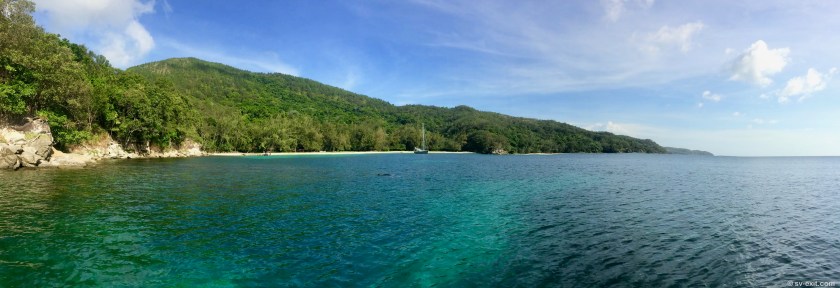
Michael Rock, Guanaja

Our anchorage was a bit farther east than we were when we had previously dived with Peter, but the reef system ran the entire length of Guanaja, and there were bright orange mooring balls identifying dive sites all along the reef.  This made it easy for us to run out in the dinghy, still in view of Exit at anchor near the beach in the distance.

One dive marked a very unique encounter with a two meter nurse shark.  After thousands of dives, hundreds of those with sharks, very few things surprise us, and we consider ourselves to be rather levelheaded diving around sharks.  While I would prefer to word the imaginary headline describing that dive: Being Continually Photo-Bombed By A Nurse Shark, I would guess that it would more often read as Persistent Shark Stalks Divers.  

What started as a brief nurse shark sighting, turned into a seeming curious interest on its part, after which it seemed to be approaching us around every corner, followed by a number of close proximity fin scratches on the shark’s chin, eventually requiring a deliberate kick of the fin to turn the pesky guy away.  
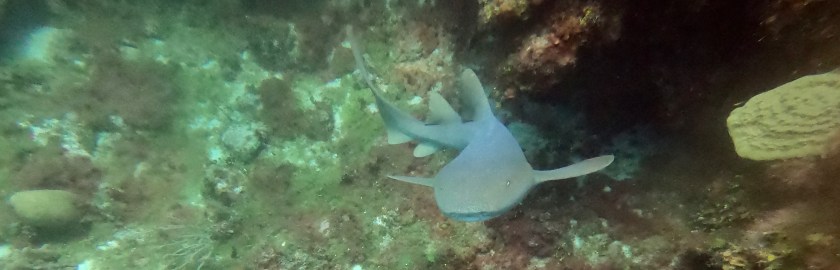
DCIM100GOPROGOPR2390.JPG

In retrospect, it seems that this highly irregular shark behaviour (anything other than a brief, elusive view for a diver)`is the result of divers being associated with food, either because of spear-fishing or dive shops feeding the sharks.  The most accurate imaginary headline probably should have read Opportunistic Animal Learns To Beg For Scraps. 

While we never felt in any danger, it is easy to see how things could end very differently with different sharks or different divers.  

In the case of spear-fishing, it’s sharks stealing someone else’s catch.  In the case of recreational diving, it’s the baiting of sharks to enhance the customer’s experience.  Very different scenarios, yet both with a lot of potential for bad outcomes.  

This was our first experience with such a persnickety marine creature.  It will, no doubt, be a story to weigh in on future discussions of shark feeding.

Dunbar Rock was obviously the big gun dive shop/resort in the area.  The Villa at Dunbar Rock is a rather imposing structure built atop Dunbar Rock which we anchored close to in El Bight.  While I’m sure there are quite mixed opinions regarding its benefits or shortcomings, we have nothing but compliments for them.  They installed and maintain the dozens of dive site moorings (not meant as overnight moorings but well done nonetheless) around Guanaja; and they happily filled our tanks on the spot for US$3 each when we asked.  Most of the time it looked like their resort was empty of guests.

After four nights enjoying the calm conditions while at anchor at Michael Rock, we headed back to El Bight. The final days of the week long Carnival celebration at Guanaja were coming to a head, and we wanted to catch the big parade at Bonacca.  

Lots of Salva Vida beer, kids prowling about in masks and costumes asking for one Lempira notes (less than a nickel) like a capitalist version of Halloween, and a community parade made for a festive afternoon in Bonacca.
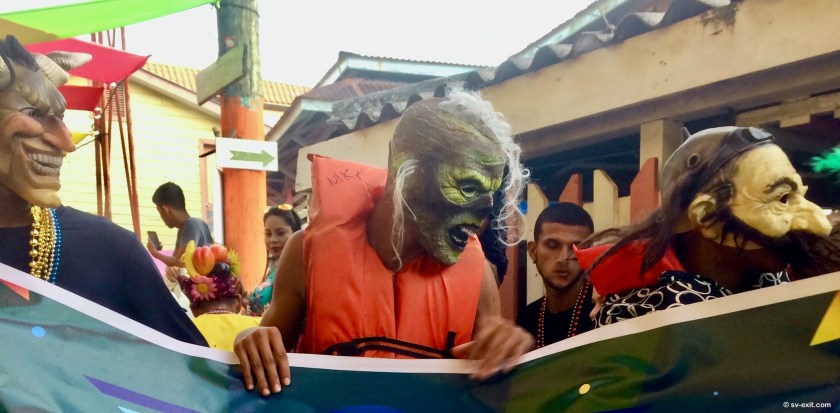
Carnival, Bonacca

As well as the beach finale for Carnival’s last day, complete with a Columbus landing reenactment… good times for all… historical accuracy be damned. 

Don might justifiably argue that his rights to anchor at the Carnival beach were impeded by the Honduran Army in a way that would certainly have disappointed Columbus (hehehe… inside joke).  In the end, however, the Honduran Army acquiesced that not everyone was going to fit on the dock that they wanted everyone to use.

Ironically, this meant that Columbus simply had to cope with the locals once again as he made his reenactment landing.
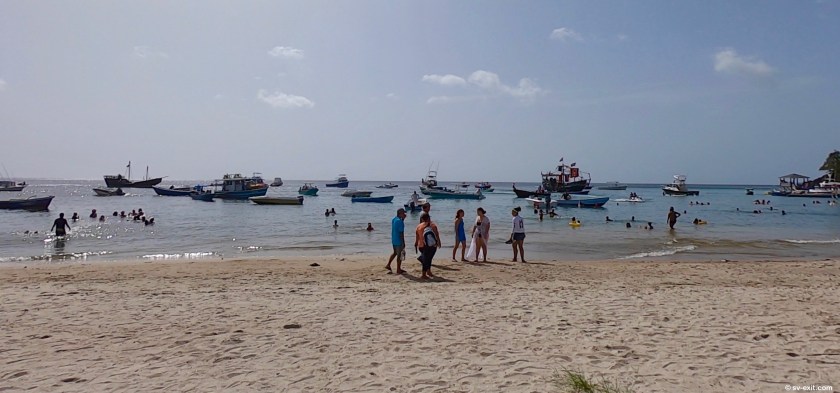
GuanajaCarnivalFinale

Again and again, throughout our stay, we were blown away by the quality of snorkelling and diving throughout Guanaja.  Still not incredible numbers of fish, but much healthier variety; as well as really impressive stretches of very unique hard and soft coral; and breathtaking expanses of sea fans more reminiscent of SE Asia than the Caribbean. 

We heard from more than one person that all of the promotional advertising footage used for world famous Roatan’s diving is actually photographed in Guanaja.

Those same individuals added that people can use whatever Guanaja photos they like as long as they don’t send cruise ships from Roatan to Guanaja!

Fair enough.

The kinds of things we have seen snorkelling have been pretty stunning.  Reef and flasher scorpianfish, stingrays, an amazing number of octopus, as well as smaller crabs and big lobster.  

The numbers of lobster has been especially dumbfounding.  

Hondo told us on the day we arrived that Guanaja has an exclusive contract with the Red Lobster restaurant chain.  Either all the Red Lobster lobster come from this area, or all of the lobster in this area go to Red Lobster (I can’t remember which one it is).  In either case, it amounts to a shitload of lobsters.

Even more amazing is how many of these lobsters are caught by scuba divers.  A local commercial  fishing boat may have sixty people aboard who take smaller dories out and dive all day breathing off scuba tanks, each diver wracking up potentially a dozen dives to depths of a hundred-plus feet.  The nitrogen loading they expose themselves to in doing so many dives is ridiculous.  Cases of bent divers are common, and fatalities are not rare. 

Considering how dangerous the job is, it might be very difficult to find someone still alive in the industry that has been diving long enough to say firsthand how adversely lobster populations have been affected by the fishing practices over the past few decades.  It might not be far off to say it’s more risky to the divers than to the lobsters.

While apparently most local boats have made the transition to using traps instead of divers when fishing out at the lobster fishing banks, we still saw commercial boats at port with dozens of dories stacked on deck and hundreds of scuba tanks piled in a cage.

I try to very consciously limit my takes from the ocean; but I couldn’t help indulging myself once in thirty days…

As the time that we have been at Guanaja reaches one month, we are still trying to wrap our heads completely around this unique and enigmatic place.  

Hector and Cart were perfect examples of as friendly and embracing locals as one could hope to meet.  Even though Cart referred to Hondo (the guy who corralled us when we first arrived) as a hustler, he went on to say, but that’s not all bad.  Even though the hustler may not be the guy who can help you, he knows the guy that can…

Expats continually stepped forward to offer advice and help.  In particular, Annette and Don have been as welcoming and shown as much hospitality as anyone we have ever met.  The rides they provided in their boat, invitations they extended, and activities they included us in went above and beyond again and again.  Gaining new friends is always one of the most rewarding benefits of visiting new places.

And yet, there seems to be an underlying something going on between the locals and expats.  We have been unable to put our finger on it.  No tension. No hostility.  Certainly no sense of security concerns.  Still, something… a subtle feeling of separation or an uneasiness of respect…?  Unsure.

Nevertheless, we couldn’t be happier having stopped at Guanaja before proceeding to Roatan.  It has unquestionably made for a smooth transition into Central America for us.  The month has slipped by more quickly than we could have imagined.  Honestly, I don’t see how Roatan is going to hold a candle to Guanaja.  We’ll see.

We haven’t met the any of the shady people who supposedly live in this sunny place.  

The phrase came to me through Jim – an eighty one year young American expat who has lived on Guanaja longer than most of the locals have lived here.  I think Jim just fancies the title A Sunny Place For Shady People.  A retired ex-Navy brass helmet diver and demolitions expert/commercial saturation diver/competition hang gliding pilot/pot grower now turned herbalist,  Jim can (and mostly likely will) tell you what it feels like to experience two hundred knot winds.  He was already living here when Hurricane Mitch flattened Guanaja over a five day period more than twenty years ago.  

Unique people?  Absolutely.  

Captivating?  Without a doubt.

Intriguing?  Sure.

Shady?  Nah.

A Sunny Place For Shady People sounds more like Florida, to me.

A Fine Line

DCIM100GOPROGOPR1960.JPG
Sailing into the sunset towards Honduras

July 6-10, 2019

I will be the first to acknowledge that I can be an idiot (on occasion I’m the second, if Kris is fast enough to get there first).  It’s not generally something that I aspire to; it just happens.

In some ways it’s a blessing.

The underdog rarely disappoints. You’ve already been written off.  If people expect very little, you can rally and impress the shit out of them every now and then.

You can always do your damnedest to know what the hell you are doing, and even achieve something resembling complete competence from time to time.  However, the person who always knows what they’re doing is a rare breed.

More often than not, they’re wrong and they just think they know what they’re doing… which technically can still make them an idiot.  Furthermore, the rare individual who actually does know exactly what they’re doing all the time, oftentimes is obliged to be a complete asshole.  On the whole, I’m not sure this is an improvement over the idiot.

Of course, the worst combination would have to be the individual who is both an asshole and an idiot.

At times, the distinction between the person who knows what they are doing and the idiot seems worlds apart.  

Someone who has an engine on their boat but only relies on it for dire emergencies, sailing onto and off of anchor; sailing through tight squeezes; even patiently sitting and going nowhere when there is no wind; is truly a competent sailor (I know some of these people, though I certainly do not sit among them yet).  They obviously know what they’re doing and they get it done, no matter what the circumstances.

Conversely, someone who has an engine on their boat and relies on it whenever they are unable to achieve six knots of speed, under sails alone, is an idiot (I know one of these people as well).  They are not really a sailor; but rather, a motorer… or, ewww… a failor.

Other times, the line can be finer.

Is the person who chooses not to utilise their engine, voluntarily subjecting their sails and gear to excessive and unnecessary wear and tear solely out of principle, more a truly competent sailor or an idiot?  Not such a clear distinction, in that case.

Probably a moot point, if you know what you’re doing… you’d make the necessary adjustments so you could still sail effectively while minimising equipment wear… damn.  I hate whomever is telling me how that is done right now… you’re probably an asshole who knows everything.

Anyway…

As we were en route to Swan Island, I felt beaten.  Despite having tried everything we could think of, we had been unable to sail nearly as much as we felt we should have been able to.  One the of log entries reads “I give up… turning on the engine.”

Sure… someone could have figured out what needed doing; but, that someone sure as hell wasn’t on our boat that day.

Consequently, we ended up running the diesel engine for nearly a third of the two days it took us to get to Swan Island.  Even with the engine running, we only managed to average 4.8 knots during that leg.

The most noteworthy aspect of the first day was a visit from another temporary hitchhiker.  Just before sundown, a bird we later identified as a Brown Noddy landed on our dinghy, which was secured to the davit and stern arch.  

The bird carefully stood there, leaning back and forth constantly to counterbalance itself in rhythm with the rolling of the boat.  Eventually, it tucked its head under its wing and appeared to enter a rather Zen-like state of both balance and sleep.  

Twelve hours later, as the sun appeared over the swell of the eastern horizon, that crazy bird was still perfectly balanced on the buoyancy tube of the dinghy, just where it had settled in as the previous day’s sun began to set.

It flew off shortly after sunrise, disappearing into the background of gently rolling waves.  Swan Island seemed like the most logical destination, given its proximity, though our silent hitchhiker appeared to be headed more in the direction of Mexico’s Yucatan Peninsula… maybe bound for Cancun… just teasing us to follow.

We had already joked that, if the damn wind wouldn’t cooperate, we might yet end up at Cancun ourselves.  But, for now, we were still shooting for Honduras.

When we arrived at the tiny smidge of land known as Isla de Santanilla (or Swan Island), the conditions seemed pretty favourable towards spending a night at anchor there.  Winds were ten to fifteen knots, making the wave action minimal, and we were able to find a spot that kept us protected from the incessant swell that seemed to wrap around the island.  

However, the wind direction meant there was no way for us to get into the small bay which allowed access to the Honduran Navy outpost, comprised of one officer and a few enlisted men (the island’s only inhabitants).  Apparently, they fancy showing visitors around the island, including a visit to the only other buildings on Swan Island – several cement foundations which are rumoured to be the ruined CIA remnants left over from a Nicaraguan Contra staging area.  

They seemed rather unconcerned after we identified ourselves over the VHF and explained our reluctance to enter the bay, given the wind direction.  As long as we were leaving in the morning… no worries.  Just give ‘em a call in the morning to announce our departure. 

So… for an afternoon and evening we had an uninhabited bay all to ourselves, the only boat on the whole island… over a hundred miles from the next nearest land… with nothing but ocean behind us if we had to pick up anchor.

In the morning we considered staying an extra day to attempt getting ashore, but we simply could not find a viable alternate anchorage.  In the end, we had to be content with the overnight stop, and a radio conversation with the Honduran Navy radio operator.  

Without the option of getting ashore, it made more sense to press on towards the Bay Islands… hopefully the smaller island of Guanaja if all went well.

The run from Swan Island to Guanaja felt like spectacular redemption compared to what we had experienced over the previous day and a half.  At first, the conditions were really not that much different from what we had seen the previous two days.  Yes… slightly better wind.  Yes… slightly less swell and confused seas.  Yes… slightly better wind angle.  But, all of those slightly different factors were resulting in a drastic night and day difference in outcome. 

More than the slightly different isolated conditions, it seemed that there was a much more profound impact resulting from the fact that we, simply put, seemed to get our shit together.  

Sometimes a much easier situation to overcome.

For nearly twenty four hours, under only power of engine, we averaged 6.2 knots… quite the turnaround.

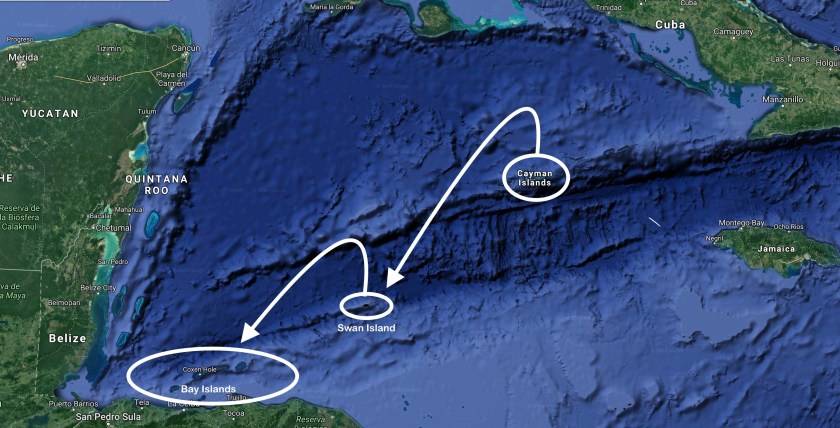
As we flew along through the darkness of the night under an unbelievable canopy of stars, at times exceeding eight knots, it was pretty crazy to realise that we were directly over the Cayman Trench, with over eighteen thousand feet of ocean separating us from the bottom.

We were quite entertained when, as we got into the wee hours of the morning, it became apparent  that we needed to rein in our speed to avoid arriving at Guanaja before sunrise. Hours later, the sunlight of a new day seemed to help tame the boisterous seas around us. 

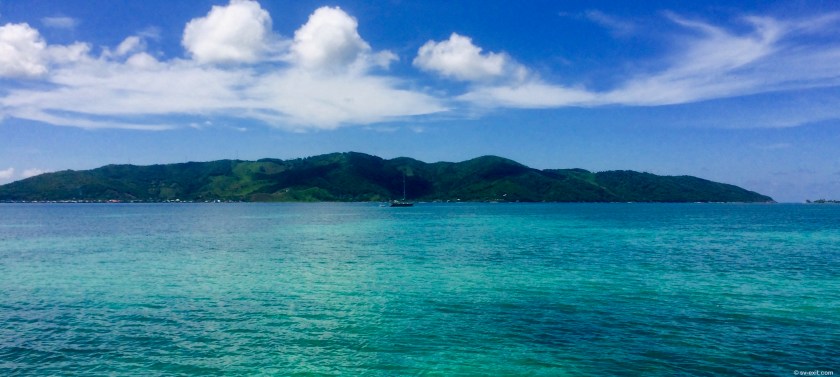
In front of us stood the lush green island of Guanaja. 

We were immediately reminded of Jamaica.  Not quite as mountainous, but still an inviting mass of green tropical jungle jutting up from the ocean, rather than a barren scab of desolate rock barely holding itself above the waves.

We had not had a chance to get ashore at Swan Island; it was really nothing more than a tiny military outpost anyway.

As we passed through the cut in the reef approaching Guanaja, we got our first real glimpse of one of the truly unique communities in all the Caribbean.  A tiny island, just off the main island, comprised of houses and buildings almost entirely built on stilts with a population somewhere between five and ten thousand people… Bonacca.

This was Honduras.  A new country… a new adventure.


Find Your Caymankind

July 7, 2019

It seemed to us that the Cayman Brac Tourism Office didn’t receive vast amounts of traffic.  

Nearly two months ago, we had stumbled across the office while having a wander about ashore, after first clearing in with Customs and Immigration.  We poked our heads inside to ask a few questions.

The very pleasant and welcoming woman immediately heaped complimentary Cayman Islands pens, fliers and business cards upon us, as well as promotional luggage tags which, on one side, displayed the rather cryptic phrase “Find Your Caymankind”. 

This phrase eventually came back around full circle nearly two months later, and we found ourselves departing Grand Cayman on a rather unexpected high.

The Cayman Islands authorities are very strict when it comes to returning any spear guns or Bahamian slings they have confiscated from boaters during their stay in the Caymans.  

Essentially, they would complete all the clearing out paperwork and then allow us twenty four hours to depart, but they would not return the weapons until we were literally about to untie from the mooring and set a course for International Waters. 

We had cleared out the day before, which allowed us to depart on a Saturday without having to pay overtime weekend fees to the the Customs & Immigration officers, but we still had to pick up our spearfishing equipment.  

We had been instructed over the VHF to bring our dingy to the dock, where an officer would meet us.  

After an hour had passed awaiting the arrival of the Customs and Border Control Officer who was in possession our spear guns and Bahamian sling, Kris made a brief visit to the nautical museum just across the street, in hopes of acquiring a last minute Cayman Islands courtesy flag.  

The problem was that we had failed to bring any money along with us in the dinghy.  Our plan was to hope for sympathy and enough trust from someone that we would call with a credit card number as soon as we got back to the Mothership. 

On our final day in the Cayman Islands we were treated to an amazing display of what had been explained to us as Caymankind  by the woman at the Tourism Office on the day we first arrived at Cayman Brac.  

Today, a woman who was waiting at the museum heard that I was trying to get a flag and simply smiled and told Kris not to worry about it… the $30 Cayman Islands courtesy flag was a gift… consider it Caymankind… wow!!!

The CBC officer arrived just as Kris returned with both a courtesy flag and an unbelievable story.  After we physically showed the officer our dinghy and promised our  immediate departure, he turned over the underwater implements of death and destruction, sending us on our merry way.

Departing The Cayman Islands

July 6, 2019

After a successful return to the States we only had to enjoy our remaining time in the Cayman Islands, lock in our next destination, and clear out.

Our final thoughts regarding the Caymans…?

Cayman Brac and Little Cayman, though more developed than the uninhabited islands and cays of the Bahamas, were still unbelievably remote locations.  And they represented the healthiest underwater environment we had come across since leaving SE Asia.

While not that “fishy”, it far out-populated the Bahamas and Jamaica.  The coral was diverse and healthy, and the topography was amazing.

The Caymans’ approach to conservation (regarding use of moorings instead of anchoring, as well as their strict hunting restrictions, and even implementation of recycling and accessible rubbish bins) was a fresh mindset, and something that was obviously having a profound positive effect on the area.

Grand Cayman, really was more of an accessible hub to civilisation for us than anything else.

Our only experience anchoring put us in a completely out of the way location in North Bay for a week  just off of Starfish Point, where except for one night, we were the only occupied boat in the bay after dark.

The dinghy trips to Stingray City were better than we would have imagined (see previous post Stingray City).  We had so much fun the first time, we opted for a second trip there.

It also provided the experience of a squall with 35-40 knot winds.  At 10:00pm, with zero visibility due to the pelting sheets of rain, we found ourselves dragging anchor.  Knowing that we could drag five miles before we would reach anything (the other side of the bay), we found ourselves in the surreal situation of watching our boat lay a track on the chart plotter while we were sitting below, unable to see the shore, as Exit dragged more than a quarter of a mile before finally having the anchor reset itself.

Strange?  Absolutely.  But also somewhat comforting to know we had nothing but open space ten feet deep behind us for miles.  Thank goodness for isolation!

Our return to the mooring balls in West Bay was more about access than safety.  We were immediately reminded that being in the midst of endless traffic and cruise ship activities was not our forte.

However, we had the pleasure of meeting a gentleman from the George Town Fire Department who kindly went out of his was to help us secure a lifetime supply of old fire hose which was invaluable to us as chafe protection for our lines.

We were also dumbfounded that, by the end of our stay on Grand Cayman, we had not only managed reunions with two of our old Scuba Junkie family members Nic and Martino (whom we had not seen in over eight years), but also stumbled across one other ex-Scuba Junkie staff (Christian) and another guy (Ben) who worked on Mabul while we were there.

Six people from the tiny island of Mabul on the tiny island of Grand Cayman, nearly ten years later and literally on the opposite side of the planet… not just a small world… an insanely small one!

And, of course, the diving…

Not only awesome dives, but also the accomplishment of finally diving directly from the Mothership.  Due to technical difficulties, we could only post a low resolution video of the experience, but what the hell… still gets us stoked watching it.

To our friends Nic and Martino, it was incredible to see you again.  Thanks especially to Nic for looking after Exit while we were back in the States.  Not goodbye, but rather, until next time…

To our friends Davey and Erica, aboard Barefoot Two (the only other live aboard sailors in Grand Cayman upon our departure), thanks for your company and your assistance multiple times.  We wish you the best during your employment with Cayman Divers.  Not goodbye, but rather, until next time…

Our next destination?

The Bay Islands, Honduras after sailing over the 15,000+ foot deep Cayman Trench and, hopefully, a brief stop at the tiny speck of land called Swan Island.

Screenshot 2019-07-04 at 1.00.54 AM

Stingray City

DCIM100GOPROGOPR1896.JPG

June 28, 2019

I think every place that has dive or snorkelling sites must have a Stingray City.  Oftentimes the site name refers to things that, at one point, must have frequented the location.  But more often than not, current sightings of whatever the site was named for are far and few in between.

Such is definitely NOT the case here.

Local history credits fishermen over a hundred years ago with inadvertently creating Stingray City when they threw the entrails of fish that were being cleaned overboard at this location.  Over time, stingrays began to gather in larger and larger numbers, and eventually came to associate boats with a free buffet.

Now, dozens and dozens of boats ferry hundreds of people out each day, essentially creating a corresponding boat city there from sunrise to sunset.  The boats that feed the stingrays propagate this expectation of free food and… voila!  Hoards of stingrays are all but guaranteed all day long, every day.  We had heard the stingrays climb all over people, sometimes even leaving massive hickeys on the bodies of the spectators. 

We were more than a bit apprehensive about the feeding aspect of the encounter.

Well… let’s face it… we’re dive snobs.

Our time at Scuba Junkie relentlessly pounded into our DNA the virtues of nonintrusive observation.  Feeding wild animals only contributes to animal dependance and unnatural behaviour.  In some cases it can make animals aggressive, if they begin to associate people with food but are not given that food.  

Likewise, the touching of animals in the wild is solely for the benefit of the people doing the touching.  Unintentional transmission of germs or disease can result in the animal’s death.  Some marine creatures (coral and turtles, for example) are covered with a protective coating on their skin.  Any contact can rub that coating off, exposing the animals to disease.

Grand Cayman’s Stingray City is located at the edge fo the reef in North Bay, about two miles from the location we anchored after returning from the States and departing Barcadere Marina.  It is one of a tiny handful of spots that allows anchoring in the entirety of the Cayman Islands.  

We had been at anchor for nearly a week already, and had been scoping out the location from our boat.  It was easy to see… the spot on the horizon that always had at least a dozen boats congregated.  It became clear that early morning, noon, or late afternoon were the prime times to go if you wanted to miss the biggest crowds.

So we hopped in the dinghy at 7:00am, jetted out to the site (which already had two boats at anchor there), and hopped in the water.

Holy Shit!!!

All skepticism regarding the appropriateness of the name “Stingray City” evaporated instantly.  It truly was a city of stingrays.  


We were glad that, though we didn’t have any food with us, the stingrays still were inquisitive enough to check us out, swimming past a few times before continuing on towards one of the other boats that did bring food.

It only took a peek around the stern of one of those boats to witness the carnage that ensued with the promise of food for the stingrays.  Normally graceful and shy, the stingrays were all over the tourists.  Normally ungraceful and obnoxious, the tourists were even more so!


We spent nearly an hour there at The Sandbank (as it is also called due to the fact that the depth is only three to ten feet in the whole area).  It was mesmerising to watch what appeared to be three distinct species of stingrays as they passed back and forth.   Sometimes alone, sometimes in pairs or small groups, sometimes in what appeared to be a Stealth Bomber squadron formation.

Another perfect example when the snorkelling was absolutely amazing, and scuba gear was not even necessary.

And then… and then… and then…

Just as the number of other boats that had arrived was beginning to approach “silly”, and we were getting ready to head back to the Mothership, it happened…

I was underwater taking a video of a nearby group of stingrays, when I felt Kris grab me and forcibly turn my head around.

Initially, I thought she was directing me towards another stingray shot… boy, was I wrong.

There… right in front of us… less than ten meters away… a GREAT HAMMERHEAD SHARK!!!!!!!!!


In four feet of water… while we were snorkelling… I shit you not.

This was Kris’ second Great Hammerhead sighting ever, but my first.  The previous time, in Australia, was something I had never lived down for missing.

But not this time.  Right in front of us… big as life.  

Of course, the deer in the headlight moment which followed the girl-like squeal I emitted resulted in a less than perfect video of the now departing beauty.

But hey… what the hell… we both saw it this time.  Thanks for that, Kris!

…We Always Find Our Way Back Home

May 20 – June 17, 2019

Back in the Evergreen State… which continues to get greener and greener as the annual revenues to the state from the now-legal cannabis industry must be the fastest growing bubble since Microsoft or Boeing, or both, hit their stride.

After too short of a visit with Kris’ mom in Anacortes, we hopped aboard an Alaska flight for the short hop across to the East side of the state.  

Unlike American Airlines, who nickel and dime you to death (they now charge an additional fee for any checked baggage), Alaska Air seems to be one of the last customer service oriented airlines in the industry.  Even on a flight lasting less than an hour, they still manage to give you a complimentary beer or wine (if you ask politely and they have a bit left, you even get refills!).  

During the next four weeks, we migrated between Spokane, Pullman, and the lake property outside Sandpoint. 

If the sale of the lake property solidified, this would likely be the last time we would be in that neck of the woods.  It had provided a sanctuary away from the grind of everyday life for nearly thirty years and, though my parent’s decision to sell was 100% sensible, we couldn’t ignore that we felt more than a twinge of sadness that it was happening.

Still, we enjoyed every moment we had there, not only relaxing as we had done dozens of times over the years before, but also rummaging through the handful of boxes that we still had stored there (deciding what would survive the additional cut and return to Spokane with us and what would be donated to the Sandpoint Humane Society’s thrift store), as well as helping out with some of the yard work (surprisingly, the lack of grass trimming and weed pulling on Exit’s daily duty roster made the task more nostalgic than mundane).

Amazingly, during our time in Spokane we got to repeatedly see a family of coyotes (the mom and five pups) who apparently have a den in the forest just behind my parent’s back yard.  They would stop by and play at the edge of the yard almost daily.  Unbelievable, considering that the house is in the middle of a city populated by over 100,000 people.

As is always the case, we had to make a trip to our old hometown of Pullman, where we spent most of our lives before setting out on a new life trajectory in 2008.  Seeing our old friends that we grew up with and still hold dear always makes the trip more than worthwhile. 

We never seem to be able to offer enough thanks to our parents, as well as our best friends Shannan and Vicki, for all their hospitality, fabulous company, and good will.  

Kris had the added bonus of traveling to Las Vegas with Vicki for three full days (for Vicki’s bowling tournament), which meant the opportunity for her to see the Grand Canyon, in addition to all the “standard” Vegas fare (See Kris’ blog “Las Vegas…Why Not?!?!”)

Overall, an incredibly enjoyable and successful trip back to the States.  We arrived with only carry-on bags and returned to Exit with two additional forty-five pound checked bags full of spare parts and goodies.

It’s impossible to ignore the fact that every time we return to the Palouse we feel a bit more and more detached from the area… more and more like outsiders, less and less like we really belong there as anything but visitors.

Nevertheless, we also can’t deny feeling an unmistakable draw to keep coming back.  As the Andy Grammer song says, “…It don’t matter where we go, we always find our way back home!”

…even if it inevitably results in adding ten percent to my body mass.

Sovereign Nations

Just another WordPress.com weblog