A few days after arriving on the Wye River we received notice from Dave that the delivery we were scheduled to crew on at the end of the month had fallen through. It was a bummer in that it would have given us our first taste of offshore sailing, something we would really benefitted from. It turned out that the 42 foot Amel, which was going to be brought down to be shown in the Annapolis Boat Show had sold, and the new owner wasn’t interested in showing his boat. Oh well… it is what it is.
The up side of this was that we now had over a week more to sail around the area before meeting up with my folks, who were flying over from Washington State to visit us and our new home.
Beating across the Chesapeake
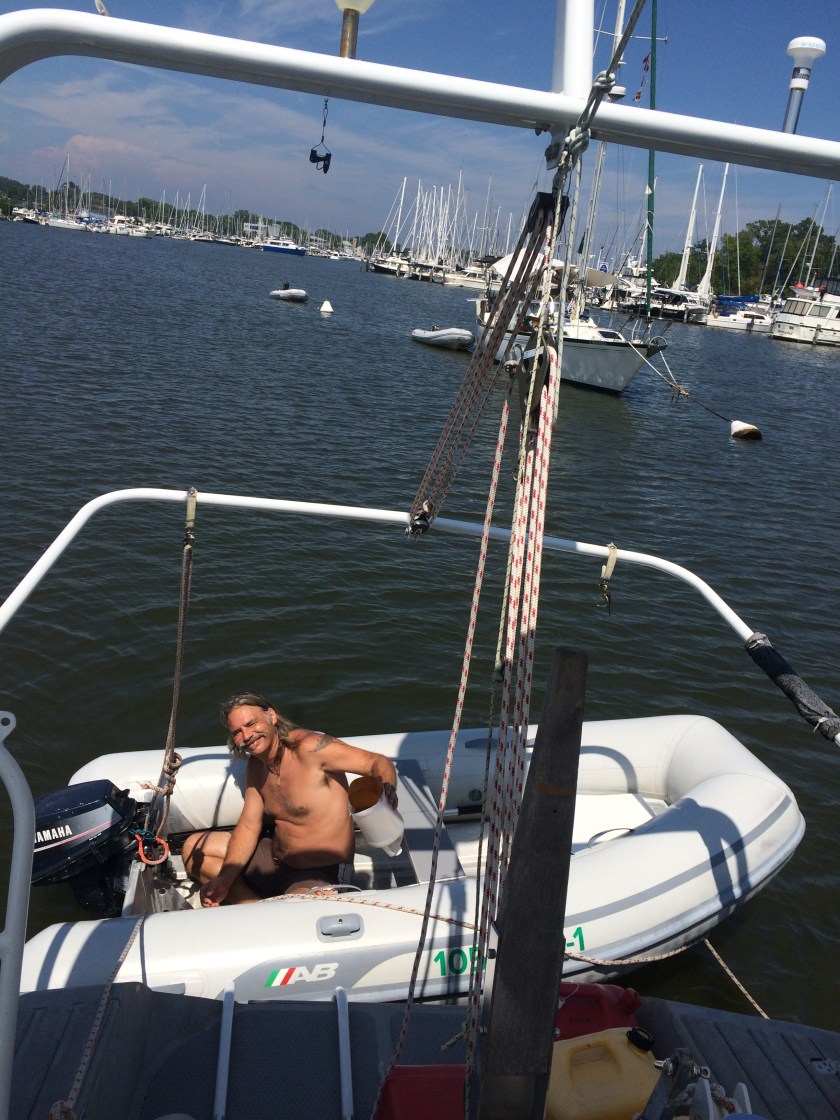
Occasional arguments had begun to flare up with the pesky Yamaha outboard which, at its own discretion, begun choosing random moments to shut down. On more than a few dinghy explorations, we found ourselves temporarily adrift after the temperamental Yama-mama decided it was time for a break.
If we couldn’t manage to get the outboard going again, then out came the oars and it was back to manual propulsion just like the old days! The only successful tactic ended up being the removal of the whole stinking fuel filter – seemed to run perfectly fine again after that. Go figure! Definitely a temporary fix… but better than rowing.
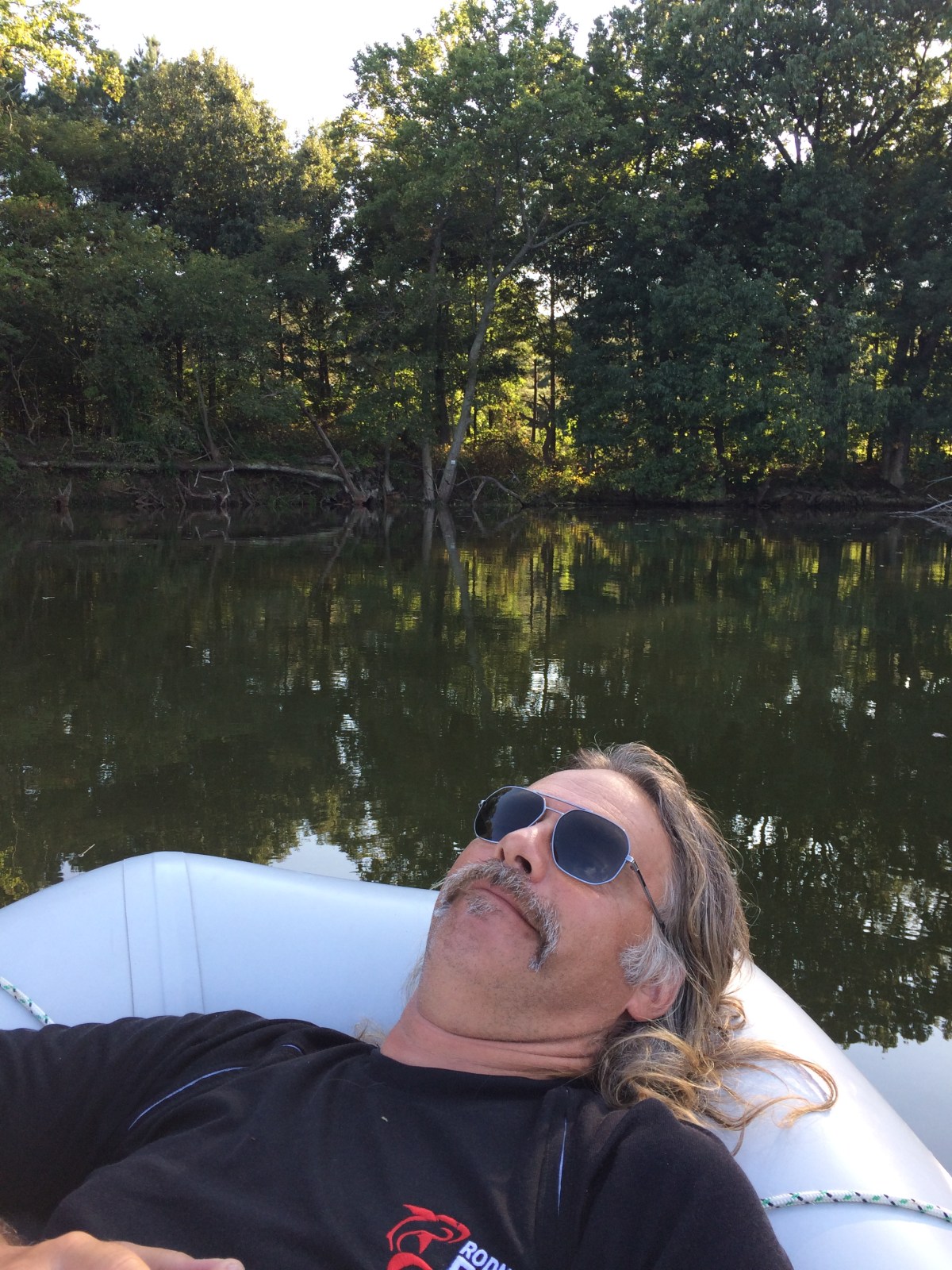
After two days at anchor in a spacious bay with no one around, outside of the occasional small boat or fisherman passing by, simply chilling out aboard Exit, just the two of us… away from it all… another one of those this is what it’s all about feelings started settling comfortably in.
We lifted anchor on a gamble that the boat which had occupied the secluded bay we had passed by on our way upriver had moved on and it paid off. After a bit of wrestling with exactly where we should position Exit before dropping the anchor, we were nestled in an even more serene and cozy spot than before.
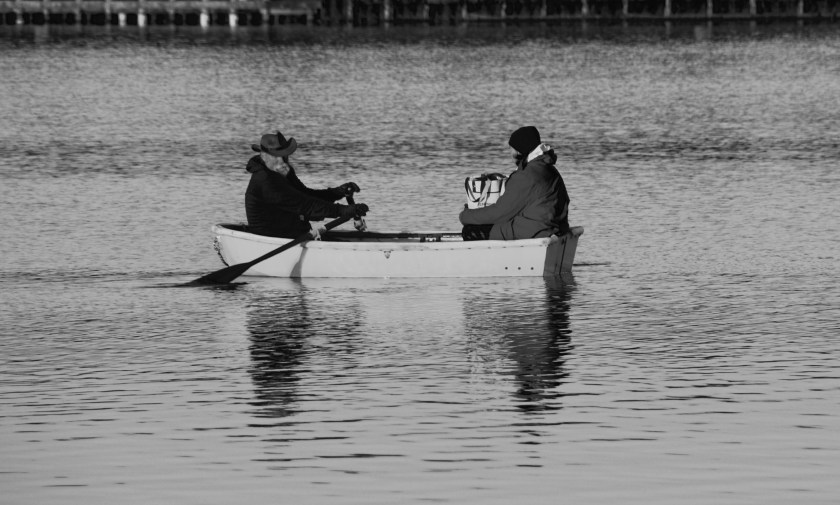
Secluded bays better for rowing anyway
We were rewarded with bald eagles flying above and perching on nearby trees, large cranes and herons hidden at the water’s edge, as well as crazy jellyfish pulsating just beneath the surface of the water. When Kris spotted a stingray gliding slowly around the bay we hopped into the dinghy and rowed around as the ray, whose graceful motion immediately reminded us both of the eagle rays we so often saw while diving in Southeast Asia, slowly circled us.
Jellyfish
Bald Eagle at sunset
Amazing pelicans
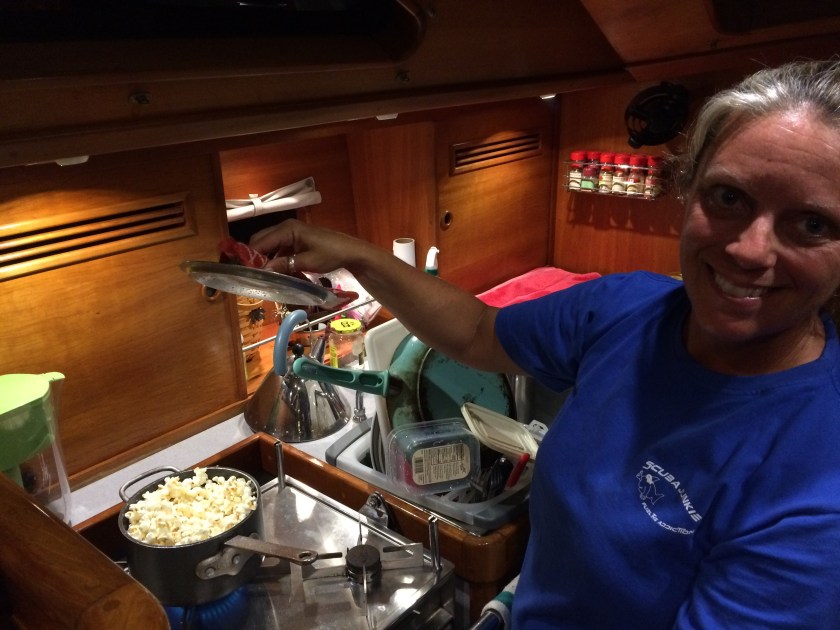
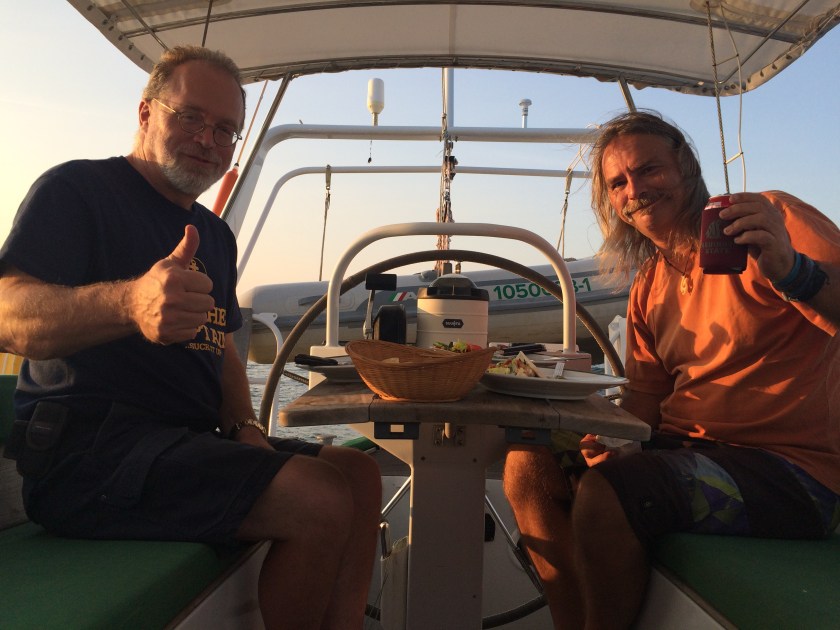
Drinks in the cockpit… cheese fondue for dinner… Triumph’s Hold On playing in the background… popcorn for dessert… definitely… this is what it’s all about.
Lacking the daily rituals of a particular work schedule or having things happening on specific days, the calendar has a strange fluidity about it. Could be Wednesday… could be Saturday. No garbage pickup Tuesday morning to remember Monday night. No darts on Thursday evening. No TV series to hypnotize everyone gathered in the living room for a weekly prescheduled hour. No lawn to mow on Saturday morning. Sure, there are endless tasks to be done… but time, for lack of better way I can think of to describe it, just seems to set its own pace on a boat. Yet, that having been said, there are still noteworthy moments in time when you just have to stop and take notice.
After six weeks of living in a gravel parking lot on the hard, we were now reaching our one month anniversary of living aboard Exit while she was actually in the water! One month… so much we’ve learned about… anchoring, docking, getting up and down the sails (well… the mainsail and Genoa anyway – I’m still convinced the purpose of a spinnaker is to put fear into the heart of reasonable people!), trimming the sails, chart reading, weather monitoring, close-quarters maneuvering, systems maintenance… it goes on and on. We’re still yet to have our first offshore sailing experience. Nonetheless, we’ve spent 700 of the past month’s 720 hours aboard Exit – I hope it’s starting to show!
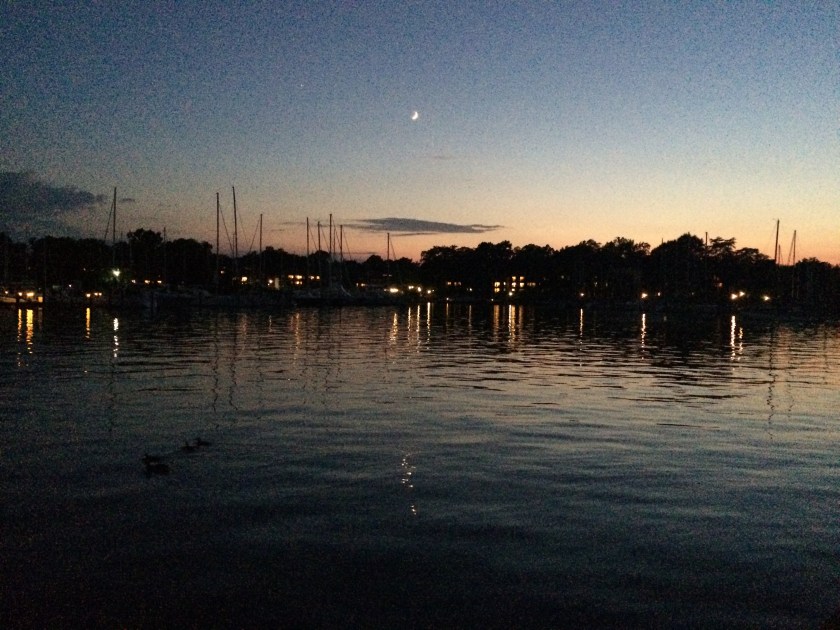
Back Creek sunset Aug 2017
At anchor Back Creek
Back Creek
For our one month anniversary, we decided to pick up the hook in Back Creek, and head across the bay to the Wye River, just outside St. Michaels. Our goal was to find some anchorages which offered a bit of fresh scenery as well as much more opportunity for seclusion… a view of the great outdoors surrounded by a forest of trees, rather than the beautifully manicured back yard of someone’s private waterfront property surrounded by a forest of masts! There are only three things looming on the horizon: helping Dave (the sailing sorcerer/mentor) complete the delivery of a sailboat from Connecticut at the end of the month for the Annapolis Boat Show, my parents arrival during the first days of October to visit us on our new home, and actually attending the Annapolis Boat Show which starts October 6.
Why go do a delivery on some other boat after just purchasing Exit? We pondered this after Dave extended the offer at the end of our Annapolis/Norfolk journey, and came to the conclusion that, while we could easily stay busy every day aboard Exit, there were times when you just have to get off the boat… its kinda like never leaving the house. Plus, part of the delivery would require some time offshore to shorten our delivery time… and offshore experience under guidance is something we can massively benefit from. A non-paying gig but what the Hell… free food, accommodations, and great experience! Dave is not only an excellent instructor and an encyclopedia of sailing knowledge, but he also has a story for just about every topic of conversation that comes up!
This leaves a week before we need to be available for the boat delivery. So it seems an excursion to the Wye River would fit in perfectly as a quiet retreat, with some sailing time built in, before the momentum of activities picks up at the end of the month.
After going through a work-in-progress checklist of things to do/verify prior to raising anchor, we eventually got up the hook and found ourselves outside the marina; but not before Kris racked up yet another flawless docking maneuver at the fuel dock so we could top up our water, get some diesel… and, oh ya, never forget to get the poo pump-out whenever possible!
We made it to the Wye River without incident, and the winds even picked up enough to allow us the pure enjoyment of sailing silently solely under “free power”. With endless anchorages, the idea was to head up the Wye East River and pick a spot along the way.
From Back Creek to the Wye River
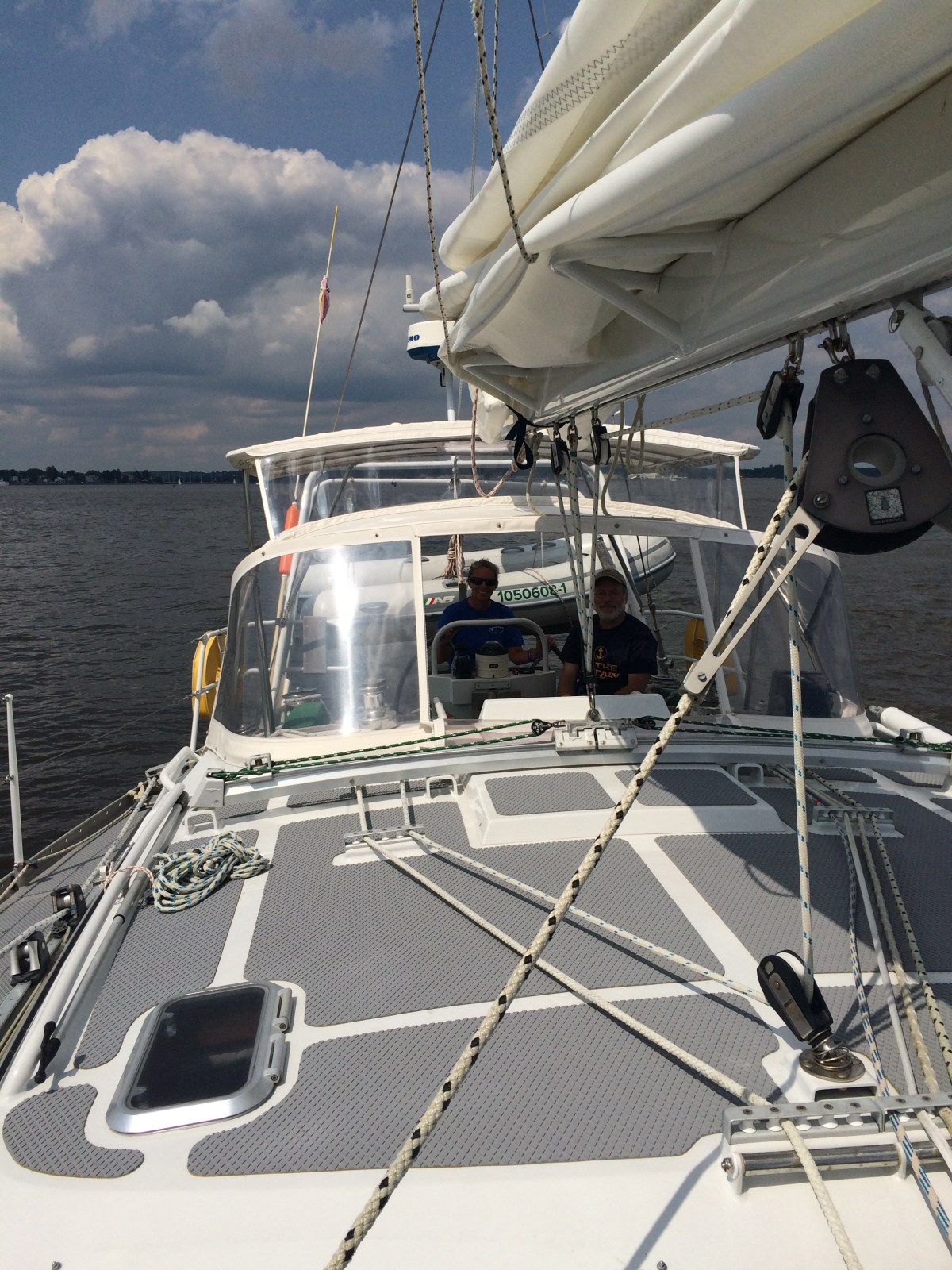
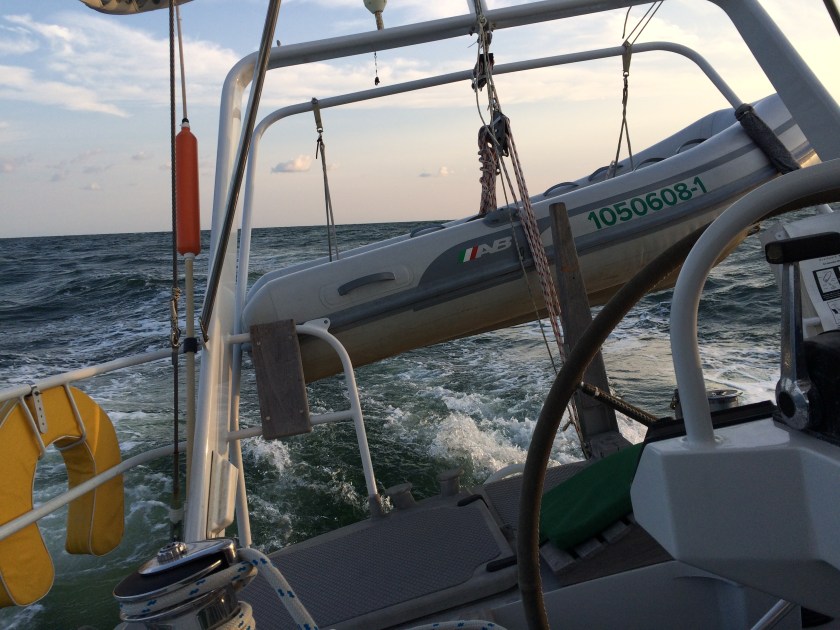
Beating across the Chesapeake
A number of possibilities were nullified by the last minute appearance of another sailboat with better timing, already tucked away in a sweet anchorage, hidden away from view until you were on almost top of the spot… doh!
We thought maybe we’d be ambitious and try for Pickering Creek, well up into the river. At the time, I don’t think we fully appreciated just how limited the space we would have to maneuver actually was… while the creek itself seemed plenty wide, the charts we were using (both paper and GPS) indicated that the mouth of Pickering Creek funneled very quickly from an eleven foot depth into a narrow channel ranging between 8-10 feet deep. The channel depth seemed fine as we already had our centerboard part way up so our draft was not more than 5-6 feet. What may not have been adequately appreciated was the fact that outside of that safe channel remained about two-thirds of the width of the creek, which sat at a depth of five feet or less, invisible to us, outside of the contour lines on a chart or the actual number on the depth gauges in in front of us there in the cockpit. Also disorienting, the fact that a channel running below the water rarely follows the exact same course as the shoreline, so you can’t simply stay in the center of the creek. Too late, the realization set in to me (the very inexperienced helmsman), that this was a classic “flying blind under instruments alone” scenario… one which required more hours behind the wheel than I had!
Compounding the situation were the physical characteristics of Exit herself. Now don’t get me wrong… she’s a beauty… but she’s also quite a big lass, and close quarters maneuvering is not her forte.
Maneuverability and steering are dependent on a lot of different factors. A boat needs a bit of water going past the rudder to gain any real steering. Some boats can utilize the water movement from their prop motion to gain steering but Exit, with her prop positioned further away than on some other boats because of her daggerboard, doesn’t have that benefit. This equates to the boat needing to be physically moving to have any real steering capability. Some boats also can utilize what is called “prop walk” in which the prop motion (either forward or backward) tends to pull the stern in one direction or another. Not so with Exit… she takes a bit to get going and even a bit longer to get turning. For Exit, another factor is the centerboard – something which gives us only a three and a half foot draft when it is up; but, when down it dramatically improves the steering (read as: makes steering possible). So, realistically, we need a bit of centerboard down to hope for any semblance of maneuverability.
So… that centerboard takes away about fifty percent of the creek depth to work with but allows us to steer. Just keep her moving…
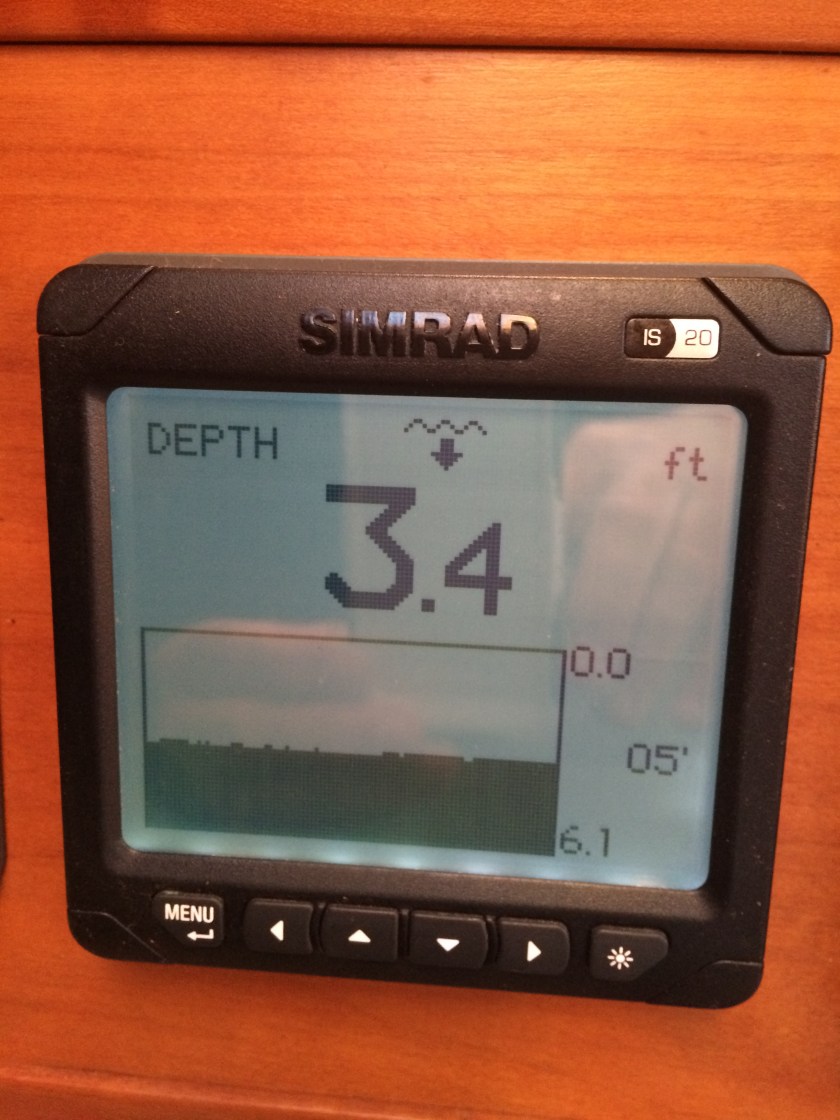
The moment of panic set in as the depth gauges began dropping fast from 9 feet.. to 8… to 7… to 6… and not slowing. Kris grabbed for the winch and quickly hoisted the centerboard… As I tried to bring Exit back into the narrow channel, the number on the depth gauge continued to drop… to 5 feet… then 4…
…now I recall at Herrington Harbor North, just after splashing back in August, putting a marked line in the water to measure the depth with the intention of verifying the number displayed on those very gauges. I told Kris, at the time, it seemed strange that the water appeared to be one foot deeper than the gauges indicated. We both shrugged in one of many “I don’t know” moments and filed it away for a moment just like now…
When the number went below 4 it was like being in a car on the ice with locked brakes – not much you can do cause now you’re just along for the ride… just the holding of breath as you wait for the sickening crunch!
However, at 3.5 feet there was no sickening crunch… nor at 3 feet… thank goodness for that gauge discrepancy… apparently! Then, at 2.5 feet, we felt and heard the now unmistakable sound of a soft bottom sliding along the underside of our hull! We still had just enough momentum that we were able turn off the shallows… but it sure scared the shit out of us; we immediately hightailed it back out of the mouth of Pickering Creek and into what now seemed like much safer navigating space.
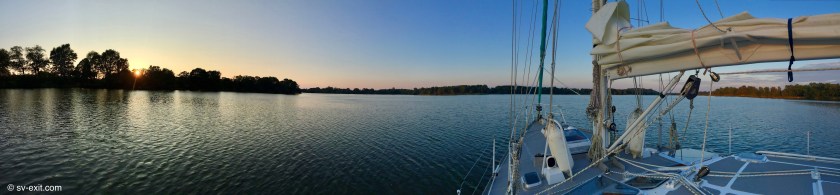
Thirty minutes later we we enjoying the quickly-becoming-a-tradition after anchor beers in the cockpit, having found our own private bay and anchorage on the Wye River. Cheers to our day and especially a near miss on running aground… it really was just a soft skim!
With the very much appreciated assistance of John Albertine who kindly taxied us around Eastport (the training captain who had earlier helped us understand many of the systems on Exit), we were able to round up everything we thought would be needed to fully resurrect our outboard.
The Norfolk trip had revealed a crack in the dinghy’s fuel container so that was already on the replacement list. And, while the gas in the container had checked out clean and water-free, I had failed to consider the fuel line which ran from the container to the engine. Rookie mistake… when I disconnected the small hose leading to the inline fuel filter to verify fuel was getting to the engine, what came out looked more like a latte than fuel. Water had somehow or another worked its way into the hose and ruined the fuel. Fortunately, it wasn’t pumped into the carburetor (at least I hoped so…) so I optimistically concluded we’d dodged a bullet there.
Whatever opening had allowed water into the hose also appeared to be preventing a good seal, effectively killing the suction in the hose. Even the bulb failed to move any fuel… so a new fuel line was added to the purchase list as well as 5 gallons of fresh petrol, just to be sure. Replacement spark plugs and a new fuel filter rounded out our arsenal.
After switching everything out, the moment of truth was once again at hand. Only this time, the fuel was flowing. First pull… nothing… shit! Patience grasshopper…couple more squeezes on the fuel line bulb… ya… choke is out… ya… good connection on the fuel lines… ya… transmission is in neutral…second pull… the engine roars to life! A cloud of white smoke… and… it keeps running!!! Aliiiiive Igor… it is aliiiiiiive!
As a self-acknowledged possessor of two left feet combined with a sometimes challenged sense of balance, a victory dance in the dinghy was out of the question… but that made the moment no less glorious.
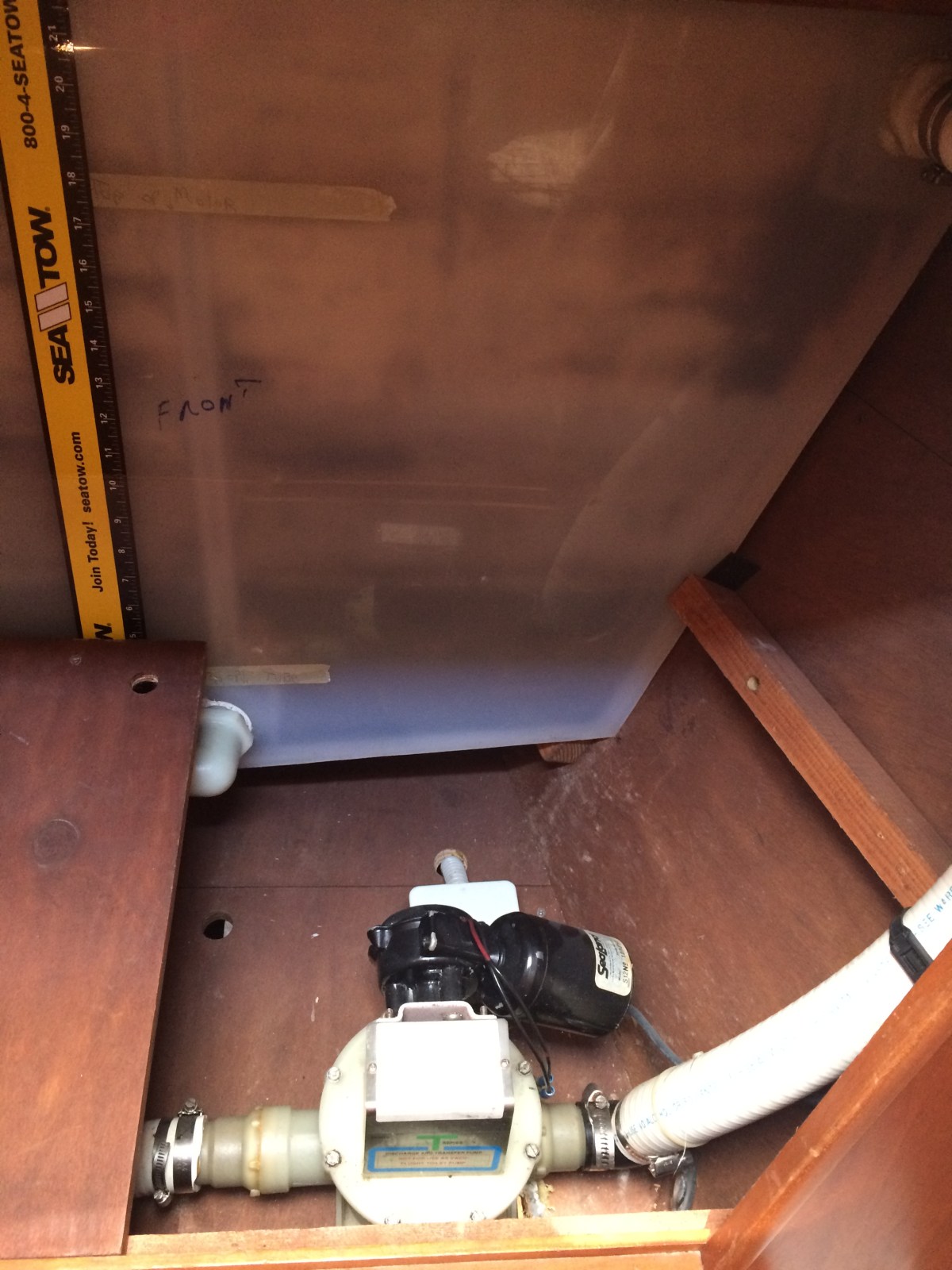
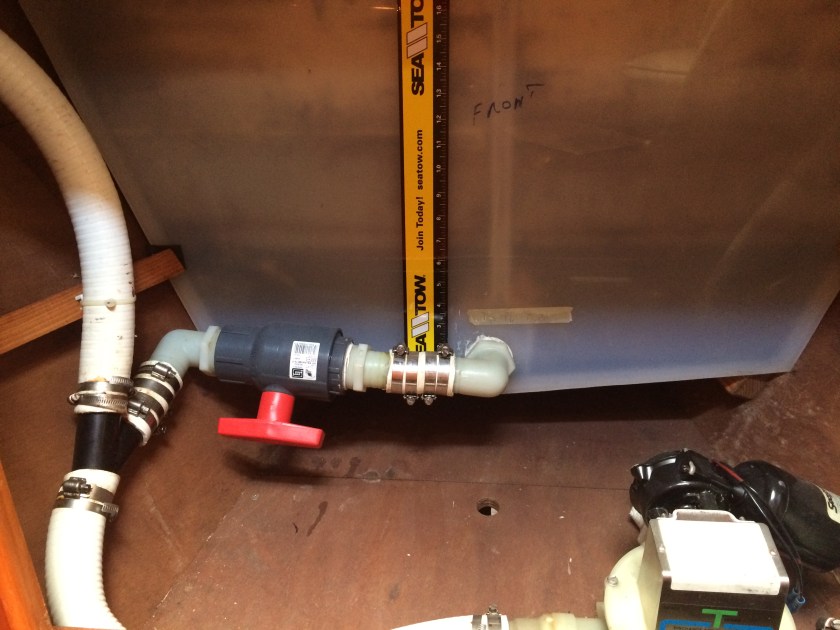
1) Our holding tank (the tank that holds all the poo and pee) has a 50 gallon capacity. 2) We last pumped out the holding tank (a surprisingly less disgusting task than one might imagine) on September 1.
The Lessons:
1) One needs to recognize that feeling great resistance in the handle of the toilet pump when trying to flush the toilet may be a signal that the holding tank is full. 2) Contents of said holding tank have no where to go once the tank is full except out the pump out port on deck and/or out the tank vent in the bow locker. 3) Recognizing quickly that this undesirable process is happening only lessens the degree of disgust to be endured if the problem actually occurs (at least as disgusting a task as one might imagine) 4) Eight days is too long between holding tank pump-outs!!!
Lurking in the darkness of the starboard lazarette,that damn Yamaha outboard engine has become somewhat of a nemesis. Semi-affectionately known as the Yama-mama, it was stowed away there before we set out for Norfolk and hasn’t been out since.
Prior to purchasing Exit, the previous owners had indicated that the outboard motor probably needed to be serviced. Our understanding was that it had began making a bit of noise the last time they used it. But not being able to even budge the starter rope proved to be the more immediately problematic issue. Removing the spark plugs (to eliminate the resistance of any compression) yielded the same result… no movement at all. Some disassembly verified that both the rotary mechanism as well as the neutral safety switch were not to blame.
This left the less-than-ideal likelihood that the pistons had actually seized up in the cylinders. A few inquiries with far more experienced and knowledgable individuals led to the conclusion that this was a job for PB Blaster (a product I’d never heard of before but learned that #1 – is even more effective than WD-40 and #2 – costs less than half as much at Home Depot as it does at West Marine). After a number of consecutive days of squirting shots of PB Blaster into the cylinders and then trying to pull the starting cord a day later to no avail, I temporarily had acquiesced defeat, and spitefully put the Yama-mama away out of immediate sight and mind.
That left human propulsion for the dinghy. Now, I certainly don’t consider myself above the physical labor of rowing; however, I’m not so keen on the humiliation (not to mention the inefficiency) of traveling in circles, loops, and meandering lines as one tries to grasp the subtleties of actually doing it effectively!
With time, the comical visual appearance of a hopelessly confused and drunken sailor had begun to fade from my rowing technique and I was able to actually get from Point A to Point B in a fairly coherent, if not capable, manner. Yet still, the obvious advantages of making peace with the Yama-mama had not escaped me.
After weeks of marinating in whatever magical juices make up the ingredients of PB Blaster, the outboard was released from solitary for one more attempt at rehabilitation. Just for good measure, another shot of PB into the cylinders, and then out with the breaker bar. The theory was that maybe the pull starter simply didn’t have the torque to break free seized pistons. But a socket on the end of the crankshaft nut with a good amount leverage might do the trick…and Holy Shit…the crank shaft moved just a bit!!!
Not a look of confidence
PB Blaster and a prayer
Half movement
Full movement
Not giving up yet…
Another ten or so crankshaft revolutions with some shots of fogging oil in the cylinders and, boom! The pistons moved perfectly…. a victory!
After verifying the fuel in the tank was clean, it was decided, what the Hell… might as well try to fire it up. A couple of shots of starting fluid (I’m a big proponent of cans that squirt stuff that somehow makes problems go away…)…key in… couple of squeezes on the fuel bulb… choke out… and a pull on the starter cord… nothing. But it sure felt smooth! Another pull and… yes! Houston, we have ignition! And immediately… oh no… Houston, we have a problem…she sprang to life and then died! Elation and then the crash… but it did run momentarily… there is hope!
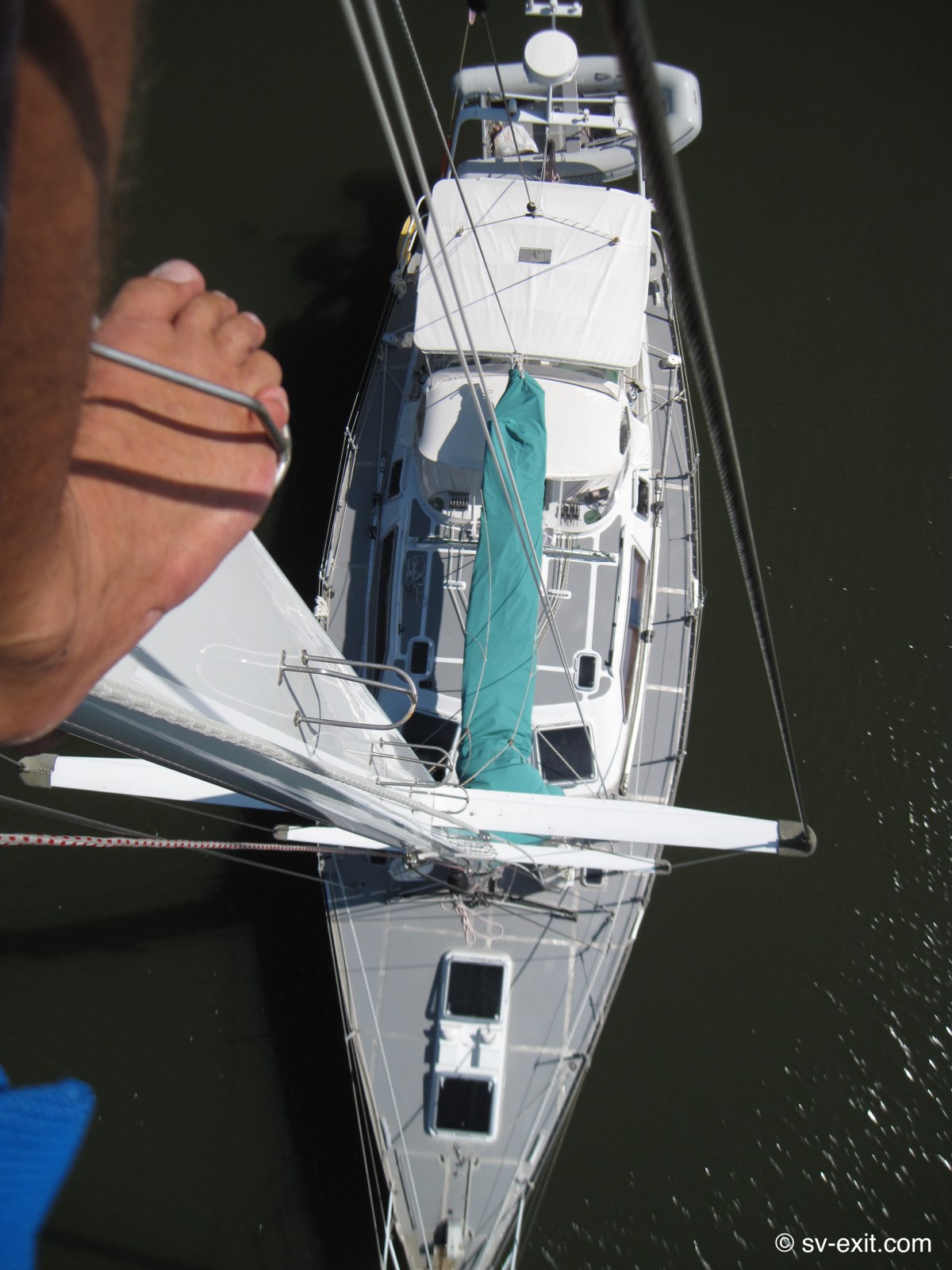
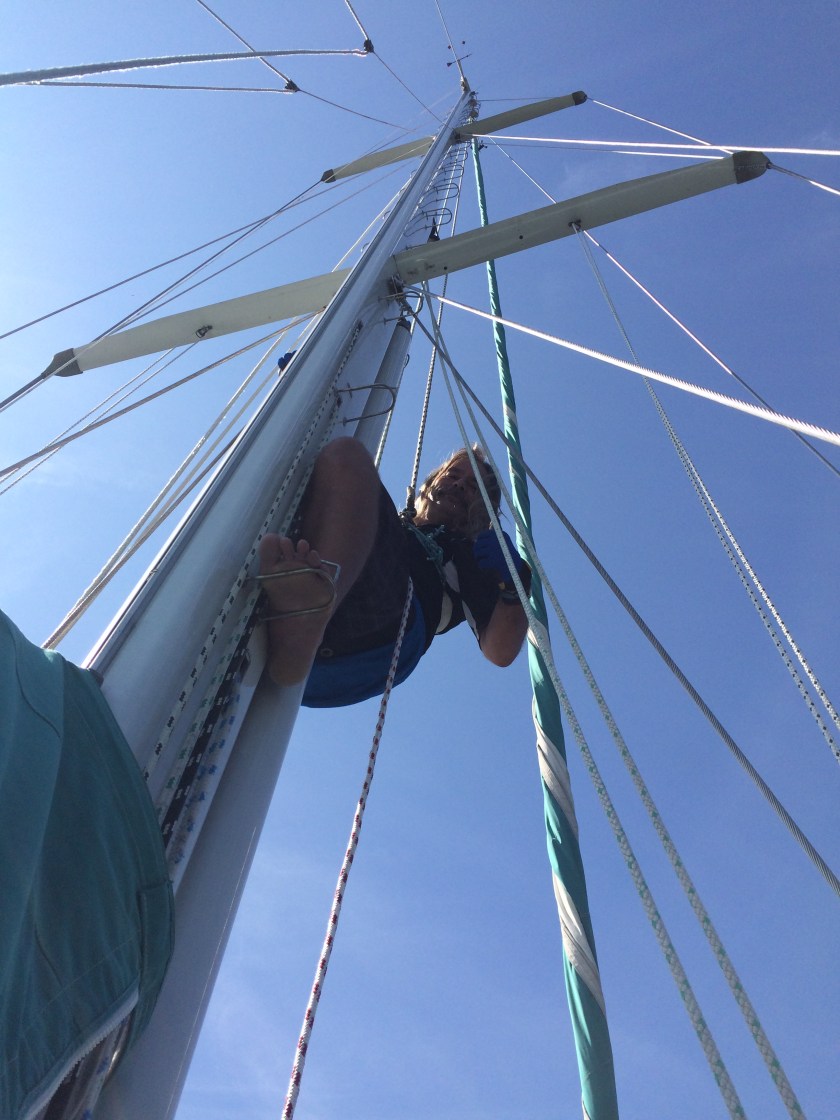
Our mainsail fiasco left us with only one option… time to break out the Bosun’s Chair and go up the mast. On the surface, this seemed like a rather straightforward, if not adrenaline inciting, task. Climb the rungs installed on the mast while being hoisted via a winch in what amounts to a sort of “directors chair without a wooden frame” connected to a halyard which already runs to the top of the mast. Hmmm… pretty straightforward until you’re 30 feet up in the air and realize you’re less than half way there!
Kris offered to go up but then, in a selfless moment of affection, offered me the honor while pointing out that “I needed a victory after yesterday.” By about 45 feet up, I was no longer so certain of her generosity.
To add a further layer of safety/security to the climbing rungs and Bosun’s Chair being winched up on the Spinnaker halyard, I had an additional spare backup line around my chest which also ran up the mast. Plus, I had attached to me a line to tie off the mainsail halyard if needed to assist in bringing it down. We also decided that tying off the tools I was bringing up with me would be prudent – I definitely wasn’t keen on dropping a screwdriver through our salon window and Kris was even less keen on the prospect of potentially having to dodge out of the way of tools raining down from above! Oh, and absolutely need to secure the camera… Hell, yes. I’ll be damned if I’m gonna go to top of this mast and not take some photos!
Tie it like your life depends on it… it does.
Kris started grinding on the winch and hoisted me a few feet into the air to get a feel for things. After clearing the boom I reached the first rung and began the slow climb. As I went up a step, Kris painstakingly cranked the winch keeping the Bosun’s Chair halyard tight. Then after tying off the line, she went to the other side of the mast, brought up the slack and tied off the second line, then returned to the first line and the whole process repeated again. The first ten feet was no problem… Kris did most of the work on that.
The physical aspect of the climbing was not nearly as intimidating as the mental aspect of the height compounded by being on such a seemingly unstable pole. While I should have been comforted in the knowledge that the mainsail under wind exerts far higher forces on the mast than the weight of an adult, the additional fact that the mainsail had come crashing down yesterday didn’t go unnoticed by this sometimes slow-on-the-draw cowboy.
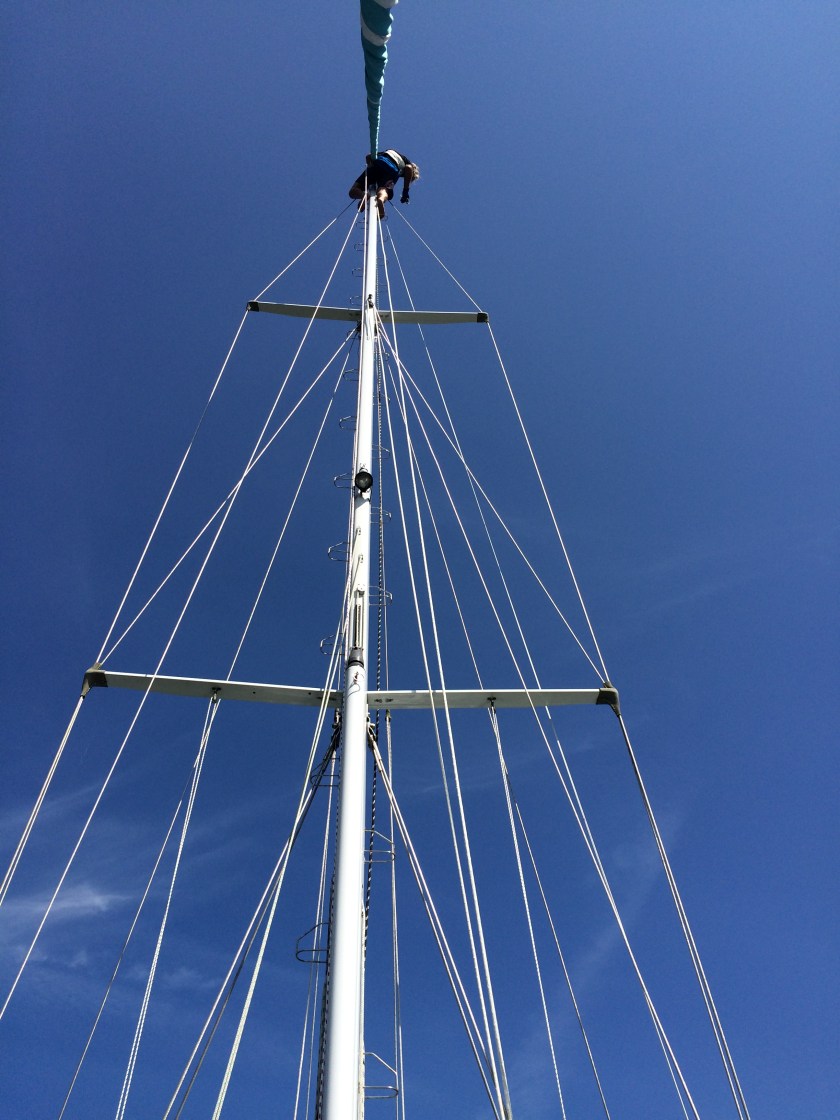
At 50 feet, I had gotten past both sets of spreaders, the deck and steaming lights, the steel shrouds and rope lines all without getting tangled, dropping anything, or falling. However, any movement Exit made in the water became more and more exaggerated as I got farther and farther above the deck… especially any side to side rocking of the boat. I’m sure there are mathematicians who could easily define and calculate the geometry, calculus, trigonometry or whatever math explained what was happening based upon simple angles and height; but the internal equation that was running in my head definitively calculated the movement as a shitload (converts the same in either metric or imperial).
This nearly prompted me to yell out to a couple of passing paddle-boarders, “Hey, this is a no wake zone!”
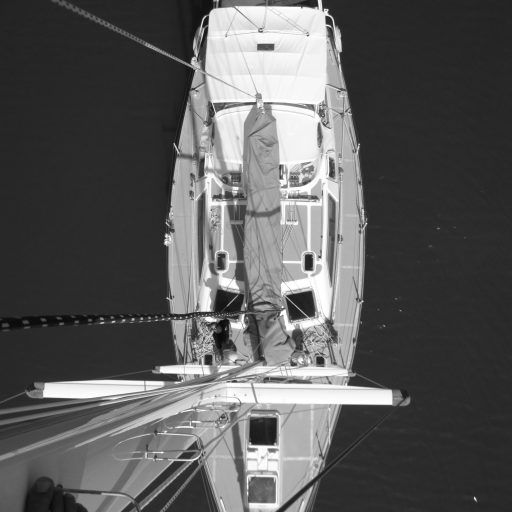
As I reached the top of the mast, 63 feet in the air, I opted for the more insightful and memorable statement of, “Holy shit… this is way high up!”
The mainsail halyard was just sitting at the top of the mast with a big ring at the end; a ring which thankfully had prevented the nightmare scenario of needing to re-run the entire halyard through the mast. All it took was a pull (no additional line needed after all), and the main halyard smoothly descended to the deck. Easy peasy!
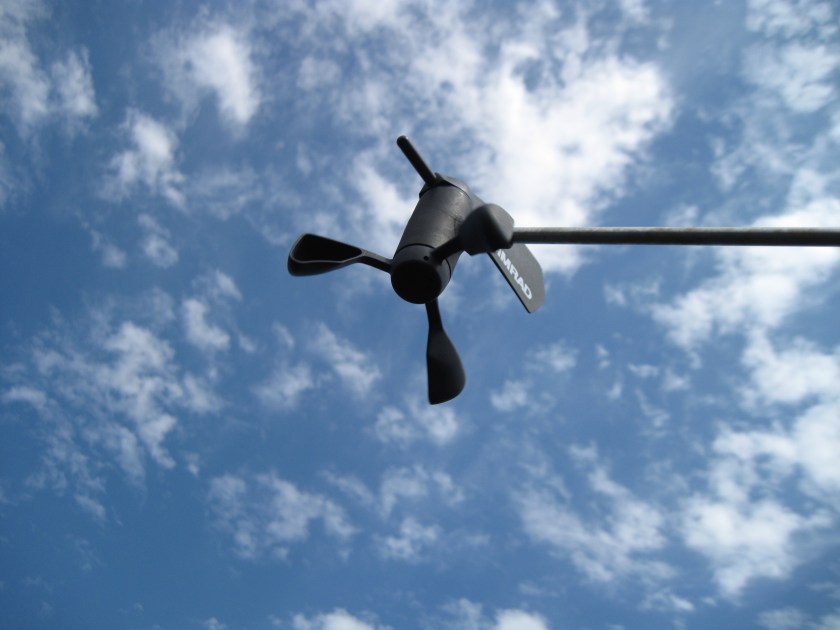
We had also decided that, while I was up there, it made sense to try to straighten the wind indicator sensor, which appeared to have been knocked about 90 degrees out of whack (probably by some belligerent, rabble-rousing bird). Basically, a wind vane with a paddle wheel oriented below it, it needed to sit at a certain angle to retrieve its’ data (wind speed and direction). We had learned by experience that when the cockpit gauges give completely incorrect wind speed information and the close-hauled and overall wind angle gauges contradict not only each other, but also the actual wind in your face, then presumably your wind indicator sensor at the top of the mast was more than likely misaligned… sure as shit… this appeared to be the case!
Wind indicator 63 feet up the mast
It turned a bit more easily than I would have liked; but, after turning it in the opposite direct and getting no resistance, I chickened out and stopped – fearing that if it was just press-fit in place, I may only make it more loose. So I rotated it 90 degrees and called it good, relaying my third inspiring quite to Kris which was, I believe, “O.K.. get me the fuck down!”
Looking down from atop the mast 63 feet in the air certainly makes the “A-List”, but I wouldn’t relish the thought of doing it every week. Making the All Time Memorable & Inspiring Quotes List was my final comment regarding the Bosun’s Chair… It’s going to take most of the afternoon to dig these boardies out of my butt crack! In addition to added safety, this contraption is a first-rate wedgie giver!
Major wedgie…
In the end, it was two steps forward and one step back. The following morning, as I was brushing my teeth, I looked up through the ceiling hatch in the forward head and I’ll be God-damned if I didn’t see that stupid wind indicator sensor at the top of the mast laying over back on it’s side again… Arrrrgh!!! Looks like another trip up the mast is in my future.
After our successful roundtrip journey to Norfolk and back, we were finally released from restrictions by our insurance company; so we decided how better to celebrate than to go for a sail… our first solo sail on Exit. Well… nothing ever goes quite as planned.
Though Exit was riding on the water, we were riding on the clouds… one of those key moments when you realize everything you had been dreaming of and struggling for was finally coming to fruition. We were aboard our own sailboat proudly navigating through the marina. One of those small world moments occurred when a sailboat with six or eight people on deck overtook us.
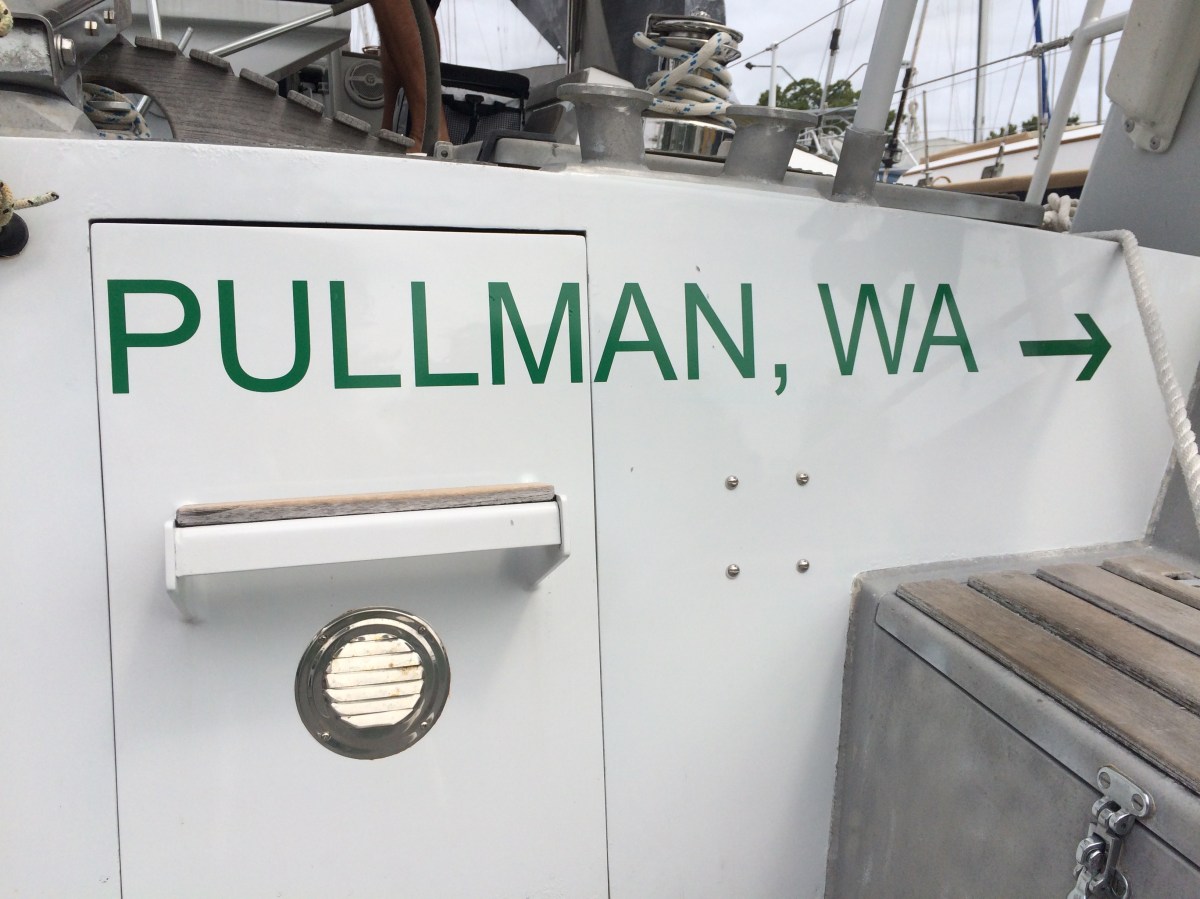
As it passed us, one of the guys on deck pointed at our transom and called over, “Go Cougs!” He went on to say, “ I was actually a UofI Vandal but I thought that was close enough!”…go figure.
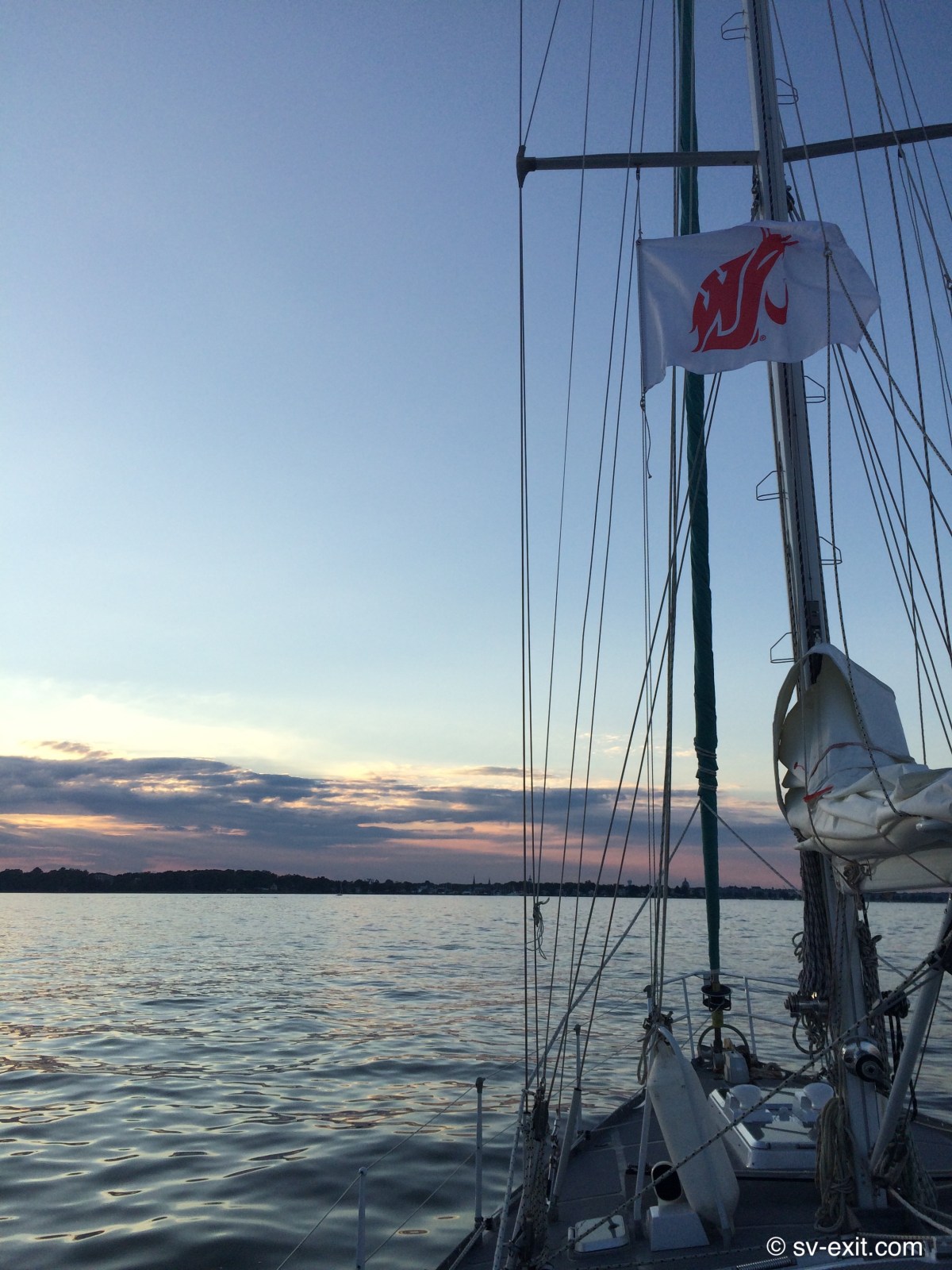
Narrowly avoiding the faux pas of flying the flag on the wrong side
Cougar Colors flying under the port spreader
We got out of the marina without any drama and motored clear of most of the boat traffic. Kris stayed at the helm in the cockpit, keeping Exit pointed into the wind, while I went out on deck to raise the mainsail. Everything seemed to be going according to plan.
Without warning, just as the mainsail reached the top of the mast… BAM! Something gave way and the sail came crashing back down onto the boom.
In and of itself, the mainsail coming down like that certainly was not ideal, but at least it posed little threat of equipment damage or bodily injury. Nonetheless, it caused one hell of a clatter as all sixty feet of sail plummeted down in about two seconds and landed on the boom below. After the initial startle subsided, I looked back into the cockpit at Kris and read the very words on her lips I was speaking simultaneously… “WTF just happened?!?!”
As it turns out, a sewn nylon strap attaching the top car (which runs up and down a track on the front of the mast) to the mainsail and halyard had separated. For some reason, the previous owners had (we were later told) improperly attached the sail in a way that, when that webbing separated, the mainsail halyard separated from the sail and slid up into the opening in which the halyard tracks back down the inside of the mast to the deck instead of remaining attached to the sail.
Broken bits
Minor issues
Fortunately, a shackle on the end of the halyard prevented the entire line from disappearing into the mast which would have required us to feed the halyard all the way back up inside the mast… not an easy task, I am told. Unfortunately, the nylon strap was the only thing connecting the sail to the halyard so, when it failed, the entire sail dropped sixty feet into a heap. We joked that it was the best flake (folding the sail back and forth in a zigzag pattern as it descends to keep it tidy on the boom) that we had experienced so far!
We were not gonna be able to solve this without going up the mast, so our sailing day was over before it had begun. We decided to make the best of the situation. Since we were already out and about, we figured we could practice some close quarters navigating by putting out a couple of fenders in the water about 5 meters apart that would be used to simulate a dock we could pull up against. I tied one fender to our dinghy anchor and chain; the other fender to a spare fixed propellor we had and threw them in the water.
Before starting our exercises, I went below for a quick trip to the head. But while I was walking past the galley we were hit with our second mishap of the day. Suddenly, I heard the unmistakable sound of a substantial amount of water pouring out from somewhere under the sink! I opened the cabinet door only to be met by a cascade of steam emerging. It was the result of water from a burst hose, coming in contact with the hot refrigerator compressor. It turned out to be the hot water hose leading to the sink which had come disconnected at the faucet… water heated by the engine while it is running which was about 195 degrees! I was able to turn off the water pump quickly which, at least, stopped the flow of scalding water. I told Kris what was going on and proceeded to start re-securing the hose to the faucet with the hose clamp. As I was tightening the clamp, Kris called down to me, “I don’t mean to add to everything, but it appears that one of the fenders is floating away!”
I climbed the stairs back into the cockpit to look in the direction she was pointing. Sure enough, the fender was barely visible almost 100 yards away… much farther from the other fender than it had been five minutes ago! Initially, I thought the fender had dragged a bit until it was in water too deep for the prop to rest on the bottom and was now floating in the current with the prop below it… Kris thought differently.
Of course, Kris was right. As we approached the fender, which had begun to drift into a maze of cab pot floats, I was perplexed to see, or rather NOT see, the line I had tied to the fender which I planned to snag with the boat hook. Slowly, the sickening realization set in that the line was not there… which meant the prop was not attached… Damn! Strike three! We finally recovered the fender but had lost the deck line and spare propeller!
Now… to me, the situation seemed rather straightforward. I had fucked up the knots and I had lost the prop… D-minus in knot tying! But our saving grace lie in the other fender, a tiny white dot barely visible a few hundred yards away still bobbing on the surface. It was essentially a marker indicating within a five meter radius where I figured the prop should be.
The only logical solution I saw was to grab the full scuba tank (left aboard by Exit’s previous owner), gear up, and hop in the water – either I drop straight down where I thought the prop sat or I run out five or six meters of line from the anchor and do a quick search pattern… and voila! Prop recovered…
Kris however, didn’t see this as the brilliant recovery plan I had envisioned… I believe the words dumb and dangerous were how she described it.
She then went on to point out that although we could anchor the boat, it would swing and drift in the wind. Combine this with near zero visibility in the muddy Chesapeake waters and a ridiculous amount of Labor Day Weekend boating traffic all around us – all this converged into what she foresaw as a potential disaster.
There is a commonly adhered to practice we have heard of in tech diving (possibly a superstition or possibly the wisdom of people who haven’t died) called the Three Strikes Rule. While I am sure this not a scuba-exclusive perspective, in tech diving the idea is when three things go wrong you abort the dive. Whether the concern is in a scenario of cascading problems (it is rarely a single event that leads to catastrophe, but rather small problems compounding into larger ones) or the more visceral mindset that three problems is simply really shitty luck so why push it further, the end idea is the same… get out while the gettin’s still good!
So… after a heated debate, I opted to defer to Kris’ wisdom (ultimately this generally proves the smart thing to do), pulled up the anchor line on the float still in the water, and we said farewell to our spare prop.
Ya, ya… someone suggested a few days later that we could have marked the GPS coordinates on our Furuno and come back another time to look but that didn’t occur to us at the time… live and learn… but hey… I’m still alive, and I think Kris generally is good with that.
The training we had been receiving under the guidance of long-time sailor, delivery captain, tech guru, and sailing community personality Dave Skolnick was both incredibly insightful and incredibly overwhelming at the same time. The culmination of this training, which would effectively tick all the required boxes put forth by our insurance company and let us off the proverbial leash, was a nearly 300 mile round trip on Exit from Annapolis, MD to Norfolk, VA. While Dave would be aboard to offer advice, insight, and assistance as necessary, it was our job to plan all the logistics of the passage (including provisioning, planning meals, course plotting, boat preparations, etc) and actually get the boat there and back. The schedule, as set forth by Dave, was to be a 48 hour nonstop voyage.
Training day on the Chesapeake
7:00am:
An early start to the day. Lots of prep work going through our pre-departure checklist which included shopping for food, checking engine fluids, and verifying proper operation, pumping out the holding tank, topping off the battery and refrigerator charge with the generator, getting everything on and belowdecks properly stowed and secured, double checking the weather forecast, discussing our intended course and any hazards or points of note along the way, securing the dinghy to the stern davit… generally confirming everything we would need to have, know, or do during the passage.
12:00 noon:
Dave arrives and we go through everything with him, confirming we have considered anything he deems necessary, as well as embellishing on anything he feels may be incomplete or overlooked.
2:00pm:
We fire up the trusty Perkins 80hp diesel engine, release our lines from the mooring ball… and Exit is underway on her first real maiden voyage with us as owners (not including the day trip from Deale to Annapolis).
Late afternoon and evening:
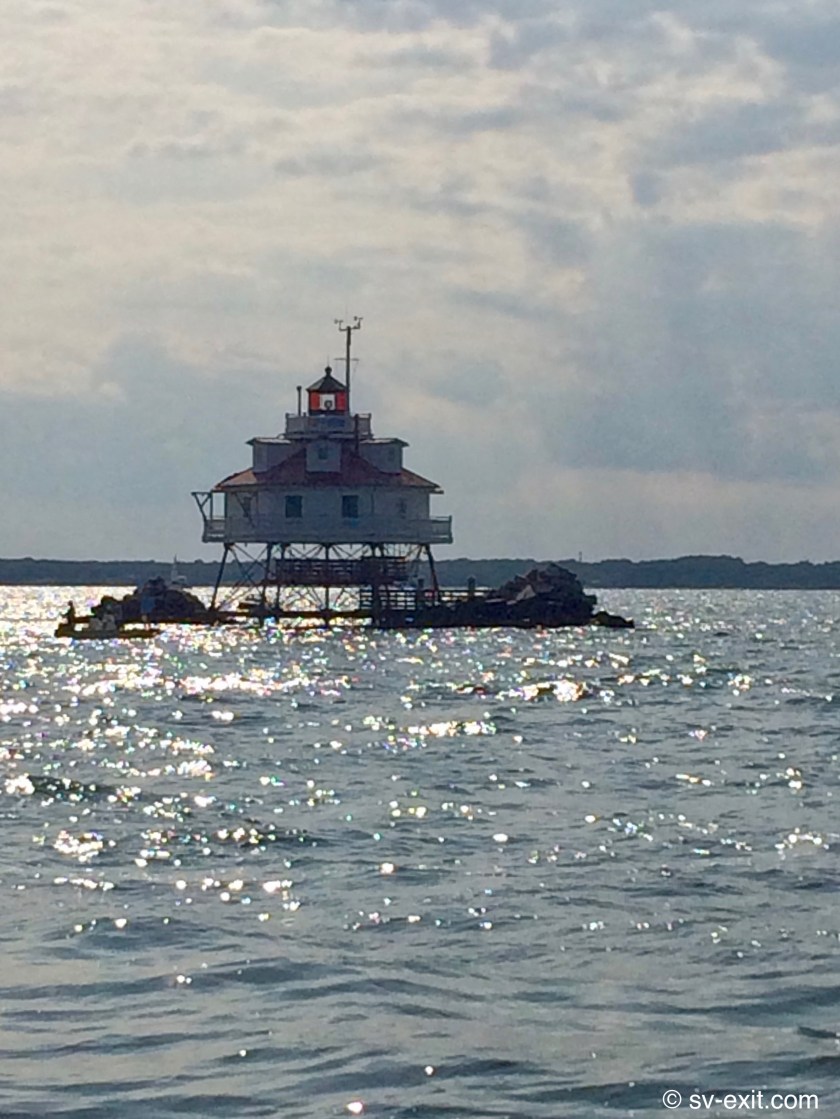
Passing Thomas Point Shoal Lighthouse – August 26, 2017
While underway it is imperative that either Kris or I be in the cockpit at all times. This is not simply to steer the boat (which is under autopilot control much of the time) but to provide a watch for any potential hazards on the water (marker buoys, other boat traffic, land… all of which we want to avoid contact with). On a 24 hour sailing schedule, this can become quite taxing as there are constantly things needing to be done by someone, not to mention making sure we get enough rest to maintain vigilance, awareness, and clear thinking. We decided that during the day we would each take three hour watch shifts from 10am to 10pm, then I would do a six hour shift from 10pm-4am and Kris would cover the 4am-10am watch (this seemed perfect as I am the night owl and Kris is much more of a morning person).
The wind was almost non-existent throughout the day and evening which, unfortunately, meant we were motoring for the entire fist day. Speed by motor averages about 6 knots, as does a good sailing pace; so it was not so much of an effect on how long it would take us. It was simply a desire to be sailing as much as possible rather than motoring (plus the wind is free, whereas the diesel gets swallowed at a rate of about one gallon every hour with the engine running).
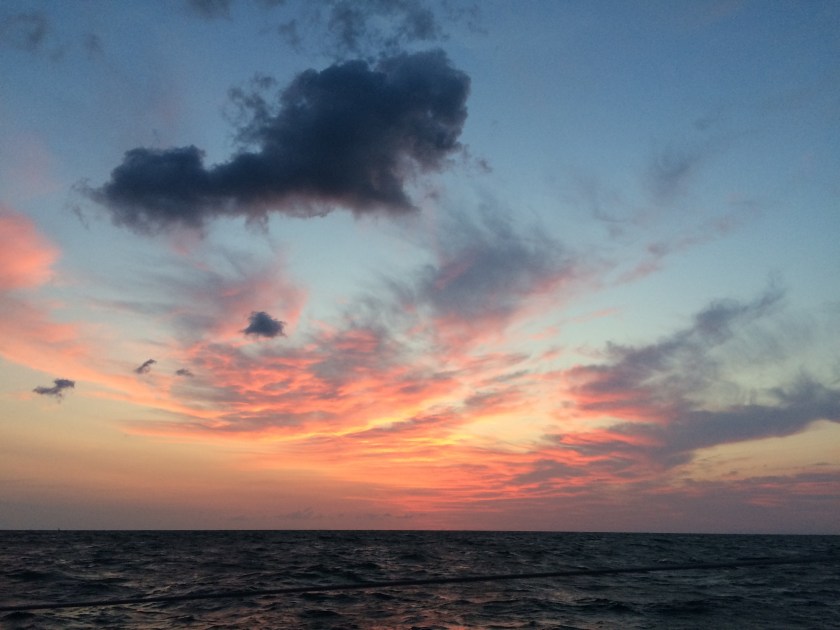
First sunset off anchor – Chesapeake Bay August 2017
As the sun set, we embarked on a new first – we had never driven a boat at night! Dave checked on us regularly, asking questions and giving advice. It seemed he had a story relevant to every topic (as well as a lot of stories that were told simply for their entertainment value). The entire time we were expected to sort things out as best we could, but it was very reassuring having Dave aboard to offer additional insight as well as the more than occasional bit of assistance.
With the nightfall, things became much more challenging from a navigational perspective. Though the lights on markers, navigational landmarks, other vessels, and even passing towns often provided an easier target to spot than during the day, it was an exasperating and exhausting experience trying to sort out exactly what we were seeing. Boat traffic undoubtably created the most difficult challenge – distance, speed, direction of travel, and identifying the type of vessel all became very hard to interpret in the dark. On more than a few occasions massive cargo ships, cruise ships and tug boats towing huge barges behind them provided surprises when we misinterpreted their distance or direction. The cargo ships, traveling at speeds which closed the gap between us at an alarming rate, often seemed like the most menacing things to deal with. Finally, at 11pm, after a particularly confusing bout of sorting out the lights of a handful of vessels that were approaching us from different angles, Kris went to bed leaving me alone in the cockpit as Dave had retired to his berth to catch a rest.
2:00am:
The arm for the throttle control protrudes a bit forward of the helm pedestal when the engine is engaged; both Kris and I had already bumped it accidentally a couple of times with our butts when standing in front of it in the cockpit causing the engine rpms to drop. So, when the engine started to slow as I was standing in front of the pedestal trying to look up at the wind indicator on top of the mast, I thought it was my butt that was to blame. I reached back and brought the throttle up a bit whereby the engine returned to its previous speed of about 2000rpms. Just as Dave’s head poked up through the companionway and I started explaining to him that I had inadvertently bumped the throttle, the engine started dropping off again… only this time I knew for a fact that I had made no contact! Again, I brought up the throttle but the engine speed continued to slow, and finally the Perkins stalled. A persistent and noisy buzzer immediately triggered at the engine’s control panel on the companionway steps and, as we tried to restart the diesel, it simply turned over and over without firing up. Not an immediate emergency but also certainly not ideal!
Obviously, this was a problem that needed solving but there was a much more immediate issue… without forward speed there was no ability to steer the boat. And, though conditions on the water were not that rough, uncontrolled drifting and bobbing about at night with other boat traffic in the area and land not far off was far from a desirable situation. By this time, Kris had sleepily emerged from belowdecks wondering what in the Hell was going on. Dave immediately took charge of the situation and declared that getting the engine running was of secondary concern. The priority now was getting the mainsail up so we could regain control of the steering. While he remained in the cockpit trying to keep Exit into the waves as much as possible, Kris and I went out on the deck to start sorting out the mainsail… something we had never attempted at night.
The combination of the boat pitching around in the waves, the darkness, difficulty hearing each other between the deck and the cockpit in the wind, and technical difficulties we were having – like getting the sail battens (hard plastic pieces sewn into the sail to help it maintain its shape under sail) clear of the lazy jacks (a rope system set up on both sides of the boom and mast to help contain the mainsail when it is being lowered), not to mention the overall stress we were feeling knowing the engine had conked out, all led to a rather formidable struggle.
When things finally settled down and we were sitting in the cockpit, comfortably moving again under the power of the mainsail and Genoa, we were shocked to learn two hours had actually passed!
By 5am, I was exhausted. Both Dave and I went to bed, leaving Kris alone in the cockpit to continue her watch and complete the first night of our passage under sail.
10:00am:
When I emerged later that morning, we were only a few hours away from Norfolk. The plan was to sail the rest of the way until we reached Little Creek (just beyond Norfolk) and try arrange a tow boat to get us into Cobb’s Marina, where we could sort out what had happened with the engine. Earlier, we had been averaging around 6 knots under engine power but now, under sail, we were traveling at 8 knots (even reaching 10 knots at times). Dave joked that we should have put up the sails earlier as he tried to make contact with the tow boat and sort out the logistics for our rendezvous. We got to work trying to sort out the engine issue while we were under sail with the hope that, if we could figure it out before arriving at Little Creek, we could call off the tow boat.
While Dave and I were below, my head buried in the engine room with Dave asking questions and advising, Kris called down to us, “I don’t want to depress you, but I’m sitting up here with dolphins!”
I groaned and said, “Thanks for that.”
Dave quickly told me to get up on the deck and enjoy the moment. Dolphins are one of a handful of things that have the ability to put an ear to ear grin on your face despite a bad situation. So, for about fifteen minutes, we forgot about our engine woes and took in the magic of having a small pod of ten or so dolphins swimming around us. Gracefully darting back and forth, occasionally breaking the surface momentarily or even leaping a bit out of the water, they seemed to be playing with us, toying with Exit as if to say “We’ll show you what hydrodynamic really is!”
After a brief but invigorating break watching them, I returned belowdeck to continue trying to troubleshoot the source of our engine failure. But, it was to no avail. My skills as a diesel mechanic quickly proved to be lacking. By about 1pm, we were tacking back and forth a couple of miles outside the marina entrance, trying to keep some distance between us and the land until the tow boat called us to say he was ready.
2:00pm:
With the tow boat providing our forward power secured to the side of Exit, we humbly made our less than triumphant Norfolk entrance into Cobb Marina sails down. As Kris steered for both vessels, the tow boat captain Berry happily chatted away with us. He knew Dave from an previous delivery we had been told about earlier.
After safely arriving and tying to the dock of the marina, we once again set about trying to diagnose the source of our Perkins’ ills. All indications seemed to point towards a fuel system issue and it appeared that we definitely had air in the system, but bleeding it at the fuel filters, fuel pump, and injectors only resulted in the engine turning over without firing up.
7:00pm:
Frustrated with our lack of success, and pending the hopeful response we awaited from Dave’s inquiry on Facebook trying to garnish ideas and suggestions from colleagues and friends, we decided to call it a day and headed to a restaurant/bar with the memorable name of Captain Groovy. Dinner and multiple drinks took the edge off a less than perfect afternoon. By the time we returned to Exit a few hours later, Dave had dozens of responses to his Facebook post, most of them confirming what we had already concluded… tomorrow was going to be an educational foray into changing both the external Racor fuel filter/water separators, the internal secondary fuel filter, and more bleeding of the fuel system.
August 28 – 9:00am:
We had spare Racor primary filters aboard but, despite all the spare parts aboard Exit, a spare secondary filter was nowhere to be found. So, while Dave arranged for one to be delivered from the nearby Napa parts store, I commenced with changing out the Racors. It involved not only the physical changing of the filters, but also a lengthy process of tracing of all the lines in the fuel system and sorting exactly how everything was laid out and routed. We learned very quickly just how important it is to not only learn the specifics of how the boat is configured, but also to label everything clearly (something which was not already done) which makes the diagnostics and repair job much easier and timely. We would take this lesson to heart and, soon after, start the time-consuming (but also insightful) process of attempting to label every water hose, seacock, fuel line, and electrical switch we could identify.
Our hope was to complete the repairs, confirm that the engine was functioning smoothly again, and get out of Little Creek by late afternoon or early evening to start the return journey from Virginia back to Maryland. The biggest concern was a pretty serious storm that was developing and moving our way. Dave sat, working at his computer, occasionally answering questions I posed while I wrestled in the tight confines of the engine compartment. Another lesson learned was that, while a given repair may not be that complicated, performing it successfully in the tight quarters allowed by the constraints of very limited boat space created it’s own challenges.
We also had developed a slow water drip coming from the ceiling in the starboard berth which had to be traced. Removal of some interior trim and a couple of panels revealed the source of the leak to apparently be one of the cockpit speakers. Tied up to the dock, our position was fixed (unlike at anchor, when the boat always swings to face into the wind); the pounding wind and rain were driving straight into the cockpit from astern, and the resulting bath apparently exceeded the speaker’s “marine” capabilities. After a quick tape job sealed off the speaker from the elements, the focus returned to getting the engine back on line.
2:00pm:
By mid-afternoon, all filters had been changed out and the fuel system bled. We crossed our fingers, turned on the key, and pressed the start button. The engine fired up straight away but still ran rough, indicating that a couple of the injectors still required some additional bleeding. Moments later, the Perkins engine sprang to life, running smoothly like nothing had ever happened. We cheered, and high fives were enthusiastically exchanged. It looked like we were back in business!
Lesson in Diesel Mechanics: Fuel Filters 101
Crap even beyond the lift pump strainer
The weather, however, had different plans for us. Multiple checks with different weather sources confirmed what we feared. Small craft advisories were already in effect all up the coastline and a serious storm was bearing down on us quickly. The forecast called for 6-8 foot waves and winds gusting as high as 50-60mph! It was certainly no hurricane, yet wind and waves of that caliber hitting us straight on the bow would mean motoring the whole time, and it would be a miserable slog for at least twelve hours, certain to beat the crap out of us the whole time.
We wanted to get moving but prudence and common sense told us to hunker down, prepare Exit for high winds by securing everything aboard, and hope for a quick break in the storm. Once again, we found ourselves in unchartered territory as we now had the learning experience of getting ready to face a storm on our boat that, at least, we’d experience from the relative safety of a marina.
6:00pm:
With everything on deck safely stowed away or secured, we watched as the storm descended upon us. The wind began to howl and the rain pounded down. At one point, a gust blew through that picked our ten foot aluminum hulled dinghy up from the arched davit it was secured to at the stern of Exit about four feet above the transom, inverted it at a ninety degree angle so we could actually see the inside of the dinghy floor from the companionway, and slammed it back down with a sickening thud. The lines and davit held but we heeded the warning and immediately clamored up on deck in the maelstrom before the storm had the opportunity to rip our dinghy clean off the davit or, even worse, break the davit itself. Dave calmly advised us to drop the dinghy into the water, pull the drain plug at its’ stern, and partially sink the dinghy to protect both it and the boat… which we did quickly.
With nothing to do but wait, we headed back to Captain Groovy for dinner and plenty of drinks. It didn’t look like anything was going to change in the weather for the foreseeable immediate future so we reserved ourselves to a evening of food someone else could prepare and plenty of drinks.
August 29:
It was now mid-afternoon but the wind and rain still had not let up. The forecast indicated that the storm would still deliver 5+ foot waves and relentless wind for quite some time. Though we were starting to get a bit of cabin fever, we could do nothing but continue waiting.
By dinner, we had decided it was time to mix things up, so Captain Groovy’s was sidelined in favor of a longer (and wetter) walk to Sushi King for sushi and saki. After dinner, we noticed on the walk back to Exit that conditions definitely seemed to be improving. We agreed to head to bed with Dave getting up to check the weather status and realtime forecasts and updates every couple of hours. If the wind and rain continued to settle down, we would make a run for it as soon as possible.
August 30 – 4:00am
With two hours still to go before sunrise, we awoke to Dave smiling and asking us “Do you want to go home?”
We climbed out of bed and quickly completed our preparations to depart from Cobbs Marina. At around 6:00am, we released our lines from the dock and slowly began making our way out into Chesapeake Bay. The wind and waves had not completely subsided, but had quieted down substantially. As we crept forward at only about three knots, we were grateful for waiting out the storm.
By 7:00am, we approached the shipping lane which ran just offshore. With nearby Norfolk being one of the busiest Navy hubs in the world, shipping traffic through the area was constant.
As we were creeping along, our VHF radio crackled to life, announcing that boats in the area should be aware of a U.S. Navy aircraft carrier that was just entering the shipping lane. We saw the Navy vessel headed towards us, basically on a near intercept course with us. Dave joked that, “At least this was not a ship from the Navy’s 7th Fleet, which had been responsible for three collisions and a ship’s grounding over the past six months resulting in multiple fatalities!”
US Navy outside Norfolk, VA
When we hailed them on the radio, we were told to maintain our current heading, as they already had seen us and would pass safely off our bow. It at this point I realized that our training captain Dave was not only a very experienced sailor (and apparently ex-CIA operative who, when active, was only four steps removed from the President!), but also was obviously a powerful sorcerer with powers far beyond our comprehension! During our training run, he had not settled for providing merely simulated scenarios for us to learn from; rather, he had managed to conjure up actual engine breakdowns, heavy storms, and now had even summoned the U.S. Navy for us to deal with!!!
Afternoon:
Finally, the wind began to shift off our bow enough that we could hoist the sails, shut down the engine (which had run like a champ since departing Little Creek), and sail in relative silence without the relentless sound of the diesel chugging away below. It was most satisfying to finally sail having chosen to do so, rather than out of necessity due to a mechanical failure.
Evening:
Sailing by moonlight
The moving horizon of a nearby ship
As the sun set and the night settled in, we continued sailing north making good time. That night,traffic seemed to be much lighter. The constant and unnerving sense of menace, trying to discern the intentions and movements of boats around us, slowly began to give way to a peaceful sense of comfort. Though there was always an awareness of who and what was in our proximity, there slowly grew a feeling of becoming one with Exit. Watching the wind subtly shift and responding with a slight change of the sail trim, we found ourselves gaining more and more understanding; patiently trying to coax another half a knot of speed became more of the focus than the uncertainty of navigating in the moonlight. The stars blanketing the sky above provided a backdrop for the comfort of solitude, not the foreboding sense of hidden dangers. When Kris climbed up into the cockpit to take the watch just before 5:00am, I was exhausted, but also exhilarated at the level of comfort that had settled in. The learning curve is steep at first… so much still to learn, but we also had learned an amazing amount already.
August 31 – 9:00am
The pace we had set since leaving Little Creek had been respectable, building from the creeping two knots under power in churning waves as we entered the Chesapeake Bay just outside Cobb Marina to over eight knots in steady breezes overnight. By mid-morning we were making a around six knots, as the wind dropped off slightly. The journey back had taken right around 27 hours.
Toads In A Hole
Through the eyes of a sorcerer…
As Annapolis became visible in the distance, Kris came down and woke me up. I don’t recall exactly what Dave had suggested, but for some reason I recall being on deck starting to make an adjustment at the mast when the boom vang (a four foot long pole angled between the mast and underside of the boom, placed to help support the boom) simply dropped to the deck with a clang! A closer inspection revealed that all four rivets securing the pole to a fitting under the boom had corroded and failed, sheering off simultaneously… the sorcerer once again conjuring his spells.
Though befuddling, this was certainly nothing like the engine stopping. We were able to tie off the pole and rely on the topping lift (a rope running from the back of the boom to the top of the mast) to keep the boom from dropping down into the cockpit when we lowered the mainsail. It seemed to be less of a disabling problem and more a reminder that anything can happen at any time.
We slowly entered the familiar surroundings of Back Creek and dropped the anchor slightly further up the creek in much nicer surroundings than right off Jabin Marina’s launching docks where we had been before. At our previous location, there was much more boat traffic passing by and constant activity at the dock. With what looked like a parking garage for boats, power boats were stacked in cradles four stories high; a fork lift with extended forks on the front moved about all day long lifting boats into and extracting boats from the storage shelves. Kris and I had joked that it looked like a power boat vending machine… drop your quarters in the slot, hit the B-14 button, and watch your boat get dropped from the shelf into the water!
The location we were now anchored in was only a few minutes away but seemed much more secluded; plush and well groomed back yards of waterfront houses looked out at us for 180 degrees of our view.
After rowing Dave back to the dock, we settled in the cockpit for several well deserved beers and reflected on our experience. Our 300 mile voyage had spanned not 48 hours, but rather 5 days. Not a harrowing offshore passage covering weeks and thousands of miles, but still an incredible adventure that turned out to be an unbelievable learning opportunity filled with a multitude of firsts for us and certainly a worthy source of many, many entertaining and memorable stories for future reference. We had not conquered… but we had survived and undoubtably learned! What more can you hope for?
We had been told that the outboard engine for our dinghy had started making a bit of noise the last time that the previous owners had used it. Either that was a bit of an understatement, or the year out of the water had not been kind to the little Yamaha 8hp motor.
While we were on the hard, the dinghy was on a storage rack about 500 yards away. Trying to get the outboard running out of the water seemed like a major pain in the ass so we decided to wait until we got it the water to deal with the engine. With the short time we had before leaving Herringon Harbor North, at Deale, this first opportunity came once we reached Back Creek.
The first time trying to load the engine from the stern lazarette to the dinghy proved to be a rather intimidating prospect on the water. I’m sure in a few months time we’ll get pretty nonchalant about what will undoubtably become a rather mundane task; but first time attempts at a tricksy task often are a daunting experience. Up from inside the stern lazarette onto the deck, down onto the transom locker, down onto the transom platform, and across the gap into a very unstable dinghy where it then had to be lowered and secured on the dinghy’s transom provided a nightmare scenario for mishaps. Visions of dropping the engine onto the boat (or ourselves) or falling somewhere along the way, or possibly even worse, watching the engine splash into the water, all flashed before our eyes. This resulted in a rather slow and conservative approach in which we decided to use the dinghy davit to lower the engine to the dinghy with it attached to a rope the entire time until the outboard was secured to the dinghy transom. Experienced yachties would obviously say one of two things: “Paranoid newbies…” or “…how else would you do it?” We weren’t sure, but the safe approach turned out successful and uneventful.
Of course, the outboard didn’t start up. Not only that, the pull cord wouldn’t budge.
Trying to revive the Yamaha outboard
As I sat in the dinghy, contemplating the possibilities while Kris searched for an answer on Google, our neighbor on the mooring ball next to us (he had passed by yesterday with his wife in their dinghy singing some unintelligible song) came motoring up to us and said hello. Sounding obviously French, he introduced himself as Christian and asked if we needed any help. We were told that he and his wife Mary had been sailing since 1992 and he swore he’d seen Exit before on the East coast. He also indicated in a very French accent, “I was singing you a French song yesterday… you have a French boat so I thought we had French neighbors but no one joined in!” We had thought he was just a happy guy and always sang when he motored about in his dinghy.
Unfortunately, his ability to translate our French owner’s manual for the Yamaha outboard (it was the original manual from the original French owner) shed no light on the problem. Fortunately, he did have a Yamaha shop manual for all Yamaha outboard engines and that was written in English which he offered to lend us.
After a very animated conversation and some kindly offered advice, Christian headed back to his boat. Eventually, a massive lightning storm that blew in quickly forced us to give up on the Yamaha for the rest of the day. We battened down the hatches and watched wide-eyed as another storm released a torrent of rain matching a solid tropical Borneo downpour, commenting how glad we were to be tucked security on a mooring ball in a very protected area.
When we woke up this morning, the sun was back and, after about a five hour meeting on our boat with John Albertine (a retired Coast Guard captain who agreed to help us check off the insurance company requirements needed to lift our sailing restrictions), we decided to have another go at the Yamaha.
Heeding earlier advice given by Christian to prevent the inevitable misery of a part falling in the water, we had returned the outboard to the safety of Exit’s cockpit before taking any components off the engine. This sounded remarkably similar to our philosophy of moving the engine; however, Christian had also laughed, saying “Ah, but advice is meant for other people, no? I would probably not take my own advice if I were doing it!”
As we worked on the outboard in the relative safety of our cockpit repair shop, we heard another voice coming from over the side of the deck… this voice obviously American.
“Are you guys really from Pullman, Washington?”
Kris responded, “Yes we are. Do you really know where Pullman, Washington is?”
James and Dena – new friends
In another small world moment, we were introduced to James and Dena. James laughed in disbelief and proceeded to tell us that he and Dena were from Washington. He had lived in the Seattle area playing music in the 90’s and had a blast playing with his band in Pullman in 1992. “It was great! We were treated like rock stars there! What was the name of that bar that was underground?”
We reminded him it was called the Cavern and told him it had subsequently changed its name to Valhalla. Again, he starting laughing when I explained that I was also playing in my own band Matrix in Pullman during that exact same time frame and, we too, had played at the Cavern on numerous occasions!
We went on to learn that, at that time, Dena was in high school not far away from us in Moses Lake.
They have been cruising together for years on the West Coast, Hawaii, and the East Coast. Living aboard their 1961 Chesapeake 32 sloop S/V Nomad, they are currently based in Annapolis working (James at the famous Bacon Sails and Dena ran the marina right next to us) but plan on heading south in November as their season of work ends here.
On their boat, they live essentially completely off the grid, utilizing almost only solar and wind generated power and had been “living the life” sailing for around two decades.
When I explained the dilemma we were having with our outboard, again James laughed, held up his oars, and proudly stated, “The one thing on a boat that doesn’t break!”
He found it even funnier when we replied, “Actually, we have oars but one of them is broken as well!!!”
We found their story both intriguing and inspiring, as it seemed they likewise found our story just as entertaining. Mutual invitations were exchanged to come aboard anytime, James and Dena said goodbye and rowed away, and we found ourselves once again alone with our broken Yamaha. A bit more troubleshooting lead to the conclusion that the Yamaha’s pistons must be seized up, leaving us at the end of another day with a non-functional outboard. Yet another day’s project.
The silver lining came in two realizations… number one: it appears the name on our transom may lead to many memorable exchanges; and number two: the people you meet while tied to a mooring ball seem to be quite a different lot than most of those you meet at the marina! We definitely like the mooring ball population. We can only imagine that this will be just as true once we start meeting people at anchor!



















 sv-exit.com