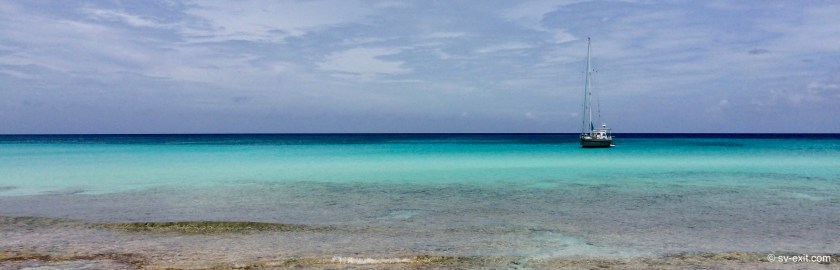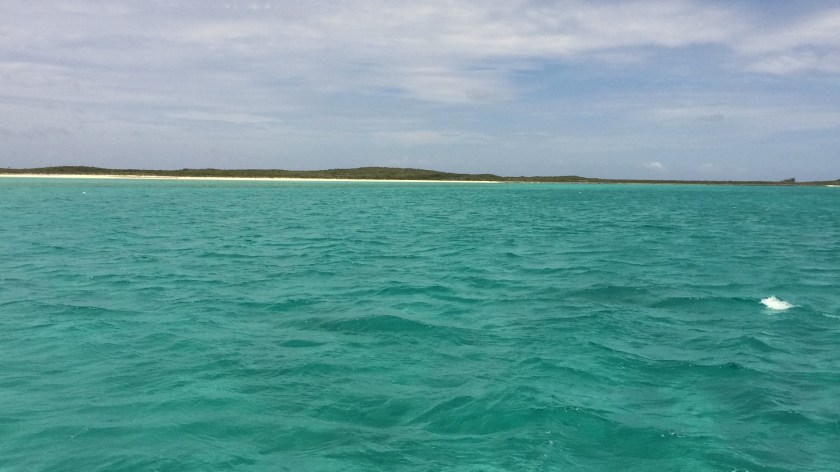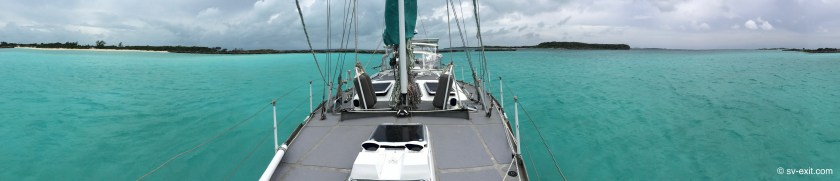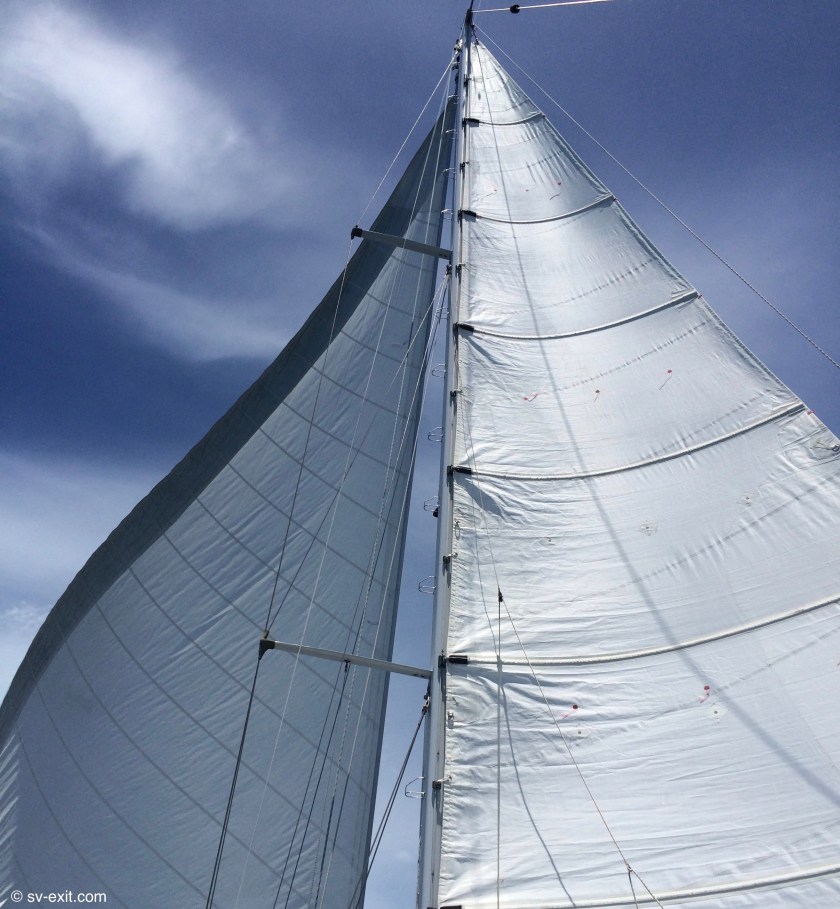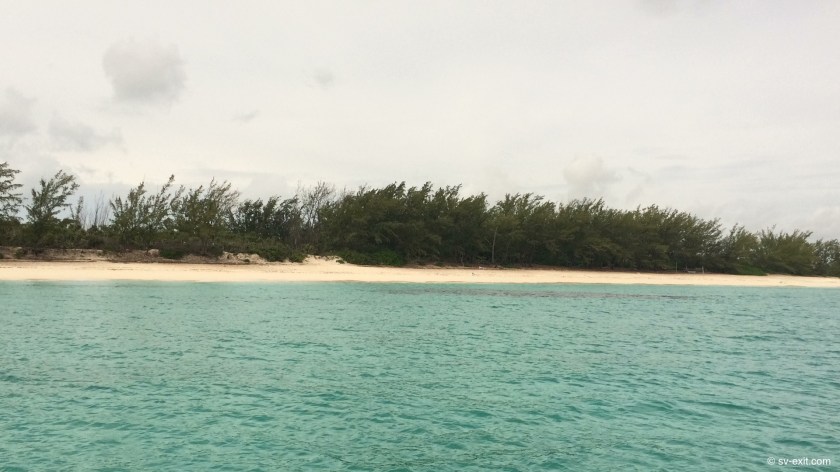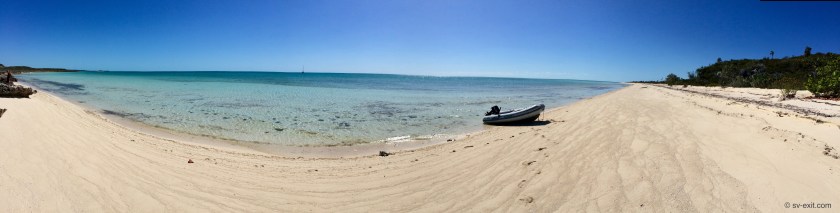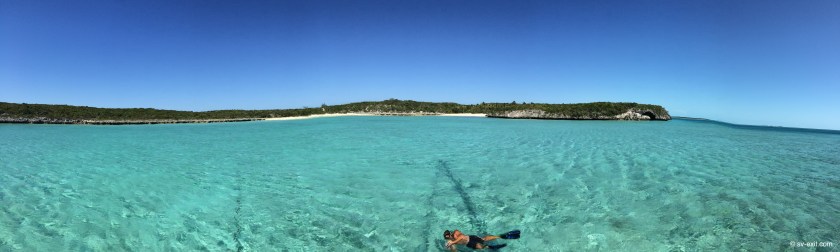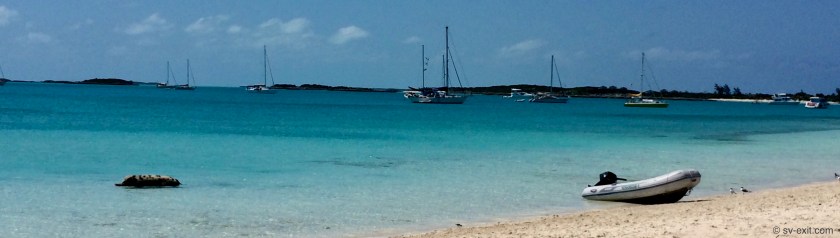
Spanish Wells, Eleuthera… Better By Dinghy

Spanish Wells
Getting from Royal Island to Spanish Wells

May 29, 2018

    One knot of speed may not seem that fast…

     But when you’re standing atop a forty six foot sailboat that is being pushed along completely sidewise by a thirteen knot wind in a channel of water not more than one hundred feet wide, it seems far, far too fast.

*****

     We had already taken the dinghy ashore the day before in order to take a look around and pick up some much needed provisions.

     Spanish Wells was picturesque.  A small community with immaculately tended yards and gardens, well kept houses which all appeared recently painted with bright and cheery colors and planter boxes in the window, it had a very sleepy but approachable feel to it.

Our five days at remote Little Egg Island had been spectacular, but incoming squalls and shifting winds had eventually forced us to move to Royal Island, which offered better protection in exchange for uninspiring scenery.  It made sense to head for Spanish Wells as the weather settled.
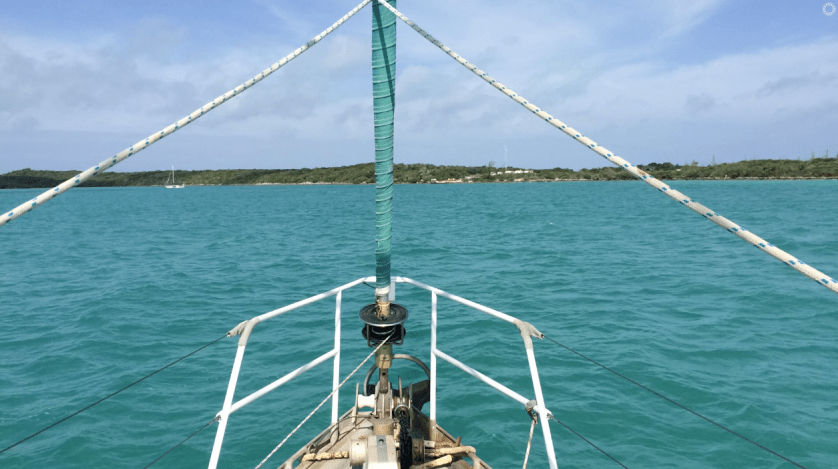
royalisland1
At anchor Royal Island, Eleuthera

     We also needed to suss out the marina situation, as we were almost out of fresh water (our rain catch efforts had proven all but fruitless since leaving Georgetown) and we also wanted to top off our diesel tank.

      From where we were at anchor, the approach to town required us to navigate inside of a very narrow channel, not more than one hundred feet wide and approximately half a mile long.  Depths of only a couple of feet awaited anyone who strayed outside of either side of the channel.  

     Once at the island, the narrow channel continued, with the town hugging the water’s edge on the right.  Eventually, as the town dwindled away on the right, the channel began to grow more narrow and shallow, eventually offering access to only small power boats.

     The dock that we could fuel up at didn’t have water and the marina that had water didn’t have fuel which meant two separate stops… not ideal.

     We have learned again and again that our highest stress levels and and greatest risk are achieved docking Exit.

     The mindset of many boaters is that docks are the safest place to be.  Any problem… get me to a dock and all is well again.  A sanctuary that offers protection and connection with the world.

     For us this couldn’t be farther from the truth.

     In fact, in our opinion, docking is nothing more than a conscious and intended (though controlled) collision with something hard… something we try to avoid, as a rule, if at all possible.  If there’s any way we can accomplish a task without putting Exit in direct contact with a solid object, well then, that sounds like the preferred method for us… every time.

     Water and fuel are the two necessities that sometimes require us to forgo this train of thought.  Lugging five to six gallon jerry cans (plastic jugs) by hand via the dinghy is sometimes an option, but simply is not very practical if we need 200 gallons of diesel and/or 200 gallons of water.

     The threshold at which tying up at a dock to accomplish this outweighs the effort involved in small quantity transfers utilizing multiple trips is obviously not absolute.  However, I can say without any hesitation, that threshold seems to increase after almost every docking experience… even the smooth ones seem to age me rapidly!

     Our situation at Spanish Wells was such that we needed almost 200 gallons of water and the dinghy ride was nearly two miles each way.  

     We like to think that we are constantly evolving into wiser and more savvy sailors/cruisers with every passing day we live aboard Exit.  We had purchased two six gallon water jugs while at Georgetown so we could fill up every time we docked at the public dock (which also had what seemed to be the Bahamas only free of charge potable water spigot on the dock).

     However, now, with only two six gallon containers aboard, the math indicated it would take us fifteen trips to fill up our fresh water tanks… a total of thirty miles in the dinghy… not very realistic.  And putting just a bit of water in the tanks didn’t make sense as water sources here can be far and few in between (with the next one possibly being even more difficult than the last).

     Which left us one option… a controlled collision with a solid object… docking.  Poop.

     Our approach to Spanish Wells in the Mothership, the half mile long hundred foot wide channel, should have been interpreted as the litmus test towards whether we should proceed or abort.

      As we entered the channel, a massive ferry appeared from the opposite direction.  Thankfully, it stopped just before committing at the other side, allowing us to pass by.

     We continued with the intention of stopping at the fuel dock.  It should have been a pretty straightforward docking except for the thirteen knot winds coming from our port side.  The narrow stretch of land covered with trees to our left helped to buffer the wind; however, the sailboat that pulled up to the fuel dock moments before we arrived left no alternative.

     With the limited space to maneuver and winds to contend with, there was no way we could hold position until they pulled away so we continued on, at least temporarily aborting the less critical fuel fill.

     With Kris stoically at the helm, we pushed on until we neared the marina dock that had the water we had really come for.  

     As we approached, we hailed them on the VHF radio.  They verified where we needed to tie up and confirmed that someone would meet us on the dock to help with the lines.  As the dock grew nearer and nearer, we could see where we needed to go, but there was no sign of the dock master.  This would be an unassisted effort.

     Both fenders and dock lines were already in place, something we learned early.  However, the exact placement of fenders on the boat is always something that can be a bit tricky to determine, based largely on the layout and construction of the dock.

     This dock was not very boat-friendly.  And dock construction is a make or break prospect… literally.

     It amazes me how many docks seem to be constructed with very little regard for the boats for which they are intended.  

     Well thought out docks (obviously by people with boats, or at least knowledge of them) utilize materials and construction designs which are forgiving to boat hulls and minimize risk of damage.

     Some of the best are floating docks, which raise and lower with the tides, offering a consistent height.  A dock platform sitting higher than a boat’s decks negates the effectiveness of using fenders, which should really be attached at the hull of of the boat.  Boat owners that tie off their fenders to the stantions or lifelines are simply begging to have their stantions torn off if the fenders get snagged.

     This risk of fenders getting hung up on something is greatly increased when the outside edge of the dock is not in a straight line, usually due to a dock designed with it’s support posts extending beyond the dock platform. 

     As a boat reaches the dock, any remaining forward momentum allow the posts grab the fender as it passes.  If you’re lucky, the fenders squeeze around the posts.  If you’re unlucky, the ropes tying the fenders to the boat snap.  If you’re really unlucky, the fenders stop short and the ropes hold; but the stantion or lifeline you were foolish enough to secure the fender to get ripped right off the boat.

     Oftentimes the posts are a bigger diameter than the fenders, which means the fender really is of very little benefit.  It either catches on the posts, or, between posts, dangles ineffectively a few inches away from the dock edge while the boat’s hull scrapes alongside the posts.

     In addition, some sort of bumper system or padding installed on the dock’s edge indicates that the marina taking your money is somewhat concerned about your boat’s well-being.

     At the very minimum, rope wrapped around the exposed posts provide some protection.  Rubber bumpers are a real blessing, though some curse the black streaks they can leave on the boat’s hull.  I’ll take the streaks any day.

     In this case, there was nothing.

     With an aluminum hull, we generally fair much better than a boat made of fiberglass when it comes to damage caused by docks.

     However, the sure sign that a dock was constructed by an idiot is when the dock supports extend beyond the platform, AND the big bolts which hold everything together aren’t even countersunk into the wood of the support posts.  

     This sadistic approach results in diabolically exposed domed stainless steel bolt heads lurking on the side of the post facing the boat.

     Despite the wind and absence of anyone to assist at the dock, Kris cooly performed a textbook docking maneuver, and we glided slowly up alongside the dock.

     Unfortunately, the dock was built by an idiot.

     As I tried to get a line secured around one of the posts, and push off so we didn’t end up with our bow (and anchor extending just forward of the bow’s edge) pushed into the exposed support posts by the wind, a sickening scraping sound emitted from twenty feet behind me as the midship section of our hull slid alongside one of the posts farther back. 

     It was the unmistakable sound of metal on metal… the head of a bolt grinding along the side of our hull… 

     Fuck.  

     We had just been tattooed by, the ironically named, Yacht Haven Marina with a vicious, and permanent scar to remind us of the day.  (Sidenote:  Lashing wooden 2x4s to use as rub rails between our fenders would alleviate a lot of the problems with problem docks… however, that system is only beneficial to the boat that already has them set up prior to needing them…).

     Shortly thereafter, the dock master sauntered up.  A nice guy, and certainly not involved in the marina’s dock design; so we decided to refrain from a commentary and chose to just get our water and get the hell out of there.

     Fifteen minutes later, with water tanks once again holding their two hundred gallon capacity, at a cost of fifty cents per gallon, we were ready to head out.

     The wind was going to make things challenging.  But, we felt, with the assistance of a push off from the dock master, we could edge over to the other side of the channel utilizing the small opening to a stream.

     As long as we didn’t go too far and run aground, we concluded that there should be room to back up and turn around in a dicey three-point turn, getting us going back in the other direction, as the channel ahead narrowed and shallowed, which eliminated the option of simply continuing forward much further.

     That was the plan.

     What we didn’t count on was the thirteen knot wind, buffered by the island and tree cover still to our left, would be funneling straight down through the opening created by the stream to our left.  So, while we able to successfully get off of the dock, as soon as we approached the mouth of the stream the wind immediately began to intensify.

     Kris managed to get Exit perfectly positioned at the mouth of the stream without touching bottom.  But as soon as we stopped, as she started to back us around, the wind caught our bow and began pushing us around much more quickly than we could react.

     She couldn’t power forward, as we were still too close to the bank opposite the marina dock, and the wind was shoving us sideways until we were almost broadside in the channel. 

     Without bow thrusters (to push the boat from side to side), forward momentum was the only thing that would give us steering.  And with the channel only one hundred feet wide, we were going to run straight into the dock we had just left before gaining that momentum.

     As Kris struggled to bring us about, the wind continued to push our bow around until, before we knew it, we were broadside in the channel, entirely at the mercy of the wind.

     One knot of speed may not seem that fast…

     But when you’re standing atop a forty six foot sailboat that is being pushed along completely sidewise by a thirteen knot wind in a channel of water not more than one hundred feet wide, it seems far, far too fast.

     Shit…shit…shit…” emerging from Kris’ mouth in the cockpit.

     Fuck…fuck…fuck…” emerging from my mouth on deck.

     The dock master, helplessly watching from the dock, trying to yell out and signal suggestions.

     As we begin drifting, a man on a power trawler tied up in a slip on the next dock down, pokes his head out and, peering at us, asks “Are you trying to dock here?”

     To which I respond, “No, we’re trying to turn around.”

     All he can say is “Oh.”

…surreal.

     With everything unfolding both in slow motion and high speed simultaneously, I can only stand on the deck and watch. 

     In a moment of sheer determination and brilliance, Kris manages, with a combination of wheel turns as well as forward and backward gunning of the engine, to regain control of Exit, bringing us fully around so we are finally facing the correct direction.

     I realize I have stopped breathing, instantly aged a number of years, and quite possibly just shit myself.

     As our heart rates slowly began to drop, and the color in our faces began to return, we looked at each other, fully realizing just how close we had come to disaster.   Just the day before there had been a multi-million dollar mega-yacht tied up along the outside edge of the next dock down, which we had just nearly missed.

     Still shaken by the dock departing fiasco, we continued down the channel until we, once again, found ourselves at the fueling dock.

    We looked at each other and, without any need for discussion, both mutually declared that there would be no more docking attempts that day.

     Screw the fuel.

     Without slowing, we passed by the fuel dock and pressed on, wanting only to get back to our anchorage.

     But Spanish Wells was not finished with us yet.

     As we reached the edge of town and prepared to enter the narrow entrance channel, a mahoosive mega-yacht pulled into the channel at the opposite end and started steaming down the center towards us.

     Undoubtably, there was no room for us to squeeze by.

     We immediately slowed.  We were at a spot that opened up much wider with mooring balls and a couple of boats to the right of us, just before the the channel bottlenecked back down, so we tried to tuck ourselves to the side, allowing room for the Mega-yacht to pass.

     But we were now clear of the stretch of land and tree cover opposite the town.  With no further protection from the winds, now coming from our right, as we came to a stop Exit’s bow once again began to immediately drift to the left pushing us sideways.

     We momentarily contemplated trying to grab a mooring ball to hold our position, but we really weren’t prepared or well positioned for that, so Kris said to hell with it and just let the wind carry us fully around until we had come about one hundred eighty degrees, facing the town again.

     Exasperated, we powered up the engine and found ourselves once more heading into town, past the fuel dock for a third time.

     Fortunately, there is a second channel to and from town on the left, located between the fuel dock and the marina we had gotten water at, so we ducked out of there opting to take a longer route back to our anchorage.

     As we departed, we unleashed a string of expletives directed at the Mega-twat, which it turned out, took the exact same course.  It turned out they had cut through town only to avoid navigating this longer route around.

     Eventually we were back at anchor with two cold therapeutic beers in hand.

    Our final assessment of Spanish Wells… beautiful in appearance but rather dark beneath it’s surface.

     We subsequently learned that Spanish Wells used to prohibit black Bahamians from being on the island after dark.  I don’t believe this is still the case but am unsure when the practice was discontinued.  Apparently, the white population of Spanish Wells is comprised of five family names and three hundred years of inbreeding hasn’t helped.  

     Speaking with the white locals, at first we couldn’t place what initially seemed like a very strange “cajun sounding” accent.  Eventually, it dawned on us that the accent we were hearing sounded incredibly South African.

     Further research uncovered numerous references to Spanish Wells racism (both historical and prevailing).

     The one conclusion we drew with absolute certainty… those visiting Spanish Wells via a boat not equipped with bow thrusters are vehemently advised to do so by dinghy.

     And if you take the Mothership in, be exceptionally wary of the dreaded Yacht Haven tattoo. 

     As for us, an increase in our inventory of fresh water jerry cans is in the very, very near future!

One Year Ago Today

May 26, 2018

     Another “one year ago today” moment.

     It’s hard to fully process that it’s been a full year since we first stepped aboard Exit in 2017.

fullsizeoutput_9e
“Exit” selling herself May 26, 2017

     At that time, we had resigned ourselves to the assumption that Exit was not in the cards for us.  Though we had been drooling over her for over a year every time we looked at the listing online, she always seemed just out of reach of our budget.  Not to mention the fact that an offer had already been made by other potential buyers.

     We boarded her only with the intention of further educating ourselves regarding options we needed to consider as we continued hunting.

     This was the opportunity, once and for all, to get past her.  As had been the case with every other boat we had looked at, we fully expected to realize that she was not nearly as magical and majestic in reality as she looked on paper.

     Get aboard, see for ourselves, and then keep looking (a process we were growing both frustrated with, based upon our seeming lack of progress, as well as fearful of, based upon the prospect that we simply couldn’t find the right boat despite the fact that we really didn’t know what we were looking for).

     We couldn’t have been more wrong.

     And once you know something beyond a doubt, there’s no going back.

     In this case we both knew, without any doubt, she was the boat for us.

     Then, stunned at this realization, from the moment we called Pete at Swiftsure Yachts (and were told that, despite an offer already being in place, we had the option of putting in our own offer since nothing was set in stone yet) the crazy whirlwind began to materialize.

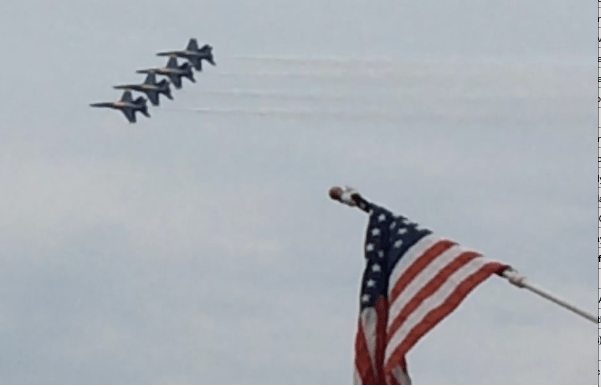
blueangelsflag
Watching the Blue Angels flying above Annapolis after calling Pete at Swiftsure

A whirlwind that eventually carried us to this point.

     A million things could have turned out differently.

     Not being religious or superstitious, fate does not get the credit here.  However, I firmly believe in circumstances sometimes providing rare opportunities.  And if capitalized upon, those opportunities can cash in on results that, in hindsight, make things seem as though they were simply meant to be.

     Had we not hopped on a train to the East Coast to look at other boats…

     Had we not decided, since we were already in the area, we might as well see Exit in person…

     Had the previous offer already been accepted…

     Had we started playing our own negotiation game with the current owner and ended up with a rejected offer ourselves…

     So many paths that could have led us away…

     And yet, here we are…

Egg Island
… May 26, 2018 – one year later at Little Egg Island, Eleuthera, Bahamas

     Sometimes the world sucks.  Sometimes it fucking rocks!


Backtracking Through The Exumas

Fowl Cay
Fowl Cay

May 11 – 23, 2018

    The process of backtracking made things much more simple than our initial exploration of the Exumas had been.

     Not having to thoroughly research every day’s course in advance, uncertain of how far we could get and what would find when we arrived, made for substantially less anxiety.  We were already familiar with the logistics and could pick and choose with much greater certainty.

     We had the opportunity to stop at a few places we had missed our first time through, like Lee Stocking Island and White Point at Great Guana Cay (which had been rudely occupied by a mega-yacht last time). 

f3314048-9a2d-43a0-9332-34a0c6fb34e0
From Lee Stocking Island to Great Guana Cay

     Yet, for the most part, we utilized mostly the same destination anchorages along the way… Fowl Cay, Shroud Cay, Highborne Cay.

Fowl Cay foul weather
Abandoned?
Better company on Shroud Cay this time

     Our intention of crossing over to the Sound side and jumping over to Eleuthera didn’t materialize as quickly as we had hoped.  Fairly strong winds shifted direction, allowing the only option for making Eleuthera from farther south to be under engine power… something we didn’t want to do.

     However, while it previously took us nearly a month to get from New Providence to George Town, reversing our direction we found ourselves back at Rose Island in less than two weeks time.  Instead of short jumps of ten to fifteen miles, with days and days spent at anchor once we had reached a new location, the priority was to keep moving until the wind became more favorable to make the jump over to the Eleutheras.

     One of the biggest sailing challenges we now faced was that of downwind sailing.  Our experience for the past nine months had largely been heading into the wind.

     Exit loves a breeze coming directly on her beam.  She flies along comfortably and the sails are relatively easy to trim.  

     As we head into the wind, she takes the extra forces upon her hull and rigging well.  She’s heavy enough that we can pound into some pretty sloppy seas (she can certainly handle them better than we can), but the big genoa really starts struggling to stay filled once we get much inside of sixty degrees of true wind angle.  She does well on a close reach but extended close hauls into waves can be an exhausting prospect.

     Sailing downwind has its’ own science to consider.  When sailing into the wind, air passes across a properly trimmed sail and creates lift, which helps to propel the boat forward (exactly the same principal utilized in aircraft wings).  However, as the wind comes from further and further astern, the sail begins to be pushed by the wind more than it is pulled along by it.

     Properly setting sail trim while broad reaching or running dead downwind has become our new challenge.  To anyone reading this who considers this basic stuff, I apologize in advance if my ignorance becomes painful to bear at times. 

     For the experienced sailor, one of the pleasures of sailing Exit is utilizing the exhaustive combinations of trim adjustments that can be made with all of the onboard gear.

     For the learning sailor, one of the frustrating, bewildering, and vexing realties of sailing Exit is utilizing the exhaustive combinations of trim adjustments that can be made with all of the onboard gear.

     With time, hopefully we’ll actually be able to utilize some of the extra downwind gear we have aboard, like whisker poles, spinnakers, and reaching poles, as well as rigging up a proper gybe preventer, all designed to make downwind sailing easier and less prone to disaster.

    But, for now, it’s about trying to maximize our sailing efficiency without the further complication of too much additional equipment.

    We find that, as our true wind angle starts to move farther aft than 140-150 degrees (approaching the stern), the genoa simply can’t get enough wind to stop luffing and flapping around.  It’s a combination of just too much sail, wind angle, and the main sail creating a severe wind shadow that the genoa sits in.

     There comes a point where the genoa has to be partially furled in to reduce the area of sail we’re trying to fill, or the main has to be reefed or repositioned (reducing it’s effectiveness) to get out of the way of the genoa.  Bringing in one or the other entirely may be the most effective approach.  We found sometimes just running the genoa at full power was more effective than two sails working inefficiently.

     Running dead downwind (with the wind directly behind you), seems like it would be the easiest sailing of all.  In fact, it appears to me to be rather complicated, and the profound risk of a dreaded accidental gybe is always nerve-racking.

     When the wind moves from one side of the boat to the other, the very large and heavy boom located under the main sail and attached to the mast, has to change sides.  

     If the wind is passing across the bow (a tack), this boom movement tends to be rather controlled as the boom is usually already positioned much closer to its’ center point.

     If the boat has been on a beam or broad reach (wind perpendicular or aft), the main sail is sheeted much farther out to the side.  

     Before the wind is allowed to come around the stern (a gybe), the boom must first be sheeted in to minimize its’ movement.  If it is sheeted in prior to gybing, when the wind catches the other side of the main sail, the boom will swing across to the other side of the boat in a controlled manner.

     On the other hand, if the crew doesn’t first sheet in the main, as the wind crosses to the other side of the mainsail, the boom, sitting far off-center, is hurled across to the opposite side of the boat with a tremendously deafening and bone jarring crash… an uncontrolled gybe.  

    Even worse is an accidental gybe.  For an unprepared crew, the swinging boom can be lethal.  If it doesn’t break equipment or bones, it certainly clears the deck of anyone…

     Obviously, sailing dead-downwind creates the highest risk of having the wind inadvertently shift from one side of the stern to the other.  But, with the sail sheeted out, nearly perpendicular to the hull, it takes a serious change of angle for the wind to get behind the sail.

     Experimenting with different sail configurations dead downwind became the norm… main only… genoa only… wing and wing (with main and genoa fully out on opposite sides) – challenging without a pole and risky without a preventer.

Wing & wing to Great Guana
Wing and wing running dead downwind

     We quickly found with the boom sheeted out that far, it was not the wind that caused as many problems as did swell and waves.  It seemed ridiculously dangerous and equipment jarring when, every time a swell would roll the boat from side to side, the mainsail momentarily relaxed and then reloaded causing a violent jolt in the boom.  

     We temporarily rigged up a primitive preventer, a line secured to the back of the boom that we ran forward to a cleat, to prevent the boom from swinging back every time we rolled in the swell.  It wasn’t adjustable from the cockpit, but it did the job and saved a lot of wear and tear on the equipment.

     Our last jump in the Exumas, less than forty miles from Highborne Cay to Rose Island, started as a beautiful day of sailing downwind at six to eight knots of speed, with everything seeming to click. By the end of the day, we were taking eight to ten foot swells on the beam as we angled towards Rose Island’s bay… Yowsa!

     Always a learning process and an ongoing experiment in progress…

Rose Island
Back to Rose Island

George Town

April 22 – May 11, 2018 

    Our first trip ashore was a bit of a disaster.

     We made the poor decision to head in with ominous dark clouds looming just above us.  

     Within moments of pushing off from Exit in our dinghy, the clouds began to unleash a torrent of rain upon us.  We pushed ahead, and managed to get ashore for some provisions but ended up absolutely soaked in exchange.

     Furthermore, on the way back to the Mothership, as we were fighting against a rather stout breeze coming right at us, we were mortified when a loud clunk came form the outboard motor and it promptly died on us.  No amount of pulling on the starting cord could get it going again.

     As we began rowing in vain against the wind, making no forward progress at all, we noticed a guy on a catamaran anchored near us approaching us in his dinghy.  

    “Have Kris hand me your line; I’ll tow you back to your boat,” he said to me as he arrived.  Perplexed, we realized he knew who we were, but it took a moment longer for us to recognize who had come to our rescue.  It was Jay, who we had met with his wife Tami at Loraine’s all-you-can-eat buffet at Black Point, just days before… what a stroke of good luck and timing.

     We spent a substantial amount of time hanging out with Jay and Tami during our stay at George Town, becoming quite close friends with them.  They continued to provide vast amounts of insight and advice to us, regarding both the Bahamas and cruising in general.

     Later, after struggling to once again resuscitate our Yamaha outboard, we discovered that our poor Yamamama was, and, as far as we could determine, always had been running on only one of it’s two cylinders since we had first revived it in Annapolis eight months earlier.  This led us to the sad conclusion that it was finally time to cough up the money for a new outboard.

     We had seen this as eventually inevitable.  Though our current 8hp engine had served to get us slowly to and from shore, we knew that to carry dive gear to and from more distant locations we would need something bigger.  And, ultimately, having a reliable outboard was as paramount to us as having a reliable car was to a dirt dweller.  

     In addition, being in the Bahamas provided the opportunity to acquire a two-stroke engine, something no longer available in the States.  Though not as environmentally friendly as a four-stroke, a 15hp two-stroke would give us the extra power needed to get up on a plane while carrying heavy dive gear, yet still be small enough to lift by hand and fit in the stern locker.  It was also cheaper.  So, we gave the George Town economy a $2300 boost and found ourselves the proud owners of a new Yamaha 15hp two-stroke outboard motor which we dubbed Y’mama.  For now, the Yamamama went into storage with an as yet undetermined future.

     The Family Island Regatta was a blast.  Watching the traditional local sailboats compete for three days was most entertaining, and we spent hours on the water amongst a virtual armada of onlookers following the racers around in dinghies.  On land, dozens of small fish shacks and bars were set up making it a very festive atmosphere.

     Fantastic BBQ ribs, freshly made conch salads, and plenty of Bahamian Kalik (pronounced Click) and Sands beers were to be had.  Kris was even given a straw hat by a very kind, if not slightly strange and intoxicated, Bahamian who proudly claimed he had been an extra playing the role of one of the pirates on the set of Pirates of the Caribbean alongside Johnny Depp.  We had trouble confirming this, but can confirm that he was definitely one of the people passed out, asleep on a stool at one of the bars, later that day.

     Then, within a couple of days of the Family Islands Regatta concluding, the harbor just outside Georgetown began to empty in a mass exodus.

     For the majority of boaters, it was time to head back to the good ol’ U.S. of A.

     Hurricane season loomed in the not to distant future, enticing many to vacate while the getting was good.  Many had merely reached the end of their boating season and were headed back to the reality of their dirt dweller existence.

     For us, our insurance didn’t dictate we be out of the Bahamas until July 15 (at which point they said if you stay, you aren’t covered in the event of a hurricane and we reserve the right to drop your insurance cause you’re obviously not an exceptionally smart policy holder).

     This gave us the opportunity to spend some time at anchor in a nearby area known as Red Shanks (completely uninhabited and empty except for a couple of other boats) as well as go for a more extensive land exploration in a rental car with Jay, Tami, and their good friend Ashley who had come to visit them.

     Our longer-term intention was soon to continue south to Long Island while we still had time.

     Unfortunately, the prevailing winds would not cooperate.  After waiting and waiting without any shift in wind direction forecasted in the foreseeable future, we bagged the idea of continuing southeast.

     We could have done it motoring the whole way.  However, we had become more and more adamant about sailing more and motoring less, which required a shift in perspective, a willingness to rethink strategies, and oftentimes a serious dose of patience.

     As sailors, we were beginning to realize that sometimes destinations should be sought out not because that’s where you wanted to go, but rather because that’s where the wind would let you sail.

     An evolution, of sorts, for us…

     If the wind continues to come from the southeast, don’t get pissed off and certainly don’t resort to relying on engine power to buck the wind.  It’s much easier, and oftentimes much more productive and rewarding, to readjust  your thinking and simply head west… or north… or southwest… or northeast…

     This sounds obvious but takes a bit of internal adjusting to fully begin to appreciate.

     We met someone who told us bluntly, if they couldn’t make 6 knots sailing they fired up their engine… period.  Their boating endeavors probably lasted no more than a few months each year.

     To us, this seemed unfathomable.  We aspire to be sailors, not motorers.  And wind is free, diesel is not. 

     Longterm cruising on a very limited and finite budget requires that we reign in our spending constantly.  Expenses must remain as low as realistically possible (safety and maintenance are the two priorities that we don’t shortchange).  

     And we have quickly learned that one of the easiest ways for a cruiser to reduce expenses is to not turn the ignition key unless absolutely necessary.

     And so, we readjusted our thinking and decided that, given the persistent wind direction, maybe Long Island wasn’t currently the best choice for us.

     Further discussion brought us to the conclusion that it made much more sense to backtrack northwest through the Exumas until we could jump off and head towards Eleuthera.

     And so the plan was set.

img_6075
Stunning Red Shanks sunset

At The Doorstep of George Town

img_5907

April 21, 2018 

    One particularly satisfying aspect of pushing farther south, after departing Staniel Cay, was that the population of Mega-twats seemed to immediately began to dwindle.  They quickly became farther apart and fewer in between… YES!

     With less than seventy nautical miles to reach George Town, we could make it in two days.

     However, we decided to break the final stretch into a few smaller sections and really try to enjoy the fact that we could drop anchor at a new location after only a couple of lazy hours on the move to enjoy a different view for a short while.

     Black Point, on Great Guana Cay, was quite a busy anchorage.  Lots of boats had the same idea that its large bay would provide good protection from a bit of a windy stint forecasted to blow through over the next couple of days.


     We went ashore and walked through a very sleepy, though friendly, town that took less than half an hour to get from one side to the other.

     Loraine’s, a restaurant run by a Bahamian woman who was also a Seven Seas Cruising Association member, was hosting a weekly all you can eat buffet for cruisers that we decided to stick around for.

     We saw people there we had met earlier as well as met a number of cruisers that we would see again and again as our paths continually intertwined.

     Jay and Tami, cruising aboard their catamaran Avighna, were two such people.  Sitting next to them at dinner, we struck up a conversation that came to be the start of a great friendship.  They offered an immense amount of advice and information, both regarding sailing in general as well as potential places to visit, as they were coming from the south and had already been in the Bahamas for over six months.

     Their southern accents (Tami from Louisiana and Jay from New Mexico) were quite pronounced and, over time, we found that they had managed to infuse our own vocabulary with regular use of the word y’all.

     Once the winds had settled down a bit, we picked up anchor again and continued heading south.

     Bay Rush Bay, also on Great Guana Cay, provided a great secluded anchorage that we had all to ourselves for a night, as did Rudder Cut Cay, just ten miles further south.

img_5910


img_5920

    En route to Rudder Cut Cay, we passed by David Copperfield’s private island resort, which apparently can be rented out for something like $300,000 a week.  We opted to pass on that.img_5938

     Though we had a small bay at Rudder Cut Cay completely to ourselves for a day, the second day four other boats showed up and invaded the space around us.

img_5946


overunderatanchor3

     On our third day there, we were sitting in the cockpit relaxing.  Suddenly, the unnerving screams of a female screaming for help cut through the air like a razor blade.  We looked around and saw what looked to be a snorkeler a few hundred yards away from us.  As the screaming continued, we quickly began to lower our dinghy, which was lifted out of the water on its davit and secured to the stern arch with four separate lines.  

     Even more unnerving than the screaming, was the silence that immediately followed as we desperately tried to free the dinghy.

      Fortunately, a man on one of the catamarans anchored further inside the bay had also heard the screams and  jumped in his dinghy, which was already in the water.  He reached the girl a minute or so before we did.

    As it turned out, he was the father.  The girl had gone snorkeling alone in a bay just around the corner and had encountered some current going in the other direction.  Struggling to get back, she had panicked and began screaming for help.  He assured us she was only shaken up and everything was fine.

     As we headed back to our boat, our heart rates finally began to drop back down to something approaching normal.  We both looked at each other shaking our heads with only half a smile, joking that we thought we had left the shockingly stressful near death rescues behind when we gave up our management jobs at Scuba Junkie in Borneo.  It was good to see that we still had the ability to react quickly when necessary, though we were less than pleased to have been tested.

     The following day we were more than ready to lift anchor and move on.  Once again, we were blown away by the shades of blue that the water took on.

img_5955

     For the previous two weeks, we had been just creeping along.  Our past five anchorages had been no more than dozen miles from one to the next, so we decided to push the final forty miles that remained to George Town all in one go.  

     We had mixed anticipations about George Town.

     For many, it is the end of the line heading south in their Bahamas adventure.  Some head straight here, drop anchor, and don’t pick up anchor again until the end of the season when they head home.

     We knew it would be pretty heavily populated with boats which, on one hand, potentially meant a lot of congestion to deal with.  On the other hand, this also meant George Town was well equipped to deal with large numbers of cruisers, with good facilities for fuel, provisions, and entertainment.  It was also the only place we found in the Bahamas that offered free water for cruisers at the dinghy dock… cheap and convenient.   Most places charged twenty five to fifty cents a gallon.

     We were arriving pretty late in the season, so the number of people was likely to be substantially lower than a couple of months prior.  However, we would also be arriving just before the commencement of a regatta, which meant a lot more people than there would otherwise be.  We considered holding out until afterwards.

     Fortunately, it was not the Cruisers’ Regatta (made up entirely of visiting boats) but rather the Family Islands Regatta, comprised entirely of local sailors competing aboard traditional Bahamian sailboats.  We were intrigued and decided to consider the timing a unique opportunity rather than a misfortune.

     George Town itself surrounds a small bay called Victoria Lake which is impossible to anchor in.  The only access is by dinghy under a small bridge sitting fifteen or so feet above the water through a narrow channel wide enough for only one boat to pass through at a time.

img_5966

     The most popular anchorages seemed to be on the opposite side of a large outer bay, which have beaches and events established almost exclusively for visiting boaters.  We opted to anchor nearer, which provided a shorter dinghy ride, eliminated the need for utilizing the $15 per person per way water taxis, and kept us clear of the boaters which sometimes appeared to herd together and minimize the requirement for local interactions.

     As it turned out, there was plenty of room, even with the large number of boats in the bay, and we had little trouble finding a spot to drop anchor.

     Finally, we had arrived at our long anticipated destination of George Town and could settle in for a while without worrying about constantly tracking weather and wind conditions, always having to plan where we were going to try to set anchor the following day.   Thankfully, as a bonus, George Town did not appear to be a destination for mega-yachts.


Swimming Pigs And James Bond

img_5890

April 13, 2018 

    Grateful that it wasn’t early in the cruising season, when we have heard everything is clogged up with far more boats all heading in the same general direction vying for the same space and resources… that should have been our attitude at Staniel Cay.

img_5875

     Big Majors Spot, an island just off Staniel Cay, looked on the charts like it had the most promising anchorage, which was aptly named the Bay of Pigs.  Obviously, a lot of other people came to the same conclusion, as there must have been at least thirty boats already at anchor when we arrived.  The bay is quite large, and certainly capable of dealing with many more vessels than that.  Nonetheless, that’s a shitload of boats swinging at anchor, all in the same general area.

img_5872
Nurse sharks stopping by as we anchor (obviously they oftentimes get fed)

     It may be a poor reflection on the Bahamas.  Plenty of countries are challenged with limited tourist attractions, a lack of extraordinary cultural distinction, or simply marketing shortcomings.  

     It could be a damning testimony of the people visiting the Bahamas.  The world is full of assholes and idiots… the worst people are both.  Who’s to say a disproportionate number of them don’t visit the Bahamas.

     For whatever reason, the fact remains that the absolute biggest tourist draw in the Bahamas is located on Big Majors Spot…

     …. and that is swimming pigs.

img_5895

     The story is that pigs aboard a ship were apparently thrown overboard in a storm… or pigs escaped from an experimental research station… or they survived a plane crash… I’m not sure which…

     Doesn’t matter (I’m pretty sure it was the first one).

     A handful of pigs ended up on the island.  

     Eventually, it was discovered that these pigs either had learned to swim, or were willing to swim when confronted with a boat full of tourists holding food.

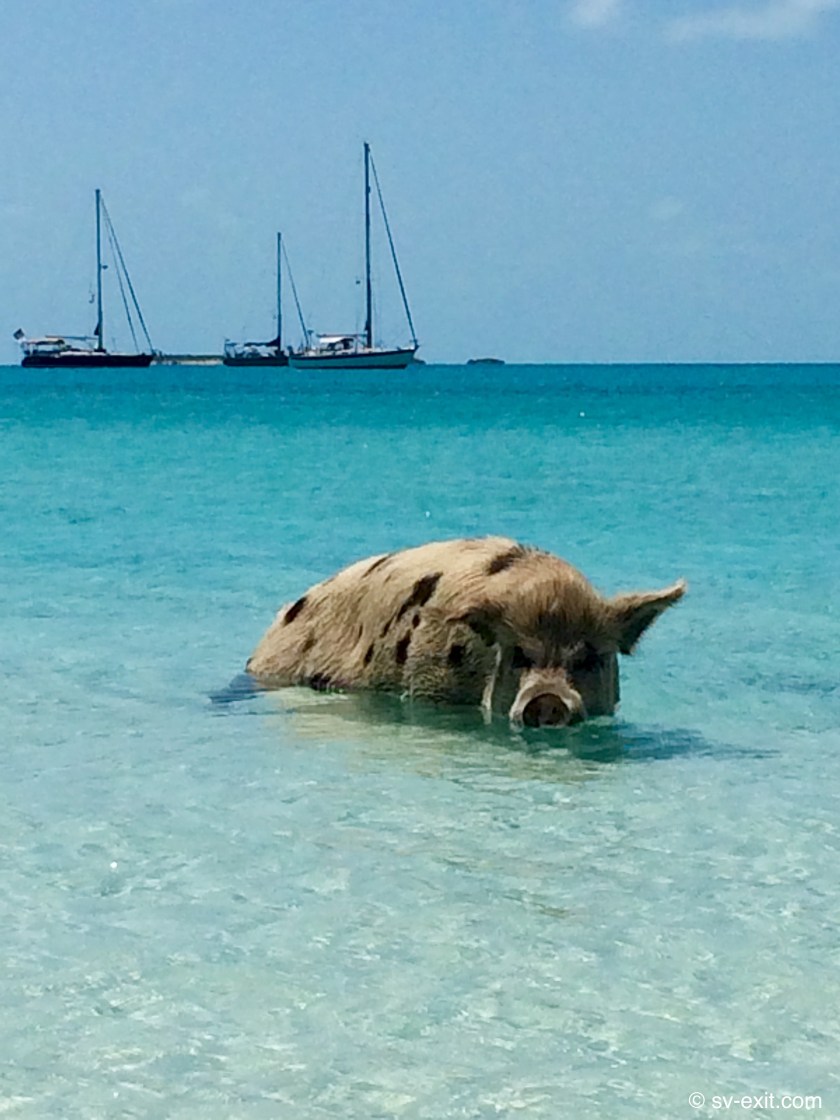
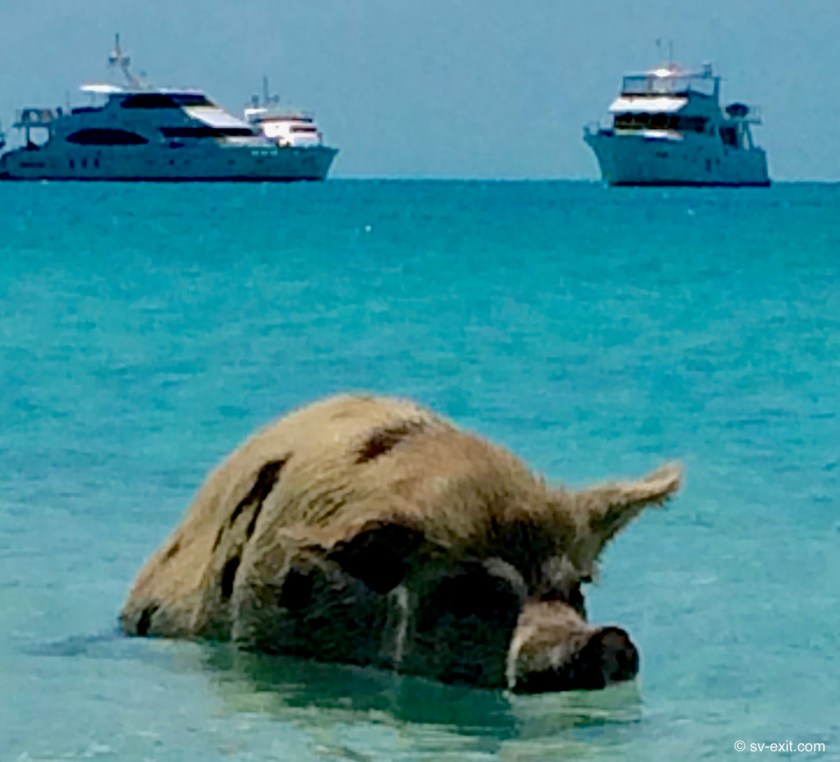
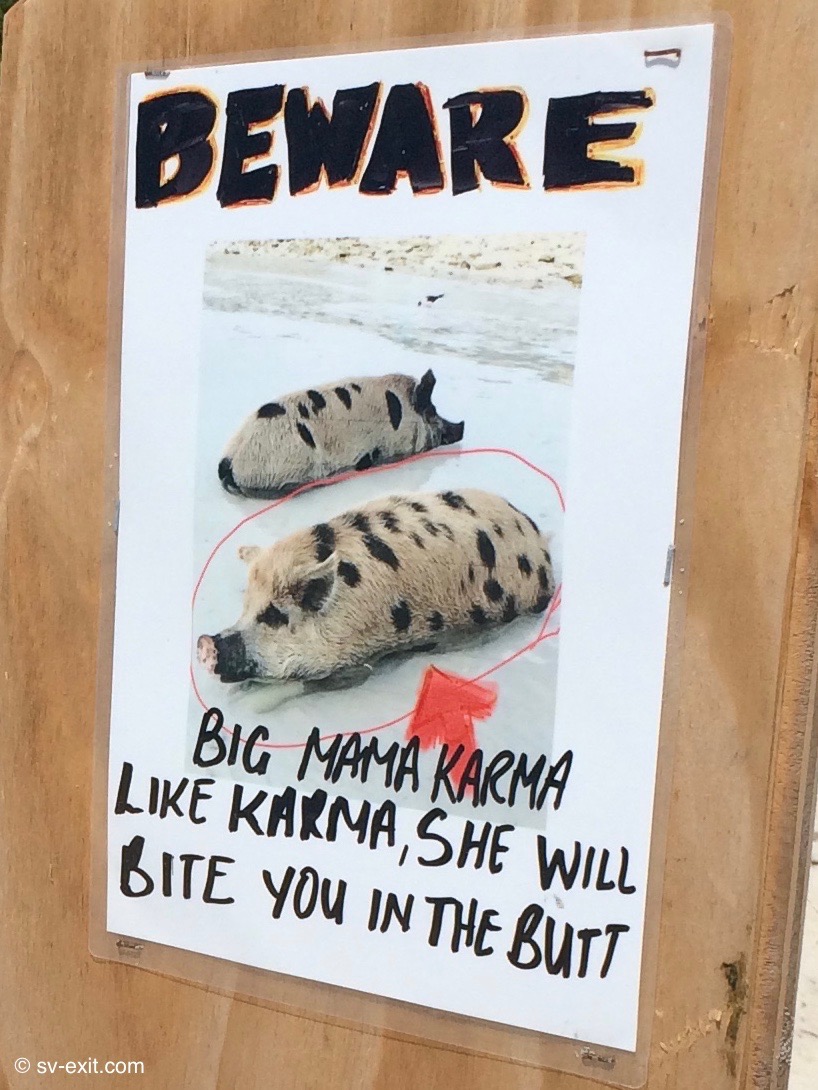
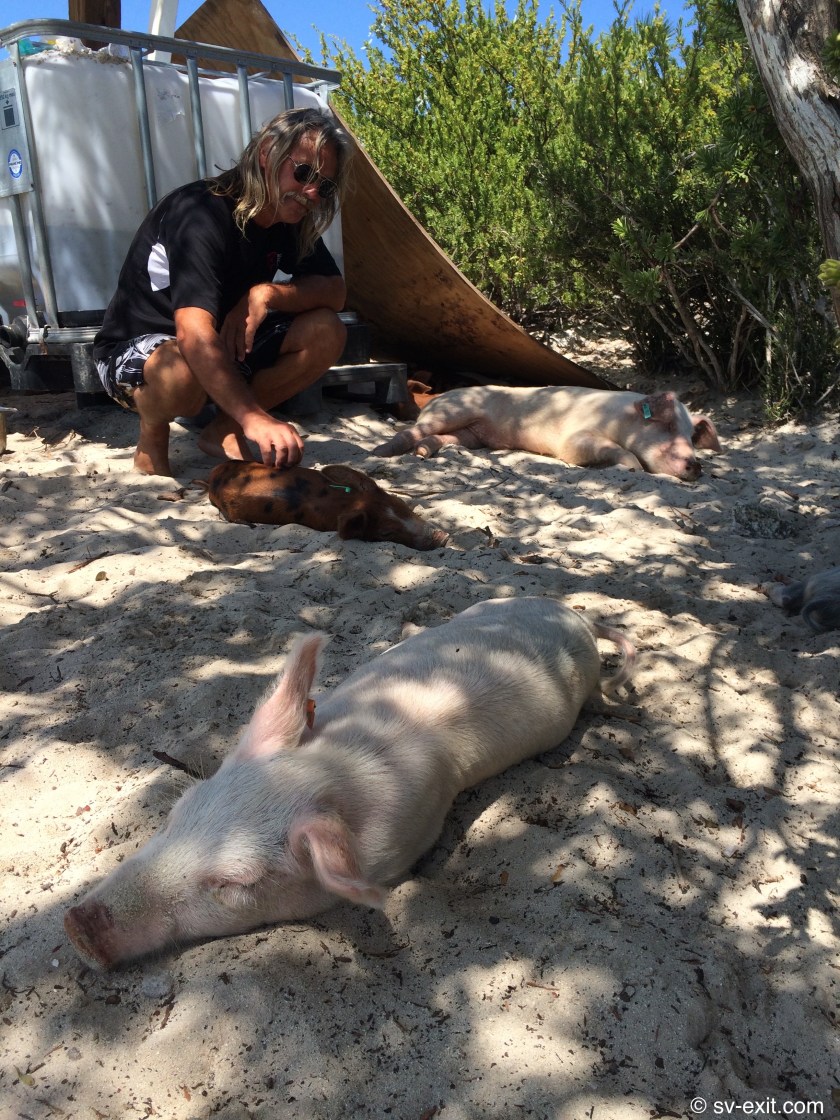
     So you now have thirty or so resident pigs on the island, ranging in size from spotted Big Mama Kharma, who is absolutely huge, to dozens of little piglets.  A sign posted on the beach warns that Big Mama Kharma, just like Kharma, will bite you in the ass!

img_5897

     We didn’t feed them.  But we did dinghy to the island to check them out.  And just like that, we became part of the perpetuation of the phenomenon of the Bahamas swimming pigs.

     I’ll admit… the pigs are pretty damn cute.

img_5896

     We had timed our visit when there weren’t any tour boats (some carrying a couple dozen people), dinghies, mega-yacht tenders, or jet skies at the beach.  We actually got to hang out with the pigs for a good ten or twenty minutes before a bunch of assholes showed up.

     The first group was a dinghy full of obnoxious Americans who held handfuls of food in front of them and then began to scream in horror and disapproval when Big Mama Kharma waded out and proceeded to try to climb into their boat.  

     Even worse, the offered food included hot dogs which I found quite sad.  Beyond being generally unhealthy, it would seem to be forced cannibalism if they contained pork… dark.

     Idiots…

     Then, before the group of Americans had left, a group of Russians showed up with their mega-yacht tender and jet skis.  

     A fat Russian guy in a Speedo started trying to pick up the piglets, ignoring the sign on the beach instructing people not to pick up the pigs.  A woman started screaming as the pigs approached and one of the men started running up and down the beach waving a bag of vegetables above his head while a half dozen pigs took up the chase behind him.

     Arrrrgh….

      I told Kris to take a photo and post it on Facebook with the question “Can you identify the actual pigs in the photo?  Hint: they don’t have passports.”  Kris thought that was a bit much.

     Mega-twats and the assholes that go with them… what can you do?

img_5889
Hmmm… not subtle enough?

     Sitting right between Big Majors Spot and Staniel Cay is Thunderball Grotto.  Named after the James Bond movie Thunderball which utilized it for a scene during filming, it is a swim through cave with an opening in the ceiling that produces spectacular rays of sunlight that pierce through the water.

     Unfortunately, numerous Mega-twat tenders always seemed to be tied up to the mooring balls every time we went past, so we never ventured inside.  Our loss.

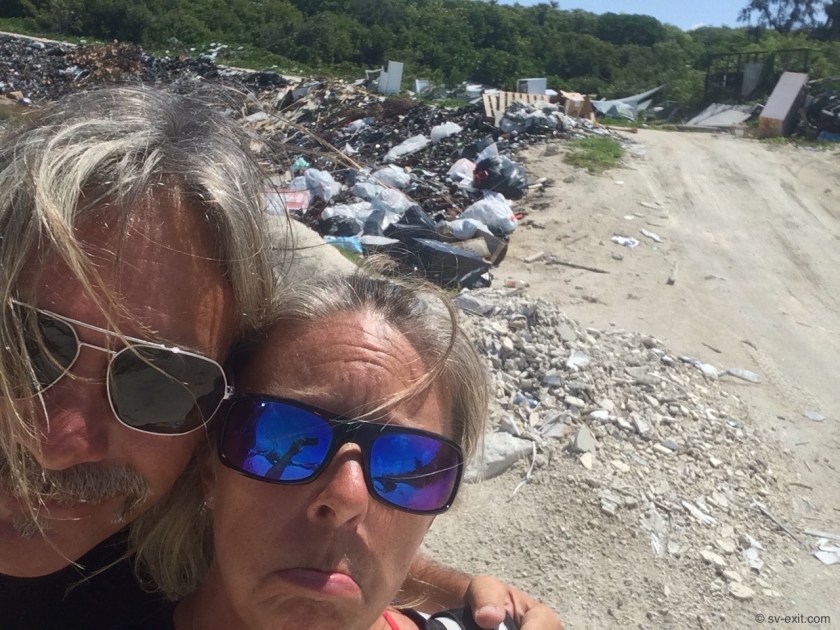
     Staniel Cay seemed very quiet.  Our two days ashore, we walked a couple of miles to the town dump to avoid paying the marina to dispose of it for us.

img_5874

     And, while we did go to the marina to have a rare splurge for a lunch that was delicious, a conch po-boy sandwich for me and salad for Kris accompanied by a couple of icy cold beers for each of us that totaled $85 seemed quite steep.

     Our visit to the local laundromat/liquor store (an undeniably brilliant marketing idea) turned out a bust.  Though it advertised itself as a wholesale liquor store, bottles of Ricardo, the local Bahamian rum that cost $10 in Nassau, were priced at a jaw-dropping $27 here.  We took a pass.

     So, after a few days awaiting better weather, it took very little contemplation to decide we needed to head on.

     We were both growing very short tempered and irritable with the constant influx of newly arriving boats that seemed to want to anchor right on top of us, as well as the never ending parade of Mega-twat jet skis that were always flying by at breakneck speed while we tried to relax in the cockpit.

     In a final display of Staniel Cay bravado, the morning we were preparing to lift anchor, a sea plane actually landed between the dozens of yachts at anchor and the beach, dropping off an obviously very wealthy person who had decided this was the most efficient way to see the swimming pigs.

     As the sea plane taxied past us and took off, not more than a couple hundred feet off our port side, we had to roll our eyes and smile… endless wealth certainly has its’ privileges.  

bigmajorsseaplane

     Whatever…

     Regardless of privileges, we’ll take a shoestring budget with a side order of humble pie any day.

Inching Along

img_5789

April 10, 2018

    We slowly made our way south towards George Town in ten to thirty mile increments.  

    In addition to seeing baby sharks and juvenile turtles in the mangrove creeks of Shroud Cay, we had spotted a loggerhead turtle as we were leaving Highborne Cay a number of days earlier.  Despite having seen thousands of green and hawksbill turtles during our time in Borneo, we were amazed at how fat the heads on the loggerheads are (makes sense considering the name… duh!).

     Overall, however, we repeatedly found ourselves very surprised at how little marine life in general we actually seemed to be seeing in the Bahamas.

     After spending a few days at Shroud Cay exploring the creeks, chilling on the beaches, and taking in the panoramas offered at island peaks rarely exceeding thirty to fifty feet, we decided to move on.

img_5778

img_5784

     For the first time, we attempted to sail off our anchor point.  

     Experienced sailors will chuckle, as this is really not that big of an accomplishment. 

     Experienced sailors will also recognize there are certain factors (wind for instance), conditions (high wind for instance), considerations (i.e. not putting too much strain on your anchor windlass), tricks (like how to make sure your sail does not fill with wind before the anchor has been freed), maneuvering and environmental awareness (maybe there is a boat just downwind of your location that will need to be avoided) as well as a great deal of forethought and discussion that all contribute to the end result:  either making sailing off of anchor really salty looking or an absolute fiasco.

     The technique is obviously a process requiring more than one attempt to fully appreciate and digest.

     Fortunately, the wind was light and there were no obstacles immediately downwind of us.  We certainly gained a bit of insight into how to do things differently next time which made it a successful learning experience.  

     Though I wouldn’t describe it as a salty looking endeavor, we like to think it at least looked competent from a distance.

     We were also hell-bent on sailing into our anchorage at the end of the day.  However, after four hours of sailing south plus one additional hour of sailing while we looked for a spot protected enough to anchor at, places with less-than-confidence-inspiring names such as Danger Cay, Lightning Rocks, and Narrow Water Cay all fell short.  In the end, we had to acquiesce the need to fire up our engine for two hours and press directly into the wind to make Warderick Wells Cay for a spot to drop the hook. 

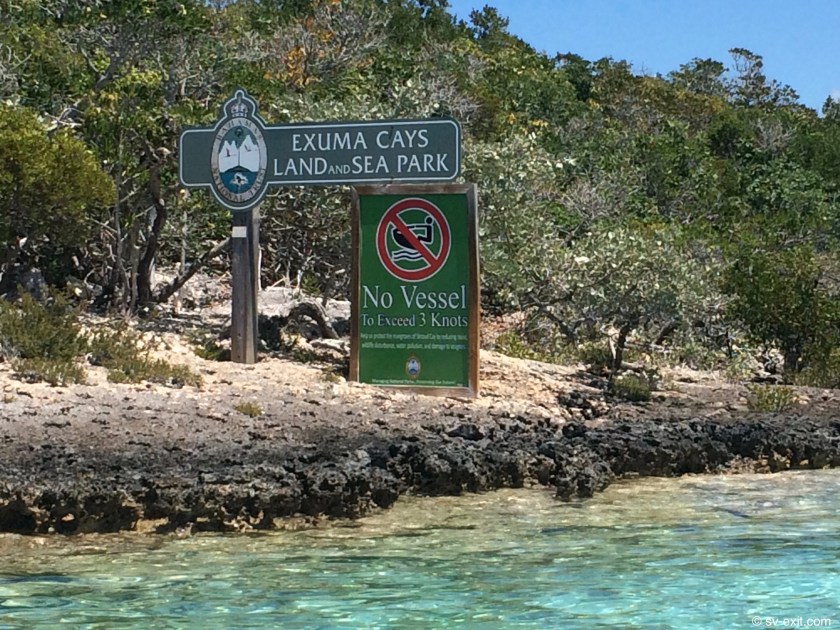
     Warderick Wells Cay houses the main office for the Exuma Cays Land and Sea Park.

img_5807

     Obviously, there are very limited resources available to patrol the park (hence the jet skis in the creeks at Shroud Cay).  So, while we weren’t surprised to see park rangers at Warderick Wells, we were quite surprised when a park speedboat pulled up alongside our anchored boat the morning after we arrived asking if we had paid the anchorage fee.

     This was news to us.  

     You’re definitely going to get charged to stay at a marina.  You’re definitely going to pay to tie up to someone’s mooring ball.  Restricting anchoring (whether it be for traffic considerations, security concerns, safety issues, or a number of other things) is not uncommon or unreasonable.  But having to pay to anchor is definitely not the norm.

    In fact, inside the Exuma Cays Land and Sea Park is the first (and so far the only) place we encountered this practice.

     At fifty cents a foot ($23.00 for us) per day, we chalked this up to supporting much needed conservation efforts and just hoped the money was well spent.

img_5749

     The island itself has a number of paths, stretching through very arid desert-like sections, connecting beaches on both the eastern sound and western bank side.  We packed sandwiches and a one liter Hydroflask full of Bahamian Rum mixed with lemonade, and traversed across paths of sand bearing names like Pirate’s Lair and Camel’s Plight.


img_5691

     And, though not superstitious, we succumbed to the cliche of the superstitious mariner, feeling obligated to leave a tribute on Boo Boo Hill upon which, in addition to a breathtaking panoramic view, there is a monument created from bits of carved and painted driftwood left by cruisers.  Legend has it that a number of unfortunate souls who ran aground on the reef still haunt the area and can be heard singing on full moon nights.  Leaving an offering atop Boo Boo Hill, to appease King Neptune in hopes of good wind and smooth seas, didn’t sound like a sure bet…but what the fuck?  It can’t hurt, can it?

     Not wanting to cough up another $23 for anchoring inside the park, we decided to go to Fowl Cay, a tiny island with a U-shaped bay fourteen nautical miles to the south, just barely outside the park boundary by about one thousand feet.

     Though we didn’t sail off our anchor, we sailed without engine for about three quarters of the day. 

     Every time we think we’re getting a better grasp of sailing technique, things seem to go to shit.  And then when we get really frustrated, things seem to suddenly start improving… go figure.  

     While other days we had difficulty maintaining four knots of speed in fifteen knots of wind, to our amazement, today Exit was managing to make six knots despite the fact that the wind indicator only read 6.4 knots on the display screen!  Hmmm… go figure.

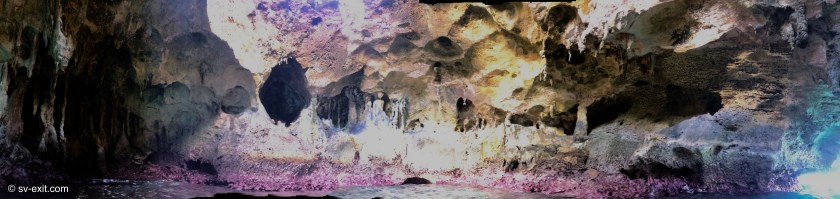
     Three days anchored at Fowl Cay gave us a chance to take the dinghy about a half a mile away to snorkel inside two amazing caves at a pair of small rocky islands called Rocky Dundas.  They were only single chambers, but quite large, complete with stalactite and stalagmite structures, as well a hole in the ceiling where the roof partially fell through.

img_5857

     We had hoped to scuba dive the area, as we had heard the space between the two caves had some very healthy coral and marine life.  Exit already had one air tank aboard when we purchased her, and we had acquired three more used tanks from Bahama Divers in Nassau.

     Though the area had some of the healthiest coral and congregations of marine life we have seen in the Bahamas, it was only about fifteen foot maximum depth, and really didn’t warrant donning the gear to explore.  And while we have had some absolutely incredible dives in less than ten feet of water, this would not have been one of them.  Oh well… the scuba gear stays stowed for now.

img_5865

img_5868
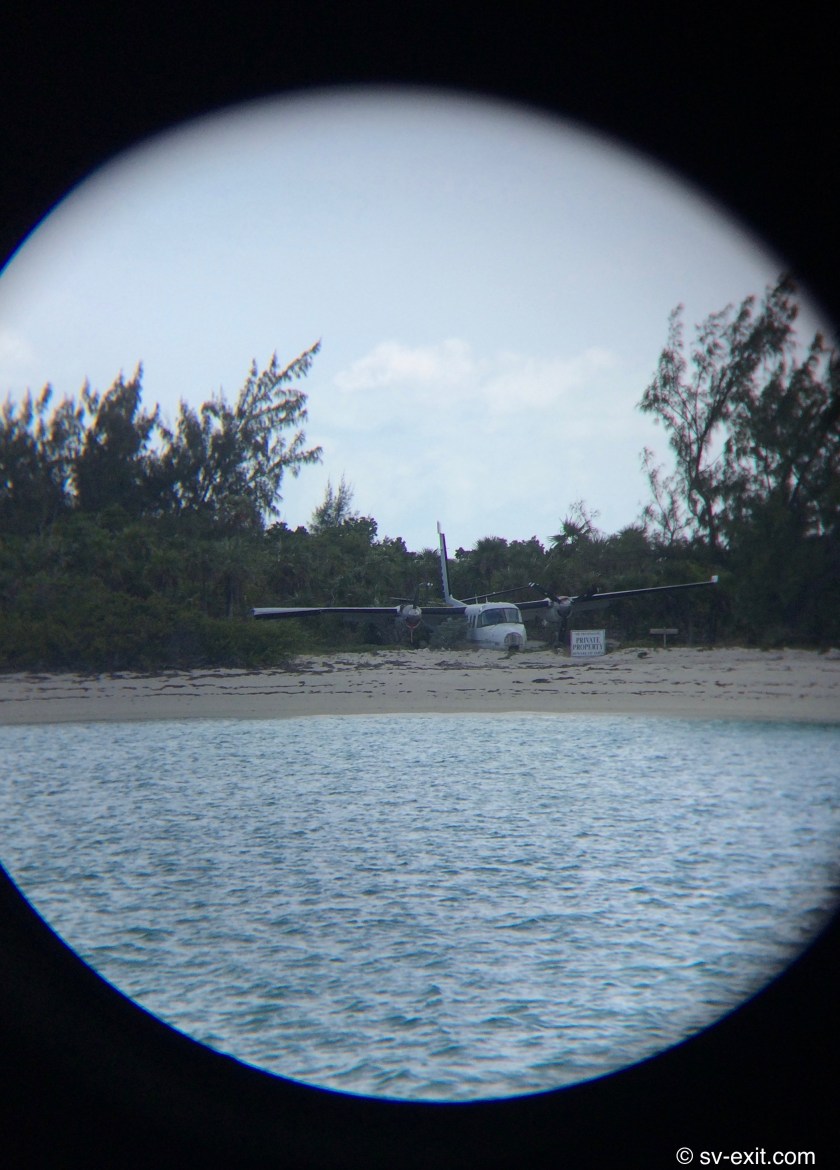
Crashed plane abandoned on Fowl Cay

     After three days, we hoisted the anchor again and set off for Staniel Cay.  In Nassau, we had been told by a guy who just arrived at the marina we were getting ready to leave that Staniel Cay was not to be missed.  Good provisioning opportunities, well equipped marinas with trustworthy fuel and plenty of entertainment were all to be had, according to the guy.

     In retrospect, the fact that he was towed into the marina possibly should have been factored into his credibility level.

     But, hey… sometimes you never know for sure until you see for yourself.

What Mega-Yacht? I Only See Mega-Twats

img_5847
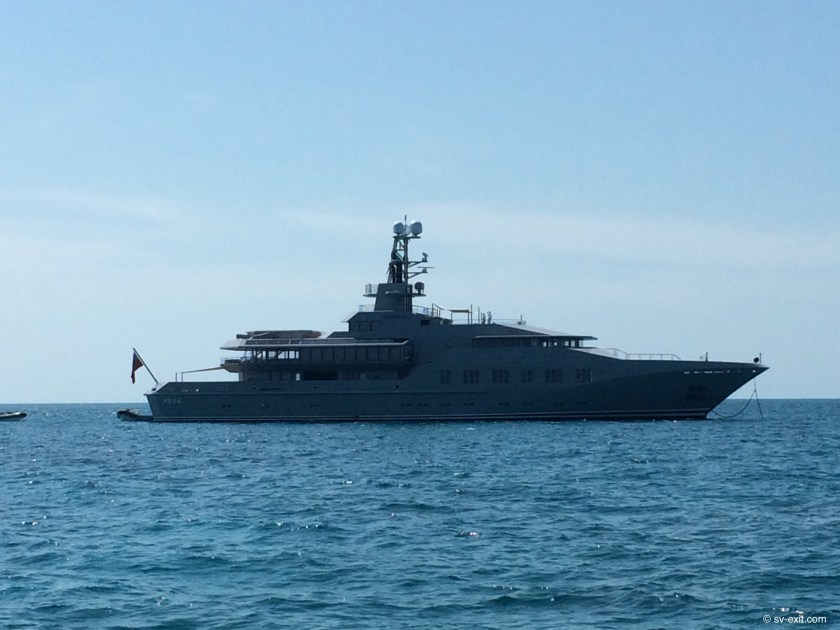
$75,000,000 Mega-Yacht M/Y Skat… the toys of billionaires

April 3, 2018

     Mega-YachtsTwats…

I’ll admit that I can certainly be a bit of an idealist (I can hear Kris laughing at that).  Generally, I try to steer away from ignorance (Kris still laughing).  

     I do realize the world is comprised of both haves and have nots.  And the haves are further distinguished between have some, have lots, and have ridiculously stupid amounts.  

      Not necessarily ideal.  Just the way it is.  

     However, there is a subsection of haves who apparently possess a need to display to everyone around them just how much some, lots, or ridiculously stupid amounts actually are.  It is this group of people that evoke a visceral reaction of absolute contempt and disgust from me.

     We began to see an uncanny number of unbelievably high dollar yachts as soon as we arrived in Bimini.  I’m not sure of the specific dollar threshold at which a yacht becomes a mega-yacht, but it seems that the distinction becomes rather irrelevant when you get right down to it.  

     I suppose the guy with the five million dollar yacht wants to be included in the mega-yacht status category while the guy who owns the twenty million dollar yacht doesn’t want his triumphant display of success to be lumped in, and therefore made less significant, by the mere five million dollar wishful thinker.

     Regardless, there is a vulgar breed of these people emerging who take things to a whole new level of unrestrained consumption and arrogant displays of wealth… I dub them the Mega-Twats.

     Oftentimes too big, or with too deep a draft, to fit into the anchorages that other boats are using, they tend to lurk just outside the general population.  They may have to anchor a mile or more out on the horizon, like a cruise ship.

     They seem to almost be on display for all to take in… separated but definitely looking down from above.

     And, make no mistake… they come with all-access passes.

     Within moments of dropping anchor, their crew of at least a half dozen people is hard at work.  Jet skis are lowered by crane from the upper deck or retrieved from inside garage-sized storage units hidden into the stern.  Three-story tall water slides, climbing walls, and banana boats are diligently inflated and deployed.  

    Evidently, as some thrill seeking adrenaline junkie on a jet ski slaloms past the other boats at anchor in the area at wide open throttle, it doesn’t appear to even occur to him or her that… hey… I’m really, really being an asshole here!  

     Rather, it seems much more that their thought process goes along the lines of… Hey… Fuck you! I like to drive this thing really fast back and forth.  I don’t have a lot of time to waste, so I’m not gonna give a shit about showing any respect to other people!  I’m rich and that makes it all about me!

     Any beaches are certainly fair game for a Mega-Twat invasion.  Not just an arrival… but an unmistakable and overbearing presence to be established.

     Thirty foot long, triple-engine speedboats bring supplies ashore in advance.  Small pavilions, tables, chairs, and entertainment areas are assembled on the beach, establishing zones of occupation to be overrun at the whimsical discretion of some asshole calling on the crew to set up an improvised, quaint, and elegantly rustic beach picnic.

*****

     When we arrived at Shroud Cay, just inside the northern boundary of Exuma Cays Land and Sea Park, we were excited to take the dinghy inland to explore endless networks of creeks that snake back and forth through expanses of low-growing mangroves.

img_5699

  The park itself is twenty two miles long and extends four nautical miles beyond the cays.  This “No Take” zone, where hunting and fishing are strictly prohibited within its’ boundaries, provides a safe haven and replenishment area for native species as well as an opportunity to educate the public.

img_5691

     Shroud Cay is only about three miles long.  The anchorage on the west side faces out towards the shallow Exuma Banks side while the cay’s east side immediately plummets more than a thousand feet down into Exuma Sound.  Winding creeks meander back and forth through the mangroves that make up the cay.

     Well clear of all the boats scattered about the anchorage, which can become a bit overbearing, many of the creeks feel remarkably isolated.  

    Obscure side canals and creeks provide endless routes to explore.  Some narrow to a point that eventually forced us to turn the dinghy around and backtrack.  Others opened into vast lakes and marshes of partially dried salt flats, more than a thousand feet across yet less than a foot deep… quite surreal… a bit primeval… way cool.

     Fortunately, it is clearly posted at the mouth of each creek that all outboard engines are restricted to idle speed and jet skies are completely prohibited from entering the creeks, allowing for a much more intimate experience.

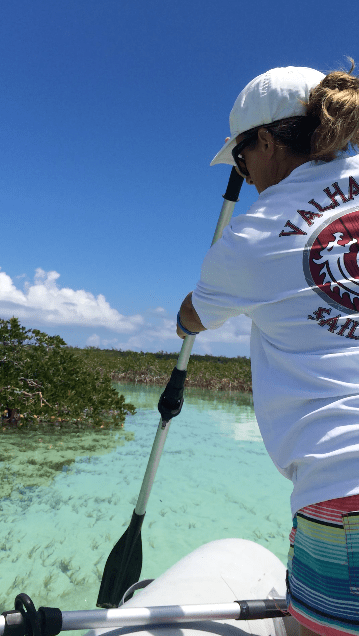
     Much of the time, we shut off the outboard entirely, opting to row with the oars and thoroughly enjoy the lack of any engine noise or other people.

krisrowingshroudcay

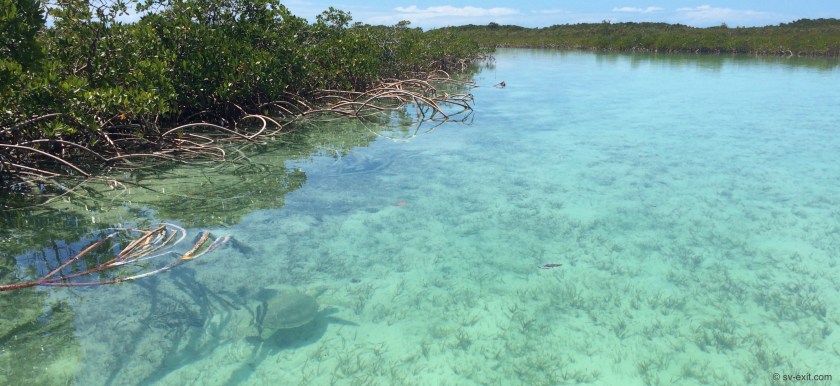
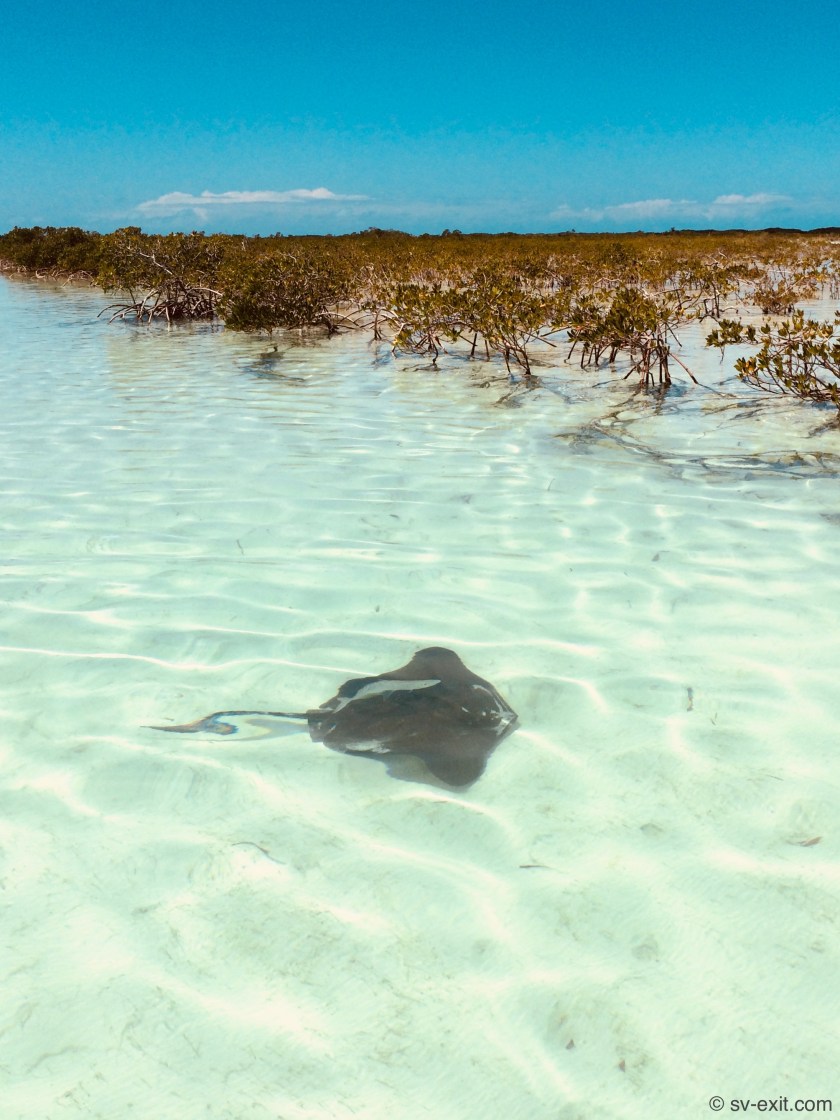
     Baby sharks and young turtles swimming by in water that looked like it was inside a Bombay Sapphire Gin bottle were the additional reward for the extra effort of rowing, instead of motoring through.

img_5719

img_5711

     And then came the occupants of one of the Mega-Twats… We heard them well before we saw them.  Two jet skis.  Not more than a couple of bends in the creek away from us.  

     The incessant whine of their wide open throttles shattered the silence.  Their unmistakeable rooster tails of water tracked towards us. 

     We had meandered onto a side creek, which had subsequently bottlenecked down to a point narrower than our dinghy, and were now backtracked to where it opened back into the main creek when the jet skies came ripping around the bend.

      Apparently, the assholes were going too fast for the sign at the mouth of the creek, which read All Vessels Idle Speed Only – No Jet Skis Allowed In Creek, to be seen as anything but a momentary blur at the outer fringes of their field of vision.  

img_5776

     Luckily, we hadn’t re-entered the main creek yet, as the dinghy would probably have been cut right in half. 

     Instead, the guy on the first jet ski zoomed by us at full throttle, just off of our bow, and around another small tender boat that also happened to be right there in the creek.  His stupid girlfriend came wailing past on her jet ski ten seconds later.

     The guy in the tender informed us that these two jack-offs were from M/Y Skat .  We later identified a gun metal floating palace that seemed to stalk us as we cruised south down through the Exumas as the offending mega-yacht… M/Y Skat (ironically, a Danish word meaning treasure but an English word meaning bear shit —- ya, I know its spelled wrong but cut me some slack).

     I was stunned to learn an ex-Microsoft engineer worth 2.6 billion dollars is the proud owner of this… seventy five million dollar (yes… $75 million is not a typo!) recreational vessel.  An RV complete with high performance jet skis and assholes to drive them… fucking Mega-Twats!

f63a3cd5-23f6-4d8e-b49a-8fd41b607824
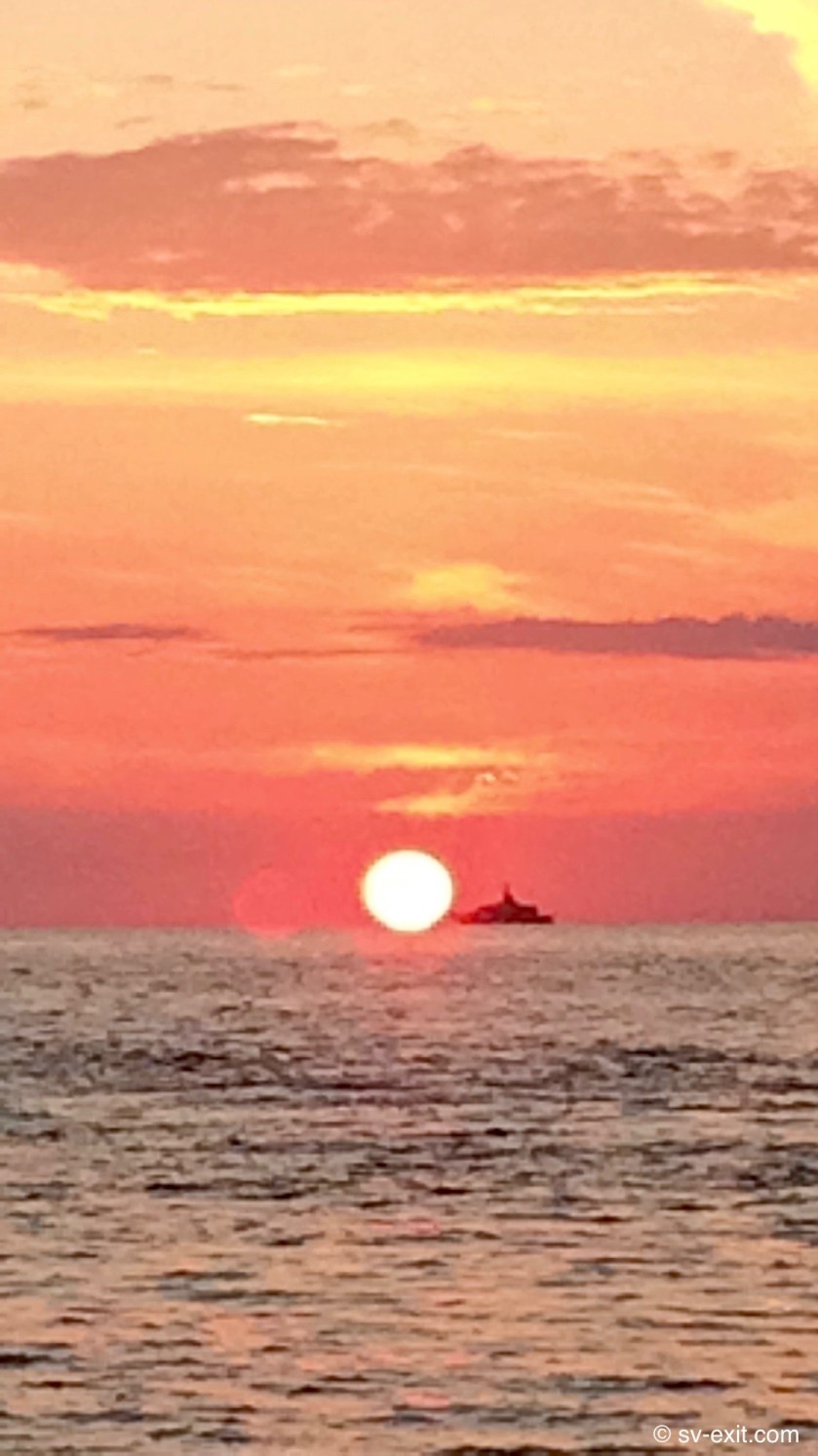
Where does a Mega-Twat anchor?  Why… between you and the sunset, of course!
img_5663
The rare uninterrupted sunset

The Exumas

April 1, 2018

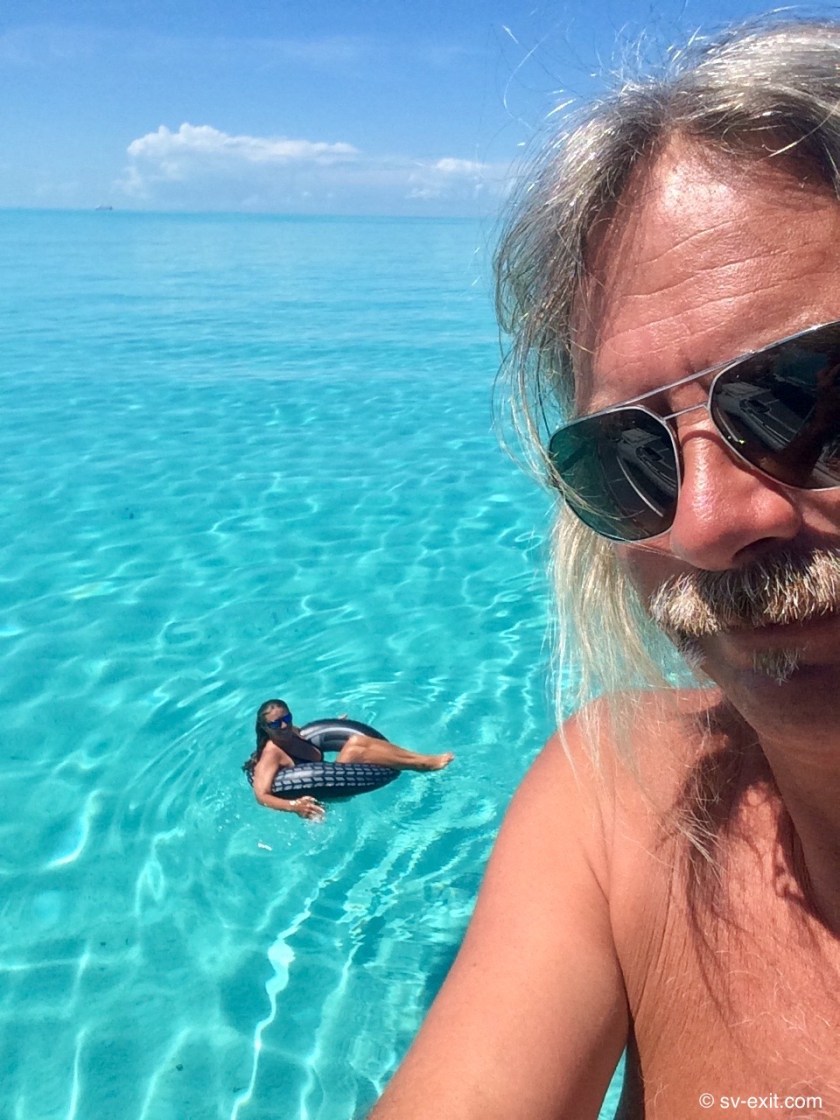
    No description (or photo, for that matter) can accurately capture the full range of colors reflecting different depths of the gin-clear water in the Bahamas – white, emerald green, turquoise, sapphire blue, indigo, brown, black.  Again and again, we pause to reflect just how unique the water here actually is.

     Our approach to the Exumas required us to, once again, cross the Great Bahama Banks.  This strange stretch of shallows, miles and miles of sandy bottom rarely deeper than twenty feet interspersed with rocks and coral heads, presents a continual exercise in navigational awareness.   Large sections are little more than underwater sandy deserts with very little to be concerned about.

     Other areas are more like minefields.  Scattered with rocks and coral, some lurking just below the waterline, these areas must be traversed with great caution, and only under certain sea and light conditions.  For those who pay attention and read the water, there is limited concern.  For those who program waypoints into a plot charter and rely only on autopilot, there can be a world of grief.

     We made for Highborne Cay, thirty five nautical miles to the southwest of us, on March 31.  Ten knot breezes allowed us to sail for more than five of the seven and a half hours the journey took, and very little of that was spent in areas requiring one of us to stand lookout on the bow.   This was the first time we had done more sailing than motoring since leaving Florida and we both thought it was long overdue.

     Once we arrived at Highborne Cay, we were almost immediately baptized into two Bahamas traditions. First, the practice of certain visiting boaters to drop anchor as unnervingly close to you as can be imagined, for no apparent reason.  Second, the ancient Bahamian tradition, now apparently being revived almost exclusively by Caucasian catamaran couples, to herald the arrival of sunset with the sometimes successful trumpeting of a conch shell.

     We had been told by one Floridian catamaran owner who had been coming to the Bahamas for the last eighteen years that it was, in fact, he who was, singlehandedly, reviving the conch shell blowing tradition.  He had the tool on his boat to properly make the hole… there was good depth along the mangroves to explore… the Bahamian military forces stopped here regularly to say hi to him… he caught more lobsters than all the other boat combined… a fifteen foot hammerhead had recently swam up to him in this bay… blah… blah… blah…

     When we do meet cruisers who have a like mindset, it can be an incredible experience.  As greenhorns, we gain amazing amounts of insight, learning best often just by listening.  Some of the best memories come from simply sitting in the cockpit, enjoying sunset drinks, speaking with kindred spirits.  And it’s with those people that interesting conversations emerge – beyond the Where are ya from?  Where have ya been?  Where are ya going?  Here’s our boat card…

     Waiting for favorable sailing winds, we spent three nights anchored at Highborne Cay, though we never had the inclination to go ashore.  We saw lots of other dinghies racing from one boat to another, obviously already well acquainted with each other.  For some reason, we rarely felt the attraction of interacting with a lot of the people surrounding us.

     Not sure if this was an anti-social tendency of dirt-dwellers we still needed to be weened of…  James would say we were simply ahead of the curve… good for us!
     We were surrounded by a couple of dozen other monohull sailboats, catamarans, and power trawlers, which made it quite claustrophobic.  But, without any doubt, it was the behemoth and arrogant displays of unlimited wealth embodied in the floating palaces of decedent excess called Mega-yachts that truly tested one’s resolve not to vomit or commit physical violence.

img_5657

Beyond Nassau

img_5611

March 24-31, 2018

    Nassau had allowed us the opportunity to see our best friends again, as well as provided the chance encounter with our new friend Ray.  Nevertheless, after nearly a month at New Providence, to say we were chomping at the bit to move on would be a vast understatement.

     The Exumas, a long line of small cays stretching southeast for over a hundred miles, just southeast of us, seemed like the most logical choice for us to visit next.  Many people we had spoken with had raved about them, and photos provided further evidence of what appeared to be the quintessential Bahamian paradise.

     Tucked in between the Exuma Sound (essentially the open Atlantic Ocean) on the east, and the Tongue of the Ocean to the west, the Exumas are comprised of a tiny thread of cays and landmasses that barely emerge above the water, dotting the easternmost edge of the Great Bahama Bank.  In fact, very few of the cays have elevations that exceed fifty feet above sea level. 

     We decided Rose Island would make for a perfect launching point to head south.  It was twenty two miles east of West Bay, which gave us a head start in the direction we needed to go, as well as got us away from much of the boat traffic surrounding Nassau and New Providence.

     We often joke that we can determine the direction we intend to go by the wind direction.  It seems to always be coming from the direction we’re trying to head… not ideal from a sailing standpoint, for sure.

     Heading for Rose Island, we struggled to gain an angle we could sail under without pushing ridiculously far off course which would also just add additional distance to travel. 

     As we pressed further offshore than we initially intended, we were perplexed by what appeared to be land sitting barely above the waterline in the distance, maybe a mile off our port side.  The perplexing part was that there was not supposed to be any land in that direction… certainly not so close.  We could still see New Providence clearly to our right… evidence that we, in fact, were where we thought we were; but also evidence that the nearest land to our left should be well over the horizon.

     We edged closer to investigate.  Surprisingly, what we discovered was that our land was actually an island of sargassum seaweed, floating on the surface of the water, covering an area that had to be nearly the size of a football field.  As we got closer, we saw an additional road of sargassum seaweed leading both to and from the sargassum island as far as we could see in either direction.

     Not wanting to suck a giant mound of sargassum seaweed into our raw water pump, we avoided plowing right through the middle, though the idea was certainly a bit tempting.  We juked back and forth for the next hour or so, avoiding additional seaweed congregations, or choosing a narrow point when we had to cut across a road of seaweed that blocked our path.

     Finally the water appeared clear in all directions, and it seemed we had left the bizarre highways and islands of living plants behind us.  

     However, during that time, we began to notice that our engine tachometer, on the helm pedestal in the cockpit, had  begun to swing erratically, bouncing up and down from the actual engine speed, at times even spinning completely around.  Another Twilight Zone situation unfolding.

     Even stranger, the volt dummy light on the main panel at the top of the companionway steps had begun flashing on and off intermittently.  The battery voltage appeared fine at the main switch panel, the solar panels were charging, and everything on the engine seemed to be running perfectly fine, so we decided to continue heading for Rose Island, which was still two to three hours away, monitoring things while we were underway.

     The voltage dummy light (which should have indicated a lack of charging when lit), continued flashing on and off, becoming more and more incessant and staying on for longer periods of time.  Also, we noticed when the light came on, the temperature gauge and engine tach on the companionway panel also stopped working.

     Still, the engine seemed to be running perfectly fine.  Not wanting to shut things down and risk the engine not starting back up, we pressed on.

     By 5:00pm, we had safely arrived at Rose Island and set the anchor.  However, an hour later, when we tried to start the engine to see if the voltage light was still acting up, we got nothing… no warning buzzer, no engine starting.  It wouldn’t even turn over.

     Fuck.

     The following day was a game of chasing down the electrical ghost in the machine.  Taking off panels.  Identifying, following, and tracing wire paths.  Checking connections.  Testing for continuity and voltage from point to point with a multimeter.  Wires disappearing into a hole in the wall or a bundle of other wires, only to emerge again who knows where else.

     Troubleshooting electrical problems are a bitch.  Not only because I am NOT an electrician.  That doesn’t help.  But, also because electricity goes beyond science, and even magic… into the realm of voodoo.  

     Not just protons, neutrons, and electrons following the laws of physics.  Not just the magic and spells of sorcerers.  But full on chicken bone, snake eyes, and pig’s blood voodoo kinda shit.

     After consulting by phone with our electrical witchdoctor Tom (the electrical engineer who had installed our solar setup) for advice, the standing theory was that the likely source of the problem was either: a faulty connection somewhere, a failing ignition switch, an alternator belt that needed tightening or a problem with the alternator itself, or possibly we had not offered a sufficient blood sacrifice.

     Every wire path and connection we could get ahold of was checked (finding two suspect loose terminals along the way).  We tightened the alternator belts.  For the time being, we opted to hold off on the blood sacrifice.

     When we turned the key in the ignition, the warning buzzer sounded.  When we pressed the Start button, the old Perkins fired up immediately.  No charge fault light on the panel.  After shutting everything down and trying again, we got the same result.  All good.

     Fucking voodoo…

     With the electrical spirits seeming to be content, we now just had to placate the weather spirits.  

     Sitting at anchor just off Rose Island for a week awaiting a change in the wind direction, we came to thoroughly enjoy our remote location.  The lights of Nassau still spread across the horizon.  Yet, we had only a handful of other boats at anchor around us.   

img_5616

img_5603

     We could go ashore and take in the breathtaking colors of the water on the opposite side of the island, dinghy around the shallow bay that separated the mangroves at the shore of Rose Island from a narrow spit of land just opposite, or hang out on the beach of that spit, typically the only people ashore at any given time.

img_5641

img_5638
Outside the barrier

     Finally, on the last day of March, we hoisted anchor and headed out.  The Bimini Islands were now behind us and in front, across the shallows of the Bahama Banks, lie the Exumas.

Sovereign Nations

Just another WordPress.com weblog