Better Late Than Never

October 15, 2019

With the 2019 Caribbean hurricane season nearing its end, we finally made it to Guatemala.  Despite our intentions of a July arrival to the Rio Dulce — a location with a long established history of protection from Caribbean storms — it was now October.  Had we waited any longer, the boat traffic we would have encountered on our way in would have mostly been departing in the opposite direction to start their sailing season.  Ya… we were a solid three months behind most everyone else… but hey, what’s new?

The hundred fifteen mile overnight sail from Utila covered the entire spectrum ranging from sublime downwind sailing, to frustrated motoring with zero wind, to a twenty five knot squall smashing us from dead upwind.

Strangely, earlier in the day, all three boats had been visited repeatedly by a roving group of very curious and seemingly unseaworthy birds.

Later, with the sun touching down on the horizon almost directly in front of us, we were treated to the privilege of being escorting into the sunset by a pod of dolphins riding Exit’s bow wake.

Exit, Samba Pa Ti, and Off The Grid had all picked up anchor and set out from Utila within an hour of each other; however, any semblance of unity (often loosely defined as three specks stretched across the horizon) instantly disintegrated when the evening squall hit.  All three boats scattered in different directions and it would be twelve hours later, outside Livingston, Guatemala, before we saw either boat again.  Fortunately, the only casualty was a flying fish discovered later on deck (not so fortunate for the fish…)

The following morning, having just concluded our overnight watches pounding through the sloppy conditions left behind by the squall, we patted each other on the back in recognition of surpassing eight thousand nautical miles travelled aboard Exit.

After anchoring in the bay of Cabo Tres Puntas, directly opposite the mouth of the Rio Dulce for a short rest time, we experienced a rather painless clearing in at Livingston.  Thanks to an early enough start, were fortunate to be able to head immediately up the river, saving us from having to anchor overnight in Livingston, which had a sketchy reputation.

Conversely, Samba Pa Ti spent the night there, hoping to sort out ongoing fuel line problems.  Apparently the streak of Honduran bad luck had gone international and crossed over to Guatemala with them, as Craig promptly had the fenders stolen off the side of his boat that night!

We had heard endless stories about how stunning the journey up the Rio Dulce was… it had been anticipated as our hurricane season hideaway for months and months.

Now, after sitting in the middle of what was predicted by both history and our insurance company to be a hurricane risk hotspot — and subsequently having watched storm after storm pass up the U.S. East Coast, through the very area our insurance company had recommended we be at — we were finally here!

Traveling up the Rio Dulce, Guatemala:

Nearly ten miles of tranquil river, winding its way through the Guatemalan jungle.  Incredibly dense foliage stretching outward in all directions, sometimes looming atop limestone cliffs carved out three hundred or more feet directly above.

We’re motoring instead of sailing, unfortunately; but it’s still magical.


Every now and then, a small group of buildings emerge along the shoreline ahead.

The chances are almost equal that the occupant of the small dugout style cayuca fishing near the shore is an over forty year old woman or a twelve year old boy.

After two hours of snaking our way back and forth, mostly in solitude, the Rio Dulce expands out into a lake called El Golfete.  On one side, a number of small community bays; on the other side, largely no development whatsoever.

After a few days at anchor in Texas Bay, we ventured out to explore other anchorages.

Oftentimes, our dinghy proved to be the absolutely invaluable resource, especially when it came to exploration.

Following a dinghy reconnaissance up a small unsounded and inaccurately charted river, we became confident enough to return with the Mothership and feel our way along, eventually dropping anchor in a spot that seemed like complete jungle isolation (with the exception of a few local boats occasionally passing by with wave and a smile.

Eventually, it was time to move a bit further upriver to the town of Fronteras where we had a date with Monkey Bay Marina.  Exit, once again, being placed under house arrest.

At US$220 per month to tie up in a slip, it was too cheap to pass up.

It provided us the opportunity to get our anchor re-galvanised (a two week prospect), complete projects like clean and waterproof our bimini and dodger covers, as well as perform oil and fuel filter changes with a means of disposal.

Plus, if everything went according to plan, we would also be able to sort out an inexpensive source for Sunbrella dinghy chaps and sun shades for Exit’s deck.  The dinghy was beginning to show signs of wear and tear from both constant use as well as  sun exposure; we couldn’t afford not to protect it.  Furthermore, a recent check with our infra-red temperature gun confirmed surface temperatures on our aluminium deck in excess of one hundred twenty five degrees Fahrenheit during the day!  That makes Exit literally an aluminium frying pan on bare feet.  It has become obvious that some kind of removable sun shade for the deck would make a huge difference in our comfort, both above and below deck.

Lastly, Exit safely tucked in a marina gave us the peace of mind to set out on a four week land exploration through Guatemala and Mexico.  The chance to experience completely new locations, revisit destinations we hadn’t seen in ten to twenty years, and rendezvous with old friends in the least likely of places.

So, Monkey Bay Marina it was.

And yep… there were monkeys.


Out Of Time

October 6, 2019

Given the opportunity, we probably would have been happy to have sat through the rest of hurricane season in Honduras, comfortable with the knowledge that the Rio Dulce was only twenty-four hours away if the weather really became threatening.

However, Honduran Immigration would certainly not have been so keen on this strategy.

We had already burned two-thirds of our ninety day visa in Guanaja.  Though we had really enjoyed Guanaja’s isolated feeling, Roatan placed us more in the grip of civilisation (as much as an island could), making repair parts and provisions much more readily available.  

For a payment of forty Lempiras (about US$1.60) to a local family, we were allowed to tie our dinghy up to the semi-derelict sailboat Cap. Herwith, which gave us access to land as well as inexpensive dinghy security… no one would be allowed to mess with a dinghy that provided ongoing income potential for the family watching it.

The dirt road leading up and over the hill brought us to a paved road which, in one direction, led us to the windlass mechanic we stumbled across.  In the other direction, just down the street, was the grocery store Eldons, which turned out to be one of the best stocked stores and most reasonably priced stores we had seen since leaving the States.

Now, after two weeks in Roatan, we had gotten our windlass working and were thoroughly stocked up on provisions.  However, we were down to only two weeks of our visa remaining before we had to be out of the country.

Two weeks in Roatan had been enough… we were well ready to move on.  Roatan has the feel of being mostly a short term tourist destination.  The cruise ship industry is obviously one of its major targets, and it shows.

On one hand, we were amazed and inspired by the conservation work being done by Sherman Arch and his family.   Nearly four decades ago, they opened a wildlife reserve right next to where we were at anchor in French Harbor.   While most of the space is dedicated to iguana preservation and conservation, they have a number of rescued toucans, parrots, turkeys, and even a monkey onsite; as well as a large space at the dock with huge tarpons.  Oddly enough, they also have dozens of lobsters which can freely enter and exit the enclosed area that we watched moving back and forth.  

On the other hand, right next to this protected area is a cay that was purchased and opened as a “watersports park” by an Iranian businessman.  You can rent jet skis, go horseback riding on the beach (actually just being led around on horseback by a staff member waist deep in the water), play on enormous plastic water toys, and visit caged tigers and lions among other endangered animals.

We were anchored, literally, between the best and the worst of humanity.

DCIM101GOPROGOPR3032.JPG
At the Iguana Reserve with Exit at anchor and French’s Cay Animal Prison in the background

Sherman Arch was an instrumental force in persuading the government to convert a football field size area, on the opposite side of the bay, into a marine protected area where fishing, including the removal of conch and lobster, is prohibited.  They patrol the area themselves.

He was visibly mortified when we described to him what we had recently seen snorkelling there; what appeared to us to be signs of cyanide fishing within the protected area – dozens of otherwise healthy octopi, eels, wrasse and other small fish dead or dying in the sand.

Despite the fact that we were well ready to clear out of Roatan and head for the Rio Dulce, we were hoping that the weather gods would be slightly more cooperative.  For weeks now, continuous fronts coming from Africa had sucked almost all of the wind from our area as they passed north of Cuba.  Forecasts had given us no more than a couple of hours of wind at a time; and any stretches of good sailing wind seemed to arrive without warning (often with accompanying squalls).

Initial information suggested that continuing to Utila, the third of the Bay Islands, might be problematic when it came to clearing out.  If customs and immigration officials turned out to be difficult to organise in Utila, as was rumoured to be the case, it could force us to return to Roatan to clear out with both the clock ticking as well as the wind against us… not a pleasant prospect.

But, after talking to a number of people, we eventually decided the concerns were unfounded.  

So, instead of moving to the even more populated West End of Roatan with S/V Samba Pa Ti and S/V Off The Grid, we opted to head for Utila.  Even if we had to to motor, at least it was in the right direction and would break up the monotony of motoring all the way to the Rio Dulce.

So, after one more beautiful Roatan sunset…

…we set out on a clear day, with zero wind.  The nearly smooth ocean surface allowed us to see a surprising amount of detail on the seabed nearly one hundred feet below.  

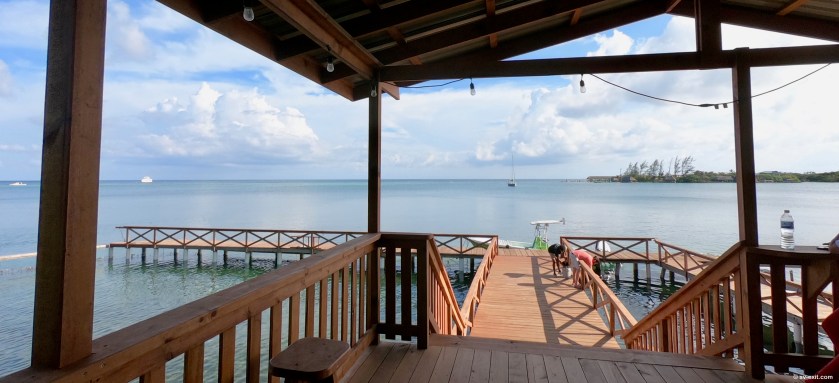
On the down side, no wind meant we motored the nearly six hours to Utila.  Still, in a bay with only one other sailboat at anchor, we found an equally beautiful sunset and possibly the best Long Island Ice Tea Kris has ever tasted (complete with conservation-minded metal straw!!!) at the bar Mango Tango, which we were anchored right next to.

Immediately the feel of Utila seemed well better than that of Roatan.  More than anything, it reminded us of the backpacker vibe of Thailand.  

Instead of the cars of Roatan, and unlike the lack of any cars in Guanaja, Utila opts for what seemed to be a compromise… golf carts, as a primary mode of motored transportation.  This meant that, once S/V Samba Pa Ti and S/V Off The Grid caught up with us, a road trip around Utila via golf cart was well in order.  Given the driving environment, and especially the close quarters in town, Josh deserved major credit for volunteering as wheelman all day.

As for scuba diving, the option of getting tank air fills for three dollars each in Utila — as opposed to the ten dollars per tank Roatan had tried to extort from us — meant scuba diving was back on the menu… which meant we even had the opportunity to take our friend Craig, from S/V Samba Pa Ti, for a dive.

As it turns out, Utila is the place to be if you have a musical itch that needs scratching.  Our first day ashore, during a conversation with an expat in one of the bars, we were told to stop by open mic night at Sea Breakers, which we did.

And, while it did feel good to pick up an electric guitar and sit in for a handful of songs/jams, I would have to confess that meeting the bartender Johnny turned out to be much more fruitful than meeting the owner, whose guitar playing skills were only marginally better than his listening skills, which were non-existent.

Rhino’s Beergarden and Delicatessen was actually the place that raised the bar to a new level when its came to phenomenal music, great company, fantastic food, and ice cold German beer!  The owner, Reiner, who had opened only one month ago, was not only able to pour a perfect glass of beer, but also cook an insane spaetzle dish with German sausage, bake delicious homemade pretzels, and play a mean guitar.

After an impromptu jam session during our final visit to Rhino’s, Reiner insisted that the  photo he took was destined to be hung on the Wall of Fame/Shame.  I left a guitar pick as a pledge that I would return someday to sign the photo.

Still, after ten days in Utila, we found ourselves holding visas that were on the verge of expiring.

Not something to fuck around with, despite what you might be told by Guanaja shady expat character “a.k.a. John Smith” who sailed into Honduras years ago, ran out of money, and now lives aboard a derelict boat, unable to leave the country not only because his boat’s not seaworthy, which is the case, but also because he owes the Honduran government thousands of dollars in fines for overstaying his visa… smart guy.

Even extending our visa in Honduras was something we had ruled out.  Based upon the C-4 agreement between Honduras, Guatemala, Nicaragua, and El Salvador, we worried that extending our visa in Honduras might result in our Guatemala visit being limited to thirty days on our entry stamp.

Not worth the risk… it was time to move on.

So, with only three days left on our ninety day visa, we painlessly (comparatively, at least) cleared out with the official at the Honduran immigration office as well as customs at the Port Captain’s office next door.

Somehow or another we had managed to avoid the lion’s share of grief and headaches during our stay in the Bay Islands — headaches which seemed to fall square on Craig, of S/V Samba Pa Ti.   A chronic and catastrophic fuel line failure coming in from Roatan; being pickpocketed on the island of Utila; having his dinghy stolen while tied up to his anchored sailboat (at least it was recovered twelve hours later); and, finally while clearing out, getting saddled with a monetary fine by the Port Captain for an expired registration document… talk about shitty luck.

Having already learned to recognise that, at best, a minimal sympathy for electrical windlass issues were to be expected in the rather large world of sailing woes, my mouth remained zipped tight.

Sovereign Nations

Just another WordPress.com weblog