The southernmost point of a seventy-five nautical mile stretch of cays nestled in the wilderness.With the exception of two islands, they are unpopulated.
Explorer Chartbook refer to the Jumentos Cays and Ragged Islands as “little dots on a small-scale chart.Not the same as being in the middle of the Pacific Ocean, more than a thousand miles from the nearest land, but still the middle of nowhere.
The epitome of a communication black hole.
Our last cell tower reception had been March 8, when we left Salt Pond, Long Island.
The first cell tower we would see is located in Duncan Town on Ragged Island, the only settlement in the Jumentos Cays and Ragged Islands, and the only place cell service was even a possibility.
Currently, we were at anchor about ten nautical miles north of Duncan Town, just outside of cell range.
After two weeks of being at anchor in bays almost completely to ourselves, or maybe with one other boat in view, we found ourselves, possibly unfairly, quite annoyed at the small armada of four boats that had appeared in the distance and were in the process of anchoring next to another boat in the bay next to us.
It was the same group that had also invaded our space nearly a week before, at one point approaching us in their dinghy to ask if we had left the pair of sparkle covered flip-flops, being brandished in one of their hands, on the nearby beach.
To be fair, they currently were a bay away; and the greater victim was certainly the poor boat already at anchor that they all plopped down next to. Harmless enough… just bloody annoying.
Yet, we had been hearing one of these four boats yammering endlessly on the VHF since Long Island a month ago.They always seemed to be contacting other boats, discussing and relaying the day’s activity schedule and immediate future plans.Even at 6am, we would hear them calling in to Chris Parker’s weather broadcasts on the SSB radio.
During the previous weeks we had grown tired of hearing the immediately identifiable and thoroughly grating New Jersey accent every time the voice crackled through the speaker.
And here they were again… instead of heading back to George Town, which had been the tentative plans relayed during earlier radio communications.
It was the eventual drone of an outboard engine that alerted us that visitors were approaching in a dinghy… the same guy who had asked us about the sparkly flip-flops… great.
However, this time, instead of flip-flops they brought a cryptic message:Has anyone been in touch with you?We were told that attempts were underway to contact you regarding the death of a friend of yours in Indonesia…
We had heard nothing.
We immediately picked up anchor and made for Southside Bay at Ragged Island, near Duncan Town and the area’s only cell tower.But, upon our arrival, we discovered that there was no cell signal.We had heard days ago that there had been no cell service for days.Apparently, the problem had not yet been resolved.
Almost immediately, we were hailed on the VHF by the sailboat anchored next to us.
They asked the same question…
They then told us that they had heard that a request to locate S/V Exit had gone out on a SSB net broadcast days ago regarding the death of someone we were friends with in Indonesia.A sailor we had met earlier, while anchored near us in Thompson Bay, Long Island, was listening to the broadcast, recognized our name, had relayed our earlier position to the net moderator, and was sending word to boats in the area to keep an eye out for us.
Fortunately, though cell service was down in the area, our Iridium Go! was nowfunctional, allowing us to send and receive basic emails through a satellite connection instead of cell tower service.
After several email exchanges to a number of perople, a clearer picture began to materialize.
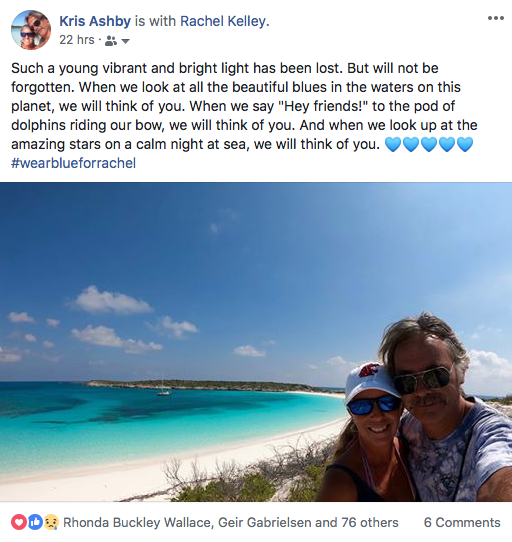
Tragically, one of our Scuba Junkie family, Rachel Kelley, whom we had worked with in Malaysia for nearly five years, had just passed away.
Rachel had returned to the U.S. after being diagnosed with cancer during our last year managing Scuba Junkie.After a hard fought battle, she had made an amazing return to Scuba Junkie and Mabul Island last year to resume teaching diving.
Sadly, her health took a turn for the worse, and her condition deteriorated quickly enough that emergency evacuation was just not possible.
Rachel passed away on March 15, 2019 in Kota Kinabalu, Borneo, with both family and friends at her side.
Rachel was an inspiring individual with an immense heart.She could surgically admonish someone’s political opinions while, at the same time, lovingly pet Scabby Pete the cat.Her commitment to teaching made her not just an incredible dive instructor, but also an energizing mentor.As a Scuba Junkie, she was not only friend, but also family.
Her final dive was far too soon; she was far too young.Those of us who had the incredible fortune of knowing her are better for it.We are all less without her. Her laugh was all it took to brighten a room.
And while we mourn Rachel’s passing with a heavy heart, we are simultaneously inspired by the Herculean effort that was put forth in getting word of this information to us.
A number of Scuba Junkie family (we love you Ric, Rohan, Lydia, Amanda, Dani, Simon) tried to get through to us via text message, Facebook, email, etc., but we had been without signal for almost two weeks.
Dani, who was at SJ when we first arrived in 2008, reached out to a yacht captain/dive friend in the Virgin Islands, who checked our blog site and posted a request for assistance on the Bahamas Cruisers Facebook page.Word made its way to the Cruiseheimers Net on SSB radio, where it was heard byS/V Imagine in Thompson Bay, Long Island.
Strangely enough, S/V Imagine had spoken with us weeks ago while randomly passing us at anchor in his dinghy.Now, he updated the SSB net of our recent location and passed word through the local morning cruisers’ net on the VHF.
Someone else who received the VHF net replied that he had seen us anchored in the Jumentos Cays and we should be within the Duncan Town cell tower range within a few days.
Meanwhile, we had emailed our friends Christian and Mary, aboard S/V I Wanda, inquiring about the SSB broadcast.They contacted the net moderator and informed him they had made email contact with us.That evening, the sailboat that had hailed us on the VHF when we arrived at Ragged Island, S/V Dot’s Way, contacted the SSB net and updated them as well.
Though the circumstances certainly were heart-rending, thank you to every single person who played a part in the effort that went into getting this devastating information to us in the North Atlantic Ocean, in the middle of nowhere, smack dab between Cuba and Long Island, Bahamas.
We departed Long Island bound for the remote destination of Jumentos Cays and Ragged Islands.
Once again, we stumbled across the Ancient Maritime Equation we first saw last month:
Ancient maritime equation: Boat Speed + Current Depth = True Wind Speed
This time:
Repeating the equation
Seems to only occur when the wind speed equals 14.1 knots… hmmmm. May require further studies…
There were repeated warnings not to undertake a journey to this area without first being entirely self-sufficient.
A combination of bad weather, bad luck, or bad decisions out here could prove unforgiving.
We had a full tank of diesel (enough to motor twelve hundred miles, or 10 days straight, if needed), two months normal supply of petrol for the outboard, enough propane to last at least four months, a potentially endless supply of fresh water (thanks to our new Spectra watermaker) as well as more than fifty lockers packed with provisions, beverages, tools, equipment, spares and things we still couldn’t identify… seemed to us like the fucking definition of the word self-sufficient.
We were not in the middle of nowhere… but we continually got the feeling that the the middle of nowhere was just around corner from us at any given moment.
DCIM100GOPROGOPR0539.JPG
DCIM100GOPROGOPR0537.JPG
DCIM100GOPROGOPR0534.JPG
Isolated.Exposed.
For the most part uninhabited, we were more likely to come across goats on the islands than people.
No Bahamas Defense Force.No Coast Guard. No marinas.No services.
Currently, we found we were one of maybe ten or so sailboats in the entire area.I can imagine that, not too many years ago, the Jumentos Cays and Ragged Islands didn’t have more than a half dozen or so sailboats visit during an entire year.
Buena Vista Cay has a population of one.Duncan Town on Ragged Island, at the very end of the chain, with a population of less than one hundred, represents the only settlement between Exuma and Cuba… and it is closer to Cuba (only sixty miles away) than George Town (it’s own country’s nearest significant population). Everything else… unpopulated.
Our arrival at Water Cay was rewarded immediately with what appeared to be an inquisitive bull shark swimming under us just after we had set the anchor.
A challenging climb in flip-flops up the steep, scrubby hill just beyond the beach provided a perfect view of the anchorage in a bay all to ourselves… nice.
DCIM100GOPROGOPR0546.JPG
DCIM100GOPROGOPR0551.JPG
DCIM100GOPROGOPR0558.JPG
Three days later, we picked up anchor and moved to Flamingo Cay fourteen miles, or about three hours, away.
DCIM100GOPROGOPR0592.JPG
DCIM100GOPROGOPR0594.JPG
DCIM100GOPROGOPR0595.JPG
DCIM100GOPROGOPR0598.JPG
DCIM100GOPROGOPR0599.JPG
We experienced a classic moment as we approached Flamingo Cay.We could see a boat already at anchor in the distance and a catamaran making straight for the anchorage from the opposite direction.
The race was on.There was no fucking way we were going to let this cat slip in just ahead of us and lay claim to the prime location we inevitably would want to anchor at.It was hard to tell with the opposing angles but it looked like we would arrive just barely ahead… yes!
Our pirate intentions gave way to laughter as we eventually realized that the cat was actually S/V Avighna.Tami and Jay had arrived at the same moment we had!
For us, Flamingo Cay holds the distinction of being the first anchorage requiring five tries to get a good anchor set.Four different locations.Even the patches of sand were not more than six inches deep over marl and rock that the anchor just scraped across the top of.
Eventually, we got an anchor set we were happy with, as did Tami and Jay, although they ended up two bays over before finally locating a spot their anchor would dig in.
We spent five nights at anchor at Flamingo Cay.
A dinghy excursion to a nearby cave.
DCIM100GOPROGOPR0602.JPG
Explorations ashore to the beach.
DCIM100GOPROGOPR0674.JPG
DCIM100GOPROGOPR0658.JPG
DCIM100GOPROGOPR0677.JPG
DCIM100GOPROGOPR0651.JPG
DCIM100GOPROGOPR0652.JPG
DCIM100GOPROGOPR0636.JPG
Though flamingos are one thing you will no longer find on Flamingo Cay, tiny red shrimp, once both a food source as well as the source of the resident flamingos’ pink coloration, are still to be found in some of the inland pools.
DCIM100GOPROGOPR0664.JPG
And finally… healthy coral and an abundance of fish to be found!The best we have seen in the Bahamas since scuba diving in the Abacos last year… which meant lobsters to be had just weeks before lobster season ends here in the Bahamas on March 30… yipee!
DCIM100GOPROGOPR0629.JPG
DCIM100GOPROGOPR0630.JPG
And sharks, sharks, sharks… woohoo!
DCIM100GOPROGOPR0623.JPG
DCIM100GOPROGOPR0625.JPG
DCIM100GOPROGOPR0626.JPG
DCIM100GOPROGOPR0624.JPG
Sadly, we had to bid fair winds and following seas to Tami and Jay for now, as S/V Avighna returned to Long Island… but the upside of sad farewells is the fact that they come at the end of happy reunions.
More than a week since arriving in the Jumentos and still yet to see our first permanent structure, much less an inhabited island. Nurse Cay… with a tiny little bay. Just enough room for us to tuck into a get out of the surge as long as the wind doesn’t shift, putting us way too close to the rocky shoreline on either side.
The only other souls to be seen are aboard a small fishing boat sitting at anchor a few thousand feet further outside the bay.They waved at us as we passed by earlier.
Twenty four hours later we would learn that the fishing boat was from Long Island and had been in the Jumentos for over a month.Manny, captain of the fishing boat, had motored over in a skiff to inquire if we had any tobacco.He had run out and his deck hand was growing quite surly as the incoming mail boat which would drop off a new supply was not due to arrive for another day.
Wanting to provide assistance to a fellow mariner, it saddened me to break the news that, alas, I had no cigarettes or cigars aboard our boat to offer.All I had was an unopened pack of rolling papers…
Immediately, Manny’s eyes lit up.
He asked if I would be willing to make a trade.
Considering I was speaking to a fisherman who had been here for a month… naturally, I expected fish to be at the top of the list of available trade commodities he would have to offer… instead, he pulled out a big bag of weed.
Immediately, Steve’s eyes lit up.
On a beach in Bali… in the countryside of Thailand… at a campsite in Australia… on the streets of Mexico… on the North Atlantic Ocean in uninhabited Jumentos, Bahamas… a weed magnet.
During a search for better protection from potential shifting winds (something we seem to continually be trying to out-guess here as our sources for weather forecasting this year have been mixed, at best), we passed right on by Buena Vista Cay, missing our opportunity to meet the one resident there, and only resident of the Jumentos Cays/Ragged Islands not living in Duncan Town.
We ended up at Double Breasted Cay, which had been highly recommended to us.
DCIM100GOPROGOPR0706.JPG
DCIM100GOPROGOPR0710.JPG
DCIM100GOPROGOPR0711.JPG
DCIM100GOPROGOPR0714.JPG
DCIM100GOPROGOPR0719.JPG
Nice… except the winds never really shifted; and we had to deal with a pack of buddy-boaters who had traveled together into the wilderness from George Town, invaded anchorages as a horde, and utilized the VHF as a preferred substitute for social media and text messaging.
However, the radio only required that you push a button when afflicted with diarrhea of the mouth instead of actually typing your thoughts, allowing you to have an even more random spewing of irrelevant thoughts…
We made a strategic move less than three miles away to what turned out to be one of the most peaceful and picturesque anchorages we have stumbled across to date.
Johnson Cay already had three boats anchored in its nearly completely enclosed horseshoe bay when we first passed by a few days prior… way too tight for our liking. But now they all picked up and moved seeking more protection from the predicted wind shifts.
When those winds never shifted, it left a perfect anchorage completely empty right next door to us… score for Exit.Which left us with a couple of days to ourselves in an epic and completely secluded anchorage.
DCIM100GOPROGOPR0729.JPG
DCIM100GOPROGOPR0723.JPG
DCIM100GOPROGOPR0728.JPG
DCIM100GOPROGOPR0735.JPG
DCIM100GOPROGOPR0737.JPG
DCIM100GOPROGOPR0741.JPG
DCIM100GOPROGOPR0747.JPG
DCIM100GOPROGOPR0761.JPG
DCIM100GOPROGOPR0752.JPG
Even better snorkeling here than at Flamingo Cay.The sharks were not one bit shy…
Here sharky, sharky…
But, after a couple of days, the wind eventually did shift with some sporadic squalls.Which left us with an ultimately drama-free though bouncy evening of experiencing just how quickly, with a bit of wind, two to three foot waves can stack up into an anchorage exposed to the open ocean.
Now that’s an anchor track!
Though the breezes tapered off the following morning, we opted to avoid a potential revisiting of the previously bouncy night with a thirty minute move to the much less picturesque though much more north-protected anchorage of Man-O-War Cay.
Turned out unnecessary.The wind never picked up again so we didn’t need the northerly protection.We traded out our sharks to snorkel with for a small herd of goats on the beach… ouch!
Hog Cay.Quite nondescript with the exception of a very large and strange looking marine creature that we happened across which appeared stranded in the shallow waves of the beach.Eventually we concluded two things:1) it must be some kind of nudibranch…2) it must not be so rare as we saw two more shortly thereafter.
At least we had a huge space all to ourselves… well, for a while.
Then a sailboat anchored in the bay next to ours.The nerve of some people… and only one bay away.Then our favorite armada of buddy-boats came and plopped down next to the boat in the other bay… had to feel sorry for that guy!!!
DCIM100GOPROGOPR0813.JPG
DCIM100GOPROGOPR0809.JPG
DCIM100GOPROGOPR0818.JPG
But to end on a more positive note… a riddle:
DCIM100GOPROGOPR0788.JPG
What do you call it when the depth gauge and wind speed indicator read the same?A Bahamas Phenomenon…
or a “Baha-menon-dat-dahhh-dat-dada…Baha-menon-dat-dahhh-dat-da…” Am I the only one with the Muppets in my head right now…?
Hey… fuck you!Comedy is not pretty!
We had not grown tired of Long Island in the least.Quite the opposite; it was one of those places that you could easily find yourself continually making excuses as to why you needed to stay.
Like Cat Island, it had come to represent a slice of the Bahamas we had been searching for… a place that felt like something more than simply Florida’s backyard playground.Not the imagery of resorts, marinas, and attractions catering to passing tourists.Real people stuck in living real lives.Fiercely proud people who had, for generations, been been carving out an existence on these islands which occupy the very edge of development and “mainstream” travel.The same people who had been helping those around them carve out that same existence at the same time.
Both qualities, capable independence and magnanimous hospitality, seemed to be a common thread woven into the fiber that makes up these tiny communities.
Still, we were both in agreement that it was time to move on.
Dawn departure from Joes Sound
When you are enjoying yourself, the difficult decision of moving on seems counterproductive.You travel to seek out enjoyable places, so why leave once you reach one of those places?
Sometimes, you have to remind yourself that the only reason you arrived at the location you are currently enjoying so much, is because you made the decision to move on from the previous location.
However, our general intention to continue pushing east as the opportunity arose was meeting resistance.Loosely, the plan was to work as far east as possible utilizing erratic wind patterns early in the year before the prevailing south-easterlies set in, which would force us to start heading south with the intent of getting below a Latitudeof 5ºN for hurricane season.
It was becoming more and more apparent that the prediction of Chris Parker (SSB radio’s weather guru for boaters), that the prevailing SE Bahamas winds seemed to be setting in early this year, was coming true with a vengeance.
This didn’t leave a lot of options for us from southern Long Island.
Motoring, which is always at the end of our list of options…
Push northeast; but we would likely be putting ourselves in a corner, trapped by southeast winds with only southeast to go…
Forego any further attempts to get any closer to the Caribbean, and make for Cuba, Puerto Rico, or Jamaica…
Make for a tiny chain of largely uninhabited islands less than a day away called the Jamentos and the Ragged Islands, ultimately still leaving all the options on the table…
As we continue to move further and further away from the safety net of marinas, supply stores, and easily obtained resources, we find a necessity to become more and more completely self-sufficient.We are constantly forced to second-guess and re-evaluate… what is the weakest link at any given time?
Though we feel confident that, even in remote locations, people will offer whatever help they can, we also feel adamant that traveling into more remote areas depending on other people, because you are poorly equipped or ill prepared, is foolhardy.
Fortunately, we have not found ourselves in an area so remote we have been unable to secure fuel or basic provisions if needed.Largely, it’s about having the foresight not to get close enough to running out of something that creates an emergency by topping up when the opportunity arrises.
With full fuel tanks (diesel, petrol, and propane), full water tanks, and recent provisioning, we should be able to go at least a month or more before needing to replenish something (with the obvious exception of fresh produce).
And yet, time and time again, we find ourselves most concerned about fresh water.
The two hundred gallon capacity of our tanks sounds endless.
At one gallon per person per day, that would last three months… Spartan.Basically, minimal drinking/cooking water and cleaning everything with salt water.We know people who do it but it amounts to survival living.
At the average dirt dweller’s consumption rate of one hundred gallons per day per person, we’d run out of water every day… silly.
Five or six gallons per day for both of us, our current average fresh water consumption rate living aboard Exit, affords us some luxuries within frugal constraints, and also makes water a monthly concern.
Not a problem in places like the United States, where free potable water can be obtained from a spigot on every dock.
Our travels through the Bahamas became our first initiation into the reality of having to buy the drinking water we were filling our tanks with.
Without city-plumbed drinking water, fresh water wells or reverse osmosis watermakers are a very limited commodity.We found that, when available, marinas would charge anywhere from twenty to fifty cents per gallon. Not cheap… but still available.
And understandable, when you have multi-million dollar pleasure boats wasting hundreds of gallons of fresh water to clean the salt off their decks.
However, as we explore areas with less and less development, even obtaining drinking water becomes a bigger and bigger issue.
The water from a tap is simply not potable, and drinking water is bought only by the bottle.
We thought rain catch would be the answer.
In theory… a no brainer.
In practice… at best, we’ve not been able to collect even half of our consumption over the course of a month.More like ten to fifteen percent has been the average over a year’s time.With different geographical rain patterns or better rain catch methods that might change; but for now… it is what it is.
Which leaves us:
Carrying free water as far as needed when available
Buying water when necessary
Scrambling to catch never enough rain when it falls from the sky
Living with self-imposed militant water restrictions
Potentially dying of thirst in the middle of the ocean
Considering the alternatives…
When we purchased Exit, there was already an installed watermaker aboard.It was a French made Aquaset… twenty five years old… looked almost unused… rated at twenty gallons of fresh water production per hour (seriously high capacity for its size)… listed as needing service by the previous owner.
Turns out water makers don’t like to sit unused for long periods and we eventually learned this one hadn’t been turned on in over fifteen years.
Still, we didn’t give up.
Optimistically, we left the rather massive contraption in place, undisturbed in the engine compartment and under the floor, where it had resided for a quarter century, largely sight unseen.
Numerous people who know far more about electrical, mechanics, and watermakers in particular, said this is a serious watermaker, but it’s not gonna be worth trying to revive… shit.
Apparently, the watermaker was rated to run on 350V (which the original generator on Exit must have been)…maird.Those crazy French.
It would cost at least a thousand dollars in parts, filters, and membranes (not including any labor) to find out if the Aquaset would ever make water again.At that point, it could cost another two or three times that to get it fully functional… shit.
Or it could be pronounced dead on arrival… shit.
*****
Salinity in ocean water is measured as TDS (total dissolved solids) in parts per million (ppm).Though it takes salinity levels of about 1000ppm to actually taste the salt, anything above 750ppm is unhealthy for drinking.The World Health Organization considers water to be potable, if total TDS do not exceed 750ppm.
Desalination of water on a scale compatible with daily use requires specialized pumps and filters, adequate power, adequate space, religious maintenance, and a healthy bank account (this intentionally excludes hand held survival watermaker products here – if you are afloat on a life raft, pumping by hand for hours to make water is considered survival; if you are trying to wash dishes, it is a ridiculous life style choice…).
Replacement options were daunting… $5-10k were numbers that were bouncing around… the appeal of 12-volt systems seemed obvious – our solar panels would recover the battery draw; but 12V water makers either generate much less fresh water or have much higher energy consumption… 230V would give us maximum volume of production without the battery concerns but would force us to use the very generator we were trying to minimize feeding more diesel to… at least 12V could rely on the solar when available but fall back on the generator to charge batteries if needed… unless the power drain was too much… or the output so low the watermaker had to be run for hours every day… watermakers ranging from three to thirty amps of electrical draw… watermakers ranging from two to twenty gallons of hourly production… arrrrrrgh!
Lots of info… no clear choices… everything is a compromise… easier to not make a decision and keep your money in your pocket for now…
… and deal with monthly fresh water concerns…
… still on Long Island… time to move on…
… but the Jumentos and Ragged Islands have no water available… sigh.
Enter the mysterious stranger… the unforeseen variable… the wild card… circumstance… the hand of Fate…
A passing comment from Jay over a week earlier regarding a used watermaker having recently been sold at Salt Pond’s local hardware and marine equipment store prompted us to inquire about used watermakers when we stopped by to ask about fishing spears.
After being introduced to Craig Fox, a Salt Pond local resident as well as owner and manager of Seafarer Marine Supply, we learned that, yes indeed, he did happen to have a used watermaker that had just become available.
The 2015 Spectra Newport 400 MKII, a 12-volt system well beyond anything we would have remotely considered new, had been installed aboard a boat that was the unlucky recipient of a lightning strike in Florida.After an insurance settlement that replaced the entire system, the previous owner (a good friend of Craig Fox) gave the system to Craig hoping that he could sell it and maybe make a little money.Craig refurbished the fried system with an entire new electrical board, DC motor, and membrane.Though $12,000 new, this particular used 2015 model was priced lower than a lesser performing model we might have considered.
Spectra has a reputation for manufacturing some of the quietest operating watermakers in production.Furthermore, at about one amp of energy consumption for every gallon of fresh water produced, Spectra watermakers are among the most energy efficient on the market.
Around fifteen gallons of fresh water produced per hour; enough to not be making water for hours and hours every day… perfect.
And, to top it all off, the Newport incorporates an automated fresh water flushing system.After a session of making water, it back flushes approximately seven gallons of the fresh water it has just produced through the filters and membrane, cleaning out all of the salt water.This procedure extends the life of a $500 membrane from one year to as much as a decade or even more.
Normally, a watermaker that isn’t run for three days has to be “pickled” (a process involving chemicals which has to be followed religiously to prevent the membrane and filters from going bad).Fresh water flushing the system every five days prevents the need to use or “pickle” the system every three days, making it more foolproof, simple and less prone to membrane deterioration.
It had the potential to nearly pay for itself in saved membrane replacement costs alone… sweet.
Realizing the necessity for having a watermaker aboard was more of process to reach that realizing the necessity for solar power.Still, in the end, a year’s experience delivered us to that conclusion.
We knew it was going to happen… it was just a matter of when.
Now, once again, circumstances seem to have landed us on the doorstep of our dear old friend Opportunity.
And so, after what could more accurately be described as a year long process rather than an isolated discussion, we decided to bite the bullet.
While Tami and Jay sailed for the Jumentos and Ragged Islands, we spent the following week installing a watermaker.
We were adamant that we wanted to install the new system outside of the hot environment of the engine compartment, where the previous one had been located.
Generating precious extra space in the engine compartment by removing the old watermaker, as well as some leftover bits and bobs from the original engine driven refrigeration compressor, was a bonus in and of itself, but it was a trade-off in giving up some storage space in the starboard aft berth, where we ultimately decided to locate the new system.
The old watermaker above the engine
Now with space to work
Out with the obsolete refrigeration cooler
The task of determining where to locate the various watermaker components, relocating the contents of already full lockers now earmarked for said watermaker, running some new hoses and electrical, not to mention actually installing the new system proved much less problematic and troublesome than we anticipated.
Port berth… a temporary garage
Sorting out the space
Engine parts out… membrane and pump in
Dive gear out… Spectra controller in
No doubt, having the through hulls already installed and a reference from the layout of the previous watermaker made things much easier.
No doubt, having Craig’s expertise and skills proved invaluable in keeping things as painless as they turned out.
In addition, his decades of experience as a local fisherman and contractor, as well as the fact that he showed up at our boat every day in his own twenty foot skiff, meant that he had no problems doing work aboard Exit while she sat at anchor.
No docks or marinas necessary… nice.
Bit of cabinet customizing
The controller in place…
… and operational
The membrane and pump
The raw water strainer and carbon filter
In the end, the system integrated perfectly into what looked like part of the original boat design.The process of switching out watermakers, all within the confined and very limited space belowdecks of a sailboat at anchor, proved daunting but achievable.
Craig Fox with our new Spectra Newport 400MKII
Back from construction site to home
Above and beyond all of the other considerations, resides the peace of mind factor.Creating a situation where water is no longer a monthly concern is priceless.
Not unlike the situation we found regarding installing solar on the boat: a painfully difficult upfront investment sets the stage for achieving a significant increase in self-sufficiency, while simultaneously contributing to achieving a significant decrease in stress levels.
With the solar charging system, it was a decision that has been absolutely without regret since day one.Hopefully the watermaker will follow in the same footsteps.





 sv-exit.com