You Can’t Depend Upon Luck, But You Need A Bit Of It

IMG_0817
Not enough space and no immediate bailout option… 20/20 hindsight

October 12, 2018

     Hurricane Michael, a Category 4 whopper, had already blasted through Florida with recorded winds of up to 155 knots, just 2 knots shy of making it officially a Category 5 hurricane, leaving complete destruction and utter chaos in its wake.  It worked its way inland up the eastern seaboard, slowly losing steam but still wrecking havoc along the way.

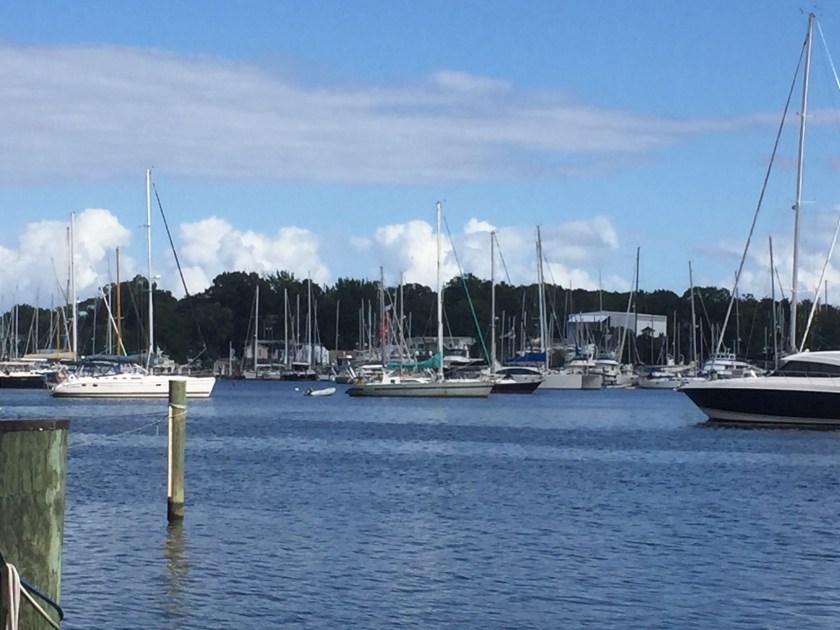
     We had moved from the southern anchorage just outside of Annapolis into Back Creek.  Even now, days after the conclusion of the Annapolis Boat Show, there were still boats at anchor everywhere.  

     Our rule had always been to resist anchoring in overcrowded areas, preferring the solitude and security of wide open spaces over the social opportunities and accessibility conveniences of more densely packed anchorages and marinas.

     Over the course of the past fourteen months, our ground tackle had repeatedly proven its worth in reliability; our experiences to date had made us confident in Exit’s ability to handle everything that had been thrown at her.

     Before moving to Back Creek, we had successfully completed the unenviable and expensive, though necessary, task of replacing all six of our house bank batteries.  After nine months of nearly complete solar independence from our generator with regards to battery charging, we had recently found ourselves needing to run the generator again just to keep up with the quickly depleting bank.

     The 12 volt batteries, which were gasping their last breaths, had begun registering minimum voltages of less than 9 volts, barely enough to keep the equipment running. The technical term would be garbage, I believe.  Our windlass, a power hog drawing a staggering 70-100 amps for the brief intervals it is needed to bring up the anchor and chain, started requiring us to run the engine for a bit of time before engaging, or it just groaned, barley moving the chain in a power deficit protest.

     We were fortunate enough to have arranged the four hundred pounds of batteries to be dropped off at a marina very nearby, allowing us to deliver the old batteries and pick up the new ones via our dinghy.  Not easy, but doable.

Now that the batteries had been replaced, everything seemed to be completely functional and all was back to normal.

     Yet, we needed to accomplish a number of other shopping tasks, and Back Creek seemed like a much easier location to work from.

     Plus, there was the residual weather of Hurricane Michael, headed in our direction.  The forecasts predicted 35 knot winds could be rolling through.  Just south of us winds were forecasted to be as high as 40-50 knots, so we hoped the projected trajectory was accurate and we would only be subjected to the outside edge of the storm.

     Our experience had been that the protection Back Creek provided could reduce wind velocities by fifty percent, which was a very appealing prospect.

     So, with some trepidation, we chose to disregard our own rule of avoiding anchoring in tight quarters in favor of an attempt to reduce our exposure to winds in excess of thirty knots (or higher if the storm shifted farther north).

     Admittedly, we were way too close for our own liking to the boat to our port side as well as too close to the boat slips of the marina directly behind us.  

     We were in just over eight feet of water, allowing us a 5:1 scope.  Not ideal, but we had ridden out thirty knot winds on only a 3:1 scope at Block Island when we had to anchor in water forty feet deep.  We trusted our Rocna anchor and oversized half inch chain to keep us in place.  Still, we decided to keep an anchor watch throughout the night, just to be sure.

    By 4:00am, the winds seemed to have topped out at about twenty three knots, and we hadn’t dragged an inch.  It seemed like all was well.

     However, we noticed that the sailboat anchored to our port side seemed even closer than before… uncomfortably close.  They didn’t appear to be dragging at all, so we suspected that they had decided to put out more chain as the winds picked up.

     With only about twenty feet of separation between our bow and their stern as they swung in front of us, I kept climbing into the cockpit every five or ten minutes to take a look… unnerving, but still unchanging.  We weren’t about to try to lift anchor and relocate in the dark with twenty-plus knot winds in tight quarters; and, after more than six hours with no problems, complacency won out over action.

     Just as I was just about to wake Kris to take over the watch, things went to shit in a matter of seconds.

     As near as we could later reconstruct what happened next, it appeared the sailboat on our left swung completely across our bow in a shifting gust of wind.  Because they were only twenty feet in front of us, thirty feet of our anchor chain was now stretched underneath them.  

     They had to have a draft of nearly six feet, which meant that with only eight feet of water depth, there couldn’t have been more than two feet of water beneath them.

     Either their keel or rudder must have tagged our chain as they passed over it, tripping our anchor.  Instantly, we were drifting backwards.

     Immediately, I woke Kris and we started the engine, but things were already moving in a blur.

     Before we could power forward, we were on top of the outer pilings of the boat slips behind us, sideways against three posts.

     Kris was at the stern and I was at midship, desperately trying to push us off the pilings, but the wind kept shoving us back onto them.

     The tip of an anchor, protruding from the bow roller of a boat in one of the slips, was caught on the inside of our lifeline, and our bow was in serious jeopardy of slipping behind another piling which would have trapped us and shoved us straight into the bow of another boat.

     A third boat, whose deck stood about two feet above ours, also had a massive protruding anchor which threatened to either hang up on our stern rail, catch our arch (which the solar panel rack, our radar, and a host of electronics antennas were mounted upon), or tear our rail mounted solar panel clean off.

     Kris moved her hand out of the way only a fraction of a second before it would have been either amputated or crushed between the anchor and our arch.

     As she fought to power Exit forward, I struggled to push us off and keep our bow from slipping behind the outer pilings and into the docked boats just ahead.

    As I repeated a combination of shit..shit…shit, no…no…no, come on…come on…come on, Exit swung out and forward, barely missing the bow roller of the furthest projecting boat in front of us by mere inches.  A crunch emanated from just in front of me as the plastic lens of our navigation light, attached to our bow railing, was torn off by the pulpit railing of the boat in the slip.

     We were finally free of the slip pilings and docked boats, but our anchor and chain were still out, and I battled to pull them up with the windlass before they caught on something, denying us any control. 

     With both of us exhausted and rather terrified, Kris perilously maneuvered in the darkness between the other boats at anchor, mooring balls, and markers while I tried to help direct us and figure out an escape route.  All the while, the twenty-plus knot winds continued to try to push us back into a catastrophic tangle of destruction.

     Eventually, we were able to thread our way through into a small clearing, but still had extremely limited steering ability.

     We angled towards another row of boat slips on the other side of the creek.  This current location was somewhat more protected, so we weren’t fighting the wind nearly as much, but it really didn’t have the space we needed.   At best, if we could get the anchor to set, we’d have a temporary sanctuary we could use to catch our breath and regroup.  

     But we found ourselves slipping backwards, repeatedly having to motor forward as we drifted dangerously close to the yachts on the opposite side of the creek, clearly demonstrating that the anchor wasn’t setting.  The usual rock solid dependability of our Rocna anchor came up short twice.

     As we hauled in the chain again after the second failed attempt, a gruff voice, apparently originating from the window of one of the boats in a slip just in front of us called out in the darkness.  

     Hey, you can’t anchor there.

     More than a bit stressed, I snapped back in a rather perturbed voice, I realize that.  We’re just trying to temporarily hold position so we can regroup to get through to the morning.

      The voice returned.  No… there’s no holding there.  You’ll drag backwards all night long.

     Shit.  OK… thanks.

     We weren’t about to try to thread our way out passed all the boats anchored and moored in Back Creek, which included a big cat that had dragged anchor for the third time just before our anchor chain got tripped, and was still struggling to reset their anchor yet again.

     This left one option… farther back up the creek.

     Unfortunately, the same two boats were still anchored back there when we arrived.

     Literally backed into a corner, we had run out of options.  All we could do was drop the anchor right next to one of the docks and back down as far as possible.  But, with no major wind shift and a person in the cockpit standing watch, we’d be good until noon when we could get the hell out of Back Creek.

     We’d gotten the shit seriously scared out of us, learned some important lessons, and dodged more than one bullet.

     Had we just gone to sleep earlier in the night, it would have been the crunching sounds of us against the dock that we would have awoken to…

     Had we gotten tangled up behind the slip pilings or with the boats that were tied up, the damage would have been catastrophic…

     Had the anchor chain gotten tangled when it tripped… had the windlass remote not worked when it was plugged in (an occasional malady)… had the battery bank (changed only three days ago) still been the old, tired bank which required a few minutes of charging before the windlass would fire up… we would have been fucked.

     Had we not been lucky enough to have lowered the rail mounted solar panels a few hours earlier, or the dinghy was hanging up on the davit at Exit’s stern, the anchor extending from the bow roller we passed so close to would have sheered off the solar panel and ripped into the inflated rubber bow of the suspended dinghy.  Upon later reflection, we were pretty sure the dinghy (which had been tied off on our stern) may very well have helped act as a bumper while we were bouncing around on the marina pilings.  That same anchor still came within a fraction of an inch of taking off Kris’ hand, ripping the solar panel off the railing, and getting hooked up on our stern arch…

     Had the boat that tripped our anchor actually dragged down on top of us, we would have been trapped between that boat and the slips… game over.

     Many things could have happened slightly differently with potentially disastrous and devastating results to both equipment and flesh.  All things considered, we got off pretty easy.  

     The lessons learned were more re-enforcements of what we already knew rather than groundbreaking epiphanies.

     Don’t settle for complacency.  

     The combination of not enough scope and not enough space is a recipe for disaster.  

     Trust your gut instincts.  We thought about moving back into the southern anchorage in the afternoon.  The trade off would have been higher exposure to the wind and waves but more space to work with – more space to put out more chain, more space to swing unfettered, more space to drag, more space to react.  We should have trusted our gut instinct.

     Trust your equipment.  If you don’t, replace it.  If the equipment is sound, it will hold you in fifty knot winds with less risk than hard things in close proximity will ever pose.

     It was ultimately our own fault that we found ourselves in the situation we did.  

     A silver lining…?  Potentially in how we reacted during the situation.  Looking beyond a poor initial decision of being there, at least we were pro-active enough to maintain an anchor watch.  In retrospect, I should have started the engine as I was waking Kris to give us an extra few seconds.  But, during the entire nail-biting ordeal, we kept cool heads and things never deteriorated into a yelling match of confusion.

     It sounds very cliche, but over and over again, there seem to be situations which arise that could be potentially very dangerous or catastrophic events.  Given an inner determination that failure is not an option, the only acceptable outcome remaining is to somehow work through the challenges and sort your shit out.

That’s not to say that simply wishing for something will make it happen.  But sometimes success has to be coaxed, tricked, improvised, massaged, or even bitch-slapped into existence, given the alternative.

     Knowledge and experience help out immensely.  Either one can give the background necessary to make informed decisions.  But lacking both doesn’t make the solution any less there… it just makes it a bit more elusive.  Creativity and tenacity don’t substitute for knowledge and experience, but they come in at a close third and fourth place.

     And, though you can’t depend on luck, sometimes you certainly need a bit of it.
Back To Back Creek

IMG_0721
Sunrise over the Big Apple

October 5 – 8, 2018 

     With two hundred miles ahead of us to reach the C&D Canal, we departed early from NYC… perfect timing to witness the arrival of one of the US Navy’s alien looking stealth warships as we sailed by Staten Island.  We gave it a wide berth as it passed by us in the opposite direction with an entourage of military zodiac escorts to our port side; however, I couldn’t help turning on our radar.  Sure enough, the massive warship appeared on the display as nothing more than a tiny blip, no more distinct than even a small marker buoy.


     Hugging the coast, we were never more than about three miles offshore.

     The only excitement was another bird, no larger than a small finch, which seemed to be well farther offshore than we would have expected (much like we had seen on our passage from St. Marys, GA to Charleston, SC) that decided we needed another crew member aboard Exit.

IMG_0751
New crew member or freeloading stowaway…?

     Except this tiny bird obviously had high ambitions.  It flew straight into the cockpit and landed on the wheel, seemingly to proclaim itself our new helmsman.  For about ten minutes, it balanced there; and, as the autopilot made slight adjustments in our course causing the wheel to turn left and right, it appeared comically that the tiny bird was actually steering Exit. 

     After a bit, it flew out of the cockpit, only to return to its perch atop our wheel a few minutes later and resume its hilarious impersonation of a undersized, feathered skipper.  Shortly after that, it stationed itself atop the lifeline, now apparently taking over the watch duties.

Eventually, our little comedian must have realized that flying would be a much more efficient and speedy approach to reaching its destination than sailing, and it flew off into the distance, finally disappearing from view.  It took quite some time before we were able to stop laughing.

     Fifteen to twenty knot winds and favorable currents allowed us to feel like we were flying down the coast for twenty-four hours.  Although, in exchange for the fast pace, we reached the Delaware Bay hours ahead of when we had planned and were met with winds that tapered off and opposing currents, forcing us to motorsail for almost the entire ten hours we spent crossing the bay.

     During this time, we continually debated whether or not we were going to attempt navigating the C&D Canal at night.  Though the canal is rather wide, we were very nervous about what we anticipated would be a mostly unlit and nerve-racking three hours.

     A couple of hours before sunset, we began to see the outline of a massive structure in the distance.  What we first thought was a huge freighter, slowly materialized into the gigantic cooling tower of a nuclear facility, steam ominously pouring out from its top.  There would be no rain collection today, even if the overcast skies decided to make an offering.


     By the time we reached the entrance to the canal, the sun had nearly set and we were already having a difficult time seeing where we needed to be going.  This solidified the decision that we would drop anchor and wait until morning, when the canal would be a much more friendly passage.

     Not long after setting anchor and having dinner, a loud roar in the distance prompted Kris to ask if we were hearing a plane passing overhead.  The answer came moments later, when the dull roar was interrupted by a louder noise, followed immediately by what sounded like a boat engine revving at high rpm for a short period.  It sounded unmistakably like a boat had just run aground.

     As we scanned the darkness, at last we saw what looked to be a flashlight twitching back and forth in the distance. After some time, a boat with a flashing blue light appeared from shore and approached the scene.  We were a bit confused when the patrol boat stopped short of coming alongside the flashlight, and then, a few minutes later pulled away and departed as what appeared to be a Coast Guard helicopter circled briefly overhead.  

     Intrigued, we turned on the VHF and were subsequently treated to far more entertainment than most people probably found on the TV that night.

     As the drama unfolded in the form of confusing lights in the distance and radio exchanges between multiple boats with flashing lights and the shore, we slowly learned what had transpired.

     Apparently, a twenty to twenty-five foot jet boat carrying an idiotic captain and three passengers had attempted to enter the C&D Canal at a much higher rate of speed than the darkness would warrant.  Either failing to notice or ignoring the brightly flashing green light of a navigational warning marker, they had slammed into one of the earthen jetties jutting out on both sides of the canal entrance, fully running their boat aground… not too smart.

     Fortunately, only one person was mildly injured with head lacerations. 

     The boat with flashing lights was Fireboat #5, which had arrived on the scene, and transported the entire group to a nearby hospital for further evaluation.

     We felt rather wise in having made the decision to drop anchor for the night, choosing to abort our night voyage through the canal.  Not that we would have run aground on the jetty; but still, we had heard reports that floating debris left over from the aftermath of Hurricane Florence weeks before was still present from the canal all the way down the Chesapeake, and we were grateful that the Coast Guard and marine patrols would not be answering a distress call from us that night.

     The following morning we passed the stranded jet boat, still sitting completely dry on the jetty.  


     For over an hour after entering the canal, we were further entertained by the numerous radio calls from what seemed like every boat following behind us, who hailed the Coast Guard on the VHF to report a boat which they had seen aground at the canal’s entrance.

     As we exited the C&D Canal two and a half hours after lifting anchor (awaiting the morning light had also given us the benefit of running with the currents), we found ourselves once again in the Chesapeake Bay.

     Annapolis was another fifty nautical miles away, and we had already begun to see more and more of the floating logs and debris we had heard about, so we made the call to stop mid-afternoon, about ten miles south of the C&D Canal, and make the final push for Annapolis the following day.

     Furthermore, we had just received a text from our friend Benjamin, aboard Crackertale, who we had first met at Block Island all the way back in August.

     We had nearly, but not quite, crossed paths again a number of times since then.  Amazingly, he was currently only a few miles away from our present location, also headed for Annapolis.  We hailed him on the VHF and agreed to meet on the Sassafras River, right next to where we had planned to anchor anyway.

     As it turned out, he decided to continue a bit further on after we had already set anchor, choosing to take advantage of favorable winds and currents that were much more critical for someone sailing single-handed on a small boat with only an outboard engine for supplemental power.  It looked as though we would have to wait for Annapolis for the reunion drinks.


     When we awoke the following morning, a heavy fog had completely obliterated any visual references in every direction.

     Our only previous experience with fog had been departing Port Canaveral, Florida, back in February, just days before we set out for the Bahamas, where we had instantly learned just how daunting and intimidating sailing in fog could be.

     With visibility effectively non-existent, we immediately recognized that this was a challenge we had absolutely no intention of undertaking, so we sat back to wait, patiently hoping it would start to burn off.

     Not long before noon, the all-encompassing white blanket of fog had begun to lift, revealing the shadowy outline of the nearby shore.  Visibility was still less than half a mile, but we had become much more familiar with using our radar over the past six months than we were in Port Canaveral, and felt confident that we could set out with the optimism that the fog would continue to lessen.

    Though the radar proved invaluable, it only lessened the degree of intimidation.   With senses on high alert, and eyes constantly shifting focus between the radar display and our surroundings, we carefully creeped along.  It was amazing how, with the radar, we could still identify not only boats, but also navigational markers and even debris in the water.  As long as we didn’t encounter a stealth warship like the one as we left NYC, we should be good to go.

     Slowly, we made forward progress.  We learned from Benjamin over the VHF that he had lifted anchor before we had, but had second thoughts as the fog thickened outside the bay he was in, and had dropped anchor again to await better visibility.  He lamented not having a radar himself at that time.

     Four hours later, we were passing the Baltimore channel intersection on the east side of the Chesapeake.  The fog had slowly, but steadily, receded and we now had three mile visibility and very calm conditions on the water.

     We noted two things: 1) Baltimore was the farthest north we had gotten on the Chesapeake in our preliminary explorations aboard Exit just after purchasing her, before we started heading south, and 2) we had just surpassed five thousand nautical miles in our travels aboard Exit.

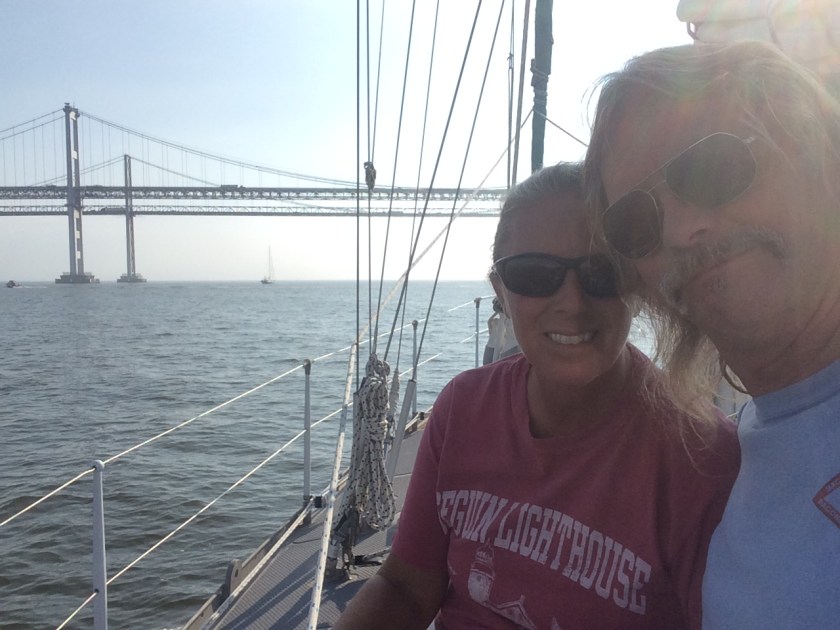
     As we passed underneath the Chesapeake Bridge, we felt an overwhelming sense of deja vu.

IMG_0801

     Two hours later, we arrived at Annapolis.  The enormous Annapolis Boat Show was on its’ last day, and boats were everywhere.  Back Creek, where we had sat for months while we first tasted the lifestyle of cruising, was chock-full and we ended up having to anchor at the south anchorage in the bay just outside Annapolis.

     We had come full circle, back to our old stomping grounds.  

     An hour or so later, Benjamin sailed up and dropped anchor.  Shortly afterwards, he stopped by with his brother and a friend who had met him upon his arrival.  He had also brought a half-full half gallon of Kraken rum…

     …welcome back.


Anchored Behind Lady Liberty

IMG_0543

IMG_0604

September 30 – October 4, 2018 

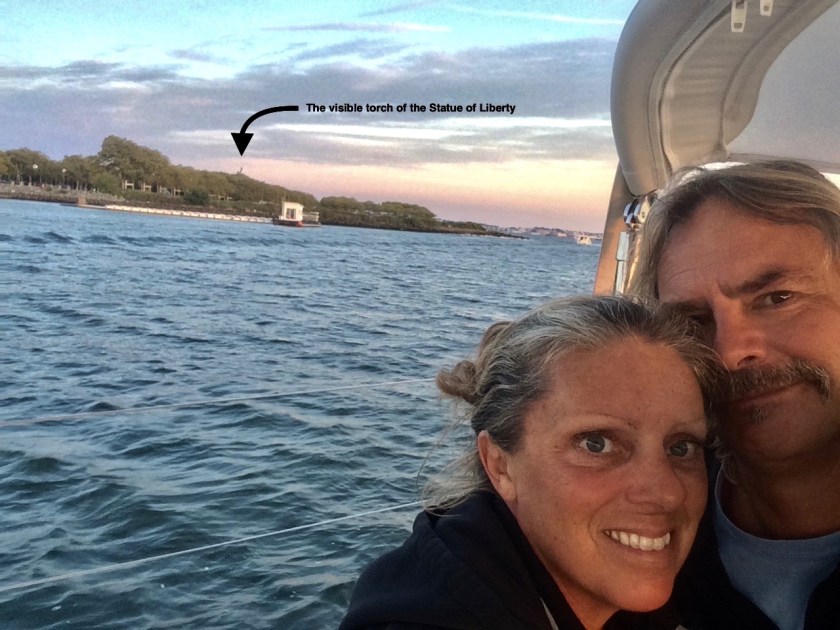
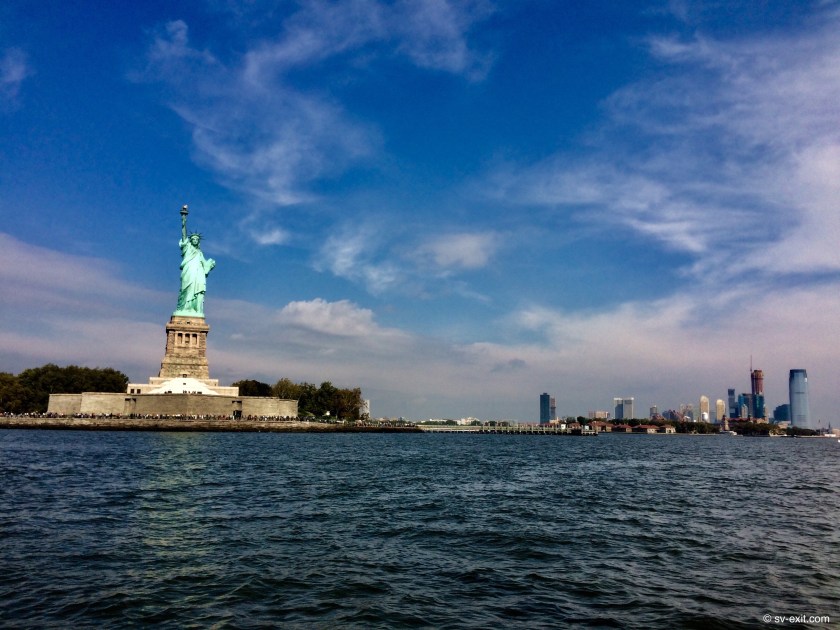
     We initially anchored in a small bay tucked away on the southwest side of Liberty State Park.  While the anchorage was very protected from the swell of all the boat traffic, it also turned out that the numerous trees lining the park completely blocked our view of the New York skyline as well as all but the head and torch of the Statue of Liberty.  We spent one night there before deciding to gamble on a better view.

Version 3

     We weren’t sure if we would be hassled trying to anchor behind the statue; we’d heard it would be ill received.  But we figured we’d give it a shot anyway.

     Understandably, the area immediately surrounding Liberty Island and Ellis Island is restricted.  There is an approximately one to two hundred yard perimeter marked with buoys designated as a security zone; any boats entering this area would undoubtably be quickly visited by a number of heavily armed boats and/or helicopters.  There is also a quarter mile wide corridor running behind the island which contained cables and pipelines that we needed to stay clear of; snagging our anchor on a cable which resulted in a power blackout for Lady Liberty would most certainly be frowned upon. 

     When all was said and done, after setting anchor between Ellis Island and the Statue of Liberty, no one even blinked a eye at us.  

     There was a bit of swell from all the ferry and sightseeing boat traffic during the day.  Nonetheless, it was minuscule price to pay for what amounted to an absolutely spectacular and unique view of New York City.

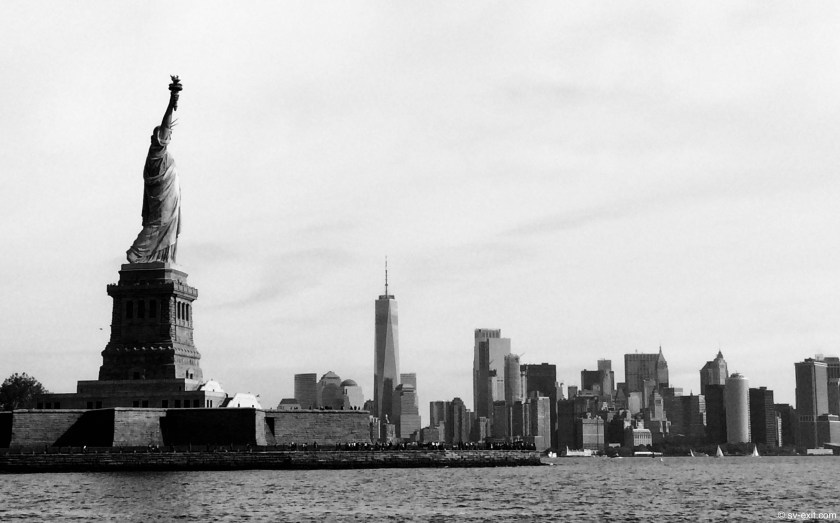
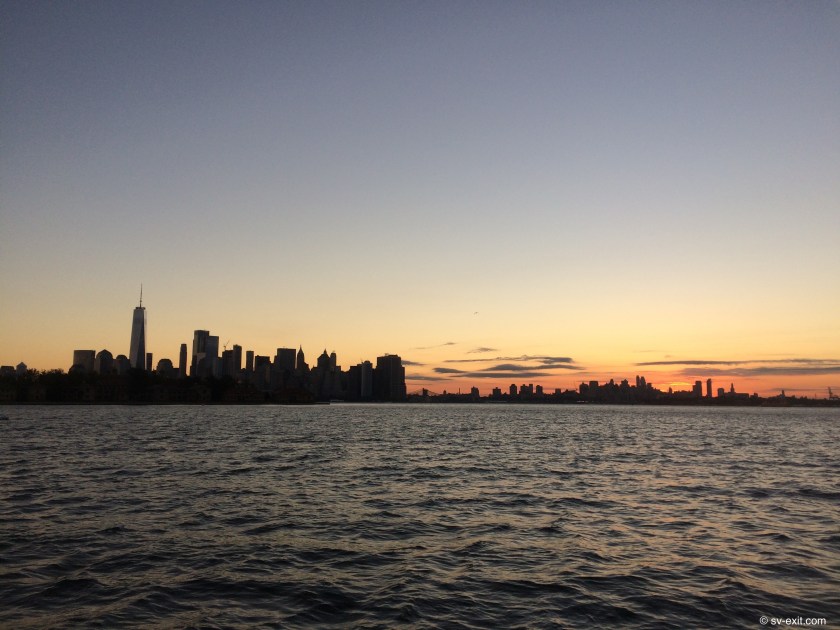
     Right next to us, on our right, stood the Statue of Liberty.  Just to our left, in the foreground, sat Ellis Island.  And just behind that, loomed the amazing skyline of Manhattan.  Sitting in our cockpit, we could see the Empire State Building, the Chrysler Building, the World Trade Tower, the Brooklyn and Manhattan Bridges… everything.  And behind the Statue of Liberty, in the distance, was Brooklyn, Staten Island, and the Verrazano Bridge, linking the two together.

IMG_0560

     The view we had during the day was diminished only by the view we had at night.  The lit Statue of Liberty right next to us and mesmerizing lights of New York’s skyline behind the dark silhouette of Ellis Island is utterly indescribable.  It has to be seen to be truly appreciated.  And to be seen from the deck of our own sailboat sitting at anchor made it even more surreal.

     After a couple of days of utter relaxation aboard Exit, we weighed anchor and headed ten miles up the Hudson River to just off of 79th Street, which gave us access to a marina dock at which we could tie up the dinghy.  

     It was October 2nd… a particularly special day for us.  It marked the thirty six year anniversary of our first date together… the beginning of an amazing journey we never could have imagined at that time.  It also marked the ten year anniversary of our exodus from the United States… the beginning of a new way of life, which also held surprises and unfathomable adventures that had completely changed us while, at the same time, had allowed us to remain true to ourselves and each other.

IMG_0609
October 2, 2018 – Ten year anniversary of our own liberation

     When we reached the 79th Street Marina, we set anchor once again.  The fee we paid for access to the dock (and a warm shower) was only a few dollars less than a mooring ball there would have cost.  However, Exit was slightly longer than the maximum length and we had heard horror stories of the mooring balls dragging regularly (probably due to oversize boats using them anyway), so we decided that our own anchor was the more reliable and prudent choice.

    This put us within walking distance of Central Park, which we visited the following day.  The fact that we had been there before, made the return no less impressionable.  The park’s endless trails and sights made for a great afternoon of wandering and people watching, despite purchasing one of the worst (and most expensive) hot dogs and pretzels, from a street vendor, that I have ever had in my life.  I am not one to typically let food go uneaten; yet, even Kris’ love of pretzels couldn’t prevent half of it ending up in a Central Park trash bin.

This slideshow requires JavaScript.

     We also had the bonus of a reunion with one of our Scuba Junkie family.  Christina Koukkos completed her Divemaster training at Scuba Junkie while we were there.  Though we hadn’t seen her in eight years, we had kept in touch via Facebook, and Christina, who lived in Brooklyn was more than happy to meet us for drinks when we contacted her.

IMG_0705

     One drink turned into multiple pitchers of beer and dinner.  After reminiscing and catching up on each others’ endeavors over the years, as well as current plans, we reluctantly said farewell until the next reunion and took a taxi back to the 79th Street Boat Basin where our dinghy awaited us.

     The currents on the Hudson River that night were ripping and we were far too close to the rocky shore for our liking, but any farther out and we were instantly in deeper than thirty feet of water.

     So, the next morning, after returning to the marina for a quick hot shower and filling of our water jugs, we once again picked up anchor and returned to our prime location behind Lady Liberty, where we chilled out for one more afternoon and enjoyed the spectacular evening skyline view of New York City.

     Now, it was time to get moving again.  We had been to Maine, and we had savored the experience of visiting New York City aboard our sailboat.

IMG_0610
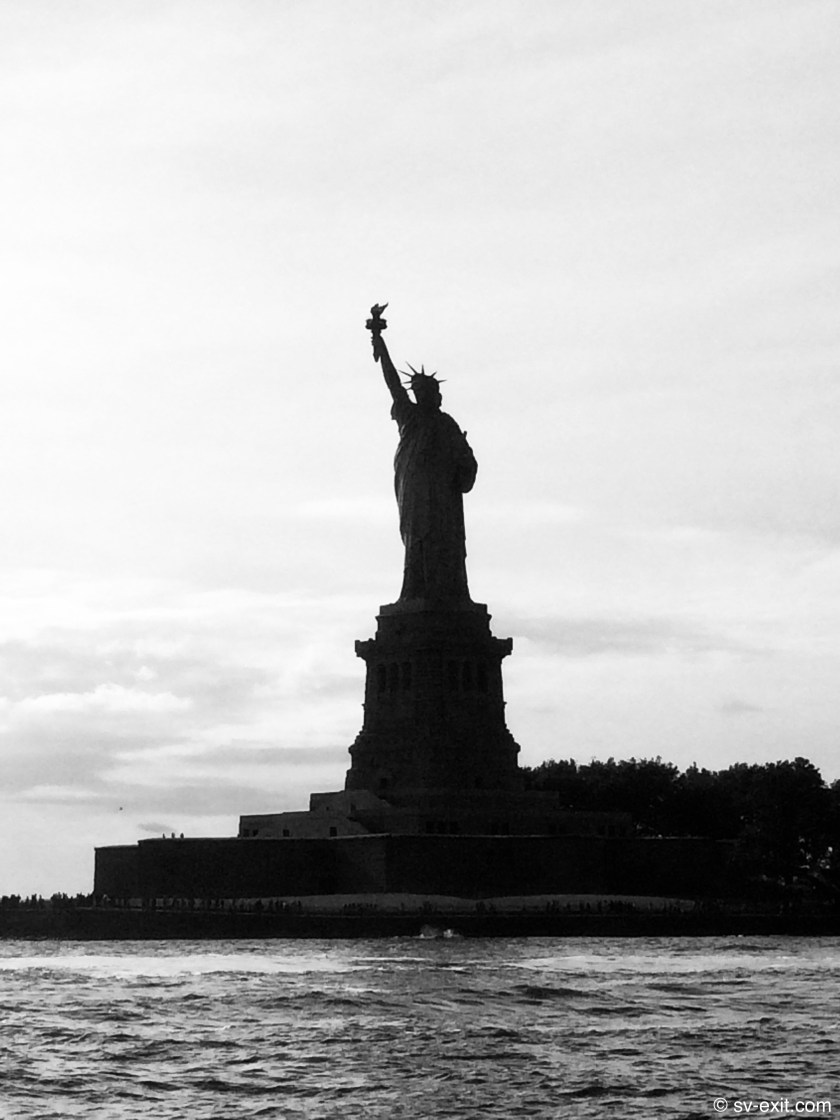
Perhaps the most iconic NYC image we captured

     Our haul out awaited us at Herrington Harbour North, with a long list of tasks to accomplish.

     From here, we would make a dash for Delaware Bay, pass through the C&D Canal (which would shave about one hundred miles off the alternative of sailing offshore all the way south to the mouth of the Chesapeake Bay and then back up north through the bay), and make a brief stopover in Annapolis.

Sovereign Nations

Just another WordPress.com weblog